Source Customized Outdoor Metal Business Card for Souvenirs, Gifts, and Decorations
Find 30 options for Customized Outdoor Metal Business Card designs suitable for personal decorations, promotion gifts, and souvenirs. Buyers can compare etched metal nameplates with ISO certification, various surface finishes, and OEM capabilities from suppliers in China.
Key considerations
Products List


High Quality Metal Aluminum Business Card Name Card with Customized Logo (02)
$0.30 - $0.50
MOQ: 100 Pieces


Factory Customized Logo Printing Metal Business Card Stainless Steel Card
$1.00 - $1.50
MOQ: 500 Pieces




Comprehensive Sourcing Guide
Strategic Sourcing Guide for Customized Outdoor Metal Business Cards
Understanding the Product Category and Technical Specifications
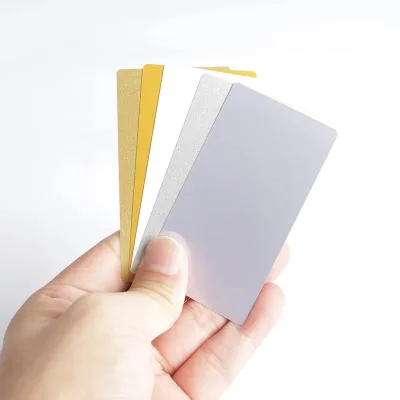
The market for customized outdoor metal business cards represents a niche intersection of traditional metalworking and modern branding needs. Unlike standard paper or plastic cards, these items are engineered for durability and longevity in external environments. Based on current industry observations, the core product is defined as a metal card, often referred to as a "Metal Card 2020" or "business card" model, designed specifically for outdoor suitability. The primary material is metal, with silver being a frequently observed finish, though the customization options allow for significant variation.
The technical architecture of these cards varies based on the intended function. Some units are purely decorative, serving as "Personal Decorations," "Souvenirs," or "Religious Crafts," while others function as active identification tools. A distinct subset of these products operates as "Smart Cards" with "Passive Card" power supply modes. These smart variants utilize "Low Frequency" technology and employ a "Non-Contact Type" read-write method. Their internal structure is typically "Read-only," designed for functions such as "Identification," "Payment," or "Information" storage, although some listings indicate a "Chip: Nothing" configuration, suggesting a purely physical or engraved utility.
The physical dimensions are a critical specification. While the general category allows for "Customized" sizes, specific industry standards for card formats often align with the ISO 7810 ID-1 format, which measures 85.5mm x 54mm x 0.8mm. However, buyers must verify if the supplier adheres to this standard or offers bespoke dimensions. The surface finish is another key technical differentiator, with options including "Polished," "Mirrored," "Frosted," "Matte," and "Glossy" treatments. The edges are equally important for outdoor durability, with manufacturing processes offering "Edges Ground or Polished" in either "Flat or Round Edge" configurations to prevent injury and ensure a premium feel.
Compliance, Certification, and Manufacturing Standards
When sourcing metal business cards for commercial or industrial use, verifying the supplier's adherence to recognized standards is paramount. The supply chain for these items often originates from manufacturing hubs in China, specifically regions like Guangdong, Shenzhen, and Zhongshan. These regions host facilities capable of "OEM" (Original Equipment Manufacturer) and "ODM" (Original Design Manufacturer) services, allowing for significant brand integration.
Certification status is a primary indicator of a supplier's quality management system. While specific certification documents must be requested from the vendor, the industry standard often cited in this sector is "ISO" compliance. Buyers should explicitly request proof of ISO certification to ensure that the manufacturing process meets international quality benchmarks. Additionally, the "R&D Capacity" of the supplier should be evaluated to confirm they possess the ability to handle "Own Brand" development alongside OEM and ODM requests.
Regarding material standards, the "prod_standard" is often listed as "Customized" or "Custom," meaning the supplier does not adhere to a single rigid standard but rather matches the buyer's specific requirements. In cases where the product is a smart card, the standard "85.5mm x 54mm x 0.8mm" is a common reference point for physical dimensions. Buyers must not assume all metal cards meet this dimension; instead, they must verify the "same as picture" or specific custom dimensions provided in the technical datasheet. The "Export Market" for these products is "Global," implying that suppliers are accustomed to international shipping regulations, but specific compliance with destination country regulations (such as RoHS or REACH for materials) should be confirmed on a case-by-case basis.
Cost Drivers and Pricing Dynamics
The pricing structure for customized outdoor metal business cards is highly variable, influenced by material costs, processing complexity, and order volume. The observed market price range spans from $0.05 to $7.50 per unit. This wide disparity is not indicative of quality variance alone but reflects the diverse nature of the product specifications. A basic, uncoated metal card with simple etching will sit at the lower end of this spectrum, while a card featuring complex "Signature Stripe/ID Number Printing," "Embossing," and multi-layer "Cmyk Offset Printing" will command a higher price.
The "MOQ" (Minimum Order Quantity) is a significant factor in unit cost. The observed MOQ range is 1 to 2000 units. Suppliers offering an MOQ of 1 are typically catering to prototyping or small-batch needs, which inherently carries a higher per-unit cost due to setup fees. Conversely, orders approaching the 2000-unit threshold often benefit from economies of scale, driving the price toward the lower end of the observed range. Buyers must balance the need for customization against the financial impact of the MOQ.
Other cost drivers include the "Surface Finished" options. Processes like "Polished," "Mirrored," or "Frosted" finishes require additional machinery time and labor compared to a standard matte finish. The "Processing" method, primarily "Machinery," also impacts cost; complex machinery setups for etching or embossing increase the baseline price. Furthermore, the "prod_packing" requirements play a role. While some suppliers offer "Safe Exportation Packing" as a standard, others provide "Polyfoam," "Gift Box," or "Customized Package" options. Custom packaging solutions, such as a "200 PCS/White Box" or "2000 PCS/Carton" configuration, add to the overall unit cost but are essential for protecting the product during transit and enhancing the unboxing experience for the end user.
Typical Applications and Usage Scenarios
The versatility of customized outdoor metal business cards allows them to serve a broad spectrum of applications. The primary usage categories identified include "Personal Decorations," "Promotion Gifts," "Souvenirs," and "Commerce Gift." These items are particularly effective for "Collection" purposes, where the durability and aesthetic appeal of metal make them desirable keepsakes. The "Style" of these cards often leans towards "Creative" or "European & American" designs, catering to diverse cultural preferences.
For outdoor applications, the "Suitable for: Outdoor" attribute is critical. These cards are designed to withstand environmental factors that would degrade paper or plastic alternatives. This makes them ideal for "Home Decorations," "Religious Crafts," and permanent signage where longevity is required. The "Age" demographic for these products is broad, suitable for "Youth," "Middle Aged," "Girls," "Elderly," and "Children," suggesting that the design can be tailored to specific target audiences.
In the context of smart cards, the "Application Field" is often the "Market," with functions extending to "Identification" and "Payment." These cards can be used in access control systems, loyalty programs, or as secure payment tokens. The "Passive Card" nature means they do not require an internal battery, making them reliable for long-term storage and use. The "Logo" customization allows for brand integration, making them suitable for corporate gifting and marketing campaigns. The "Craft" options, such as "ID Number Printing" or "Embossing," further expand their utility in sectors requiring secure identification or personalized branding.
Supplier Evaluation and R&D Capabilities
Evaluating a supplier for customized metal business cards requires a deep dive into their operational capabilities. The "R&D Capacity" is a key metric, with many suppliers listing "OEM, ODM, Own Brand" as their core competencies. This indicates that the supplier can not only manufacture to a buyer's design but also contribute to the design process itself. Buyers should verify the extent of this capacity by requesting examples of previous "Own Brand" projects.
The "Location" of the supplier is another critical factor. The primary manufacturing hubs are in "Guangdong, China," "Shenhzen, China," and "Zhongsan, China." Each of these regions has its own supply chain ecosystem. Guangdong is known for its extensive manufacturing base, while Shenzhen is a hub for technology and electronics, which is relevant for smart card production. Zhongshan may offer specific advantages in metalworking. Buyers should consider the logistical implications of these locations, including shipping times and potential tariffs.
The "Production" process is heavily reliant on "Machinery," which suggests a high degree of automation and consistency. However, the "Customization" aspect means that human oversight is still required for quality control. Buyers should inquire about the specific machinery used for "Etching" and other techniques to ensure it aligns with their quality expectations. The "Processing" capabilities should be matched against the specific "Craft" requirements, such as "Signature Stripe" or "ID Number Printing."
Quality Control and Long-Term Procurement Considerations
Ensuring consistent quality in customized metal business cards requires a robust quality control (QC) strategy. The "Surface Finished" options, including "Matte/Glossy/Frosted Finish," must be inspected for uniformity and defects. The "Edges Work" should be checked for smoothness, ensuring that "Edges Ground or Polished" edges do not have burrs or sharp points that could cause injury. The "Standard" of the product, whether "Customized" or adhering to a specific dimension like "85.5mm x 54mm x 0.8mm," must be verified against the approved sample.
Lead times are a critical component of procurement planning. The observed "Delivery Time" ranges from "8-10 Days for Sampling" to "12-15 Days for Production." These timelines are estimates and can vary based on the complexity of the customization and the current workload of the supplier. Buyers should factor in these lead times when planning product launches or marketing campaigns. The "prod_packing" method, such as "Polyfoam, Gift Box or Customized Package," must be tested to ensure it provides "Safe Exportation Packing" and protects the cards from damage during transit.
For long-term procurement, establishing a relationship with a supplier that offers "Customized" packaging and "Custom Logo" services is essential. The ability to maintain consistent quality over multiple production runs is vital. Buyers should request a "Standard" sample that matches the "same as picture" criteria before committing to a large order. The "Export Market" experience of the supplier, noted as "Global," suggests they have experience with international logistics, but buyers should still verify their ability to handle specific export documentation and compliance requirements for their target markets.
Comparison of Product Attributes and Specifications
To facilitate decision-making, the following table summarizes the key attributes and specifications observed in the market for customized outdoor metal business cards. This comparison highlights the variability in options available to buyers.
| Attribute | Standard/Observed Options | Notes for Verification |
|---|---|---|
| Material | Metal (Silver observed) | Verify alloy type and thickness. |
| Dimensions | Customized; 85.5mm x 54mm x 0.8mm (Standard) | Confirm if ISO ID-1 standard is required. |
| Surface Finish | Polished, Mirrored, Frosted, Matte, Glossy | Request physical samples for finish quality. |
| Edge Work | Flat, Round, Ground, Polished | Check for burrs and safety. |
| Technology | Passive Card, Low Frequency, Non-Contact | Verify chip presence (None vs. Smart Card). |
| Customization | Logo, Size, Color, Packing | Confirm ODM/OEM capabilities. |
| Certification | ISO (General) | Request specific ISO certificate copy. |
| Origin | Guangdong, Shenzhen, Zhongshan, China | Verify factory location and audit reports. |
| MOQ | 1 - 2000 Units | Negotiate based on volume and price. |
| Lead Time | 8-10 Days (Sample), 12-15 Days (Production) | Confirm actual timeline for large orders. |
This table serves as a checklist for buyers to ensure all critical parameters are addressed during the sourcing process. By systematically evaluating each attribute against the supplier's capabilities, buyers can mitigate risks and secure a high-quality product that meets their specific requirements for outdoor durability and brand presentation.
FAQs
What customization options are available for metal business cards?
Customization is available for size, logo, and surface finish. Buyers can request specific dimensions, custom logos, and finishes like polished, mirrored, or frosted to match their branding needs.
Which certifications do suppliers typically hold for these products?
Suppliers often hold ISO certification to ensure quality management standards. Buyers should verify specific ISO documentation to confirm the manufacturing process meets international benchmarks before ordering.
How long does production take for custom metal cards?
Production typically takes 12 to 15 days after sampling is approved. Sampling itself requires 8 to 10 days, so total lead time depends on the approval speed and order complexity.
Can these cards be used for outdoor applications?
Yes, these cards are suitable for outdoor use due to their durable metal construction. They resist environmental factors better than paper or plastic alternatives, making them ideal for long-term display.
What is the minimum order quantity for metal business cards?
The minimum order quantity ranges from 1 to 2000 units depending on the supplier. Lower MOQs allow for prototyping, while larger orders often reduce the per-unit cost significantly.
Which surface finishes are offered for these metal cards?
Available surface finishes include polished, mirrored, frosted, matte, and glossy options. The choice affects the aesthetic and tactile feel, with some finishes requiring additional machinery processing time.