Source Dielectric Heating Spray Dryer for Labs, Pharma, and Food
Compare 30 available Dielectric Heating Spray Dryer units featuring rotary atomization and PLC control. Buyers can evaluate models with SUS304 construction, varying capacities from 1000 to 1800 ML/h, and multiple heat sources including electricity and steam.
Key considerations
Products List

Dielectric Heating Powder Mode Material Status Spray Drying Machine
$7745.00 - $232350.00
MOQ: 1 Piece


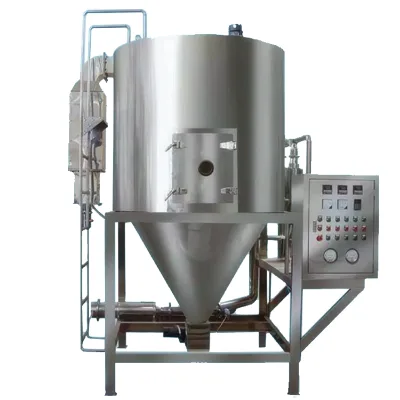


LPG High-Speed Centrifugal Spray Dryer for Heat-Sensitive Materials
$5000.00 - $200000.00
MOQ: 1 Pieces


Advanced Electric Steam Spray Dryer for Efficient Industrial Drying Operations
$5200.00 - $91000.00
MOQ: 1 Pieces


Comprehensive Sourcing Guide
Strategic Sourcing Guide for Dielectric Heating Spray Dryers
Understanding the Dielectric Heating Technology in Spray Drying
The integration of dielectric heating into spray drying systems represents a significant technological advancement for buyers seeking precise thermal control and rapid processing capabilities. Unlike traditional convective heating methods that rely on hot air circulation, dielectric heating utilizes high-frequency electromagnetic fields to generate heat directly within the material itself. This distinction is critical for applications involving heat-sensitive materials where surface overheating must be avoided. The supplied product data confirms that "Dielectric" is a recognized heating mode for specific models, distinguishing them from units utilizing "Convective" or other heating modes.
When evaluating a Dielectric Heating Spray Dryer, the primary technical observation is the mechanism of energy transfer. The system applies an electric field that causes polar molecules within the liquid feed to oscillate, generating internal friction and heat. This method is particularly advantageous for materials with high dielectric loss factors. Buyers must verify that the specific unit they are considering explicitly lists "Dielectric" as its heating mode, as the market contains a mix of technologies including rotary atomization and various flow types such as "Parallel Flow" and "Contra-Flow." The choice of heating mode directly influences the final product quality, drying kinetics, and energy efficiency.
The power requirements for these systems vary significantly based on the scale and specific heating configuration. Observed specifications indicate power ratings ranging from 3kW to 6kW, with voltage inputs spanning from 220V to 480V. Some models operate on 380V 6KW configurations, while others may be rated at 220V 3KW or 220V 4KW. This variance suggests that the dielectric component is often part of a larger system where the total power consumption includes the atomization motor, the main fan, and the control systems. Procurement teams must ensure that their facility's electrical infrastructure can support the specific voltage and amperage requirements of the selected model, as mismatched power supplies can lead to operational failures or safety hazards.
Technical Specifications and Operational Parameters
A comprehensive understanding of the technical specifications is essential for matching the equipment to production needs. The physical dimensions of these units are not uniform; observed data lists specific configurations such as 1150mm800mm1450mm, 110010001200mm, and 105010501850mm. Other models may have dimensions that "Depend on The Model," indicating a high degree of customization. Buyers should not assume a standard footprint but must request detailed dimensional drawings for the specific configuration they intend to purchase to ensure it fits within their facility's allocated space.
The material construction is a critical factor for durability and product purity. The majority of observed units are constructed from "SUS304 stainless steel," with some models offering "SUS316" or "SUS304L/SUS316L" options. The material status of the feed can vary, accommodating "Bulk, Strap, Cream, Solution, Powder," or specifically "Powder" for the output. The atomization mechanism is typically "Rotary Atomization," which is a standard for producing consistent particle sizes. The rotary speed for these systems is observed to range between 15000 and 25000 RPM, a high-speed range necessary for creating fine droplets that dry rapidly.
Capacity and throughput are other defining specifications. The rated capacity for these dryers is observed to range from 600ml/h to 1500ml/h, with some models capable of handling up to 1800ml/h. The inlet temperature for the drying air is a crucial parameter, with observed ranges spanning from 60°C to 200°C. The lowest inlet air temperature is noted at 60°C, while the air inlet temperature for specific models is listed at 110°C. These thermal parameters must be carefully aligned with the thermal properties of the material being processed to prevent degradation or incomplete drying.
| Parameter | Observed Range/Value | Verification Requirement |
|---|---|---|
| Material | SUS304, SUS316, SUS304L, SUS316L | Verify grade for chemical compatibility |
| Power | 220V 3KW, 220V 4KW, 380V 6KW | Confirm facility voltage compatibility |
| Capacity | 600~1500ml/h, up to 1800ml/h | Match to production volume needs |
| Inlet Temp | 60°C ~ 200°C | Ensure material thermal stability |
| Atomization | Rotary (15000-25000 RPM) | Check for required particle size |
| Dimensions | 1100-1150mm (L), 800-1050mm (W), 1200-1850mm (H) | Validate floor space constraints |
Compliance, Certification, and Safety Standards
Navigating the compliance landscape for industrial drying equipment requires a rigorous approach to certification verification. While the general market context often references "CE" certification, the specific product data indicates that certifications "Depend On The Model" and may include "ISO/CE" for certain units. Buyers must not assume that every listed unit carries these certifications; instead, they must request the specific certification documents for the exact model number, such as the "Ypg" series mentioned in the data.
The standard for the product is explicitly stated as "Depends On The Model," which implies that compliance with international safety and quality standards is not uniform across the entire product line. This variability necessitates a proactive verification process where the buyer requests the certificate of conformity for the specific configuration being purchased. For operations in regulated industries such as pharmaceuticals or food processing, the absence of a specific certification can be a dealbreaker.
Safety standards regarding electrical components are equally important. The core components listed include bearings, pumps, gears, motors, and engines. The voltage range of 220V-480V requires that the electrical design adheres to relevant national and international electrical safety codes. Buyers should verify that the equipment includes necessary safety interlocks, emergency stop mechanisms, and proper grounding, especially given the high-voltage nature of dielectric heating systems. The "Condition" of the equipment is listed as "New," which implies that the safety features should be intact and functional, but a pre-shipment inspection is still recommended to validate these claims.
Cost Drivers and Total Cost of Ownership
The cost structure of dielectric heating spray dryers is influenced by several variables, including the heating technology, material grade, and customization level. The observed price range in the market is extremely broad, spanning from $1 to $1,580,000. This wide disparity indicates that the base price is not a reliable indicator of the final cost, which is heavily dependent on the specific configuration and scale of the unit. A unit with a 6KW dielectric system and SUS316L construction will naturally command a higher price than a smaller, 3KW unit with standard SUS304 construction.
The material of construction is a primary cost driver. Upgrading from SUS304 to SUS316 or SUS316L increases the material cost significantly due to the higher nickel and molybdenum content required for enhanced corrosion resistance. Similarly, the heating source options, which include "Electricity," "Fuel," "Natural Gas," "Steam," and "Oil," will impact the initial equipment cost and the ongoing operational expenses. While the data highlights "Electricity" as a heating source for dielectric models, the availability of other heat sources suggests that hybrid systems or alternative configurations may be available at different price points.
Customization is another significant factor. The data explicitly states that "Customization: Available," which means that buyers can tailor the dimensions, capacity, and control systems to their specific needs. However, custom engineering inevitably adds to the cost and may extend the lead time. The "prod_packing" is listed as "Wooden Cases," which is a standard for heavy industrial equipment but adds to the shipping weight and cost. Buyers should also consider the cost of core components like the high-speed rotary atomizer and the PLC touch screen control system, as these are critical for performance and longevity.
Typical Applications and Process Compatibility
The versatility of the Dielectric Heating Spray Dryer is evident in the wide range of material statuses it can handle, including "Bulk, Strap, Cream, Solution, Powder." This flexibility makes the technology suitable for diverse industries, from pharmaceuticals to food processing and chemical manufacturing. The ability to process solutions and creams into powders with a "Dry Powder Yield" of greater than or equal to 95% is a key performance metric for buyers evaluating process efficiency.
The flow type, whether "Parallel Flow" or "Contra-Flow," determines the interaction between the hot air and the droplets. Parallel flow is often preferred for heat-sensitive materials as the hottest air meets the wettest droplets, preventing surface hardening. Contra-flow may be used for applications requiring higher thermal efficiency or specific particle characteristics. The "Airflow Spray" type and "Rotary Atomization" work in tandem to create a fine mist that is rapidly dried by the heated air, resulting in a consistent powder product.
The "Mini sample" size of 50ml is a critical feature for buyers conducting pilot testing or small-batch production. This capability allows for the validation of process parameters before scaling up to full production capacity. The "Dry Molecules" size range of 1-25μm indicates the potential particle size distribution, which is crucial for applications requiring specific flowability or dissolution rates. Buyers must ensure that the specific model they select can achieve the desired particle size for their end application, as this is often a function of the atomization speed and the drying air temperature.
Supplier Evaluation and Quality Assurance
Evaluating suppliers for dielectric heating spray dryers requires a focus on technical capability and after-sales support. The data indicates that "After Service" options include "Video Support," "Online Support," and "Spare Parts." These services are vital for maintaining operational continuity, especially for complex equipment like dielectric dryers. Buyers should assess the responsiveness and technical depth of the support team, as troubleshooting high-frequency heating systems often requires specialized knowledge.
The origin of the equipment is listed as "China," which is a major manufacturing hub for industrial drying equipment. While this offers competitive pricing, it necessitates a rigorous quality control process. Buyers should verify the manufacturing standards and the quality of the core components, such as the motor, pump, and bearings. The "Condition" being listed as "New" is a baseline requirement, but buyers should also inquire about the warranty period and the availability of replacement parts.
Quality assurance should extend to the verification of the "Model No" and the specific configuration. Since the "prod_standard" depends on the model, buyers must ensure that the supplier provides a detailed specification sheet that matches the agreed-upon requirements. The use of a "PLC Touch Screen/Button Type" control system suggests a modern interface, but buyers should verify the software version and the ease of programming for different process parameters.
Long-Term Procurement and Maintenance Considerations
Long-term procurement strategies for dielectric heating spray dryers must account for maintenance, energy efficiency, and scalability. The "Heat Source" options provide flexibility, but the choice of electricity for dielectric heating implies a reliance on stable power grids. Buyers should consider the energy efficiency of the system, as dielectric heating can be more energy-intensive than convective methods depending on the material properties.
The "Weight" of the units varies, with observed values of 120kg and 210kg. This impacts the installation requirements, including the need for reinforced flooring or specialized lifting equipment. The "prod_packing" in "Wooden Cases" suggests that the equipment is designed for long-distance shipping, but buyers should plan for the unpacking and assembly process, which may require specialized technicians.
Scalability is another consideration. The "Capacity" ranges from 600ml/h to 1800ml/h, which may be suitable for pilot or small-scale production. For larger operations, buyers may need to consider multiple units or a larger custom-built system. The "Customization" availability allows for scaling, but it also requires careful planning to ensure that the process parameters remain consistent across different scales.
In conclusion, sourcing a Dielectric Heating Spray Dryer involves a detailed analysis of technical specifications, compliance requirements, and long-term operational needs. By focusing on the specific attributes observed in the market data, such as the heating mode, material grade, and capacity ranges, buyers can make informed decisions that align with their production goals. The variability in specifications and certifications underscores the importance of due diligence and direct communication with suppliers to ensure the selected equipment meets all necessary requirements.
FAQs
What material is used for the spray dryer construction?
The unit is constructed from SUS304 stainless steel, with some models offering SUS316 or SUS316L options. This material ensures durability and product purity for various processing needs.
Can the machine handle different material statuses like creams?
Yes, the equipment accommodates bulk, strap, cream, solution, and powder material statuses. This versatility allows for processing diverse feed types into fine powders with high yield.
What is the maximum capacity of the dielectric spray dryer?
The rated capacity ranges from 600 to 1500ml per hour, with some models reaching up to 1800ml per hour. Buyers should select a model based on their specific production volume requirements.
Which heating sources are available for this spray dryer?
Available heating sources include electricity, fuel, natural gas, oil, and steam. The specific model selected determines the exact heat source configuration and operational energy requirements.
How is the atomization speed controlled in the system?
The rotary atomizer operates at speeds between 15000 and 25000 RPM to create fine droplets. This high-speed range is essential for achieving the desired particle size and drying efficiency.
What is the minimum sample size required for testing?
The system supports a minimum sample size of 50ml for pilot testing and validation. This feature enables buyers to verify process parameters before scaling up to full production capacity.
Can the product dimensions be customized for specific facilities?
Yes, customization is available for dimensions and other specifications depending on the model. Buyers must request detailed drawings to ensure the unit fits their allocated facility space.