Source Eco-Friendly Square Glass Spice Jar for Kitchen Storage
Compare 30 verified listings for the eco-friendly square glass spice jar, featuring customizable lids and food-grade materials. Buyers can evaluate MOQs, lead times, and packaging options for kitchen storage needs.
Key considerations
Products List


Comprehensive Sourcing Guide
Strategic Sourcing Guide for Eco-Friendly Square Glass Spice Jars
Navigating the global market for sustainable packaging solutions requires a precise understanding of material properties, supply chain logistics, and compliance frameworks. For buyers seeking eco-friendly square glass spice jars, the procurement landscape is defined by a specific intersection of aesthetic design, functional integrity, and environmental responsibility. This guide synthesizes verified product attributes and industry standards to provide a robust framework for evaluating potential suppliers and securing high-quality inventory. The focus remains on square-shaped glass containers designed for food storage, specifically catering to the spice industry, where preservation and presentation are paramount.
Technical Specifications and Material Integrity
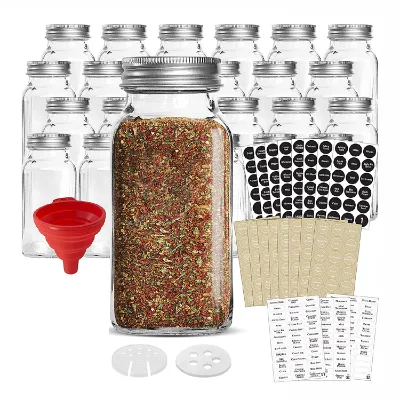
The foundation of any successful procurement strategy lies in the detailed technical specifications of the product. For square glass spice jars, the primary material is clear glass, which offers superior barrier properties against moisture and oxygen compared to many plastic alternatives. The specific design profile is a square shape, a choice that optimizes shelf space and provides a modern, European or pastoral aesthetic depending on the supplier's design portfolio. The glass thickness is a critical metric for durability; observed data indicates a thickness of 3mm, which suggests a robust construction capable of withstanding the rigors of shipping and retail handling without excessive breakage.
Capacity variations are common in this category, with standard volumes ranging from 4oz (approximately 120ml) to 6oz (180ml). Buyers must verify the exact volume against their product requirements, as the "King Size" or "Small" designations can vary by manufacturer. The closure system is equally vital for maintaining the freshness of spices. The most prevalent configuration observed involves a plastic insert paired with an aluminum cap, though options for stainless steel lids or plastic lids with ceramic cores are available. The closure type is typically a screw cap, ensuring a tight seal that prevents leakage and preserves aroma.
| Feature | Observed Specification | Procurement Verification Point |
|---|---|---|
| Shape | Square | Confirm dimensional tolerances for shelf fit |
| Material | Glass (Clear, Lead-free) | Request certificate of lead-free composition |
| Thickness | 3mm | Verify via physical sample or third-party test |
| Volume | 120ml to 180ml (4oz-6oz) | Match to product fill weight and density |
| Lid Material | Plastic/Aluminum or Stainless Steel | Check compatibility with specific spice oils |
| Color | Clear or White | Confirm opacity requirements for light sensitivity |
Compliance, Certification, and Environmental Standards
The "eco-friendly" designation in the core keyword demands rigorous verification of environmental claims. While the product attributes explicitly mention that the glass is "Lead-free" and "Recyclable," buyers must not assume these attributes apply universally to every listed product without documentation. The term "Food grade" is a standard requirement for containers used in the food industry, but specific regulatory compliance (such as FDA or EU food contact regulations) must be confirmed on a per-supplier basis.
Regarding certifications, while ISO 9001:2015 is a recognized standard for quality management systems, it is not explicitly confirmed in the provided product data for all suppliers. Therefore, procurement teams should treat certification status as a variable to be verified rather than a guaranteed baseline. Buyers should request valid ISO certificates or equivalent regional quality certifications from shortlisted suppliers. The "Eco-Friendly" feature is supported by the recyclability of glass, but the sustainability of the entire lifecycle, including the lid materials (plastic vs. metal), should be assessed. Suppliers offering "Customized" standards should be evaluated on their ability to meet specific regional environmental regulations regarding packaging waste.
Cost Drivers and Pricing Dynamics
Understanding the cost structure of square glass spice jars is essential for budgeting and margin analysis. The observed price range in the market spans from $0.04 to $2.50 USD per unit. This wide variance is driven by several factors, including the complexity of the mold, the thickness of the glass, the type of lid material, and the volume of the order. The "Square Shape" often incurs a slightly higher manufacturing cost compared to round jars due to the complexity of the molding process, which requires more precise tooling to ensure sharp corners and structural integrity.
The Minimum Order Quantity (MOQ) is a significant cost driver. Data indicates MOQs ranging from 100 to 10,000 units, with a high-confidence observation of 3,000 pieces and another of 5,000 pieces in stock. Orders falling below these thresholds may result in significantly higher per-unit costs or may not be accepted at all. Conversely, larger orders often unlock volume discounts. The "Single gross weight" of 15.0 kg for a single package (likely a carton containing multiple units) highlights the weight factor in shipping costs. Since glass is heavy, logistics expenses can constitute a substantial portion of the landed cost, particularly for air express shipping, which is listed as an available packing option but is generally more expensive than sea shipping.
Supplier Evaluation and Operational Capabilities
When evaluating potential suppliers, buyers must look beyond the product listing to assess operational reliability. The "Place of Origin" is consistently listed as China, with specific mentions of Jiangsu as a production hub. This region is known for its glass manufacturing capabilities, but buyers should verify the specific factory location to ensure it aligns with their ethical sourcing policies. The "Delivery time" is typically 15-30 days, which is a standard window for glass manufacturing and shipping. However, this lead time can fluctuate based on raw material availability and order volume.
Suppliers offering "Free" samples are a valuable resource for quality assessment. This allows buyers to physically inspect the 3mm thickness, the seal integrity of the plastic insert and aluminum cap, and the clarity of the glass. The "Customization" aspect is a key differentiator; many suppliers accept "OEM" (Original Equipment Manufacturer) requests, allowing for customized logo printing and specific mold openings. However, buyers must be aware that opening a new mold for a "Special Shape and Size" involves additional costs and lead times. The "Small Orders: Accepted" attribute suggests flexibility, but this should be balanced against the potential for higher unit costs and stricter quality control on smaller batches.
Quality Control and Inspection Protocols
Implementing a robust quality control (QC) protocol is non-negotiable when sourcing glass products. The primary risks include breakage during transit, seal failures, and inconsistencies in glass thickness or color. Given the "Food grade" requirement, any visual defects such as bubbles, stones, or scratches that could compromise the barrier properties must be rejected. The "Seal" feature is critical for spice preservation; buyers should test the closure tightness to ensure it prevents moisture ingress and aroma loss.
Inspection should cover both the glass jar and the closure system. For the glass, verify the square dimensions and the 3mm thickness using calipers. For the closure, check the threading compatibility and the condition of the plastic insert or aluminum cap. Since the product is "Recyclable," ensure that the materials used in the lid are compatible with local recycling streams. Third-party inspection services are recommended for orders exceeding the standard MOQ to verify that the production run matches the approved sample. The "Single package size" of 40x35x30 cm provides a baseline for palletization, but buyers should confirm the packing density to optimize container utilization and reduce shipping costs.
Long-Term Procurement and Market Considerations
Sourcing eco-friendly square glass spice jars is not merely a transactional activity but a strategic decision with long-term implications. The trend toward sustainable packaging favors glass over plastic, driven by consumer demand for recyclable materials. However, the supply chain for glass is sensitive to energy costs and raw material fluctuations. Buyers should consider the "Customized logo printing" as a branding opportunity that adds value to the product, but this requires a stable supplier relationship to maintain consistency over time.
The "Industrial Use" is specified as "Food," which implies that the supplier must maintain a clean manufacturing environment. For long-term partnerships, buyers should prioritize suppliers who demonstrate flexibility in "prod_packing" options, such as offering both carton and palletized shipping, to adapt to changing logistics needs. The "Model Number" (e.g., RT55GJ910 or W-0-6) serves as a unique identifier for the specific design; maintaining a consistent model number across orders ensures that the packaging remains compatible with existing filling and labeling equipment.
In conclusion, successful procurement of eco-friendly square glass spice jars requires a meticulous approach to verifying technical specifications, confirming environmental claims, and evaluating supplier capabilities. By focusing on the observed attributes such as the 3mm thickness, square shape, and food-grade materials, buyers can make informed decisions that balance cost, quality, and sustainability. The wide range of MOQs and pricing options allows for scalability, but careful due diligence is essential to navigate the complexities of the global glass packaging market.
FAQs
What is the minimum order quantity for these jars?
The minimum order quantity is typically 3000 pieces, though some stock items may require 5000 units. Small orders are accepted by some suppliers, but they may incur higher per-unit costs compared to bulk purchases.
How thick is the glass used for these square jars?
The glass thickness is observed to be 3mm, ensuring durability for shipping and retail handling. This thickness provides a robust barrier against moisture and oxygen while maintaining a modern square profile.
Can I get a free sample to check the quality?
Yes, suppliers offer free samples for quality assessment before placing a bulk order. This allows you to verify the 3mm thickness, seal integrity, and clarity of the glass before committing to a large purchase.
What materials are used for the lid and cap?
The lid typically consists of a plastic insert paired with an aluminum cap. Options also include stainless steel lids or plastic lids with a ceramic core, depending on the specific customization requirements.
Where are these glass spice jars manufactured?
The place of origin is China, with specific production hubs located in Jiangsu. This region is known for its glass manufacturing capabilities, ensuring a steady supply of food-grade containers.
What is the typical delivery time for an order?
The standard delivery time ranges from 15 to 30 days after order confirmation. This lead time accounts for manufacturing, quality control, and logistics preparation for sea or air shipping.
Are these jars suitable for food storage and spices?
Yes, the jars are explicitly designed for food industrial use and are marked as food grade. They feature a seal to prevent leakage and preserve the aroma of spices effectively.