Source Electric Grooved Panini Grill for Hotels, Restaurants, and Outdoor Events
Find and compare 30 Electric Grooved Panini Grill options from verified suppliers. Buyers can evaluate specifications like voltage, power, and customization features to select the ideal unit for commercial kitchens, hotels, or outdoor catering.
Key considerations
Products List




Comprehensive Sourcing Guide
Strategic Sourcing Guide for Electric Grooved Panini Grills
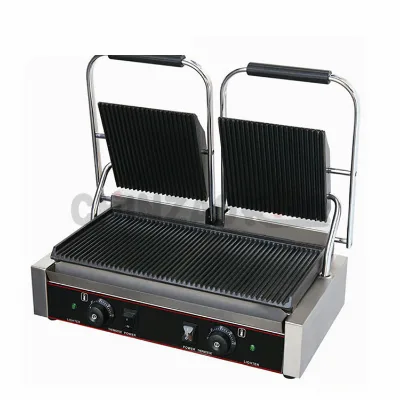
The global demand for commercial and semi-commercial kitchen equipment has driven a significant expansion in the availability of electric grooved panini grills. These appliances are designed to deliver high-heat contact grilling, creating the signature char marks and compression essential for panini sandwiches, burgers, and vegetable preparations. For procurement professionals, navigating the market requires a disciplined approach that separates verified product attributes from marketing generalizations. This guide synthesizes observed market data and technical specifications to provide a framework for sourcing electric grooved panini grills that meet operational needs while adhering to safety and compliance standards.
Technical Specifications and Performance Parameters
When evaluating electric grooved panini grills, the primary focus must be on the power delivery, voltage compatibility, and physical construction. The observed market data indicates a diverse range of power configurations, with specific units listing power ratings of 1500W and 2.2kW (2200W). This variance suggests that buyers must align their electrical infrastructure with the specific unit's requirements. Voltage specifications in the current market are equally varied, with listings showing compatibility for 110V, 220V, and 220-240V ranges. Sourcing a unit with a voltage mismatch can lead to equipment failure or safety hazards, making it imperative to verify the exact voltage rating against the destination facility's power supply before finalizing a purchase.
The physical construction of these units is predominantly stainless steel, a material chosen for its durability, corrosion resistance, and ease of cleaning in high-volume environments. Specific product models, such as the SB-PG02 and TEG-811E, highlight the use of stainless steel housings and plates. The dimensions of these units also vary; for instance, one observed model measures 430mm in length, 390mm in width, and 210mm in height, while others may differ significantly. Buyers should request precise dimensional data to ensure the equipment fits within their designated kitchen footprint. Furthermore, the weight of the units is a critical logistical factor. Observed gross weights (G.W) for certain models reach up to 16.6kg, which impacts shipping costs and the structural requirements of the installation surface.
Control mechanisms are another vital technical specification. The market features units equipped with mechanical timers, allowing for precise cooking cycles. Some models include a reheat function, adding versatility for warming previously cooked items without overcooking. The presence of a dust cap and automatic pop-up mechanisms further enhances user safety and convenience. While some units are described as having a "New" design or "Modern" style, the functional attributes like the hinge type and non-stick coatings on the plates are more relevant to operational longevity. The hinge mechanism, specifically noted as non-stick coated in some listings, is crucial for preventing food residue buildup and ensuring smooth opening and closing over thousands of cycles.
Compliance and Certification Verification
In the B2B procurement of electrical appliances, compliance is not merely a formality but a critical risk management strategy. The supply chain for electric grooved panini grills is heavily populated with products originating from China, specifically from regions like Guangdong and Guangzhou. This geographic concentration often correlates with specific certification profiles. The most frequently observed certifications in the current market data include CE, RoHS, and CB. The CE marking indicates conformity with health, safety, and environmental protection standards for products sold within the European Economic Area. RoHS compliance ensures that the product does not contain restricted hazardous substances, which is increasingly important for environmental regulations globally.
However, buyers must exercise caution when interpreting certification claims. While "CE" is a common standard listed, the specific certificate details can vary. Some product listings mention "Certificate: China," which may refer to domestic standards rather than international recognition. It is essential to verify that the CE certification is valid for the specific target market of the buyer. For instance, a unit certified for the Chinese domestic market may not meet the specific electrical safety requirements of the European Union or North America. The CB scheme, often mentioned alongside CE, represents a global certification system that can facilitate acceptance in multiple countries, but its validity must be confirmed for the specific destination.
Additionally, the "ISOCustomized" designation found in some listings suggests that certification status may be tied to the customization level of the order. Buyers should explicitly request copies of the test reports and certificates from the supplier to validate these claims. Relying solely on the product page listing without independent verification can lead to compliance failures at customs or during safety inspections. The standard "609666412" mentioned in some contexts appears to be a dimensional specification rather than a standard, highlighting the need for buyers to distinguish between physical dimensions and regulatory standards.
Cost Drivers and Pricing Structures
The pricing of electric grooved panini grills is influenced by a complex interplay of factors, including power rating, material quality, and customization options. The observed price range in the market spans from $25 to $400 USD. This wide disparity indicates that the market includes both basic, entry-level models and high-end commercial units. The lower end of the spectrum likely corresponds to units with lower power ratings, simpler mechanical controls, or less robust construction. Conversely, the higher price points are associated with units featuring higher wattage (such as 2.2kW), advanced features like reheat functions, and premium stainless steel construction.
Customization is a significant cost driver in this category. The market data confirms that customization is available, with options ranging from OEM branding to specific design modifications. Units labeled with "OEM" or "Customized" often command a premium due to the additional engineering and tooling required. The Minimum Order Quantity (MOQ) also plays a role in the final cost per unit. Observed MOQs range from 1 to 1000 pieces. Buyers purchasing small quantities may face higher unit costs due to the lack of economies of scale, while those ordering in bulk can negotiate more favorable pricing. However, high MOQs can tie up capital and increase inventory risk.
Supply ability is another factor affecting cost and availability. Some suppliers list a supply ability of 1000 pieces per month, which suggests a moderate production capacity. Buyers should consider whether this capacity aligns with their projected demand. If a supplier cannot meet the required volume within a reasonable timeframe, it may lead to delays and increased costs associated with sourcing from alternative vendors. The port of dispatch, often listed as Guangzhou or Shenzhen, also influences logistics costs. Buyers should factor in freight charges and potential tariffs when calculating the total landed cost of the equipment.
Typical Applications and Operational Environments
Electric grooved panini grills are versatile appliances designed for a wide range of applications. The observed market data highlights their suitability for outdoor settings, hotels, and commercial establishments. In a commercial kitchen, the high power output and durable stainless steel construction allow for continuous operation during peak hours. The grooved design is particularly effective for grilling sandwiches, ensuring even heat distribution and the characteristic sear marks that appeal to customers. The automatic pop-up feature is essential in high-volume environments, allowing staff to quickly remove cooked items and maintain a steady workflow.
For hotel and catering operations, the reheat function adds significant value. This feature allows for the warming of pre-prepared items without compromising texture, which is crucial for maintaining food quality during service. The compact dimensions of some models make them suitable for kitchens with limited counter space, while larger units with higher power ratings are better suited for high-throughput environments. The "Normal" shape and "Modern" style of these units ensure they fit seamlessly into various kitchen aesthetics, from rustic to contemporary.
Outdoor applications present unique challenges, such as exposure to the elements and varying power availability. Units designed for outdoor use must have robust construction to withstand these conditions. The stainless steel material provides a good baseline for weather resistance, but buyers should verify if the specific model includes additional protective features for outdoor deployment. The voltage compatibility is also critical for outdoor events, where power sources may differ from standard commercial outlets. Ensuring the unit matches the available voltage (110V vs. 220V) is essential for safe and effective operation.
Supplier Evaluation and Quality Control
Selecting the right supplier is as important as selecting the right product. Given the concentration of manufacturers in Guangdong and Guangzhou, China, buyers should conduct thorough due diligence to ensure the supplier's reliability. The "Brand Name" and "OEM" status listed in product descriptions can be misleading; many suppliers offer white-label products where the actual manufacturer may differ from the brand name displayed. Buyers should request the actual factory name and location to verify the production capabilities.
Quality control should be a central part of the procurement process. Buyers must verify the manufacturing process and the materials used. While "Stainless Steel" is a common material, the grade and thickness can vary significantly, affecting durability and heat retention. The "Die Casting Iron and Stainless" designation suggests a composite construction, which may offer enhanced stability but requires verification of the casting quality. The "Concentration and Dry" process mentioned in some listings is ambiguous and should be clarified with the supplier to ensure it refers to a legitimate manufacturing step rather than a generic term.
Inspection protocols should include checks for the mechanical timer functionality, the integrity of the non-stick coating on the hinges and plates, and the accuracy of the voltage and power ratings. Buyers should request pre-shipment inspection reports or arrange for third-party inspections to verify that the products meet the agreed-upon specifications. The "Automatic Grade" being listed as "Manual" for some units indicates a need for careful verification of the automation features. Ensuring that the automatic pop-up and reheat functions work as intended is critical for operational efficiency.
Long-Term Procurement Considerations
Sourcing electric grooved panini grills involves more than just the initial purchase; it requires a long-term view of maintenance, support, and scalability. The "Supply Ability" of 1000 pieces per month suggests that suppliers can handle growth, but buyers should confirm their capacity to support after-sales needs. This includes the availability of spare parts, such as heating elements, thermostats, and replacement plates. The "Carton Box" and "Carton" packing methods observed indicate standard packaging, but buyers should ensure that the packaging is robust enough to prevent damage during transit and storage.
The "Health" advantage listed in some product attributes suggests a focus on hygiene, which is paramount in food service. Buyers should verify that the non-stick coatings are food-safe and durable enough to withstand frequent cleaning. The "New" design and "Morden" style are marketing terms that should be evaluated against the actual functional improvements they offer. Long-term cost of ownership should be calculated by considering energy efficiency, maintenance requirements, and the expected lifespan of the equipment.
Finally, buyers should establish clear communication channels with suppliers regarding lead times and order modifications. The "Port of Dispatch" being Guangzhou or Shenzhen is standard, but buyers should confirm the specific shipping terms and lead times to avoid delays. By maintaining a disciplined approach to verification and quality control, buyers can secure reliable electric grooved panini grills that meet their operational needs and comply with all relevant standards.
FAQs
What certifications do electric grooved panini grills typically have?
Most units feature CE, RoHS, and CB certifications for safety compliance. Buyers must verify that these certificates are valid for their specific target market, as some listings may only indicate domestic standards like China certification rather than international recognition.
Which voltage options are available for these grills?
Available voltage ratings include 110V, 220V, and 220-240V configurations. It is critical to match the unit's voltage rating with the destination facility's power supply to prevent equipment failure or safety hazards during operation.
Can I customize the branding and design of the grill?
Yes, customization is available for OEM branding and specific design modifications. This option often requires a higher Minimum Order Quantity and may increase the unit cost due to additional engineering and tooling requirements.
What is the typical power rating for commercial models?
Commercial units typically operate at 1500W or 2.2kW power ratings. Higher wattage models are better suited for high-throughput environments, while lower wattage units may be appropriate for smaller kitchens or semi-commercial applications.
Where are these grills primarily manufactured?
The majority of these appliances originate from Guangdong and Guangzhou in China. Buyers should verify the specific factory location to ensure reliable production capabilities and to accurately calculate shipping costs from ports like Guangzhou or Shenzhen.
What is the minimum order quantity for these products?
Minimum Order Quantities range from 1 to 1000 pieces depending on the supplier. Smaller orders may incur higher unit costs, while bulk purchases allow for better pricing but require careful capital management and inventory planning.