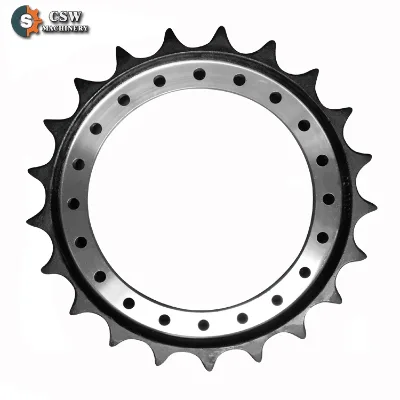
Source Excavator Undercarriage Drive Sprocket for Car, Marine, Machinery
Find 30 verified options for the Excavator Undercarriage Drive Sprocket suitable for excavators, agricultural machinery, and marine applications. Buyers can compare specifications, customization options, and surface treatments from multiple suppliers.
Key considerations
Products List


PC2000 Excavator Undercarriage Parts Replacement Sprocket Final Drive Sprocket
$100.00 - $5000.00
MOQ: 1 Pieces


Excavator Track Sprocket Undercarriage Final Drive Gear Sprocket Assembly
$100.00 - $5000.00
MOQ: 1 Pieces

Excavator Track Sprocket Undercarriage Drive Sprocket Wheel For Mining Equipment
$100.00 - $5000.00
MOQ: 1 Pieces

Excavator Drive Sprocket Undercarriage Components For Construction Machinery
$100.00 - $5000.00
MOQ: 1 Pieces

Excavator Undercarriage Sprocket OEM Drive Sprocket Replacement For Heavy Equipment
$100.00 - $5000.00
MOQ: 1 Pieces


Comprehensive Sourcing Guide
Strategic Sourcing Guide for Excavator Undercarriage Drive Sprockets
Navigating the global market for excavator undercarriage drive sprockets requires a disciplined approach that balances technical precision with supply chain reliability. These components are critical to the mobility and operational efficiency of heavy machinery, serving as the primary interface between the engine's power and the track system's movement. Buyers must understand that while the core function remains consistent, the specifications for these parts vary significantly based on the original equipment manufacturer (OEM) and the specific model of the excavator. This guide outlines the essential factors for sourcing these components, focusing on verified attributes, compliance standards, and quality assurance protocols derived from current market data.
Technical Specifications and Compatibility Verification
The foundation of a successful procurement strategy lies in the accurate identification of technical specifications. Drive sprockets are not generic components; they are engineered to fit specific pitch ranges and tooth profiles. The market data indicates a critical variable known as the "Crawler undercarriage pitch," which typically ranges from 90 to 592. This numerical range is not merely a suggestion but a hard constraint; selecting a sprocket with an incorrect pitch will result in immediate mechanical failure and potential damage to the entire track system. Buyers must verify the exact pitch measurement of their existing undercarriage before initiating any purchase order.
Furthermore, the toothed portion shape is a defining characteristic. In the context of excavator applications, the observed standard is the "Spur Gear" configuration. This shape is designed to engage with the track links effectively, transferring torque while minimizing wear. The manufacturing method for these components is predominantly "Cast Gear," though some suppliers may offer "Forging / Casting" techniques. The choice between casting and forging can influence the grain structure and ultimate tensile strength of the part. Additionally, the hardness of the tooth surface is a crucial metric, with "Hardened Tooth Surface" being a standard requirement for durability in high-load environments.
Compatibility extends beyond physical dimensions to include brand alignment. The supply chain supports a wide array of major excavator brands, including Sumitomo, Hitachi, Sany, Hyundai, Komatsu, Kobelco, LiuGong, Volvo, Doosan, JCB, XGMA, Caterpillar, and Kato. When sourcing replacement parts, the "Product name" and "Product Keywords" often reference specific models such as PC20-5, PC2000, or SH200/240. It is imperative for buyers to cross-reference these model numbers with their machine's serial number to ensure the sprocket is an exact fit. The "Bore" type is another technical detail to verify, as options may include "Finished Bore" or "Precossing Bore," depending on whether the part requires immediate installation or further machining.
Compliance, Certification, and Manufacturing Standards
In the industrial sector, compliance with international standards is a prerequisite for ensuring part longevity and safety. The sourcing landscape for excavator sprockets is governed by recognized standards such as ANSI, DIN, and ISO. These standards provide a framework for dimensional tolerances and material properties. Buyers should specifically look for products that adhere to the "Standard" classification rather than "Nonstandard" variants, unless a custom solution is explicitly required for a legacy machine.
Certification plays a pivotal role in supplier validation. A high-confidence indicator of a reputable manufacturer is the possession of ISO9001 certification. This standard, often cited in the context of "Condition: New" products, verifies that the supplier maintains a quality management system that ensures consistent product quality. While some background data references ISO 9001:2000, the current market expectation generally aligns with more recent iterations of the standard. Buyers must request proof of certification rather than relying on marketing claims.
The origin of the product is also a factor in compliance. The primary manufacturing hubs identified in the current data are located in China, specifically in regions such as Hebei, Shandong, and Guangdong. These locations are known for their robust heavy machinery manufacturing capabilities. However, the "Place of Origin" should be clearly stated on all documentation. Additionally, the "Standard Or Nonstandard" attribute confirms that the product meets established industry norms, which is essential for maintaining warranty validity and ensuring interchangeability with other undercarriage components.
Cost Drivers and Pricing Dynamics
Understanding the cost structure of excavator drive sprockets is essential for budgeting and negotiation. The observed price range in the market is extensive, spanning from $0.50 to $5,000 USD. This wide variance is driven by several key factors, including the material composition, the manufacturing complexity, and the scale of the order. The material used for the segment is frequently "40Mn2" or "50Mn," which are manganese steel alloys known for their high strength and wear resistance. The choice of material directly impacts the unit cost, as higher-grade alloys command a premium.
The "Annual Output" of a supplier is another significant cost driver. Suppliers with a capacity of 100,000 sets per year are likely to offer more competitive pricing due to economies of scale. Conversely, smaller operations may charge higher rates for lower volumes. The "MOQ" (Minimum Order Quantity) also influences the final price. Data indicates that MOQs can range from 1 to 500 units, with some suppliers offering a low entry point of just 2 pieces. For buyers looking to minimize upfront inventory costs, suppliers with lower MOQs are advantageous, though the per-unit cost may be higher.
Packaging and logistics costs are often overlooked but can significantly affect the total landed cost. The "prod_packing" varies from "Wooden Box" to "Plywood Case/Pallet." The weight of the single package can be substantial, with some items weighing up to 50.000 kg. This weight impacts shipping costs, particularly for air freight, making sea freight the preferred method for heavy industrial parts. The "Single package size" of 70x70x20 cm provides a baseline for logistics planning, but buyers should confirm exact dimensions for their specific order to avoid unexpected freight charges.
Typical Applications and Operational Context
Excavator drive sprockets are designed for a specific set of high-stress applications. The primary "Application" category is the "Excavator," specifically for "excavator undercarriage parts." These components are essential for the "Replace/Repair" of worn-out machinery, ensuring that the equipment returns to full operational capacity. The "Purpose" is explicitly defined as replacement, meaning these parts are intended to restore the machine to its original performance specifications.
Beyond the excavator, the broader "Application" scope includes "Car," "Agricultural Machinery," "Marine," "Machinery," and "Motor." While the core focus is on heavy construction equipment, the underlying technology is applicable to various sectors requiring robust power transmission. The "Condition" of the product is universally "New," indicating that buyers should not expect refurbished or used parts in this specific market segment. The "Quality" is often described as "Original Product," suggesting that the parts are manufactured to meet the original equipment manufacturer's specifications, whether they are genuine OEM parts or high-quality aftermarket equivalents.
The operational environment for these sprockets is demanding. They must withstand significant torque, abrasive conditions, and continuous vibration. The "Surface Treatment" options, such as "Black Oxide" and "Zinc Plated," are critical for corrosion resistance. The "Color" of the product, which can be "Nature Steel," "Black," "Yellow," or "Gray," often serves as a visual indicator of the surface treatment or the specific OEM branding. For instance, yellow and black color schemes are common in the construction industry for visibility and safety, while nature steel indicates an untreated or primed surface.
Supplier Evaluation and Quality Assurance
Evaluating a supplier for excavator undercarriage parts requires a multi-faceted approach that goes beyond price comparison. One of the most reliable indicators of a supplier's commitment to quality is the availability of "Video outgoing-inspection." This feature allows buyers to visually verify the condition and specifications of the product before it leaves the factory. It is a transparency measure that reduces the risk of receiving substandard goods. Buyers should prioritize suppliers who offer this service as part of their standard procedure.
The "Warranty" period is another critical metric for supplier evaluation. A warranty of "2 years" is a strong indicator of confidence in the product's durability. This coverage provides a safety net for buyers, ensuring that any premature failures are addressed by the manufacturer. Additionally, the "Brand Name" associated with the product, such as "CSW," can be a factor in brand recognition and trust, though buyers should verify that the brand is authorized to manufacture parts for the specific excavator models they are servicing.
Quality control processes should be transparent. The "Manufacturing Method" and "Technique" (Forging / Casting) should be clearly documented. Buyers should request material test reports to verify the "segment material" composition. The "Standard Specifications or Customized" attribute indicates that the supplier is flexible, but buyers must ensure that any customization does not compromise the structural integrity of the part. The "prod_standard" of 0.950.70.75 may refer to specific dimensional tolerances or packaging standards, which should be confirmed with the supplier to ensure alignment with the buyer's requirements.
Long-Term Procurement Considerations
Sourcing excavator drive sprockets is not a one-time transaction but part of a long-term maintenance strategy. Buyers should consider the "Annual Output" of the supplier to ensure they can meet future demand without supply chain disruptions. A supplier with a capacity of 100,000 sets is better positioned to handle large orders and maintain consistent inventory levels. The "Place of Origin" also plays a role in long-term logistics; suppliers located in major manufacturing hubs like Shandong or Guangdong often have more established export channels and better infrastructure for handling large shipments.
The "Product name" and "Product Keywords" should be consistent across all orders to facilitate easy reordering and inventory management. Using specific model numbers like PC20-5 or SH200/240 ensures that the correct parts are ordered every time. Buyers should also consider the "prod_packing" options, such as "Pallet" or "Plywood Case," which can affect storage and handling costs at the destination. Standardized packaging reduces the risk of damage during transit and simplifies the receiving process.
Finally, the "Condition" and "Quality" of the product must remain consistent over time. Buyers should establish a relationship with suppliers who can guarantee "Original Product" quality and maintain the "Hardened Tooth Surface" specifications. Regular communication and periodic audits of the supplier's quality control processes can help maintain high standards. By focusing on these long-term factors, buyers can ensure a reliable supply of high-quality drive sprockets that keep their excavators operating efficiently and safely.
Summary of Key Procurement Parameters
To facilitate quick reference during the sourcing process, the following table summarizes the critical parameters identified in the market data. This comparison highlights the essential attributes that buyers must verify to ensure a successful procurement outcome.
| Parameter Category | Key Attributes & Values | Verification Requirement |
|---|---|---|
| Technical Specs | Pitch: 90–592; Tooth Shape: Spur Gear; Hardness: Hardened | Confirm exact pitch and hardness grade for machine model. |
| Materials | Segment Material: 40Mn2 / 50Mn; Surface: Black Oxide/Zinc Plated | Request material test reports for alloy composition. |
| Compliance | Standards: ANSI, DIN, ISO; Certification: ISO9001 | Verify valid ISO9001 certificate and standard adherence. |
| Compatibility | Brands: Hitachi, Komatsu, CAT, etc.; Models: PC20-5, SH200/240 | Cross-reference model number with machine serial number. |
| Logistics | Origin: China (Shandong, Hebei, Guangdong); Weight: Up to 50kg | Confirm packaging size and shipping method (Sea/Air). |
| Commercial | MOQ: 1-500 (Low end 2pcs); Warranty: 2 years; Price: $0.5-$5000 | Negotiate MOQ and warranty terms based on order volume. |
By adhering to these guidelines and verifying the specific attributes listed above, buyers can navigate the complex market for excavator undercarriage drive sprockets with confidence. The focus on verified data, clear standards, and robust supplier evaluation ensures that the procurement process yields high-quality components that meet the rigorous demands of heavy machinery operations.
FAQs
What materials are used for excavator undercarriage drive sprockets?
The segment material is typically 40Mn2 or 50Mn manganese steel alloys. These materials provide high strength and wear resistance essential for heavy-duty applications.
Which certifications should I look for in a sprocket manufacturer?
Look for ISO9001 certification to ensure consistent quality management. This standard verifies that the supplier maintains rigorous production controls for new products.
How can I verify the pitch range for my excavator sprocket?
The crawler undercarriage pitch typically ranges from 90 to 592. You must verify the exact pitch measurement of your existing undercarriage before purchasing.
Can I find suppliers offering video outgoing-inspection services?
Yes, some suppliers provide video outgoing-inspection to verify product condition before shipment. This service allows buyers to visually confirm specifications before the order leaves the factory.
What is the typical warranty period for these drive sprockets?
A standard warranty period is 2 years for these components. This coverage ensures that premature failures are addressed by the manufacturer under defined conditions.
Which brands are compatible with these excavator sprockets?
These sprockets are compatible with major brands like Hitachi, Komatsu, and Caterpillar. They also fit models from Sumitomo, Hyundai, Sany, and Volvo.
What packaging options are available for shipping heavy sprockets?
Packaging options include Wooden Box, Plywood Case, or Pallet. Single package weights can reach up to 50 kg, requiring careful logistics planning.