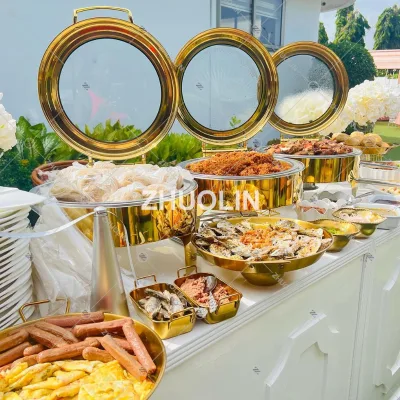
Source Gold Mirror Polished Chafing Dish for Hotels, Restaurants, Catering
Compare 30 Gold Mirror Polished Chafing Dish options from Chinese manufacturers. Buyers can review specifications like stainless steel 201 material, alcohol fuel heating, and varying capacities for hotel buffet and restaurant serving applications.
Key considerations
Products List


Other Hotel Stainless Steel Hammered Gold Round Chafing Dishes for Catering
$180.00 - $205.00
MOQ: 5 Pieces


Comprehensive Sourcing Guide
Strategic Sourcing Guide for Gold Mirror Polished Chafing Dishes
Understanding the Product Category and Core Attributes
The procurement of gold mirror polished chafing dishes requires a precise understanding of the intersection between aesthetic presentation and functional food safety. These items are not merely serving vessels but are engineered for high-volume food service environments such as hotel buffets, catering events, and restaurant serving lines. The defining characteristic of this product category is the "gold mirror" finish, which is achieved through high mirror polishing processes applied to stainless steel materials. This finish provides a luxurious visual appeal that elevates the perceived value of the food being served, while the underlying material ensures durability and resistance to corrosion.
Based on observed market data, the primary material composition for these units is stainless steel, specifically grades such as Stainless Steel 201. The manufacturing process involves significant surface treatment to achieve the high mirror polishing effect. Buyers must recognize that the "gold" color is often an option available alongside the "origin" or natural steel finish, and this aesthetic choice is a critical differentiator in the procurement decision. The product is categorized under serving equipment, specifically designed for buffet display and food storage applications. The functional requirement is to keep food warm, often utilizing alcohol fuel as a hot resource, which necessitates specific design considerations for heat distribution and safety.
Technical Specifications and Dimensional Analysis
When evaluating gold mirror polished chafing dishes, technical specifications must be scrutinized to ensure compatibility with existing kitchen infrastructure and serving requirements. The physical dimensions of these units vary significantly depending on the intended capacity and shape. Observed models indicate a range of configurations, including square, round, and rectangular shapes. For instance, specific product models have been identified with dimensions such as 39x43.5x29 cm or 64.5x34.5x38 cm, highlighting the importance of verifying the exact footprint before ordering.
Capacity is another critical technical parameter. The supply chain data reveals units ranging from less than 7 liters to 9 liters, with some specific models offering an 8-liter capacity. This variance directly impacts the volume of food that can be served in a single pan, influencing the number of units required for large-scale events. The thickness of the material is also a vital specification; observed data points to a thickness of 0.55 mm for certain models. While this thickness provides a balance between weight and durability, buyers should verify if thicker gauges are available for heavy-duty commercial use.
The heating mechanism is a fundamental technical aspect. Most units in this category utilize fuel-based heating, specifically alcohol fuel, rather than electric or gas connections. This requires the inclusion of a fuel pan and a water pan within the chafing dish assembly. The temperature adjustability is a key performance metric; however, current observations indicate that many standard models do not offer temperature adjustment features, relying instead on the heat output of the fuel source. Buyers must confirm if the specific model selected allows for temperature control or if it operates at a fixed heat level suitable for the menu items being served.
Compliance, Certification, and Material Standards
In the realm of food service equipment, compliance with safety and material standards is non-negotiable. The primary material used, Stainless Steel 201, is a common grade in the industry, but its suitability for direct food contact must be verified against local health regulations. While the supplied data mentions a product standard labeled as "A," this is a generic placeholder and does not constitute a specific international certification like NSF, CE, or FDA. Buyers must not assume that the presence of a "standard" label implies full regulatory compliance without further documentation.
The manufacturing origin is predominantly China, with specific production hubs noted in Guangdong. This geographic concentration suggests a mature supply chain but also necessitates rigorous due diligence regarding the specific factory's quality management systems. The product standard referenced in the data (450410270MM) appears to be a dimensional specification rather than a safety certification. Therefore, procurement teams must explicitly request valid third-party test reports and food safety certifications from the supplier.
Compliance checks should extend to the packaging materials as well. The observed packing methods include PP bags, poly bags, white boxes, brown boxes, and color boxes, often with foam pads for protection. These materials must be food-safe and free from contaminants that could leach into the product during storage or transport. Additionally, the customization options available, such as OEM logos (e.g., CS/OEM), must be executed using inks and processes that do not compromise the food safety of the unit. Buyers should insist on written confirmation that all customization processes adhere to relevant food contact safety standards.
Cost Drivers and Pricing Dynamics
The pricing of gold mirror polished chafing dishes is influenced by a complex interplay of material costs, finishing processes, and order volume. The observed price range in the market spans from approximately $14.13 to $205 USD, a significant variance that reflects differences in material quality, finish complexity, and capacity. The "gold mirror" finish itself is a cost driver, as it requires additional polishing steps and potentially higher-grade plating or coating compared to standard brushed steel finishes.
Material thickness is another primary factor affecting cost. Units with a thickness of 0.55 mm may be priced differently than those with thicker gauges, which offer greater durability and heat retention. The shape of the dish also impacts manufacturing complexity; round and rectangular shapes may have different production costs compared to square configurations. Furthermore, the inclusion of accessories, such as specific fuel pans or specialized lids (e.g., roll-top types), can increase the unit price.
Order volume plays a crucial role in final pricing. The minimum order quantity (MOQ) observed ranges from 1 to 100 units. Buyers purchasing small quantities may face higher per-unit costs, while those placing larger orders can leverage economies of scale. The customization of logos and packaging also introduces variable costs. While some suppliers offer standard packaging, custom color boxes or branded packaging will incur additional charges. Buyers should request detailed breakdowns of costs to understand how much of the price is attributed to the base unit versus the finishing and customization services.
Typical Applications and Operational Requirements
Gold mirror polished chafing dishes are designed for high-visibility serving environments where presentation is as important as functionality. The primary application is in hotel buffet food equipment, where the aesthetic appeal of the gold finish enhances the dining experience. These units are also widely used in restaurant serving lines, catering events, and banquet halls. The ability to keep food warm for extended periods makes them ideal for self-service stations where food is displayed for long durations.
The specific design features, such as the roll-top lid or unique chafing dish types, cater to different operational needs. For example, a roll-top design might be preferred for dishes that require frequent access, while a square shape might be better suited for buffet lines with limited counter space. The capacity of the unit, ranging from under 7 liters to 9 liters, allows buyers to select the appropriate size based on the expected foot traffic and food consumption rates.
The heating method, specifically alcohol fuel, dictates the operational requirements. These units are self-contained and do not require external power sources, making them versatile for outdoor events or locations with limited electrical infrastructure. However, the lack of temperature adjustment in many models means that buyers must carefully match the dish to the food type. Dishes that require precise temperature control may not be suitable for these fuel-based units, and buyers should verify if the specific model can maintain the required holding temperature for their menu items.
Supplier Evaluation and Quality Control Protocols
Selecting the right supplier for gold mirror polished chafing dishes requires a multi-faceted evaluation process. Given the concentration of manufacturers in Guangdong, China, buyers should prioritize suppliers with a proven track record in exporting food service equipment. The availability of customization options, such as OEM logos, indicates a supplier's capability to meet specific branding requirements. However, the presence of customization does not guarantee quality; therefore, buyers must assess the supplier's quality control protocols.
Quality control should begin with the raw materials. Buyers must verify that the stainless steel used is indeed Stainless Steel 201 or a higher grade, and that it meets food safety standards. The surface finish is another critical area of inspection. The "high mirror polishing" process must be consistent across all units to ensure a uniform gold appearance without scratches or imperfections. Buyers should request samples to inspect the surface quality and the durability of the gold finish under normal use conditions.
Inspection of the final product should include checks for structural integrity, such as the stability of the frame and the fit of the lids. The dimensions provided in the product specifications, such as 46x40x32 cm for carton size, should be verified to ensure they match the actual product dimensions. Additionally, the packaging method, which includes PP bags and foam pads, must be robust enough to prevent damage during shipping. Buyers should consider implementing a third-party inspection service to verify the quality of the goods before shipment, particularly for large orders.
Long-Term Procurement and Maintenance Considerations
Long-term procurement of gold mirror polished chafing dishes involves considerations beyond the initial purchase price. The durability of the gold finish is a key factor; buyers should inquire about the maintenance requirements to ensure the aesthetic appeal is maintained over time. The high mirror polishing process, while attractive, may be susceptible to scratching or tarnishing if not handled correctly. Buyers should request care instructions and recommended cleaning agents from the supplier to preserve the finish.
Lead times and delivery schedules are also critical for long-term planning. The observed delivery time is within 35 days after the deposit, which is a standard timeframe for manufacturing and shipping. However, buyers should account for potential delays due to customs clearance or logistical issues. Establishing a reliable supply chain with consistent lead times is essential for maintaining inventory levels and meeting event schedules.
Sustainability and waste management are increasingly important in procurement decisions. The packaging materials, such as cardboard boxes and foam pads, should be evaluated for their recyclability. Buyers should encourage suppliers to use eco-friendly packaging options where possible. Furthermore, the longevity of the product itself contributes to sustainability; a durable chafing dish that lasts for years reduces the need for frequent replacements. Buyers should prioritize suppliers who offer warranties or guarantees on their products, ensuring that any defects are addressed promptly and minimizing the total cost of ownership.
FAQs
What material is used for gold mirror polished chafing dishes?
The primary material is stainless steel, specifically grade 201. This material ensures durability and corrosion resistance while supporting the high mirror polishing process required for the gold finish.
How is the heating method implemented in these chafing dishes?
Most units utilize alcohol fuel as the hot resource for heating. This fuel-based system allows for self-contained operation without external power, though many standard models do not offer temperature adjustment features.
Which shapes are available for gold mirror polished chafing dishes?
Available shapes include square, round, and rectangular configurations. Specific models feature dimensions like 39x43.5x29 cm or 64.5x34.5x38 cm to suit different buffet display requirements.
Can I customize the logo on these chafing dishes?
Yes, customization is available for logos such as CS or OEM branding. Buyers should ensure that all customization processes adhere to relevant food contact safety standards to maintain product integrity.
What is the typical delivery lead time for these products?
The standard delivery time is within 35 days after the deposit is received. This timeframe covers manufacturing and initial shipping preparation from the production hubs in Guangdong, China.
How does the capacity vary across different chafing dish models?
Capacities range from less than 7 liters up to 9 liters depending on the model. Specific units offer capacities of 8 liters or 9 liters to accommodate varying food service volumes.