Source Gold Micro Insert Cross Necklace for Decoration, Health, Religious
Compare 30 Gold Micro Insert Cross Necklace options from Shenzhen suppliers. Buyers can evaluate stainless steel materials, plating styles, and customization services for decoration, health, and religious uses.
Key considerations
Products List


Cast Stainless Steel Cross Necklace Threaded Cross Pendant Men's Necklace
$2.60 - $2.85
MOQ: 100 Pieces




Comprehensive Sourcing Guide
Strategic Sourcing Guide for Gold Micro Insert Cross Necklaces
Navigating the B2B market for gold micro insert cross necklaces requires a disciplined approach that balances aesthetic appeal with rigorous supply chain verification. For procurement professionals, the term "Gold Micro Insert Cross Necklace" often encompasses a variety of product configurations, ranging from simple religious pendants to fashion-forward decorative items. The core challenge lies in distinguishing between generic listings and verified, compliant inventory that meets specific operational requirements. This guide synthesizes available product attributes and industry standards to provide a framework for evaluating potential suppliers and defining precise technical specifications.
Defining Technical Specifications and Material Integrity
The foundation of any successful procurement strategy for jewelry begins with a granular understanding of technical specifications. In the context of cross necklaces, the physical dimensions and material composition are paramount. Data indicates that length variations are a critical differentiator, with observed specifications including 45cm and 60cm chains, as well as combined ranges of 45cm to 60cm. Buyers must explicitly verify the chain length against their target demographic's preferences, as a 45cm chain typically sits at the collarbone, while a 60cm chain offers a longer, more casual drape.
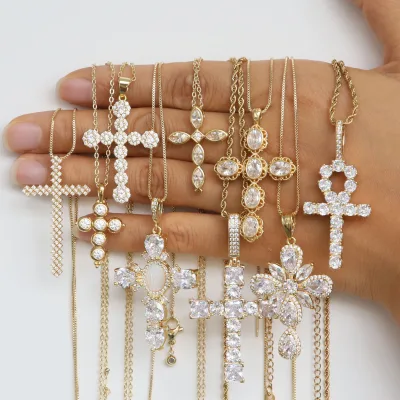
Material selection is equally critical. Stainless steel is a frequently cited material for these items, offering durability and resistance to tarnish. The surface finish is often achieved through polishing and black plating, or gold plating, which directly impacts the perceived value and cost. The "micro insert" aspect of the keyword suggests a specific design complexity, often involving small, detailed components. When evaluating product listings, procurement teams should look for specific model identifiers, such as HDX0865, HDX20081201, or XL102109, to ensure traceability. Furthermore, the pendant shape is consistently identified as a cross, but the specific dimensions, such as a standard of 35mm by 55mm or a height of 570mm with a 30mm width, must be confirmed on a per-order basis. Buyers should not assume standard sizing applies to all listings; some products explicitly state that size is customized and requires direct communication with customer service to finalize dimensions.
Compliance, Certification, and Safety Standards
In the jewelry sector, compliance is not merely a regulatory formality but a prerequisite for market access, particularly in North America and Europe. A primary concern for buyers is the safety of the materials used, specifically regarding allergens. Trusted standards indicate that compliant products should be Nickel and Lead Free. This is a non-negotiable attribute for jewelry intended for prolonged skin contact, as nickel allergies are prevalent among the general population.
Beyond material safety, the operational integrity of the supplier is often validated through third-party certifications. High-confidence data points to the presence of ISO9001, SGS, and BSCI certifications in the supply chain. ISO9001 ensures that the manufacturer adheres to international quality management standards, while SGS provides independent verification of product quality and safety. BSCI (Business Social Compliance Initiative) is crucial for buyers concerned with ethical labor practices and social responsibility within the manufacturing facility. Additionally, some product listings reference CE certification, which is essential for products entering the European Economic Area.
When sourcing, buyers must verify that the specific batch of gold micro insert cross necklaces carries these certifications. It is insufficient to rely on a supplier's general reputation; the certification status must be linked to the specific product model and production run. For instance, while one model may list SGS and CE standards, another might only reference a box gauge standard of 25 * 25 * 25CM without explicit safety certifications. Procurement teams should request current certification documents for every new supplier engagement to ensure continuity of compliance.
Cost Drivers and Pricing Dynamics
Understanding the cost structure of gold micro insert cross necklaces is essential for budgeting and margin analysis. The observed price range in the market spans from $0.71 to $17.80 USD, a significant variance that reflects differences in material quality, plating thickness, and design complexity. The lower end of this spectrum likely corresponds to basic stainless steel items with standard gold plating, while the higher end may involve more intricate micro-insert designs, thicker plating, or additional packaging features.
Several factors drive these costs. The plating process, whether it is gold plating or black plating, is a major cost component. The durability of the plating is often linked to the warranty offered; listings indicate warranties ranging from 1-2 years for fade-proof performance to 1-3 years for general product integrity. Longer warranties often correlate with higher-quality plating processes and more rigorous quality control, which increases the unit cost.
Minimum Order Quantity (MOQ) is another significant cost driver. The standard MOQ observed is 100 pieces, though some listings allow for a range of 1 to 200 pieces. For buyers with smaller initial requirements, the unit cost may be higher due to the lack of economies of scale. However, some suppliers offer refundable sample fees for orders of 100 pieces, which can mitigate the initial financial risk for new buyers. Buyers should also consider the packaging costs; options range from simple OPP bags to independent packaging, with the latter adding to the overall unit price but potentially increasing retail value.
Typical Applications and Target Demographics
The versatility of gold micro insert cross necklaces allows them to serve multiple market segments. The product attributes indicate suitability for males, females, and the elderly, suggesting a broad appeal that transcends strict gender boundaries. This versatility is often driven by the dual usage of the items for decoration and religious purposes. For the religious market, the cross pendant shape is a primary driver, making these items suitable for personal faith expression or as gifts within religious communities.
In the fashion sector, the style attributes such as "cute," "fashion," and "extremely simple" indicate that these necklaces are marketed as everyday wear. The "micro insert" design likely appeals to consumers seeking subtle, detailed jewelry rather than bold, statement pieces. The target demographic also includes the elderly, implying that the design may prioritize comfort, ease of wear, and classic aesthetics over fleeting trends.
When planning procurement, buyers should align their inventory mix with these specific use cases. A balanced portfolio might include simpler, fashion-forward designs for general retail and more traditional, robust designs for religious or gift markets. The "Health" usage attribute, while less common for jewelry, may refer to the hypoallergenic nature of the materials, which is a selling point for consumers with sensitive skin.
Supplier Evaluation and Operational Capabilities
Selecting the right supplier requires a thorough evaluation of their operational capabilities and logistical infrastructure. The origin of the products is consistently noted as Shenzhen or China, a major hub for jewelry manufacturing. Buyers should verify the specific location, as "Shenzhen" and "Shen Zhen" are often used interchangeably but refer to the same manufacturing ecosystem.
Lead times are a critical factor in supply chain planning. Observed delivery times range from 7-15 days to 15-25 days. These variations depend on the complexity of the order, the customization level, and the current production capacity of the supplier. For urgent orders, buyers must confirm if the supplier can meet the shorter 7-15 day window. Additionally, the availability of OEM and ODM services is a key indicator of a supplier's flexibility. Suppliers that welcome OEM and ODM requests can customize the product model, packaging, and branding to meet specific buyer requirements.
Shipping methods are another operational consideration. Common shipping ways include DHL, UPS, EMS, and FedEx. Buyers should evaluate the cost and speed of these options relative to their delivery deadlines. The packaging method, whether OPP bags or independent packaging, also impacts the shipping weight and volume, which in turn affects logistics costs.
Quality Control and Long-Term Procurement Strategy
Maintaining consistent quality is essential for brand reputation. Quality control measures should include verification of the "Nickel & Lead Free" status and the integrity of the gold plating. The warranty periods of 1-2 years for fade-proof performance or 1-3 years for general durability serve as a benchmark for expected product longevity. Buyers should implement a sampling protocol to test these warranties before committing to large orders.
For long-term procurement, building a relationship with suppliers who offer refundable sample fees for orders of 100 pieces can be advantageous. This policy allows buyers to test the product quality without significant financial risk. Furthermore, the ability to communicate directly with customer service regarding product size customization ensures that the final product meets exact specifications.
Buyers should also monitor the standardization of their inventory. While some products have fixed standards like 35mm*55mm, others require custom sizing. Establishing clear communication channels for size verification is crucial to avoid discrepancies in the final delivery. By focusing on suppliers with robust certifications, clear lead times, and flexible customization options, buyers can secure a reliable supply chain for gold micro insert cross necklaces that meets both quality and operational demands.
Comparative Analysis of Product Attributes
To facilitate decision-making, the following table summarizes key attributes observed across different product listings, highlighting the variations buyers must navigate.
| Attribute | Observation A | Observation B | Observation C |
|---|---|---|---|
| Material | Stainless Steel | Stainless Steel | Stainless Steel |
| Plating | Gold | Gold | Black (via Polishing) |
| Chain Length | 45cm | 60cm | 45cm, 60cm |
| MOQ | 100 PCS | 100 PCS/Jewelry Necklace | 100 PCS |
| Warranty | 1-3 Years | 1-2 Fade-Proof | 1-3 Years |
| Certification | ISO9001, SGS, BSCI | SGS, CE | Nickel & Lead Free |
| Origin | Shenzhen | Made in China | China |
| Packaging | OPP Bag | Independent Packaging | OPP Bags Individually Packed |
| Delivery Time | 7-15 Days | 15-25 Days | 7-15 Days |
This comparison underscores the necessity of detailed specification checks. While the core material remains consistent, the plating, dimensions, and certifications vary significantly. Procurement teams must use this data to create precise purchase orders that align with their specific market needs and quality expectations. By adhering to these guidelines, buyers can effectively source gold micro insert cross necklaces that deliver value and reliability.
FAQs
What materials are used for gold micro insert cross necklaces?
Stainless steel is the primary material used for these necklaces, offering durability and resistance to tarnish. The surface finish often includes gold plating or black plating achieved through polishing processes to enhance aesthetic appeal.
Which certifications verify the safety of these jewelry products?
Compliant products typically carry ISO9001, SGS, and BSCI certifications to ensure quality and ethical labor practices. Additionally, items are often certified as Nickel and Lead Free to meet safety standards for skin contact.
How long is the delivery time for these custom orders?
Delivery times generally range from 7 to 15 days for standard orders, while customized requests may take 15 to 25 days. Buyers should confirm specific lead times based on their customization requirements and current production capacity.
Can buyers customize the size and packaging of the necklaces?
Yes, customization is available for product size, though some models require direct communication with customer service to finalize dimensions. Packaging options include OPP bags or independent packaging, depending on the specific product model and buyer preference.
What is the minimum order quantity for purchasing these necklaces?
The standard minimum order quantity is 100 pieces, though some listings allow for a range between 1 and 200 pieces. Buyers should verify the specific MOQ for each model, as some jewelry necklaces have a fixed requirement of 100 pieces.
Where are these gold micro insert cross necklaces manufactured?
The products originate from manufacturing hubs in Shenzhen or generally in China. Buyers should verify the specific origin location, as some listings specify Shenzhen while others simply state Made in China for the production source.
Which shipping methods are available for international delivery?
Common shipping methods include DHL, UPS, EMS, and FedEx for international delivery. Buyers can select from these carriers based on their urgency and budget requirements, ensuring reliable transport from the manufacturing origin to the destination.