Source Gold Processing Shaking Table for Gold Tin and Iron
Compare 30 Gold Processing Shaking Table units from Jiangxi, China. These gravity separators handle gold, tin, and iron ore with 380V AC motors and energy-saving designs for efficient mineral separation.
Key considerations
Products List


Wholesale Shaker Table Gold Goncentrator Table Machine Gold Shaker Table
$1700.00 - $2300.00
MOQ: 1 Pieces
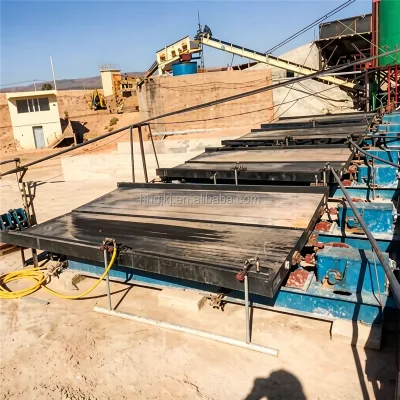


Shaker Table Gravity Separation Mining Equipment Mineral Processing Gold Shaking Table
$1000.00 - $1600.00
MOQ: 1 Pieces


Comprehensive Sourcing Guide
Gold Processing Shaking Table Sourcing Guide
Selecting the right gravity separation equipment is a critical decision for any mining operation focused on recovering fine gold and other heavy minerals. A Gold Processing Shaking Table, often referred to technically as a 6-S shaking table, relies on the principle of differential gravity separation to concentrate valuable particles from ore. Unlike flotation or cyanidation methods, this mechanical approach does not require chemical reagents, making it an environmentally friendly and cost-effective solution for small to medium-scale mining projects. Buyers must understand that while the core mechanism is consistent across suppliers, the specific deck configurations, motor specifications, and material durability vary significantly, directly impacting recovery rates and operational longevity.
The procurement process for these machines requires a disciplined approach to verifying technical claims against actual performance capabilities. Sourcing guides must emphasize that observed listing data often contains inconsistencies regarding certifications, voltage requirements, and deck separation ranges. For instance, while some listings claim universal compatibility, others specify distinct decks for coarse, fine sand, and slime particles. Buyers need to navigate these variations by focusing on verifiable specifications such as voltage, power consumption, and feeding size limits. This guide provides a structured framework for evaluating suppliers, ensuring that the selected equipment aligns with the specific mineralogical characteristics of the ore being processed.
Product Scope and Observed Listing Signals
The market for gold processing shaking tables presents a wide range of product listings, with observed prices spanning from $100 to $300,000 USD. This vast disparity often reflects differences in machine scale, material quality, and included services rather than just brand prestige. Many listings indicate a Minimum Order Quantity (MOQ) of one unit, suggesting that these machines are frequently sold as individual units for specific site requirements rather than bulk industrial installations. Buyers should interpret the lower end of the price spectrum as potentially representing smaller, bench-scale models or basic configurations, while higher price points likely correspond to larger capacity units with advanced features or comprehensive installation packages.
Listing signals also reveal significant variability in product attributes, which requires careful scrutiny during the sourcing phase. For example, while some products are described as "Energy Saving" and "New," others may list different voltage requirements or motor types. The observed data shows that some units operate on 380V with a 1.1KW AC motor, while others might have different power specifications. Additionally, the origin of these machines is predominantly listed as China, with specific mentions of Jiangxi as a production hub. Buyers must recognize that these signals are observational and not universal guarantees; a listing claiming "In Stock" delivery may not apply to all configurations, and "30 Days" delivery times are common for custom or standard export packing orders.
Technical Specifications to Verify
Verifying the deck configuration is paramount when sourcing a Gold Processing Shaking Table, as the separation efficiency depends heavily on the particle size range of the target mineral. The supplied facts indicate that these machines often feature multiple decks designed for specific separation tasks: a coarse deck for 2-0.5mm mineral particles, a fine sand deck for 0.5-0.074mm particles, and a slime deck for particles smaller than 0.074mm. Buyers must confirm which deck configuration is included in their order, as a standard unit may not be optimized for slime recovery if that is the primary goal of their operation. The feeding size is typically listed as 0-2mm, and exceeding this range can lead to equipment damage or poor separation results.
Motor and power specifications are another critical area for verification, as they determine the machine's operational stability and energy consumption. Common specifications observed include a 1.1KW motor power and a 380V voltage requirement, which are standard for many 6-S model units. However, buyers should not assume all units share these exact specs; some listings may indicate different motor types or power ratings. The weight of the unit, often cited around 1 ton, is also a key logistical factor that affects shipping costs and foundation requirements. Additionally, the beneficiation area, noted as 7.6 in some contexts, and deck dimensions, such as 1855mm, should be cross-referenced with the supplier to ensure the machine fits the available space and throughput requirements of the processing plant.
Compliance and Safety Documentation
Certification verification is a non-negotiable step in the procurement of industrial mining equipment. The observed data frequently cites CE and ISO9001 certifications, which are essential for ensuring that the machine meets international safety and quality management standards. Buyers must request valid certification documents directly from the supplier, as listing these marks on a product page does not guarantee current validity or scope. The ISO9001:2008 standard is mentioned in some listings, but buyers should verify if the supplier has upgraded to more recent versions of the standard, as this reflects their commitment to continuous quality improvement. Additionally, some listings reference SGS standards, which may indicate third-party inspection or testing, but the specific nature of this compliance should be clarified.
Safety and operational documentation must also be thoroughly reviewed before finalizing a purchase. The equipment is constructed from materials such as carbon steel, with features like oil resistance, which are important for durability in harsh mining environments. Buyers should ensure that the supplier provides comprehensive operation manuals, maintenance schedules, and safety guidelines in English. The "Standard Export Packing" or "Naked in Container" options mentioned in listings have significant implications for protection during transit; buyers must confirm that the packing method includes adequate shock absorption and weatherproofing to prevent damage to the deck and motor components. Without proper documentation and verified certifications, the risk of operational failures and safety incidents increases substantially.
Cost Drivers and Commercial Terms
The total cost of ownership for a Gold Processing Shaking Table extends beyond the initial purchase price, encompassing installation, maintenance, and energy consumption. While the observed price range is broad, the commercial terms often include a one-year warranty, which is a standard offering in this sector. Buyers should clarify what the warranty covers, particularly regarding the motor and deck surface, as these are high-wear components. The "After-Service" option of sending an engineer to the worksite for installation and guidance is a valuable feature that can reduce downtime and ensure proper setup, but it may incur additional travel and accommodation costs for the buyer.
Delivery times and payment terms are also significant cost drivers that require negotiation. Listings indicate delivery times of either "In Stock" or "30 Days," depending on the model and customization requirements. Customization is available for many units, allowing buyers to tailor the machine to specific ore characteristics, but this may extend lead times and increase costs. The packing method, whether "Standard Export Packing" or "According Your Require," can also affect shipping costs and insurance premiums. Buyers should seek clear commercial terms that define responsibilities for shipping, insurance, and customs clearance to avoid unexpected expenses upon arrival.
Supplier Qualification and Quality Control
Evaluating supplier qualification involves assessing their manufacturing capabilities and quality control processes. The fact that products originate from Jiangxi, China, a known hub for mining machinery, provides a baseline for potential supplier density, but it does not guarantee quality. Buyers should verify the supplier's production capacity, factory size, and history of exporting similar equipment. The mention of "Gandong" as a standard in some listings may refer to a specific manufacturer or brand, but buyers should not rely on this alone for quality assurance. Instead, they should request references from previous clients and, if possible, conduct virtual or physical factory audits to inspect production lines and quality control checkpoints.
Quality control should also extend to the pre-shipment testing of the equipment. Some listings mention "Testing" as a service provided, which could include factory acceptance tests to verify separation efficiency and motor performance. Buyers should insist on video evidence or third-party inspection reports before shipment. The "Visit: Welcome" attribute suggests that some suppliers are open to buyer inspections, which is a positive indicator of transparency. By prioritizing suppliers who offer robust quality control measures and are willing to undergo buyer verification, purchasers can mitigate the risk of receiving substandard equipment that fails to meet the required recovery rates for gold processing.
Long-Term Procurement Checks
Long-term procurement success depends on establishing a reliable supply chain for spare parts and ongoing technical support. The deck surface, motor, and vibration mechanisms are subject to wear and tear, and having access to genuine replacement parts is crucial for minimizing downtime. Buyers should confirm the availability and lead times for spare parts, such as deck liners and motor components, before finalizing the contract. The "1 Year" warranty is a starting point, but buyers should negotiate extended service agreements or maintenance contracts that cover post-warranty support. This ensures that the equipment remains operational and efficient throughout its lifecycle.
Continuous performance monitoring and feedback loops are also essential for long-term procurement checks. Buyers should track key performance indicators such as recovery rates, energy consumption, and maintenance frequency to evaluate the machine's performance over time. If the equipment does not meet expected benchmarks, buyers should engage with the supplier for troubleshooting and potential modifications. The "Customized" nature of many units allows for adjustments based on operational feedback, so maintaining open communication with the supplier is vital. By treating the procurement process as an ongoing partnership rather than a one-time transaction, buyers can optimize the performance and longevity of their gold processing shaking tables.
FAQs
What certifications do gold processing shaking tables have?
These machines typically carry CE and ISO9001 certifications to ensure safety and quality standards. Some models also meet SGS standards and are produced in Jiangxi, China, ensuring compliance with international requirements for mining equipment.
Can I customize the Gold Processing Shaking Table specifications?
Customization is available for many models to meet specific operational needs. Buyers can request tailored deck sizes or packing options, though some standard models like the 6-S are also offered as non-customized units for immediate delivery.
How long is the delivery time for these machines?
Delivery times vary between 30 days for custom orders and immediate availability for stock items. Buyers should verify current inventory status as some units are listed as in stock while others require standard manufacturing lead times.
What is the warranty period for the shaking table?
The standard warranty period is one year for the equipment. This coverage often includes after-sales support where engineers are sent to the worksite for installation and guidance to ensure proper operation of the machinery.
Which minerals can this gravity separator process effectively?
The separator is designed for gold, silver, tin, columbium, tantalum, titanium, iron ore, and copper. It handles various particle sizes across coarse, fine sand, and slime decks to separate metallic and non-metallic ores efficiently.
What is the power consumption of the shaking table motor?
The motor power is typically 1.1KW using an AC motor type. This energy-saving design supports efficient operation while maintaining the necessary vibration for separating mineral particles within the specified feeding size range of 0 to 2mm.