Source Hand Grip Ball for Finger Exercise, Rehabilitation, and Stress Relief
Compare 30 Hand Grip Ball listings from verified suppliers in China. Buyers can evaluate specifications like material, size, and customization options to find the right product for finger exercise or rehabilitation needs.
Key considerations
Products List
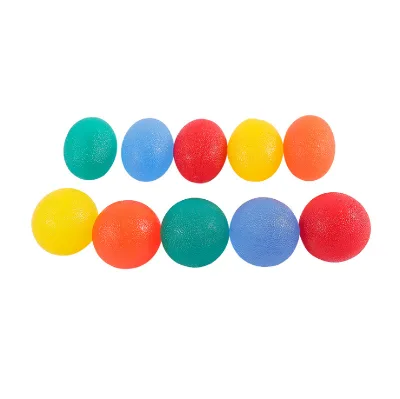


Fingers Silicone Grip The Ball Soft Therapy Exercise Grip Hand Massage Ball
$0.50 - $1.50
MOQ: 1000 Pieces


Comprehensive Sourcing Guide
Strategic Sourcing Guide for Hand Grip Ball Procurement
Understanding Product Variants and Technical Specifications
The term "Hand Grip Ball" encompasses a diverse range of products, from therapeutic exercise tools to industrial components, each requiring distinct technical verification. In the current market, buyers must distinguish between consumer-grade fitness equipment and specialized industrial rubber products. Based on available market data, specific variants exist with defined physical attributes. For instance, one category of exercise balls is characterized by a specific model number, such as HF1001, with a standardized size of 50mm. These units are often constructed from TPR (Thermoplastic Rubber) or Silicone Rubber, materials selected for their elasticity and durability. The weight of these specific exercise units typically falls within the 51-53g range, a metric critical for users requiring precise resistance levels in rehabilitation or strength training.
Conversely, the market also presents industrial-grade rubber slabs and flooring components that may be confused with grip balls due to overlapping material properties. These industrial items, sometimes associated with model GF-302, utilize raw materials like natural rubber and pads, often featuring a metal frame layer. Their specifications differ significantly, with standard diameters ranging from 55mm to 60mm or even extending to a broader spectrum of 0.5mm to 76.2mm depending on the specific application. Buyers must verify whether the product is a single-item unit or part of a bulk industrial slab system. The application field is a primary differentiator; while some products are explicitly labeled for "finger exercise," others are designated for industrial flooring, printing, or as insulating rubber slabs.
| Product Attribute | Exercise Ball Variant | Industrial Rubber Variant |
|---|---|---|
| Primary Material | TPR, Silicone Rubber | Natural Rubber, Pad, Metal Frame |
| Standard Size | 50mm, 55mm, 60mm | 0.5mm - 76.2mm, 25-125mm |
| Weight | 51-53g | Not typically specified per unit |
| Application | Finger exercise, Rehabilitation | Industrial flooring, Insulation, Printing |
| Key Features | Corrosion-resistant, Wear-resistant | Insulating, Heat-resistant, Impact-resistant |
The distinction is vital because the performance requirements for a finger exercise ball differ vastly from those of an industrial rubber component. The exercise variant focuses on color options like red, orange, yellow, green, and blue, often sold in single units or polybags. The industrial variant emphasizes features such as being cold-resistant, heat-resistant, and insulating, with packaging often involving wooden cases or cartons containing multiple pieces.
Compliance, Certification, and Quality Verification
When sourcing hand grip balls, particularly those intended for medical, therapeutic, or high-volume industrial use, verifying compliance with international standards is non-negotiable. The supply chain for these products often originates from manufacturing hubs in China, specifically regions like Hebei and Qingdao. While the origin location is a logistical fact, the quality assurance relies heavily on the certifications held by the supplier.
Buyers should look for evidence of ISO certification, specifically ISO 9001:2000, which indicates a commitment to quality management systems. Additionally, third-party testing certifications such as SGS are crucial for validating material safety and performance claims. For products claiming to be insulating or used in environments requiring specific safety standards, these certifications provide the necessary audit trail. However, it is important to note that not every listed product in a broad search will possess these credentials. The presence of a certification on a product listing should be treated as a claim that requires independent verification before contract finalization.
In the context of industrial rubber products, the HS Code (Harmonized System) serves as a critical classification tool. An HS code of 401699 indicates rubber articles, which helps in determining tariff implications and regulatory requirements for import. Buyers must ensure that the supplier's declared HS code matches the physical product to avoid customs delays or misclassification penalties. Furthermore, the "Universal" attribute found in some listings suggests compatibility with various standards, but this should be cross-referenced with the specific technical requirements of the buyer's application.
Cost Drivers and Pricing Dynamics
The pricing structure for hand grip balls is influenced by a complex interplay of material costs, customization levels, and order volume. The observed market price range is extensive, spanning from $0.06 to $1000 per unit. This wide disparity is not indicative of a single product line but rather reflects the diversity of the market, from low-cost, mass-produced exercise balls to high-value, custom-engineered industrial rubber components.
Material composition is a primary cost driver. Products made from TPR or Silicone Rubber generally have different cost structures compared to those utilizing natural rubber with metal frame layers. The inclusion of customization, such as logo printing or specific color requirements, adds to the unit cost. While some suppliers offer customization as a standard feature, the complexity of the customization dictates the final price. For instance, a simple logo print on a standard 50mm ball will cost significantly less than a custom-molded industrial slab with specific insulating properties.
Order volume also plays a pivotal role in pricing. The Minimum Order Quantity (MOQ) varies widely, ranging from as low as 1 piece to as high as 5000 pieces. Suppliers with lower MOQs often charge a premium per unit to cover setup and administrative costs. Conversely, bulk orders can leverage economies of scale, though the supply ability of the manufacturer must be sufficient to meet the demand. A supplier with a stated supply ability of 5000 pieces per week may offer more competitive pricing for large orders compared to a smaller operation.
Typical Applications and Usage Scenarios
The application of hand grip balls is highly segmented, requiring buyers to match the product to the specific use case. In the consumer and fitness sector, these balls are primarily used for finger exercise and rehabilitation. The specific weight of 51-53g and the 50mm size make them suitable for targeted hand strengthening, often used in physical therapy or by athletes looking to improve grip strength. The availability of multiple colors (red, orange, yellow, green, blue) allows for differentiation in training programs or branding.
In the industrial sector, the application shifts entirely. Products labeled as "Industrial Rubber Slab" or "Rubber Floor Covering" are designed for durability and safety in harsh environments. Their features, such as being corrosion-resistant, wear-resistant, and insulating, make them ideal for factory flooring, printing machinery bases, or areas requiring electrical insulation. The "Metal Frame Layer" in some variants suggests a structural application where load-bearing capacity is required. Buyers must carefully distinguish between a product intended for a gym and one intended for a factory floor, as the performance metrics for each are mutually exclusive.
Supplier Evaluation and Operational Logistics
Evaluating a supplier for Hand Grip Ball procurement requires a thorough assessment of their operational capabilities and logistical readiness. The "Place of Origin" is a key indicator of the manufacturing ecosystem. Suppliers located in Hebei and Qingdao, China, are common sources for these products. However, the location also dictates the logistics chain. The "Port of Dispatch" is frequently listed as Shenzhen, which is a major shipping hub. Buyers must calculate the total landed cost, including freight from the port of dispatch to their destination.
Lead times are another critical factor in supplier evaluation. The "Sample time" for these products is typically 7-10 days, which is a standard window for producing and shipping prototypes. For bulk orders, the "Delivery Time" can extend to 30 days or more, depending on the order volume and production schedule. Suppliers with a stated "Supply Ability" of 5000 pieces per week can generally accommodate larger orders more reliably than those with lower capacity.
Payment terms are another area requiring careful negotiation. The standard terms observed in the market include TT (Telegraphic Transfer) and LC (Letter of Credit). TT is generally faster and less expensive for the buyer but offers less security, while LC provides a higher level of financial protection but involves banking fees and longer processing times. The "Packing Details" also vary, with options ranging from simple polybags to robust cartons or wooden cases. For industrial components, wooden cases are often necessary to prevent damage during transit, whereas exercise balls may only require polybagging.
Quality Control and Long-Term Procurement Considerations
Implementing a robust quality control (QC) strategy is essential for mitigating risks in Hand Grip Ball procurement. Given the variation in materials and specifications, buyers should not assume that all products listed under a single category meet the same quality standards. The "Feature" list, which includes attributes like heat-resistant and impact-resistant, should be verified through sample testing before placing a bulk order. For industrial applications, verifying the "Insulating" properties is critical to ensure safety compliance.
Long-term procurement considerations involve establishing a reliable supply chain that can adapt to changing demands. The "Customization" attribute is a significant factor here. Suppliers that offer logo printing and custom sizes provide greater flexibility for branding and specific application needs. However, customization can introduce variability in production quality. Buyers should establish clear quality benchmarks for customized items, ensuring that the "Logo" placement and "Size" accuracy remain consistent across batches.
The "Standard Parts" attribute, where applicable, suggests that some products adhere to established dimensional standards, which can simplify integration into existing systems. However, for custom items, the lack of standardization requires more rigorous inspection protocols. Buyers should also consider the "Packaging" consistency, as damaged goods upon arrival can disrupt operations. Ensuring that the supplier uses appropriate packaging, such as cartons for exercise balls or wooden cases for industrial slabs, is a key part of the long-term strategy.
Finally, the "Selling Units" and "MOQ" constraints must be aligned with the buyer's inventory strategy. A supplier offering a low MOQ of 1 piece allows for testing and small-batch procurement, which is useful for startups or R&D. However, for established operations, negotiating a higher MOQ to secure better pricing and consistent supply is often necessary. The "Universal" attribute, if present, can be a valuable indicator of compatibility, but it should be validated against the specific technical requirements of the buyer's application to ensure it does not lead to integration issues. By systematically addressing these factors, buyers can navigate the complex landscape of Hand Grip Ball procurement with confidence and precision.
FAQs
What materials are used for hand grip balls?
Hand grip balls are typically made from TPR or Silicone Rubber. Some industrial variants use Natural Rubber with a metal frame layer. Buyers must verify the specific material listed for their intended application.
Which certifications should I look for in suppliers?
Look for ISO 9001:2000 and SGS certifications. These indicate quality management and material safety. Not every product listing includes these credentials, so verification is essential before finalizing contracts.
How long does it take to receive samples?
Sample time is typically 7 to 10 days. This standard window applies to producing and shipping prototypes. Bulk order delivery times may extend to 30 days depending on volume and production schedules.
Can I customize the logo and size?
Customization is available for logos and specific sizes. Buyers can request custom dimensions like 55mm or 60mm. However, customization complexity will influence the final unit cost and production timeline.
What is the minimum order quantity for these balls?
The minimum order quantity ranges from 1 to 5000 pieces. Specific products like the HF1001 model may require 1000 pieces. Lower MOQs often carry a higher per-unit cost to cover setup fees.
Where are these products typically manufactured?
Products originate from manufacturing hubs in Hebei and Qingdao, China. The port of dispatch is frequently Shenzhen. Buyers should factor in logistics costs from these specific locations when calculating total landed costs.