Source Industrial Steel Wine Cabinet with Key Lock for Bars, Hotels, and Estates
Compare 30 listings for an Industrial Steel Wine Cabinet with Key Lock designed for secure storage in bars, hotels, and private estates. Buyers can evaluate customization options, dimensions, and certifications like ISO9001 and SGS to find the right fit.
Key considerations
Products List

Industrial Style Metal Wine Storage Rack Cabinet Custom Size Stainless Steel Wine Cabinet
$1000.00 - $2000.00
MOQ: 1 Pieces


Modern Custom Wine Display Rack Cabinet Metal Wine Rack Stainless Steel Wine Cabinet
$1000.00 - $2000.00
MOQ: 1 Pieces


Vintage Industrial Wine Cabinet for Luxurious Loft Living
$50.00 - $80.00
MOQ: 1 square feet
Guangdong Wine Decoration Warehouse Cellar Engineering Co., Ltd.

Luxury Bronze Steel Wine Cabinet with Multi-Zone Temperature Control
$399.00 - $599.00
MOQ: 2 square feet
Guangdong Wine Decoration Warehouse Cellar Engineering Co., Ltd.


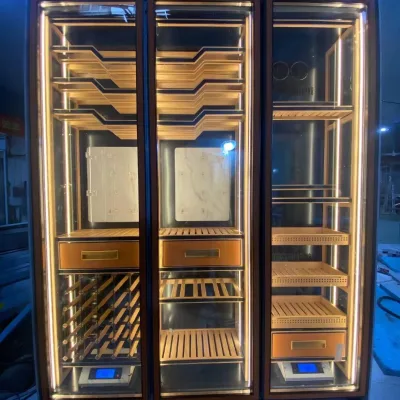


$90.00 - $100.00
MOQ: 1 Square Meters


Comprehensive Sourcing Guide
Strategic Sourcing Guide for Industrial Steel Wine Cabinets with Key Locks
Understanding Product Specifications and Material Integrity
When sourcing industrial steel wine cabinets with key locks, the primary objective is to identify units that balance structural durability with precise environmental control. The core material specification for these units is consistently stainless steel, a choice driven by the need for corrosion resistance in humid cellar environments and the requirement for a robust, tamper-resistant structure. The observed product attributes indicate that these cabinets often feature a "Combined Type" structure, suggesting a modular design that may integrate locking mechanisms with storage compartments.
The physical dimensions of these units vary significantly based on the intended application and storage capacity. Buyers must verify specific size parameters, as the market offers a range of configurations. For instance, some industrial models are specified with dimensions around H1025mm x W900mm x D400mm, while larger commercial units may reach H1850mm in height with widths varying between 700mm and 780mm. The depth of approximately 390mm to 400mm is critical for accommodating standard wine bottle racks.
A critical technical specification to evaluate is the door panel thickness. In high-quality steel or hybrid units, the door panel thickness is often standardized at 18 mm or 21 mm. This thickness ensures that the cabinet can withstand the weight of a full load of bottles without sagging and provides sufficient mass for the locking mechanism to function securely. The "Key Lockers" open type attribute confirms that the primary security feature is a mechanical key lock, which is essential for industrial settings where access control is mandatory. Additionally, the "Double Doors" configuration is common, offering a wider opening for loading and unloading while maintaining a compact footprint.
Compliance, Certification, and Regulatory Standards
In the B2B procurement of industrial storage solutions, verifying compliance with international standards is non-negotiable. The supply chain for these units often involves manufacturers holding multiple certifications that validate their quality management systems and safety protocols. Buyers should expect to see evidence of ISO 9001, which certifies quality management, and ISO 14001, which addresses environmental management. Furthermore, ISO 45001 certification indicates adherence to occupational health and safety standards, a crucial factor for industrial suppliers.
Beyond general management systems, product-specific certifications are vital. The market data indicates the presence of CE and EU certifications, which are mandatory for products entering the European market. These certifications ensure that the electrical components (if the unit includes cooling features) and the mechanical structures meet European safety directives. Additionally, certifications such as SGS and Bci (British Columbia Institute) suggest third-party verification of material quality and manufacturing processes.
For units incorporating cooling or temperature control features, RoHS compliance is often observed. This certification ensures that the product does not contain hazardous substances, aligning with global environmental regulations. The presence of a "Design Patent" is another significant indicator of innovation, suggesting that the locking mechanism or the internal shelving design is protected intellectual property, which can be a proxy for unique engineering solutions. Buyers must request valid certificates for these standards before finalizing any order, as the absence of these documents may indicate a non-compliant product.
Cost Drivers and Pricing Dynamics
The pricing structure for industrial steel wine cabinets with key locks is influenced by a complex interplay of material costs, customization levels, and logistical factors. The observed price range in the market spans from approximately $3.67 to $2,000. This wide variance is not indicative of a single product type but rather reflects the spectrum from basic, non-customized units to fully integrated, temperature-controlled industrial systems.
The primary cost driver is the degree of customization. Products labeled as "Customized" or "Custumized" (noting the specific attribute spelling in the data) often command higher prices due to the engineering and tooling required for bespoke dimensions, colors, or locking mechanisms. The "Customized Color" attribute allows for branding alignment, which adds value but also increases production complexity. Similarly, the "Customized Specification" standard implies that the buyer is paying for a tailored solution rather than an off-the-shelf item.
Material composition significantly impacts the final cost. While stainless steel is the dominant material for the industrial sector, some listings reference wood or MDF (Medium Density Fiberboard) panels, particularly in hybrid designs where the aesthetic appeal of wood is combined with the structural integrity of steel. The "Solid Wood" and "MDF" attributes suggest that some units may use these materials for interior shelving or exterior cladding, which can lower the cost compared to all-steel construction but may reduce durability in high-humidity environments.
The Minimum Order Quantity (MOQ) is another critical cost factor. The observed MOQ ranges from 1 to 300 units, with a specific high-confidence fact indicating an MOQ of 100 PCS for certain models. Ordering at or above this threshold often secures a lower unit price. Conversely, buyers requiring smaller quantities may face higher per-unit costs or may need to source from suppliers with a lower MOQ threshold, which could affect the overall budget. Packaging costs, ranging from "Wooden Box" to "Mail Package" or "Carton/Pallet," also contribute to the final landed cost, especially for heavy units weighing up to 45 Kg.
Typical Applications and Functional Requirements
Industrial steel wine cabinets with key locks serve diverse applications ranging from commercial hospitality to private residential collections. The "General Use" attribute of "Home Furniture" indicates that these units are versatile enough for high-end residential installations. However, the "Industrial" nature of the keyword implies a broader utility in commercial settings.
In the hospitality sector, such as hotels, restaurants, and bars, these cabinets are used for secure storage of premium wines. The "Key Lockers" feature ensures that expensive inventory is protected from theft or unauthorized access. The "Combined Type" structure allows for the integration of display areas and secure storage, catering to the dual need of showcasing products while maintaining security.
For private collectors, the "Cellar" and "Cold Storage" attributes highlight the unit's ability to function as a specialized wine cooler. The "Double-temperature" feature is particularly relevant for these applications, allowing for the simultaneous storage of different wine types at their optimal temperatures. The "Coolingdisplaystorage" feature confirms that these units are not merely storage boxes but active environmental control systems.
The "Practical" and "Artistic" design attributes suggest that buyers can choose between purely functional units for back-of-house storage or aesthetically driven units for front-of-house display. The "CAD/3D" design capability mentioned in the attributes indicates that suppliers can provide custom visualizations, which is invaluable for architects and interior designers planning large-scale installations. Whether the application is a corporate wine room, a retail display, or a private cellar, the key lock mechanism remains a constant requirement for security.
Supplier Evaluation and Manufacturing Capabilities
Selecting the right supplier requires a rigorous evaluation of their manufacturing capabilities and service offerings. The geographic origin of these products is primarily China, with specific hubs in Foshan, Guangdong, and Henan. Foshan is a well-known manufacturing center for furniture and metalwork, suggesting a high concentration of suppliers with relevant expertise.
Buyers should prioritize suppliers that offer both OEM (Original Equipment Manufacturer) and ODM (Original Design Manufacturer) services. These service attributes indicate that the supplier is flexible enough to produce units based on the buyer's specifications or to offer their own proprietary designs for customization. The "Our Service: OEM; ODM" attribute is a strong indicator of a supplier's ability to adapt to specific client needs.
The production process should be transparent. Suppliers should be able to demonstrate their ability to handle "Customized" specifications, including the "Customized Specification" standard and "Customized Color" options. The presence of a "Design Patent" suggests that the supplier invests in R&D, which is a positive signal for long-term product viability.
When evaluating suppliers, buyers must also consider the "Condition" of the product, which is listed as "New." This confirms that the units are manufactured to current standards and are not refurbished or second-hand. The "Weight" of 45 Kg for certain models provides a baseline for logistics planning; buyers must ensure their shipping partners can handle this weight class. Additionally, the "Place of Origin" and "prod_origin" details help in assessing the supply chain's resilience and the potential for trade tariffs or logistics delays.
Quality Control and Long-Term Procurement Considerations
Ensuring the long-term reliability of industrial steel wine cabinets requires a robust quality control (QC) strategy. The "Thickness of Door Panel" at 18 mm or 21 mm is a key metric for QC inspections. Buyers should verify that the actual thickness matches the specification, as deviations can compromise the structural integrity and the security of the lock.
The "Structure: Combined Type" implies that the assembly of different components must be precise. Quality checks should focus on the alignment of the doors, the smoothness of the locking mechanism, and the stability of the internal shelving. The "Key Lockers" feature must be tested for durability and ease of use. In industrial settings, frequent locking and unlocking can lead to wear; therefore, the quality of the lock hardware is paramount.
For units with cooling features, the "Temperature Type: Double-temperature" and "Power Source: Electricity" attributes necessitate electrical safety checks. Buyers should verify that the cooling systems operate within the specified temperature ranges and that the electrical components comply with the CE and RoHS certifications. The "Function: Cold Storage" claim must be validated through performance testing to ensure the unit can maintain the required temperature under various load conditions.
Long-term procurement considerations also involve the "prod_packing" method. Whether the unit is shipped in a "Wooden Box," "Mail Package," or "Carton/Pallet," the packaging must be sufficient to protect the product during transit. Given the weight of up to 45 Kg, improper packaging can lead to damage, resulting in costly replacements and delays.
Finally, buyers should consider the "Lead Time" and "MOQ" in their procurement planning. While specific lead times are not provided in the data, the MOQ of 100 PCS for certain models suggests that buyers should plan for bulk orders to optimize costs. However, for smaller projects, the availability of suppliers with an MOQ of 1 allows for flexibility. Establishing a long-term relationship with a supplier who can consistently deliver "New" condition units with the required certifications will ensure a steady supply of high-quality wine cabinets for industrial applications.
FAQs
Can I get a customized Industrial Steel Wine Cabinet with Key Lock?
Yes, customization is available for these units with options for custom colors and specifications. Buyers can request tailored dimensions like H1025mm or H1850mm heights and specific door configurations to match their cellar needs.
What certifications do these industrial steel wine cabinets typically have?
These units often carry ISO 9001, ISO 14001, and ISO 45001 certifications for quality and safety. Additional certifications like CE, RoHS, SGS, and Design Patents may also be present to ensure compliance with international standards.
Which material is used for the door panels of these cabinets?
The door panel thickness is commonly 18 mm or 21 mm for structural integrity. While stainless steel is the primary material, some models may incorporate wood or MDF panels for aesthetic appeal in hybrid designs.
How does the minimum order quantity affect pricing for these cabinets?
The minimum order quantity typically starts at 100 pieces for standard models. Ordering at or above this threshold often secures a lower unit price compared to smaller orders that may face higher per-unit costs.
What is the typical weight and packaging for these industrial units?
These cabinets can weigh up to 45 kg and are shipped in wooden boxes, cartons, or on pallets. The packaging method depends on the specific model and shipping requirements to ensure safe transit of the heavy unit.
Can these cabinets function as cold storage for wine cellars?
Yes, some models feature double-temperature control and electricity power sources for cold storage functions. These units are designed for cellar use with cooling and display capabilities to maintain optimal wine conditions.
Where are the manufacturers of these steel wine cabinets located?
Manufacturers are primarily located in Foshan, Guangdong, and Henan, China. These regions are known hubs for furniture and metalwork production, offering a concentration of suppliers with relevant manufacturing expertise.