Source Manual Sausage Stuffer for Home, Commercial, and Catering Use
Explore 30 listings for Manual Sausage Stuffer options including stainless steel models with varying capacities from 3L to 15L. Buyers can compare specifications, dimensions, and packaging details to find suitable equipment for home, commercial, or catering applications.
Key considerations
Products List


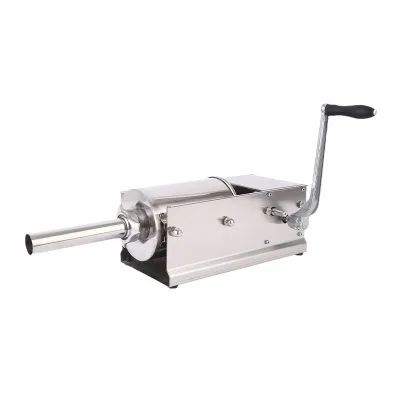
3L 5L 7L Commercial Widely Use Manual 2 Speed Horizontal Stainless Steel Sausage Stuffer
$86.51 - $106.87
MOQ: 1 Minimum

Stainless Steel Manual Sausage Making Machine Sausage Stuffer for Making Sausages
$85.00 - $90.00
MOQ: 50 Pieces


Premium High Quality Sausage Stuffer Machine for Efficient Meat Processing
$77.00 - $90.00
MOQ: 1 Pieces

Comprehensive Sourcing Guide
Strategic Sourcing Guide for Manual Sausage Stuffers
Understanding Manual Operation and Material Standards
The procurement of a Manual Sausage Stuffer requires a distinct shift in evaluation criteria compared to automated industrial equipment. The defining characteristic of this category is the "Manual" automatic grade, indicating that the device relies on human power to drive the piston or plunger rather than electric motors or hydraulic systems. This operational mode is critical for buyers seeking equipment that offers portability, independence from power grids, and a tactile connection to the production process. The primary construction material observed across the current market offerings is Stainless Steel. This material choice is non-negotiable for food-grade applications, as it ensures resistance to corrosion, ease of cleaning, and compliance with hygiene standards.
When evaluating the physical build, buyers must look beyond the general claim of stainless steel to verify the specific grade and finish. The texture of the equipment is often described as "All Stainless Steel," suggesting that the hopper, barrel, piston, and casing tubes are constructed from this durable alloy. This uniformity prevents cross-contamination and simplifies sanitation protocols. The absence of electrical components in the core mechanism reduces the risk of motor failure and eliminates the need for complex maintenance schedules associated with powered machinery. However, the manual nature of the operation introduces a variable in production speed that must be factored into the procurement strategy. Buyers should anticipate that output rates will be directly proportional to the operator's physical endurance and the mechanical advantage provided by the lever or screw mechanism.
Technical Specifications and Dimensional Variability
A comprehensive review of available inventory reveals significant variance in technical specifications, particularly regarding capacity and physical dimensions. The product models currently listed range from 3-liter units to heavy-duty 15-liter capacity models. For instance, the 3L model features a compact size of 310310530mm, while the 5L model (HR-5L) increases in height to 650mm with a standard footprint of 313165cm. The 7L variant (HR-7L) further extends to 775mm in height, maintaining a similar base footprint. The largest unit, the 15L model (ADL-KD15), presents a wider profile at 410310770mm, reflecting the increased volume required for high-capacity stuffing.
These dimensional differences directly impact the logistical planning for both storage and transportation. The packing dimensions vary significantly, with the 3L model requiring a packing box of 845370370mm, whereas the 15L model requires a more substantial 885500400mm package. Weight is another critical specification; the net weight (N.W) ranges from 9.8kg for the smallest unit to 43kg for the 15L capacity model. The gross weight (G.W) follows a similar trend, starting at 11.5kg and reaching 51kg for the largest unit. These figures are essential for calculating shipping costs and determining the structural requirements of warehouse shelving or transport vehicles.
| Product Model | Capacity | Product Size (mm) | Packing Size (mm) | Net Weight (kg) | Gross Weight (kg) |
|---|---|---|---|---|---|
| 3L | 3 Liters | 310310530 | 845370370 | 9.8 | 11.5 |
| HR-5L | 5 Liters | 310310650 | 690360370 | 10.9 | 12.5 |
| HR-7L | 7 Liters | 310310775 | 845370370 | 12.3 | 14.0 |
| HR-15L | 15 Liters | 410310770 | 885500400 | 22.0 | 26.0 |
| ADL-KD15 | 15 Liters | 410310770 | 885500400 | 43.0 | 51.0 |
It is important to note that while some models share the same capacity rating, their physical dimensions and weights differ, suggesting variations in wall thickness, internal design, or the inclusion of additional accessories. Buyers must verify the specific dimensions of the unit they intend to purchase against their available floor space and loading dock constraints.
Compliance, Certification, and Safety Verification
In the realm of food processing equipment, regulatory compliance is a paramount concern. The observed product listings indicate that many units carry CCC and CE certifications. The CE mark signifies conformity with health, safety, and environmental protection standards for products sold within the European Economic Area, while CCC (China Compulsory Certification) is a mandatory standard for products sold in the People's Republic of China. These certifications suggest that the manufacturing processes adhere to specific quality and safety benchmarks.
However, buyers must exercise due diligence. The presence of a certification label on a product page does not guarantee that every unit in a specific batch meets the standard, nor does it automatically extend to the specific model being ordered. Procurement teams should request valid, up-to-date certification documents directly from the supplier before finalizing an order. Furthermore, the "Manual" classification implies that the equipment does not require electrical safety certifications for the motor itself, but the structural integrity and material safety must still be verified. The "1 Year Guarantee" listed as a warranty term provides a baseline for after-sales support, but buyers should clarify the scope of this guarantee, including whether it covers manufacturing defects, wear and tear, or specific components like seals and gaskets.
Cost Drivers and Minimum Order Quantities
The pricing landscape for manual sausage stuffers is influenced by several key factors, including capacity, material quality, and customization options. The observed price range spans from 1 USD to 6000 USD, a wide disparity that reflects the difference between basic entry-level models and heavy-duty commercial units. The primary cost driver is the capacity of the unit; larger barrels require more stainless steel and more robust structural supports, directly increasing the material and manufacturing costs.
Minimum Order Quantity (MOQ) is another significant variable in the procurement equation. The data indicates a flexible MOQ structure, with some models available for as few as 10 pieces, while others require a minimum of 50 pieces. This variability allows buyers to tailor their orders based on their scale of operation. Small-scale artisans or test batches may benefit from the lower MOQ options, whereas larger commercial operations might leverage the higher MOQ thresholds to negotiate better unit economics.
Customization is a notable feature in this category. While some models are listed as "Customized" with customization available, others are marked as "Non-Customized." Buyers seeking specific branding, unique color finishes, or modified dimensions should prioritize suppliers who explicitly offer customization services. However, it is crucial to understand that customization often impacts lead times and unit costs. The standard packaging, which includes honeycomb boxes or cartons, is designed to protect the equipment during transit, but buyers with specific packaging requirements should discuss these needs early in the negotiation process.
Typical Applications and Operational Context
Manual sausage stuffers are ideally suited for applications where precision, control, and small-to-medium batch production are prioritized over high-speed throughput. These units are commonly found in artisanal butcher shops, small-scale charcuterie producers, and home-based food businesses. The manual operation allows the operator to feel the resistance of the meat mixture, enabling them to adjust the stuffing pressure to prevent air pockets or casing bursts. This tactile feedback is often impossible to replicate with automated systems, making manual stuffers the preferred choice for high-end, specialty products.
The 3L to 7L range is particularly effective for small-batch production, allowing for quick turnaround times between batches without the need for extensive cleaning or setup. The 15L models, while still manual, are designed for higher volume output, suitable for medium-sized operations that require efficiency without the capital expenditure of electric machinery. The portability of these units, facilitated by their relatively low weight (even the 15L model at 43kg is manageable with proper handling equipment), makes them versatile for use in different locations, such as mobile food stalls or temporary event setups.
Supplier Evaluation and Quality Control Protocols
When evaluating potential suppliers, buyers should focus on the origin and manufacturing standards. The product listings indicate origins in Zhejiang, China, a region known for its manufacturing capabilities. However, the location alone does not guarantee quality. Buyers must verify the supplier's track record, specifically their experience with food-grade stainless steel equipment. The "1 Year Guarantee" is a starting point, but a robust supplier will offer comprehensive support, including spare parts availability and technical assistance.
Quality control should be a central component of the procurement strategy. Buyers should request detailed inspection reports that verify the material grade of the stainless steel used. The "All Stainless Steel" texture claim should be backed by mill certificates or third-party testing results. Additionally, the packing specifications, such as the use of honeycomb boxes or cartons, should be inspected to ensure they provide adequate protection against damage during shipping. The dimensions of the packing must align with the product dimensions to prevent over-packing or under-packing, which can lead to product damage or increased shipping costs.
Long-Term Procurement and Maintenance Considerations
Long-term procurement planning for manual sausage stuffers involves considering the lifecycle of the equipment and the availability of replacement parts. The stainless steel construction ensures a long service life, but the mechanical components, such as the piston seals and casing tubes, are subject to wear and tear. Buyers should inquire about the availability of these consumable parts and the cost of replacement. The "1 Year Guarantee" typically covers manufacturing defects, but regular maintenance is required to keep the equipment in optimal condition.
The manual nature of the operation also means that the equipment is less prone to complex electronic failures, which can reduce downtime and maintenance costs. However, the physical effort required for operation may lead to operator fatigue, which could impact productivity over long shifts. Buyers should consider ergonomic factors and the potential need for operator training to maximize efficiency. Finally, the flexibility of the MOQ and customization options allows for scalable procurement strategies, enabling businesses to start small and expand their inventory as demand grows without being locked into large initial commitments.
FAQs
What is the Automatic Grade of these manual sausage stuffers?
The automatic grade is Manual, meaning the device relies on human power rather than electric motors. This operational mode ensures portability and independence from power grids while requiring direct physical effort from the operator.
Which materials are used to construct the sausage stuffer barrels?
The primary construction material is Stainless Steel, often described as All Stainless Steel texture. This ensures resistance to corrosion, ease of cleaning, and compliance with food-grade hygiene standards for all major components.
What certifications do the listed products typically carry?
Many units carry CCC and CE certifications, indicating conformity with safety and environmental standards. Buyers should request valid documents directly from the supplier to verify that specific batches meet these benchmarks before ordering.
How does the capacity range vary across the available models?
Models range from 3 liters to 15 liters, with specific variants like HR-5L and HR-7L available. Larger capacities like the 15L ADL-KD15 require more robust structural supports and heavier stainless steel construction.
Can buyers request customized packaging or product dimensions?
Customization is available for some models, while others are listed as Non-Customized. Buyers seeking specific branding or modified dimensions should prioritize suppliers who explicitly offer these services, noting that this may impact lead times.
What is the Minimum Order Quantity for these manual units?
The MOQ varies significantly, with some models requiring as few as 10 pieces and others needing 50 pieces. This flexibility allows small-scale artisans to order in smaller batches while larger operations can leverage higher thresholds.
What warranty coverage is provided for the equipment?
A 1 Year Guarantee is listed as the standard warranty term for these units. Buyers should clarify if this covers manufacturing defects, wear and tear, or specific components like seals and gaskets before finalizing the purchase.