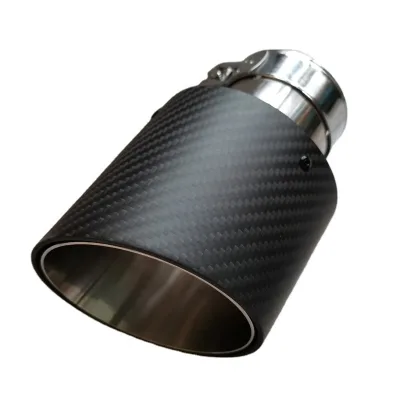
Source Matte Carbon Fiber Exhaust Tip for Cars, Trucks, SUVs
Find 30 listings for Matte Carbon Fiber Exhaust Tip options from verified factories. Compare specifications like material, size, and delivery times to select the right component for your vehicle needs.
Key considerations
Products List

Cars Available Single or Dual Exit Customizable Matte Carbon Fiber Exhaust Tips
$6.99 - $59.90
MOQ: 1000 Pieces


High Quality Exhaust Tail Pipe Black Automobile Carbon Fiber Exhaust Tip
$3.99 - $10.99
MOQ: 10 Pieces


Matte Carbon Fiber M Performance Exhaust Tail Pipe Muffler Tip for Cars
$29.90 - $50.90
MOQ: 50 Pieces




Comprehensive Sourcing Guide
Strategic Sourcing Guide for Matte Carbon Fiber Exhaust Tips
Technical Specifications and Material Composition
When sourcing matte carbon fiber exhaust tips, buyers must first establish a clear understanding of the underlying material science and physical specifications that define product performance. The core material for these components is typically identified as polyacrylonitrile-based carbon fiber, which provides the structural integrity required for high-temperature exhaust environments. In the observed market data, the raw materials are explicitly noted as polyacrylonitrile-based carbon fiber, often combined with stainless steel for the main body to ensure durability and heat resistance. The mechanical properties of these components are categorized as high-performance type, with specific emphasis on high modulus characteristics that resist deformation under thermal stress.
The physical form of the product is a critical differentiator. Listings indicate the shape is a carbon fiber tube, often designed as a chopped fiber state to optimize the weave pattern for a matte finish. The dimensions are rarely standard; instead, the specification for length and size is frequently customized to fit specific vehicle chassis configurations. Buyers should verify that the supplier offers "Customized" specifications for length and size, as the "Customzied" attribute appears consistently in product data. Furthermore, the installation type is a vital technical parameter. The market data distinguishes between "Bolt-on" and "Clamp-on" installation methods, meaning the procurement strategy must align with the vehicle's existing mounting points. The product model identifiers, such as GLL3, GLL 17, or generic "exhaust muffler" and "Exhaust Tips" designations, serve as reference points but should not be assumed to be universal across all suppliers without verification.
Compliance, Certification, and Regulatory Standards
Navigating the regulatory landscape is essential for international procurement, particularly when targeting markets in Europe, North America, and the Middle East. The observed product data highlights several certification attributes that buyers must validate. The primary certifications noted include ISOCE, RoHS, and ISOTS. It is crucial to understand that these certifications often apply to specific components like the exhaust tail pipe or the exhaust pipe assembly rather than the entire vehicle system. The discharge standard is explicitly listed as Euro III in some contexts, which serves as a baseline for emissions compliance in certain regions, though buyers must confirm if this aligns with current local regulations.
The certification status is not a blanket guarantee for every listed product. The data shows variations where "ISOCE,RoHS" are listed alongside "ISOTSComponent:Exhaust Tail Pipe," suggesting that certification may be tied to specific sub-components or manufacturing batches. Buyers should not assume that a matte carbon fiber tip automatically meets Euro III or higher standards without requesting current test reports. The "prod_standard" is also listed as "Customized" or "Stainless Steel," indicating that the material standard itself may vary by order. When evaluating compliance, the buyer must verify that the "ISOTS" certification covers the specific manufacturing facility and that the "RoHS" compliance extends to any adhesives or coatings used in the matte finish process. The origin of the products is consistently noted as China, specifically Zhejiang, China (Mainland), which requires buyers to ensure that the supplier's export documentation accurately reflects these origins for customs clearance.
Cost Drivers and Pricing Dynamics
The pricing structure for matte carbon fiber exhaust tips is influenced by a complex interplay of material costs, customization levels, and order volume. The observed listed price range in the market data spans from 3.3 to 69.99 USD, a significant variance that reflects differences in material quality, finish complexity, and order quantity. The lower end of this spectrum likely corresponds to standard sizes or simpler manufacturing processes, while the higher end may reflect custom-molded tips with high-modulus carbon fiber and premium matte finishes.
A primary cost driver is the "Customization" attribute. Products with customized lengths, sizes, and logos incur higher unit costs due to the setup time and specialized tooling required. The "MOQ" (Minimum Order Quantity) is another critical factor; while some listings state "No Special Requirement," others show an observed MOQ range of 1 to 1000 units. Buyers purchasing small quantities may face higher per-unit costs, whereas bulk orders can leverage economies of scale to reduce the price. Additionally, the "Material of Main Body" being stainless steel adds a layer of cost compared to purely carbon fiber constructions, as it requires welding and finishing processes. The "Delivery" lead time, ranging from 10-15 days to 15-30 days after receiving a deposit, also impacts the total cost of ownership, as expedited shipping options or longer production cycles can affect cash flow and inventory planning. Buyers should request detailed quotes that break down material costs, tooling fees, and shipping expenses to understand the true cost drivers.
Typical Applications and Market Segmentation
The application of matte carbon fiber exhaust tips extends across various automotive sectors, driven by the demand for aesthetic enhancement and performance signaling. The "Main Market" data indicates a strong presence in Europe, North America, and the Middle East, with a specific mention of the "All Over World" market. The product is designed for both "OEM" (Original Equipment Manufacturer) and "After Market" applications, meaning it serves both vehicle manufacturers and individual car enthusiasts. The "Component" is identified as an "Exhaust Tail Pipe" or "Exhaust Pipe," and the "Product Name" often includes descriptors like "Matte Black Carbon Fiber M Performance Exhaust Tai," suggesting a focus on performance-oriented vehicle segments.
The noise characteristics of these components are also relevant to their application. The "Noise Source" is attributed to the "Noise of Engine," specifically categorized as "Mechanical Noise" and "Transmission Noise." This indicates that the exhaust tip is part of a system designed to manage engine acoustics. The "Automobile Chassis Noise" is noted as "Transmission Noise," implying that the exhaust system interacts with the broader vehicle dynamics. For buyers targeting the "After Market," the "Installation Type" (Bolt-on or Clamp-on) is a decisive factor, as it determines the ease of retrofitting on existing vehicles. The "Logo" acceptance for customization allows brands and dealers to offer branded products, enhancing the value proposition for end-users seeking personalized automotive accessories.
Supplier Evaluation and Operational Capabilities
Selecting the right supplier requires a rigorous evaluation of their operational capabilities and business structure. The data indicates that suppliers can be classified as either a "Factory" or a "Trading Company," with the observed data explicitly listing "Factory" as a status. This distinction is vital, as factories typically offer more direct control over the production process, material sourcing, and quality assurance compared to trading companies. The "Employee" count is noted as "More Than 200," suggesting a substantial manufacturing capacity that can handle larger orders and complex customization requests.
The "Shipping" logistics are another key evaluation point. Suppliers offer delivery via "Express," "Air," or "Sea," providing flexibility based on the urgency and volume of the order. The "prod_packing" is described as "Carton Box or Wooden Cases" or "Normal Export Packing," which is essential for protecting the fragile carbon fiber components during transit. Buyers should verify the supplier's ability to handle "Customized Logo" requests and ensure that the "Delivery" lead time of 2~5 weeks or 10-30 days aligns with their inventory needs. The "Factory or Trading Company" status should be confirmed through site audits or third-party verification to ensure the claimed manufacturing capacity is accurate. Additionally, the "prod_origin" being Zhejiang, China (Mainland) requires buyers to assess the local infrastructure and logistics networks that support export operations.
Quality Control and Long-Term Procurement Considerations
Ensuring consistent quality in matte carbon fiber exhaust tips requires a robust quality control framework and a long-term procurement strategy. The "Mechanical Property" is listed as "High-Performance Type," and the "Performance" is noted as "High Modulus Type," but these are observations that must be validated through independent testing. Buyers should request detailed test results regarding thermal resistance, tensile strength, and finish durability to ensure the product meets the "High-Performance" claims. The "State" of the fiber is described as "Chopped Fiber," which may affect the visual texture and structural consistency; therefore, visual inspection protocols are necessary to ensure the matte finish is uniform and free from defects.
Long-term procurement considerations include the stability of the supply chain and the ability to scale production. The "Delivery Time" variability, ranging from 10-15 days to 15-30 days after deposit, highlights the need for flexible inventory management. Buyers should establish clear communication channels with the supplier to manage lead times and mitigate potential delays. The "Customized" nature of the "prod_standard" and "Size" means that any changes in vehicle models or design requirements will necessitate re-tooling, which can impact future costs and timelines. To mitigate these risks, buyers should develop a multi-tiered supplier strategy, maintaining relationships with multiple factories to ensure continuity of supply. Finally, the "OE No." is listed as "Performance," which suggests that the product is designed to meet or exceed original equipment standards, but buyers must verify this claim against specific vehicle requirements to ensure compatibility and safety.
FAQs
What materials are used for matte carbon fiber exhaust tips?
The main body is typically stainless steel combined with polyacrylonitrile-based carbon fiber. This composition ensures high heat resistance and structural integrity for high-performance applications while maintaining the desired matte aesthetic finish.
Can buyers request customized sizes and logos for these tips?
Yes, customization is available for length, size, and logos. Buyers can specify unique dimensions to fit vehicle chassis and add their own branding, though this may affect lead times and minimum order requirements.
Which certifications do these exhaust components typically hold?
Products often carry ISOCE, RoHS, and ISOTS certifications. These standards apply to specific components like the exhaust tail pipe or pipe assembly, ensuring compliance with safety and environmental regulations for international markets.
How long is the delivery time for custom orders?
Delivery typically takes 10 to 30 days after receiving the deposit. Some orders may require 2 to 5 weeks depending on the level of customization and current production capacity at the factory in Zhejiang, China.
What installation types are available for these exhaust tips?
Installation options include bolt-on and clamp-on methods. Buyers should verify the specific mounting requirements of their vehicle to ensure compatibility with the chosen installation type for a secure and proper fit.
What is the minimum order quantity for these products?
There is no special requirement for minimum order quantity in some listings, while others range from 1 to 1000 units. The specific MOQ depends on the supplier and the level of customization requested for the order.
Which markets are the primary destinations for these exhaust tips?
The main markets include Europe, North America, and the Middle East. Products are also available for the global market, serving both OEM and aftermarket segments with a focus on high-performance vehicle applications.