Source Modern Solar System Space Capsule for Villa Hotel Apartment
Find and compare 30 Modern Solar System Space Capsule units designed for villas, hotels, and apartments. These steel structure homes offer fast installation, wind resistance, and customizable features with CE and ISO certifications for diverse applications.
Key considerations
Products List

Capsule Cabin Modern Capsule House Capsule Prefabricated Houses Capsule House Space Capsule
$30000.00 - $36000.00
MOQ: 1 Pieces

Modern Space Capsule Prefab Capsule House Modular Space Capsule House Vessel House
$30000.00 - $36000.00
MOQ: 1 Pieces


Modern Eco-Friendly Space Capsule House with Solar Panels for Travel Living
$26500.00 - $36000.00
MOQ: 1 Pieces

High Technology Solar Panels Space Capsule House with Hotel Living for Travel
$19500.00 - $23500.00
MOQ: 1 Pieces


Prefab House Space Capsule Capsule House Space Modular Space Capsule
$13400.00 - $35000.00
MOQ: 1 Sets


Modern Luxurious Space Capsule with Intelligent Control System Camping Capsule
$11000.00 - $34000.00
MOQ: 1 Pieces

Modern Luxury Space Capsule with Intelligent System Prefabricated Camping Capsule
$11000.00 - $34000.00
MOQ: 1 Pieces

Relaxation Space Capsule Compact Mobile Residence and Prefabricated Structure Space Capsule
$15190.00 - $36090.00
MOQ: 1 Pieces


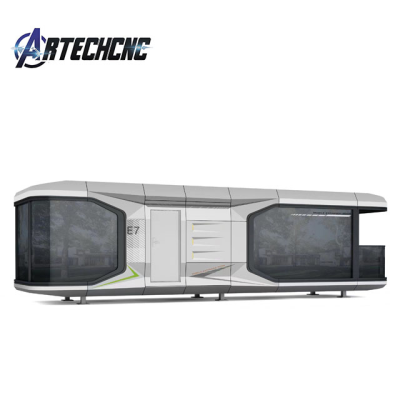


Modern Luxury Space Capsule with Intelligent Control System Camping Capsule Modular House
$12700.00 - $13000.00
MOQ: 1 Pieces


Disassembled Mobile Modular Structure Intelligent Electric System Small Prefab House
$18000.00 - $26000.00
MOQ: 1 Pieces
Comprehensive Sourcing Guide
Strategic Sourcing Guide for Modern Solar System Space Capsule Units
The global demand for modular, high-efficiency housing solutions has accelerated the interest in space capsule structures, particularly those integrated with modern solar systems. For B2B procurement professionals, navigating this market requires a disciplined approach that distinguishes between marketing terminology and verifiable technical specifications. The following guide outlines the critical factors for sourcing these units, focusing on the observed product attributes, structural integrity, and compliance requirements found in current market listings.
Technical Specifications and Structural Configuration
When evaluating space capsule units, buyers must first scrutinize the fundamental geometric and material specifications. The market currently features distinct models, such as the V6 and D-series capsules, which vary significantly in shape and dimension. The V6 Space Capsule House, for instance, is characterized by a triangular shape, a design choice that influences both aerodynamic performance and internal spatial utilization. Its dimensions are recorded as a first floor of 5550mm in length, 4050mm in width, and 2550mm in height, with a second floor measuring 5550mm by 2900mm. In contrast, the D7 model presents a rectangular footprint, offering a larger footprint of 11500mm in length, 3300mm in width, and 3300mm in height, covering an area of 38 square meters on a single layer. The D5 model follows a similar rectangular profile but with a reduced length of 8500mm and a single-layer area of 28 square meters.
The structural composition is a primary determinant of durability and transportability. The observed data indicates that these units are predominantly constructed from steel structures, providing a robust framework capable of withstanding various environmental stresses. This material choice supports several key performance attributes, including wind resistance, earthquake resistance, and moisture proofing. Furthermore, the units are designed with thermal insulation and leak-proof capabilities, ensuring habitability in diverse climates. The weight of these units is a critical logistical factor; for example, specific models are noted to weigh approximately 9.5 tons, which directly impacts transportation costs and the requirements for site preparation.
Compliance, Certification, and Safety Standards
In the B2B sector, verifying compliance is non-negotiable. Procurement teams must ensure that suppliers provide valid documentation for all safety and quality certifications. The current product landscape shows that many space capsule units carry CE certification, a mandatory conformity mark for products sold within the European Economic Area. Some listings also reference ISO certification, indicating adherence to international management system standards. Additionally, specific models may carry the BIOGREEN-LUCAS designation, suggesting a focus on environmental standards, though buyers should verify the specific ISO or CE clauses applicable to their region.
Safety is further reinforced by the listed features of these units. Attributes such as "Safe," "Earthquake Resistant," and "Waterproof" are not merely marketing claims but are linked to the underlying steel structure and engineering standards. The "Life Span" of these units is cited as 30 years, a figure that buyers should treat as a design expectation rather than a guaranteed performance metric without third-party verification. When evaluating suppliers, request proof of the CE mark and any ISO certificates relevant to the manufacturing facility. Do not rely solely on the product name or model number for compliance; the certification status must be explicitly stated in the supplier's documentation for the specific batch being ordered.
Cost Drivers and Financial Parameters
Understanding the cost structure of space capsule procurement is essential for budgeting and ROI analysis. The observed price range for these units spans from $500 to $38,000 USD. This wide variance is driven by several factors, including the model size, the level of customization, and the inclusion of advanced systems. The D7 model, with its larger dimensions and modern design style, likely commands a higher price point compared to the more compact V6 or D5 units.
Beyond the base unit cost, buyers must account for transportation and packaging. The standard transportation method for these units is the 40HQ container, which implies specific logistical considerations for international shipping. Packaging is another cost driver, with options ranging from "Shipping" packages to "Export Package" or "Wooden Box Packaging." The choice of packaging affects the protection of the unit during transit and the subsequent on-site assembly costs. Additionally, the "Fast Installation" feature suggests that while the initial unit cost may be higher, the reduction in on-site labor time and construction duration can offset these expenses. Buyers should also consider the "Warranty" terms, which are observed to be 3 years for certain models, as this impacts the long-term cost of ownership and risk mitigation.
Typical Applications and Functional Versatility
The versatility of space capsule houses makes them suitable for a diverse range of commercial and residential applications. The observed data highlights several primary use cases. The V6 model is specifically noted for "Villa" applications, suggesting its suitability for high-end residential developments or luxury retreats. The D7 and D5 models, with their rectangular shapes and larger floor plans, are frequently associated with "Hotel" and "Apartment" usage. This indicates their potential for use in eco-resorts, temporary housing for construction sites, or modular apartment complexes.
The "Design Style" further influences application suitability. The D7 model features a "Modern" design, while the D5 model is described as having a "European Style." These aesthetic differences allow procurement teams to match the units to specific architectural visions or brand identities. The "Eco-Friendliness" and "Environmental Protection Low Cost Recycle" attributes make these units particularly attractive for sustainable development projects. The inclusion of a "Smart Home System" in the configuration equipment further enhances their appeal for modern hospitality and residential markets, allowing for automated climate control and security integration.
Supplier Evaluation and Customization Capabilities
Selecting the right supplier requires a rigorous evaluation of their customization capabilities and service offerings. The market data confirms that "Customization" is available for these units, with options for "Customized Colors" and "Customerized" branding. Some suppliers support logo customization, which is vital for corporate branding in hotel or resort projects. The "Customized Or Not" attribute is listed as "Customized," indicating that the standard offering is often a baseline that can be tailored to specific project requirements.
Buyers should also assess the "After-Sale Service" provided. The availability of "Online Technical Support" is a standard offering, but the depth of this support—whether it includes remote diagnostics, video conferencing for installation guidance, or spare parts logistics—must be clarified. The "Order Number" of 1 Set suggests that suppliers are willing to handle small batch orders, which is beneficial for pilot projects or smaller developments. However, the "MOQ" (Minimum Order Quantity) range of 1 to 20 units indicates that while single-unit orders are possible, bulk purchasing may offer better terms. When evaluating suppliers, prioritize those who can demonstrate a clear process for handling custom requests, from design modification to final delivery.
Quality Control and Long-Term Procurement Considerations
Ensuring the long-term viability of a space capsule project requires a focus on quality control and lifecycle management. The "Life Span" of 30 years is a significant selling point, but it relies heavily on the quality of the steel structure and the integrity of the waterproofing and thermal insulation systems. Buyers should verify the "Feature" list, which includes "Wind Resistance," "Waterproof," "Thermal Insulation," and "Leak Proof," against independent test reports or third-party validation. The "Transportation" method of 40HQ containers must be managed carefully to prevent damage during transit, which could compromise the structural integrity of the unit.
Long-term procurement considerations also include the "Configuration Equipment." The inclusion of a "Smart Home System" implies a need for ongoing technical support and potential software updates. Buyers should inquire about the compatibility of these systems with existing building management infrastructure. Furthermore, the "Advantage" of being "Environmental Protection Low Cost Recycle" suggests that the units are designed for disassembly and reuse. This aligns with circular economy principles and may offer tax incentives or sustainability credits in certain jurisdictions. Finally, the "Warranty" period of 3 years should be reviewed in detail to understand what components are covered and the process for claiming repairs or replacements.
Summary of Key Product Attributes
To facilitate quick comparison during the sourcing process, the following table summarizes the key attributes of the observed space capsule models. This data is derived directly from the product listings and serves as a reference for initial screening.
| Attribute | V6 Space Capsule House | D7 Space Capsule House | D5 Space Capsule House |
|---|---|---|---|
| Shape | Triangular | Rectangle | Rectangle |
| Dimensions (L x W x H) | 5550 x 4050 x 2550 mm (1st Floor) | 11500 x 3300 x 3300 mm | 8500 x 3300 x 3300 mm |
| Area (One Layer) | Not specified | 38 m² | 28 m² |
| Material | Steel Structure | Steel Structure | Steel Structure |
| Primary Application | Villa | Hotel | Apartment |
| Design Style | Not specified | Modern | European Style |
| Certification | CE | CE | ISO, CE |
| Weight | Not specified | Not specified | 9.5t |
| Warranty | Not specified | Not specified | 3 Years |
| Customization | Available | Customized Colors | Customized Colors |
By adhering to these guidelines and verifying the specific attributes against the supplier's documentation, procurement professionals can effectively source Modern Solar System Space Capsule units that meet their project requirements while mitigating risks associated with quality, compliance, and logistics.
FAQs
What certifications do Modern Solar System Space Capsule units carry?
Many units carry CE certification, and some listings also reference ISO certification. Buyers must verify valid documentation for safety and quality standards before purchasing, as compliance is non-negotiable for international procurement.
How long is the expected life span of these space capsule houses?
The cited life span for these units is 30 years. This figure represents a design expectation based on the steel structure and engineering standards, though third-party verification is recommended for specific batches.
Can buyers customize the color and logo of the space capsule?
Yes, customization is available for colors and logos. Suppliers support customized branding and color options, allowing procurement teams to match specific architectural visions or corporate identities for hotel and residential projects.
What is the typical price range for these modular housing units?
The observed price range spans from 500 to 38,000 USD. This variance is driven by model size, customization levels, and the inclusion of advanced systems like smart home configurations.
Which transportation method is standard for shipping these capsules?
The standard transportation method is the 40HQ container. This implies specific logistical considerations for international shipping and requires careful management to prevent damage during transit.
What warranty terms are typically offered for these structures?
Some models are observed to have a 3-year warranty period. Buyers should review these terms in detail to understand covered components and the process for claiming repairs or replacements.
How are these units constructed to ensure structural safety?
They are predominantly constructed from steel structures to provide a robust framework. This material choice supports attributes like wind resistance, earthquake resistance, and moisture proofing for diverse climates.