Source Single Pole Wall Switch with USB Socket for Home Hotel Lighting
Compare 30 Single Pole Wall Switch with USB Socket options featuring CE and CCC certifications. Buyers can review specifications like 16A rated current, IP ratings, and customization availability for commercial and residential projects.
Key considerations
Products List


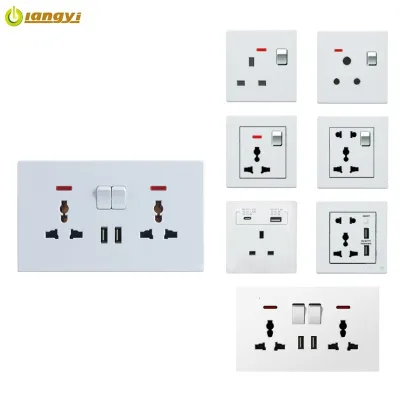


Wall Socket and Switch Waterproof Switch Outdoor Socket Waterproof Sockets
$0.30 - $5.50
MOQ: 500 pieces

Wall Socket and Switch Switch Electric Plugs and Sockets Switch Hotel Switch
$0.80 - $3.00
MOQ: 500 pieces
Comprehensive Sourcing Guide
Strategic Sourcing Guide for Single Pole Wall Switches with USB Integration
The global demand for integrated electrical solutions has driven a significant shift toward combining traditional switching mechanisms with modern connectivity features. For procurement professionals targeting a Single Pole Wall Switch with USB Socket, the market presents a complex landscape of technical variations, compliance requirements, and supply chain dynamics. This guide synthesizes available product data and industry standards to provide a disciplined framework for sourcing these specific components. The objective is to navigate the nuances of product attributes, ensuring that the final selection aligns with both functional requirements and regulatory mandates without relying on unverified market assumptions.
Technical Architecture and Functional Specifications
Understanding the internal architecture of a Single Pole Wall Switch with USB Socket is the first step in defining procurement specifications. Based on observed product data, these units often utilize a capacitive principle for detection, which allows for touch-sensitive operation in specific configurations, though traditional rocker mechanisms remain prevalent. The core switching mechanism is typically described as a single-pole on-off switch, designed to control a single circuit. This distinguishes them from double-pole variants, which are often found in industrial or heavy-duty applications.
The physical structure of these switches varies, with some models adopting a power built-in type where the switching mechanism is integrated directly into the housing. The wiring configuration is a critical technical parameter; observed data indicates options for both "Null Line and Live Line" and "Single Live Line" wiring. Procurement teams must verify the specific wiring topology required for their installation environment, as mismatched wiring can lead to operational failure or safety hazards. Furthermore, the detection method for touch-sensitive models is frequently identified as retro-reflective mode, a technology that relies on light reflection to trigger the switch.
The application scope for these devices is broad, ranging from residential and commercial settings to hotels, hospitals, and general-purpose industrial facilities. The product models observed, such as the VB102YS, VY144Y, QB15YS, and KV11, suggest a wide array of form factors and capacities. When evaluating technical specifications, buyers should note that while some units are rated for 16A, others may have different current ratings depending on the specific model and intended load. The "Normal Open" type is a common configuration, meaning the circuit is open when the switch is in the resting position and closes upon activation.
Compliance, Certification, and Regulatory Standards
Navigating the certification landscape is paramount for international procurement. The supply data indicates a high frequency of CE certification, often appearing alongside CCC (China Compulsory Certification) and ISO standards. The presence of both CE and CCC suggests that many suppliers target both the European and Chinese markets, but buyers must verify that the specific batch of goods carries the valid certificates for the destination region. For instance, a unit marked with "CCC, CE" may not automatically satisfy UL requirements for the North American market unless explicitly stated.
While background knowledge suggests standards like UL 498 and IEC 60884-1 are relevant to electrical safety, the provided product facts do not explicitly confirm these standards for every listed item. Therefore, procurement protocols must include a verification step where the supplier provides the specific test reports for the ordered model. The "Standard Grounding" attribute observed in some listings indicates that grounding is a feature of certain models, which is a critical safety requirement for wall sockets. Buyers should explicitly request documentation confirming the grounding integrity and the specific safety standards met by the product, rather than assuming compliance based on general market trends.
The "IP Rating" is another area requiring careful scrutiny. While the data mentions "IP Number of Holes: Porous," it does not provide a definitive IP code (e.g., IP44, IP54). In wet areas or commercial kitchens, a specific IP rating is essential. Procurement teams must treat the "Porous" description as an observation of a specific product variant and not as a universal standard for all single pole switches with USB. Verification of the actual ingress protection rating against the installation environment is a mandatory step before finalizing an order.
Cost Drivers and Economic Factors
The economic landscape for sourcing these components is influenced by several variables, including customization, volume, and material quality. The observed price range of 0.24 to 6.25 USD represents a significant spread, reflecting differences in build quality, brand positioning, and feature sets. The lower end of this range likely corresponds to basic, non-customized units with standard packaging, while the higher end may include models with advanced features, premium materials, or custom branding.
The Minimum Order Quantity (MOQ) is a critical cost driver, with observed ranges spanning from 100 to 3000 units. Buyers with smaller procurement needs may face higher per-unit costs or may need to consolidate orders with other buyers to meet the MOQ thresholds of larger manufacturers. The "Cheap Price High Quality" advantage noted in some supplier descriptions should be treated with caution; it is a marketing claim rather than a guaranteed technical specification. Instead, buyers should focus on the value proposition relative to the specific model's features and the supplier's track record.
Customization is a significant factor in cost structure. The data confirms that customization is available for these products, allowing for modifications in color, branding, or functional features. However, custom orders typically incur higher MOQs and longer lead times. The "OEM ODM Is Accepted" attribute indicates that suppliers are willing to produce private-label goods, but this service often comes with additional setup costs and minimum volume requirements. Buyers must balance the need for customization against the budget constraints and the urgency of the project timeline.
Typical Applications and Installation Environments
The versatility of single pole wall switches with USB sockets makes them suitable for a diverse range of applications. The data highlights usage in commercial, residential, hotel, and hospital settings. In commercial environments, such as offices and retail spaces, these switches provide a convenient way to control lighting while simultaneously offering power for mobile devices. The "Control Button" and "Disconnector" usage attributes suggest that these units can serve dual purposes, acting as both a lighting control and a power isolation point.
In the hospitality sector, the integration of USB charging ports is particularly valuable. Hotels often require guests to have easy access to power for charging devices without the need for additional adapters. The "Home Appliance" and "Electronics" application tags indicate that these switches are designed to handle the loads associated with modern electronic devices. However, the "Industrial" application tag suggests that some models are robust enough for factory or warehouse environments, though buyers must verify the specific durability and protection ratings for such harsh conditions.
The "Durable" protection attribute observed in the data implies that these products are designed to withstand regular use. However, the specific conditions under which this durability is tested are not detailed in the provided facts. For high-traffic areas, buyers should prioritize models with reinforced housings and high-quality internal components. The "New" condition of the products listed ensures that buyers receive fresh inventory, which is crucial for maintaining warranty validity and ensuring optimal performance.
Supplier Evaluation and Quality Assurance
Evaluating suppliers requires a disciplined approach that goes beyond surface-level marketing claims. The data indicates that products originate from China, with specific mentions of Zhejiang as a manufacturing hub. While this provides a geographical context, it does not guarantee quality. Buyers should conduct thorough due diligence on potential suppliers, focusing on their production capabilities, quality control processes, and history of compliance.
The "Service: OEM ODM Is Accepted" attribute suggests that suppliers are flexible, but this flexibility must be matched with rigorous quality assurance protocols. Buyers should request samples for testing before placing large orders. These samples should be evaluated against the specific technical specifications, such as the wiring type, switch mechanism, and USB charging capability. The "25years" guarantee mentioned in the data is a significant selling point, but it must be verified for its terms and conditions. A long-term guarantee often indicates a manufacturer's confidence in their product, but it requires clear contractual definitions to be valuable.
Quality control should also extend to the packaging and logistics. The observed packing methods, ranging from "1PC/Plastic Bag" to "Carton--Plywood Case," indicate that packaging varies based on the order size and product type. For fragile items or high-value shipments, the "Plywood Case" option may be necessary to prevent damage during transit. Buyers should ensure that the packaging standards align with their logistical requirements and that the supplier has a reliable track record for on-time delivery.
Long-Term Procurement Considerations
Sourcing single pole wall switches with USB sockets is not just a one-time transaction but a long-term relationship that requires strategic planning. The "Fast Deliver Time" advantage noted in some supplier profiles is attractive, but it should not come at the expense of quality or reliability. Buyers should establish clear communication channels with suppliers to ensure that any changes in specifications or supply chain disruptions are managed proactively.
The "Customized" nature of many products means that long-term procurement plans should account for potential changes in design or functionality. As technology evolves, the USB ports on these switches may need to support newer standards, such as USB-C or higher power delivery. Buyers should discuss future-proofing options with suppliers to ensure that the products remain relevant over time. Additionally, the "Advantage: Cheap Price High Quality" claim should be monitored through regular performance reviews to ensure that the supplier maintains their standards as order volumes increase.
Finally, the environmental impact of the products should be considered. While the data does not explicitly mention eco-friendly materials, buyers can inquire about the sustainability of the manufacturing process and the recyclability of the components. As global regulations on electronic waste and energy efficiency tighten, sourcing products that align with these trends will become increasingly important. By maintaining a focus on technical compliance, supplier reliability, and long-term value, procurement professionals can successfully navigate the complex market for single pole wall switches with USB integration.
FAQs
What certifications are available for Single Pole Wall Switch with USB Socket?
Common certifications include CE, CCC, and ISO standards. Buyers must verify that the specific batch carries valid certificates for their destination region, as CE alone does not guarantee UL compliance for North America.
Which wiring types are supported by these switches?
Products support both Null Line and Live Line configurations as well as Single Live Line wiring. Procurement teams must verify the specific wiring topology required for their installation environment to prevent operational failure.
Can I customize the color and branding of the switch?
Customization is available for color, branding, and functional features. Custom orders typically incur higher minimum order quantities and longer lead times, so buyers must balance needs against budget and project timelines.
What is the typical price range for Single Pole Wall Switch with USB Socket?
The observed price range spans from 0.24 to 6.25 USD. This spread reflects differences in build quality, brand positioning, and feature sets, with lower costs often corresponding to basic non-customized units.
Which models are suitable for commercial and residential applications?
Models like VB102YS and KV11 are suitable for commercial, residential, hotel, and hospital settings. These units are designed to handle loads associated with modern electronic devices and lighting control in high-traffic areas.
How does the detection method work on touch-sensitive models?
Touch-sensitive models frequently utilize a retro-reflective mode detection method that relies on light reflection to trigger the switch. This technology allows for capacitive operation in specific configurations alongside traditional rocker mechanisms.