Source Waterproof Moisturizing Foundation Cream for Face, Body, and Events
Find 30 verified listings for Waterproof Moisturizing Foundation Cream suitable for all skin types. Buyers can compare certifications like GMPC and ISO, packaging options, and customization services from Guangzhou manufacturers.
Key considerations
Products List


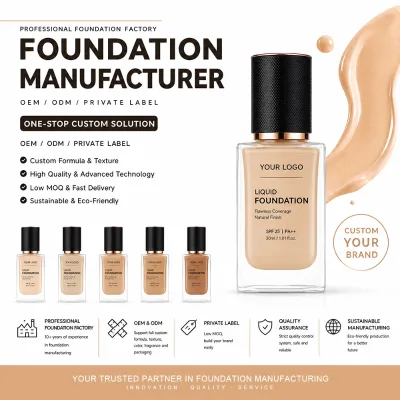
Moisturizing Waterproof Oil Control Oil Correcting Makeup Liquid Foundation
$2.40 - $2.50
MOQ: 1000 Pieces


Comprehensive Sourcing Guide
Strategic Sourcing Guide for Waterproof Moisturizing Foundation Cream
Understanding Product Formulations and Core Attributes
The procurement of Waterproof Moisturizing Foundation Cream requires a precise understanding of the product's dual nature as both a cosmetic coverage tool and a skincare-infused formulation. Based on the observed market data, this category encompasses a diverse range of formulations, primarily categorized by their base ingredients. Buyers must distinguish between products utilizing chemical ingredients, mineral-based components, and herbal extracts. The market data indicates that some listings specify "Chemical" as the main ingredient, while others highlight "Mineral" or "Herbal" bases. A critical observation in the current supply landscape is the existence of hybrid formulations where the main ingredient is listed as "Mineral, Chemical," suggesting a blend designed to balance coverage with skin compatibility.
The functional profile of these products is heavily defined by their "Waterproof" attribute, which is a consistent requirement across the majority of listings. This feature ensures the foundation resists water, sweat, and humidity, making it suitable for long-wear applications. Furthermore, the "Moisturizing" aspect is often linked to the product's ability to "Cover up Flaws" while maintaining skin hydration. The target skin type for these formulations is broadly categorized as "All Skin Types," indicating a general market approach rather than a niche targeting of specific dermatological needs. However, buyers should verify if the specific "Moisturizing" claim is supported by the ingredient list, as the term can be applied loosely in some listings.
The physical form of the product is consistently observed as "Cream," which offers a balance between the fluidity of a liquid foundation and the coverage of a stick or powder. This consistency in form simplifies the initial screening process, but the viscosity and texture can vary significantly based on the specific model and ingredient ratio. The packaging for these creams ranges from simple plastic containers to more elaborate paper boxes, with some suppliers offering "Sava Package: Paper Box with Strong Bubble" for enhanced protection during transit. The standard net weights observed in the market vary from small travel sizes of 4g to standard retail sizes of 30ml, 40ml, and 50ml. Buyers must align their order specifications with these standard sizes or negotiate custom volumes, as "Customized" is a frequently listed standard option.
Compliance, Certification, and Regulatory Standards
Navigating the regulatory landscape is paramount when sourcing waterproof foundation creams, as the product is applied directly to the face and must meet strict safety standards. The supply data reveals a robust presence of certifications, with "GMPC," "ISO," "MSDS," "GMP," and "FDA" appearing frequently across different product listings. These certifications indicate that the manufacturing facilities adhere to Good Manufacturing Practice for Cosmetics (GMPC) and General Manufacturing Practice (GMP), ensuring a controlled production environment. The inclusion of "MSDS" (Material Safety Data Sheet) is critical for logistics and safety, providing detailed information on the chemical composition and handling requirements of the product.
For buyers targeting international markets, the presence of "REACH" certification is a significant differentiator, particularly for shipments entering the European Union. REACH compliance ensures that the chemical substances used in the foundation meet European safety standards. Additionally, the "FDA" certification suggests adherence to United States Food and Drug Administration regulations, which is essential for the North American market. It is important to note that while these certifications are listed as high-confidence facts in the market data, they are not universal to every single product listing. Buyers must verify the specific certification status for the exact product model they intend to purchase, as a listing may show "GMPC, ISO, MSDS, GMP" while another includes "REACH" or "FDA."
The product standards also extend to shelf life and production timelines. The observed data indicates a shelf life of "36 Month" for certain models, while others list a "Pao" (Period After Opening) of "12 Month." This distinction is vital for inventory management and retail planning. A 36-month shelf life suggests a stable formulation that can be stored for extended periods, whereas the 12-month Pao informs the end-user about the product's viability once opened. Furthermore, the production time is noted to range from "7-30 Days," which buyers must factor into their supply chain planning. The trade terms available, including "EXW," "Fob," "CIF," "CFR," "Dda," and "DDP," offer flexibility in logistics management, allowing buyers to choose the level of control and risk they wish to assume during the shipping process.
Cost Drivers and Minimum Order Quantity Dynamics
The pricing structure for Waterproof Moisturizing Foundation Cream is influenced by several variables, including formulation complexity, packaging customization, and order volume. The observed price range in the market is between 0.4 and 5 USD per unit. This wide variance suggests that the cost is heavily dependent on the specific product model, the quality of ingredients (e.g., mineral vs. chemical), and the level of customization required. Lower-priced items in the 0.4 USD range likely correspond to basic formulations with standard packaging, while items approaching 5 USD may feature premium ingredients, specialized packaging, or higher certification levels.
Minimum Order Quantity (MOQ) is another critical cost driver, with observed ranges spanning from 24 units to 12,000 units. This flexibility accommodates both small businesses testing the market and large retailers seeking bulk supply. The low end of the spectrum, starting at 24 units, allows for low-risk entry and sampling, while the high end of 12,000 units indicates the capacity for mass production and significant economies of scale. Buyers should be aware that the MOQ may vary by product model; for instance, custom packaging options might require a higher MOQ than standard stock items. The "Customized" packaging option, which includes "Paper Box" or "Carton" solutions, often incurs additional setup costs and may influence the MOQ threshold.
When evaluating cost, buyers must also consider the "Trade Term" implications. Terms like "EXW" (Ex Works) place the responsibility of shipping and insurance on the buyer, potentially increasing the total landed cost if logistics are not managed efficiently. Conversely, "DDP" (Delivered Duty Paid) simplifies the process but may be reflected in a higher unit price. The "Production Time" of 7-30 days also impacts cost, as expedited production requests may incur rush fees. Additionally, the "OEM & ODM" (Original Equipment Manufacturer and Original Design Manufacturer) services are listed as "Aceptable," which allows for branding customization. However, OEM/ODM projects typically involve higher costs due to the development of custom molds, labels, and formulas, which must be factored into the total budget.
Typical Applications and Market Segmentation
Waterproof moisturizing foundation creams are designed for a wide array of applications, primarily focused on "Face Makeup." The core function of these products is to provide a flawless finish while offering protection against environmental factors. The "Waterproof" attribute makes these foundations particularly suitable for events, outdoor activities, and hot climates where sweat and humidity are concerns. The "Sunscreen" function observed in several listings adds an extra layer of utility, offering protection against UV rays, which is a highly valued feature for daily wear products. This dual functionality of coverage and sun protection positions the product as a versatile solution for both professional makeup artists and everyday consumers.
The market segmentation for these products is broad, catering to "All Skin Types." This inclusivity suggests that the formulations are engineered to be non-comedogenic and suitable for sensitive, oily, dry, and combination skin. The "Moisturizing" aspect ensures that the foundation does not dry out the skin, a common issue with long-wear waterproof products. The ability to "Cover up Flaws" further enhances its appeal, as it addresses the primary consumer need for a smooth, even complexion. The "Application" is explicitly listed as "Face Makeup," confirming that these products are not intended for body use or other cosmetic applications.
In terms of usage scenarios, the 36-month shelf life and 12-month Pao make these products ideal for retail environments where inventory turnover may vary. The "Customization" availability allows brands to tailor the product to specific market needs, such as creating a line specifically for humid tropical regions or for professional stage makeup that requires extreme durability. The "Standard" sizes of 4g, 15ml, 30ml, 40ml, and 50ml provide options for different consumer preferences, from travel-sized essentials to full-size retail products. The "Packaging" options, ranging from simple plastic to paper boxes with bubble protection, also influence the perceived value and suitability for different market segments, with premium packaging often associated with higher-end brands.
Supplier Evaluation and Production Capabilities
Evaluating suppliers for Waterproof Moisturizing Foundation Cream requires a thorough assessment of their production capabilities, location, and quality control measures. The observed data indicates that the primary production origin is "Guangzhou" and "Guangdong, China," which are major hubs for cosmetic manufacturing. These regions are known for their extensive supply chains and expertise in cosmetic production, offering a competitive advantage in terms of cost and efficiency. Buyers should verify the specific factory location, as "Guangzhou" and "Guangdong" are distinct administrative regions, and the proximity to ports may affect shipping logistics.
The "OEM & ODM" capability is a key indicator of a supplier's flexibility. Suppliers that accept OEM and ODM requests can produce products with custom branding, packaging, and formulations. This is essential for brands looking to differentiate themselves in a crowded market. The "Customization" of the product packing, including options like "Paper Box" and "Carton," further demonstrates the supplier's ability to meet specific branding requirements. Buyers should inquire about the supplier's capacity to handle custom orders, including the lead time for developing new molds or packaging designs.
Quality control is another critical factor in supplier evaluation. The presence of certifications like "GMPC," "ISO," and "GMP" suggests that the supplier has established quality management systems in place. However, buyers should request specific quality control reports and test results for the products they intend to purchase. The "MSDS" documentation is particularly important for verifying the safety of the chemical ingredients used. Additionally, the "Production Time" of 7-30 days indicates the supplier's ability to meet standard lead times, but buyers should confirm if this timeline applies to custom orders or standard stock items.
Quality Control and Long-Term Procurement Considerations
Ensuring consistent quality in Waterproof Moisturizing Foundation Cream requires a robust quality control (QC) strategy. Buyers should implement a multi-stage QC process that includes pre-production sampling, in-process inspection, and final product testing. The "Shelf Life" of 36 months and "Pao" of 12 months are critical metrics that must be verified through stability testing. Buyers should request stability test reports to ensure that the product maintains its waterproof properties, texture, and color over time. The "Main Ingredient" composition, whether "Chemical," "Mineral," or "Herbal," should be analyzed to ensure consistency across batches.
Long-term procurement considerations involve building a sustainable relationship with suppliers who can scale production as demand grows. The "MOQ" range of 24 to 12,000 units offers flexibility, but buyers should negotiate volume discounts for larger orders to optimize costs. The "Trade Term" options, such as "EXW," "Fob," "CIF," and "DDP," should be evaluated based on the buyer's logistics capabilities and risk tolerance. For long-term partnerships, buyers may prefer terms like "CIF" or "DDP" to reduce the complexity of international shipping.
Sustainability is an emerging consideration in the cosmetics industry. Buyers should inquire about the recyclability of the "Plastic" and "Paper Box" packaging options. The "Sava Package: Paper Box with Strong Bubble" offers protection but may generate more waste if not designed for recycling. Additionally, the "Customized Packaging by Clents" option allows for eco-friendly solutions, which can be a competitive advantage in the market.
Finally, buyers should monitor the "Certification" status of their suppliers regularly. Certifications like "REACH" and "FDA" are subject to renewal and may change over time. Maintaining a database of supplier certifications and ensuring they remain valid is essential for compliance and risk management. By focusing on these quality control and long-term considerations, buyers can secure a reliable supply of high-quality waterproof moisturizing foundation creams that meet their specific market needs.
Comparative Analysis of Product Specifications
To facilitate informed decision-making, the following table summarizes the key specifications observed in the market data for Waterproof Moisturizing Foundation Cream. This comparison highlights the variations in models, ingredients, packaging, and standards that buyers should consider during the sourcing process.
| Product Model | Main Ingredient | Function | Standard Size | Packaging Type | Certification | Origin |
|---|---|---|---|---|---|---|
| AO2023719 | Chemical | Waterproof | 50ml | As Customer Required | GMPC, ISO, MSDS, FDA, GMP | Guangzhou |
| F-24 | Mineral | Waterproof, Sunscreen | 4g | Paper Box | GMPC, ISO, MSDS, GMP | China |
| MBM266 | Herbal | Sunscreen | 30ml | Be Customized Packaging | GMPC, ISO, MSDS, FDA, GMP, REACH | Guangdong, China |
| LF | Mineral, Chemical | - | 40ml | - | - | - |
| MBM496 | - | - | - | - | ISO, MSDS, GMP | - |
| Concealer | - | - | - | Paper Box with Strong Bubble | - | - |
| Q512 | - | - | Customized | Carton | - | - |
| Q516 | - | - | - | - | - | - |
| 8518 | - | - | - | - | - | - |
| 9506 | - | - | - | - | - | - |
| FO01 | - | - | 15 | Box | - | - |
This table illustrates the diversity of the market, with variations in ingredient composition, packaging, and certification levels. Buyers should use this data to identify products that align with their specific requirements and to ask targeted questions to suppliers regarding the missing or ambiguous data points. By leveraging this structured comparison, buyers can streamline their sourcing process and make more informed procurement decisions.
FAQs
What certifications do waterproof moisturizing foundation creams typically have?
These products commonly hold GMPC, ISO, MSDS, GMP, and FDA certifications. Some listings also include REACH compliance for European markets. Buyers must verify the specific certification list for each product model, as not every item includes all listed credentials.
How long is the shelf life for these foundation creams?
The observed shelf life is 36 months for certain models. Once opened, the Period After Opening is typically 12 months. This distinction is vital for inventory planning and ensuring product safety before and after the package is opened.
Can buyers request custom packaging for these foundation creams?
Yes, customization is available for packaging including paper boxes and cartons. Suppliers offer options like Sava Package with bubble protection or standard plastic containers. Customization may influence the minimum order quantity and production timeline.
What is the production time for these foundation creams?
The standard production time ranges from 7 to 30 days. This duration allows for manufacturing and quality checks before shipping. Buyers should factor this lead time into their supply chain planning, especially for OEM or ODM projects.
Which ingredients are used in waterproof moisturizing foundation creams?
Main ingredients vary and include chemical, mineral, and herbal components. Some formulations are hybrid blends of mineral and chemical ingredients. The specific ingredient list depends on the product model and intended skin type compatibility.
What is the price range for these foundation creams?
The observed price range is between 0.4 and 5 USD per unit. Costs vary based on formulation complexity, packaging customization, and order volume. Lower prices typically correspond to basic formulations while higher prices may include premium features.
Where are these foundation creams manufactured?
Products originate from Guangzhou and Guangdong, China. These regions are major hubs for cosmetic manufacturing with extensive supply chains. Buyers should verify the specific factory location as it may affect shipping logistics and trade terms.