Eco-Friendly PP Food Storage Rack Suppliers and Manufacturers
Source 19 verified suppliers for Eco-Friendly PP Food Storage Rack solutions. Compare key dimensions including lead times, MOQs, and response rates to identify suitable partners. Review product specifications and pricing details to streamline your procurement process effectively; review the available evidence before requesting comparable quotations from suitable candidates.
Suppliers List

Dongguan Simply Metal Products Co., Ltd.
- Trading Company
- China Guangdong
- Lead time23 days
- Avg. response≤ 9h
Main productsWire Shelving, Wire Shelving Units, Shelving, Shelf, Wire Wall Shelf, Wire Rack Shelving, Wire Storage Racks, Wire Racks, Metal Wire Shelving, Wire Storage Shelves
Main marketsSouth America,Africa,Southeast Asia/ Mideast,Europe,Australia,North America


$5.00 - $10.00
MOQ: 100 Pieces

Eagle Catering Equipment Co., Ltd.
- Manufacturer/Factory
- China Guangdong
- Lead time30 days
- Avg. response≤ 9h
Main productsTrolleys, Gastronorm Containers, Table, Shelves, Sink, Barrier Post, Cookware, Buffetware, Barware, Kitchen Utensils
Main marketsSouth America,Eastern Europe,Mid East,North America,Southeast Asia,Eastern Asia,Oceania,Western Europe,Africa

Xuzhou Risen Industry and Supply Co., Ltd
- Verified by TUVRHEINLAND
- Trading Company
- China Jiangsu
- Lead time30 days
- Avg. response≤ 4h
Main productsHousehold Adornment, Household Supplies, Home Decoration, Compressed Sofa, Dining Furniture, Bothroom Organizer, Kitchen Storage, Glass Ornaments, Ceramic Tableware, Home Fragrance
Main marketsSouth America

Guangzhou Aemaxx Household Products Co., Ltd.
- Verified by BV
- Trading Company
- China Guangdong
- Lead time30 days
- Avg. response≤ 7h
Main productsWaste Bin, Trash Bin, Garbage Bin, Scale, Toilet Brush, Kitchen Trolley, Timer, Food Dehydrator, Storage, Mirror
Main marketsSouth America,Others(foreignTradeCapacity.exportBusinessCapacityMarketOther),Southeast Asia/ Mideast,East Asia(Japan/ South Korea),Europe,Australia,North America

New PP Kitchen Racks Stainless Steel Shelf Storage Plastic Bathroom Storage Shelf
$7.04 - $7.73
MOQ: 500 Pieces


Nanjing OKE International Storage Systems Co., Ltd.
- Verified by CTI
- Trading Company,Manufacturer/Factory
- China Jiangsu
- Lead time15 days
- Avg. response≤ 5h
Main productsWarehouse Storage Racking, Pallet Racking, Selective Pallet Racking, Drive-in Pallet Racking, Push Back Racking, Pallet Shuttle Racking, Gravity Flow Racking, Cantilever Rack, Steel Platform, Light Duty Racking
Main marketsSouth America,Eastern Europe,Mid East,North America,Southeast Asia,Eastern Asia,Western Europe,Africa

Taizhou Shangyi Plastic Co., Ltd.
- Verified by TUVRHEINLAND
- Trading Company
- China Zhejiang
- Lead time23 days
- Avg. response≤ 17h
Main productsFood Container, Storage Container, Lunch Box, Bento Box, Plastic Laundry Basket, Plastic Storage Container, Plastic Cutting Board
Main marketsSouth America,Southeast Asia/ Mideast

Kitchen Organizer 2-Layer Plastic Dish Rack Multi-Function Dish Storage Rack
$1.30 - $1.35
MOQ: 3000 Pieces


Plastic Food Storage Container Bin Organizer for Snacks, Produce, Vegetables, Pasta
$0.45 - $0.50
MOQ: 5000 Pieces


Guangxi Huajiu Home Furnishing Co., Ltd.
- Manufacturer, Trading Company
- Guangxi, China
- Lead time15 days
- Avg. response≤ 11h
Main productsPortable Wardrobes,Shoe Racks,MDF Furniture,Storage Shelves,Flower Stands
Main marketsWestern Europe(25.00%), Southeast Asia(25.00%), North America(25.00%), Eastern Europe(5.00%), Eastern Asia(5.00%), South America(5.00%), Mid East(5.00%), Oceania(5.00%)

CAO COUNTY DAWANG ARTS AND CRAFTS CO., LTD.
- Verified by TUVRHEINLAND
- Manufacturer/Factory
- China Shandong
- Lead time23 days
- Avg. response≤ 20h
Main productsWooden Cabinet, Iron Furniture, Wall Shelf
Main marketsEastern Europe,North America,Western Europe

High Quality Kitchen Storage Rack
MOQ: 1500 Pieces

High Quality Multi-Function Bamboo Utensil Tray Storage Rack
MOQ: 1500 Pieces
Ningbo Dazen Technology Co., Ltd.
- Trading Company
- Zhejiang, China
- Lead time45 days
- Avg. response≤ 10h
Main productsKitchen Supplies, Household Supplies, Children's Supplies, Cleaning Supplies, Bar Supplies
Main marketsWestern Europe(23.00%), North America(19.00%), South America(16.00%), Southern Europe(12.00%), Northern Europe(11.00%), Eastern Europe(11.00%), Eastern Asia(5.00%), Southeast Asia(3.00%)

- Verified by BV
- Trading Company
- China Zhejiang
- Lead time30 days
- Avg. response≤ 12h
Main productsLunch Box
Main marketsSouth America,Africa,Southeast Asia/ Mideast,East Asia(Japan/ South Korea),Europe,Australia,North America
Hebei Boto Storage Equipment Co., Ltd
- Verified by SGS
- Combined
- China Hebei
- Lead time30 days
- Avg. response≤ 4h
Main productsWarehouse Rack
Main marketsDomestic

Storage Racks for Modern Warehouse - Durable and Environmentally Friendly
$600.00 - $800.00
MOQ: 1 Tons


High Quality Storage Racks Environmentally Friendly for Industrial Applications
$600.00 - $800.00
MOQ: 1 Tons


Suzhou Shunhong Metallic Products Co., Ltd.
- Trading Company,Manufacturer/Factory
- China Jiangsu
- Lead time23 days
- Avg. response≤ 8h
Main productsShopping Cart, Roll Container, Warehouse Trolley, Storage Cage, Shopping Basket, Shopping Trolley, Supermarket Cart, Hand Push Cart, Wire Mesh Cages, Checkout Counter
Main marketsSouth America,Eastern Europe,Mid East,North America,Southeast Asia,Eastern Asia,Oceania,Western Europe,Africa

Stackabke Plastic Basket for Vegetable & Fruit Rack Plastic Vegetable Storage Basket
$10.00 - $15.00
MOQ: 200 Pieces


Ningbo General Union Co., Ltd.
- Verified by BV
- Trading Company
- China Zhejiang
- Lead time30 days
- Avg. response≤ 10h
Main productsCleaning Brush, Bottle, Kitchenware, Storage Box, Outdoor, Pet, Fitness Equipment, Digital Devices, Camping, Pet Bottle
Main marketsSouth America,Africa,Southeast Asia/ Mideast,East Asia(Japan/ South Korea),Europe,Australia,North America


High Quality Retractable Metal Multi-Layer Vegetable Storage Rack with Wheels
$18.85 - $25.95
MOQ: 100 Pieces

- Trading Company
- China Zhejiang
- Lead time0 days
- Avg. response≤ 10h
Main productsHousehold, Personal Care, Kitchenware, Fitness, Car Items, Tools, Health Care, Paint Brush, Magic Mesh, Beauty


Rotating Seasoning Storage Rack Multifunctional Sorting Rack
MOQ: 500 Pieces

Suzhou Highbright Enterprise Limited
- Combined
- China Jiangsu
- Lead time30 days
- Avg. response≤ 4h
Main productsShopping Trolley, Shopping Cart, Gondola Shelf, Display Shelf, Shop Fittings, Store Fixtures, Roll Container, Shopping Basket, Checkout Counter, Swing Gate
Main marketsSouth America,Africa,Southeast Asia/ Mideast,East Asia(Japan/ South Korea),Europe,Australia,North America

Beijing Tianyuan Rongli Technology Co., Ltd.
- Verified by SGS
- Trading Company
- China Beijing
- Lead time15 days
- Avg. response≤ 3h
Main productsMelamine Board, Chipboard, MDF, Solid Wood Pellet Board, Custom-Made Furniture, Dining Room Furniture, Living Room Furniture, Steel-Wood Furniture
Main marketsSoutheast Asia/ Mideast


Customizable Storage Rack with Detachable Metal Cart for Organizing Snacks
$18.50 - $19.29
MOQ: 500 Pieces
Ningbo Hongwei Plastic Co., Ltd
- Verified by SGS
- Combined
- China Zhejiang
- Lead time23 days
- Avg. response≤ 1h
Main marketsDomestic

Space-Saving Stackable Food Storage Containers for Kitchen Organization
$0.06 - $0.08
MOQ: 20000 Pieces


Versatile Stackable Food Containers for Kitchen Organization and Storage
$0.06 - $0.08
MOQ: 20000 Pieces


Versatile Stackable Food Containers for Efficient Kitchen Organization
$0.06 - $0.08
MOQ: 20000 Pieces
Quanzhou Anxi Jiangou Home Furnishing Co., Ltd
- Verified by SGS
- Trading Company
- China Fujian
- Lead time0 days
- Avg. response≤ 2h
Main productsStorage Rack, Dog Crate, Wine Rack, Table Leg, Wall-Mounted Shelf, Clothing Rack, Plant Stand
- Verified by BV
- Combined
- China Guangdong
- Lead time30 days
- Avg. response≤ 8h
Main productsFolding Table, Folding Ladder, BBQ Grill, Kitchen Shelf, Wooden Table
Main marketsEast Asia(Japan/ South Korea)


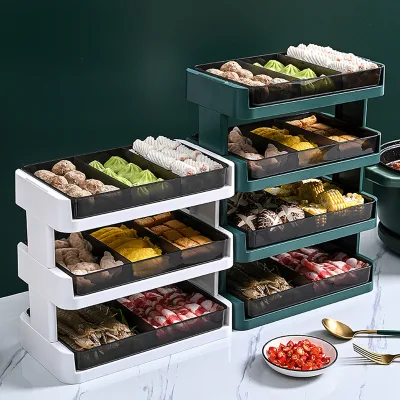


Comprehensive Sourcing Guide
Eco-Friendly PP Food Storage Rack Supplier Concentration and Factory Types
When you search for eco friendly PP food storage racks, the supplier pool typically splits into two company types: factories that mold their own plastic products, and trading companies that aggregate kitchenware and shelving from multiple workshops. One useful signal in supplier profiles is the main products line. A manufacturer listing trolleys, gastronorm containers, shelves, and kitchen utensils is likely a commercial kitchen equipment factory, while a trading company listing wire shelving and storage racks across many metal categories is likely a reseller of mixed goods. Both can source PP storage racks, but their control over mold quality, food-grade resin selection, and production scheduling differs significantly.
Location data in supplier results can also reveal concentration. Some suppliers are registered in Guangdong, China, which appears directly in product origin attributes for kitchen and restaurant equipment. When location is displayed with high confidence, treat it as a cluster hint and look for neighboring factories in the same province. When location is missing or vague, you should identify clusters yourself: filter supplier lists by the origin field shown on individual products, compare shipping ports referenced in quotations, and ask candidates which industrial zone molds their PP parts. Do not assume a supplier is a factory just because the word "manufacture" appears in its name; confirm company type from the displayed label before shortlisting.
How to Verify Eco-Friendly PP Food Storage Rack Suppliers
Verification starts with the attributes a platform actually displays, not with claims in chat messages. Check whether the supplier's profile shows a company type label, a system certification field, or an escrow-related designation, and record exactly which fields are present or marked NIL. Some suppliers show no system certification at all; that absence is information, and it tells you to request evidence directly rather than assume compliance. Also compare the product category path: a rack listed under warehousing and supermarket supplies is positioned differently from one listed under home storage and organization, and that positioning hints at whether the supplier normally serves commercial or retail buyers.
Next, verify product claims against the listing data. PP food storage racks may be described as eco-friendly, but the material field on some listings only says "Plastic," so you should ask for resin specifications and food-contact documentation before paying a sample fee. Use the displayed customization field: several results state "Available," which you can test by requesting a small modification and watching how concretely the supplier responds. Confirm the origin attribute matches the company's stated location, and check that the product model and dimensions in the attributes table match what the salesperson quotes. A supplier whose catalog data is internally consistent, whose response arrives within the displayed response-time window, and who accepts sample negotiation is far more credible than one whose answers drift.
What to Compare Across Eco-Friendly PP Food Storage Rack Suppliers
Build a comparison sheet with dimensions that are actually shown in supplier results. Lead time is one: observed values in this category range from roughly three to four weeks, so any quote dramatically longer deserves questioning. Minimum order quantity varies widely, from single-piece sampling on some listings to 100 or 300 pieces on others, which fundamentally changes whether you can test the market before committing. Response time is another practical dimension; several suppliers report response times around eight to nine hours, so use that as a baseline for how quickly a motivated vendor replies. Note establishment year where displayed, since longevity correlates with operational stability.
Beyond the profile-level fields, compare product-level economics. One stainless steel commercial storage rack shows a flat 50-dollar unit price with an MOQ of one, while PP and mixed-material racks in the same results span roughly one to ten dollars with MOQs of 50 to 300. Price-per-unit alone is meaningless without the MOQ beside it. Also compare packaging specifications, since foam packing, export cartons, and pallet options affect landed cost differently, and compare customization availability, because some suppliers confirm customization on every listing while others leave the field blank. Remember that not every supplier displays every attribute; score suppliers on the completeness and consistency of what they do show, and treat blanks as questions for the vendor rather than assumptions.
Common Eco-Friendly PP Food Storage Rack Sourcing Risks
The most common risk in this category is material ambiguity. Listings frequently label products as eco-friendly while the material attribute only reads "Plastic," which tells you nothing about whether the PP is virgin resin, recycled content, or food-contact grade. If you plan to store food directly on these racks, buying on the word "eco-friendly" without resin documentation risks customs rejection or retail delisting. A second risk is size mismatch: results show products described with very different dimensional standards, from compact cutlery organizers of roughly 107 millimeters to large-format commercial racks, so a model number alone will not protect you from ordering the wrong footprint.
Operational risks follow from supplier type. Trading companies in this space may list metal wire shelving as their main product line while brokering plastic racks from a third factory, which lengthens problem resolution when a mold defect appears. Lead times around 23 to 30 days look manageable, but they assume production capacity is free; during peak kitchen-equipment seasons, actual output can slip with no contractual penalty. Packaging is an underrated risk too: thin PP shelves shipped in plain cartons rather than foam packing arrive warped or scratched, and several listings do specify foam packing, so divergence is a red flag. Finally, foldable and multi-tier designs introduce assembly-failure points; request an assembled sample rather than a photo before approving mass production.
Eco-Friendly PP Food Storage Rack Regional Sourcing and Logistics
Guangdong, China appears explicitly in the origin attributes for commercial kitchen and buffet equipment in this supplier set, and it is a reasonable starting point for regional targeting because the province hosts dense tooling and molding infrastructure. However, some listings only state "China" as origin, so your regional picture should be assembled from product-level data rather than company headquarters alone. When you cannot identify a cluster from displayed data, work it out through logistics: ask each candidate which port they ship from, what the quoted freight basis is, and whether the factory or a freight forwarder handles export documentation. Convergent port answers across several suppliers suggest a shared industrial zone.
Transportation terms in the observed listings are generally marked as shipment, with packing ranging from foam packages to export cartons and, for heavier steel racks, wooden or steel pallets. These differences matter for PP racks because plastic deforms under compression; if a supplier normally palletizes steel shelving but packs plastic racks loose in cartons, ask about stacking limits. Sample logistics also deserve planning: some listings describe sample terms as "Negotiate" rather than fixed, so budget for sample freight and confirm whether the sample fee is credited against a later bulk order. For mixed orders, ask whether a manufacturer of gastronorm containers and sinks can consolidate your PP racks with metal kitchenware in one container, reducing freight cost per unit.
Eco-Friendly PP Food Storage Rack Commercial Terms and Order Planning
Commercial terms in this category are visible on individual listings and should anchor your negotiation. Payment is commonly listed as T/T, which means you should negotiate a deposit-and-balance structure rather than full prepayment, especially with suppliers who show no system certification. Customization is marked available on multiple listings, so treat tooling or print changes as negotiable scope, but ask whether customization alters the stated MOQ or lead time. Sample terms are sometimes listed as "Negotiate" rather than a fixed policy, giving you room to request free samples at higher intended volumes, while one commercial rack listing shows single-piece availability at a fixed 50-dollar price for expensive items.
Order planning should sequence your commitments. Start with the lowest MOQ listing that matches your quality target, often in the 50-to-100-piece range for PP organizers, then scale to the 300-piece tier only after inspection. Build a timeline backward from your delivery date using the displayed lead times of roughly 23 to 30 days as the production window, then add buffer for booking and customs. Confirm packing mode in the purchase contract, since foam packing, export cartons, and palletized shipping appear inconsistently across listings, and specify which one applies to your order. Finally, record the exact product model, standard dimensions, and origin stated on the listing inside your contract, so the goods you receive are contractually tied to the evidence you sourced.
(Word count check: approximately 1,390 words across six sections, each within the 225–235-word limit.)
FAQs
What is the price range for eco friendly PP food storage racks?
Prices for these racks typically range from $2.38 to $10.00 per unit depending on the specific model and customization requirements. Some basic plastic containers start at $2.38, while specialized stackable units may cost up to $10.00. Buyers should verify exact pricing based on their order volume and specific design needs.
What is the minimum order quantity for these storage racks?
Minimum order quantities vary significantly by product type. Some items require a minimum of just one unit, while others demand 50, 100, or 300 units. Buyers must check the specific MOQ for each product model, as requirements range from single-piece samples to bulk wholesale orders of 300 units.
How long does production and shipping take for these racks?
Lead times generally range from 23 to 30 days for manufacturing and preparation. Response times from suppliers average around 8.70 to 8.72 hours. Buyers should confirm exact delivery schedules with the supplier, as production times depend on order size and whether customization or standard packing is selected.
Are these racks customizable for specific business needs?
Yes, customization is available for many of these storage solutions. Suppliers offer options for custom models, standards, and colors to fit specific requirements. Buyers can request tailored dimensions or branding, though they should negotiate sample availability and confirm that custom orders may affect lead times and minimum order quantities.
Where are these eco friendly storage racks manufactured?
These products are manufactured in Guangdong, China. Suppliers in this region specialize in commercial equipment and home storage solutions. Buyers should verify the place of origin on product listings to ensure the goods meet their sourcing preferences and logistical requirements for international shipping and customs clearance.
What payment methods are accepted for these storage racks?
Common payment methods include T.T (Telegraphic Transfer) for standard transactions. Buyers should confirm payment terms with the supplier before placing orders. Some suppliers may offer other options, so it is essential to verify the accepted payment methods during the negotiation phase to ensure smooth transaction processing.