Emergency Stop Power Pushbutton Switch Suppliers and Manufacturers
Compare 10 verified Emergency Stop Power Pushbutton Switch suppliers in China Zhejiang with response times, lead times, and certifications like CE and ISO. Review product specs and pricing to source the right industrial switch for your needs; review the available evidence before requesting comparable quotations from suitable candidates.
Suppliers List

Juzhenhuiquan (Yue Qing) Supply Chain Co., Ltd
- Verified by SGS
- Trading Company,Manufacturer/Factory
- China Zhejiang
- Lead time15 days
- Avg. response≤ 8h
Main productsEnclosure Box, Meter Socket, Load Center, Panel Lock, Cam Lock, Electrical Enclosure, Distribution Box, Distribution Board, Electrical Box, Push Button Switch
Main marketsSouth America,Eastern Europe,Mid East,North America,Southeast Asia,Eastern Asia,Oceania,Western Europe,Africa

Yueqing Dahe Electric Co., Ltd.
- Verified by TUVRHEINLAND
- Manufacturer/Factory
- China Zhejiang
- Lead time15 days
- Avg. response≤ 4h
Main productsPush Button Switch, Signal Lamp, Indicator Lights, Push Button Light Switch, Emergency Stop Button, Rotary Switch, Key Switch, Selector Switch, Momentary Push Button Switch, Emergency Stop Switch
Main marketsEastern Europe,North America,Western Europe


Hban Mechanical Safety Protection Emergency Stop Push Button Switch with Protective Cover
$1.88 - $2.02
MOQ: 1 Pieces

10A Red Emergency Stop Switch 22mm 1no Reset Push Lock Push Button Safety E Stop Button
$2.20 - $2.34
MOQ: 1 Pieces

IP65 Waterproof Push Button Switch Key Lock Stop Emergency Button 22mm 10A E Stop Switch
$3.07 - $3.26
MOQ: 1 Pieces

Hban Emergency Power-off Protection Push Button Switch with Locking Function for Machinery
$1.99 - $2.13
MOQ: 1 Pieces

Yueqing Lifang Electric Co., Ltd.
- Verified by SGS
- Trading Company
- China Zhejiang
- Lead time15 days
- Avg. response≤ 5h
Main productsIsolating Switch, Relay, Power Transformer, AC Contactors, Pushbutton Switches, Proximity Switches, Photoelectric Switches, High Voltage Cabinets, Water Proof Box, Temperature Controller
Main marketsSoutheast Asia/ Mideast

NINGBO FBELE ELECTRONICS CO., LTD.
- Trading Company
- China Zhejiang
- Lead time15 days
- Avg. response≤ 13h
Main productsSolar Cell, Buzzer, Fuse and Fuse Holder, Terminal Block, Switch, Speaker, Telephone Receiver, Siren, Rj, USB Connector
Main marketsSouth America,Southeast Asia/ Mideast,Europe

Tangshan Xieli Conveyor Belt Transport Equipment Co., Ltd
- Verified by SGS
- Combined
- China Hebei
- Lead time15 days
- Avg. response≤ 1h
Main productsPull Cord Switch, Conveyor Belt Scraper, Slip Detector, Level Switch, Limit Switch, Belt Sway Switch, Audible and Visual Alarm, Material Flow Detector, Belt Alignment Device, Conveyor Cover
Main marketsSouth America,Southeast Asia/ Mideast
Yueqing Huilong Industrial Control Electrical Appliances Co., Ltd.
- Verified by SGS Group
- Trading Company
- Lead time15 days
- Avg. response≤ 3h
Main productsRelay, Switch, Sensor, Contactor, Circuit Breaker
Main marketsMid East(50%), North America(5%), South America(5%)
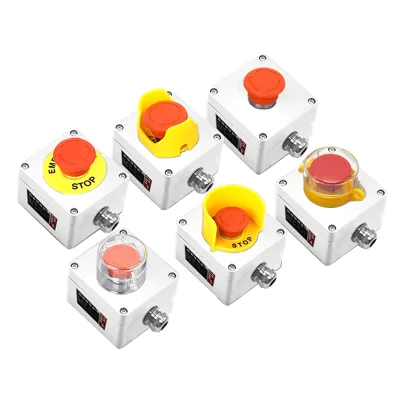
Cast Aluminum Emergency Stop Button Switch with Protective Cover Waterproof Protective
$3.06 - $62.72
MOQ: 5 Minimum
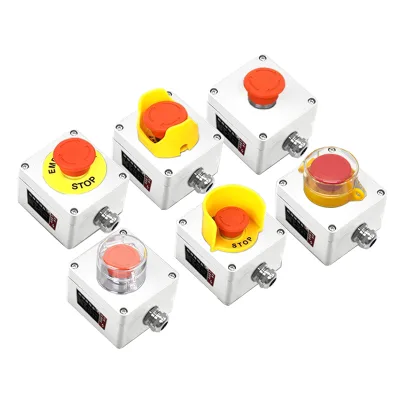

Yueqing Greenwich Imp & Exp Co., Ltd.
- Manufacturer/Factory
- China Zhejiang
- Lead time45 days
- Avg. response≤ 11h
Main productsMCCB, Contactor, Starter, Connector, Relay, Magnetic Starter, MCB, Circuit Breaker, DC Contactor, Vacuum Breaker
Main marketsSouth America,Eastern Europe,Mid East,North America,Southeast Asia,Eastern Asia,Oceania,Western Europe,Africa

Anhui LiftTop Mechanical and Electrical Co., Ltd.
- Verified by SGS
- Trading Company
- China Anhui
- Lead time15 days
- Avg. response≤ 2h
Main productsController, Forklift Part, Connector, Handle, Contactor, Curtis Motor, Battery Connector, Zapi Controller, Ge Programmer, Accelerator Pedal
Main marketsSouth America,Southeast Asia/ Mideast,Domestic,Europe,Australia,North America

Hefei Huanxin Technology Development Co., Ltd.
- Verified by BV
- Combined
- China Anhui
- Lead time15 days
- Avg. response≤ 6h
Main productsCurtis Controller, Forklift Parts, Accelerator Pedal, Instrument Cluster, DC Contactor, DC Converter, Emergency Switch, Rear Axle, AC & DC Motor, Drive Wheel Unit
Main marketsSouth America,Africa,Southeast Asia/ Mideast,East Asia(Japan/ South Korea),Domestic,Europe,Australia,North America

Ningbo Sentek Electronics Co., Ltd.
- Verified by BV
- Combined
- China Zhejiang
- Lead time30 days
- Avg. response≤ 15h
Main productsSmoke Alarm, Smoke Detector, Fire Detector, Magnetic Contact, Co Alarm, Co Detector, Gas Detector, Carbon Monoxide Detector, Heat Detector, Smoke Sensor
Main marketsSouth America,Africa,Southeast Asia/ Mideast,East Asia(Japan/ South Korea),Europe,Australia,North America


Comprehensive Sourcing Guide
Emergency Stop Power Pushbutton Switch Supplier Concentration and Factory Types
Emergency Stop Power Pushbutton Switch sourcing today is heavily shaped by supplier concentration in eastern China, with Zhejiang province standing out as a documented production base. Listings in this category show manufacturers and trading companies based there, and one product even carries an origin notation of Wenzhou, China, which points to the well-known electrical component cluster in that province. Buyers should treat Zhejiang as a confirmed sourcing region when shortlisting, because the density of enclosure, distribution box, and push button switch makers there supports competitive pricing and shorter domestic sub-supply chains for contacts, mushroom heads, and contact blocks.
Supplier types matter as much as geography. The verified results show two broad models: hybrid trading company plus manufacturer/factory operations that list enclosures, meter sockets, load centers, and panel locks alongside push buttons, and pure manufacturer/factory businesses focused on push button switches, signal lamps, indicator lights, rotary switches, key switches, and selector switches. The focused factories often maintain their own brand identities and broader certification packages, while the hybrid players offer bundle purchasing for control panels. Neither model is inherently better; a pure factory may give deeper product engineering support such as OEM and ODM customization, whereas a trading-style supplier may consolidate an entire enclosure build. Map each shortlisted candidate against these two archetypes before requesting quotations so you know whether you are buying from the production line or through an intermediary.
How to Verify Emergency Stop Power Pushbutton Switch Suppliers
Verification should begin with third-party audit status, because safety-critical components like emergency stop switches justify more diligence than commodity electricals. The observed results include suppliers verified by SGS and others verified by TÜV Rheinland, which are independent inspection bodies rather than self-declared claims. Where a verification badge is displayed, confirm what scope it covers—factory audit, product inspection, or both—and whether the report is current. Some suppliers additionally list management system certifications such as ISO 9000, ISO 9001, and ISO 14001; ask for certificate numbers and validate them against the issuing body's database before relying on them in a quality agreement.
Beyond badges, verify capability directly. Evidence from the results shows suppliers offering customization on their emergency stop listings, OEM and ODM capacity, and brand-owned product lines—each of which you should test with a concrete request, such as a custom legend plate or a specific contact configuration. Product-level attributes displayed in listings, including CE marking on certain push button models and certificates like CE, RoHS, Reach, UL, and CCC noted on individual items, should be matched to actual test reports for the exact model number you intend to buy, not a family-level certificate. Also check operational signals: response times recorded on some profiles range from roughly three and a half to seven hours, so a supplier who replies slowly before the order will be slower after it. Request factory photos, a live video walkthrough, and references from buyers in your market segment.
What to Compare Across Emergency Stop Power Pushbutton Switch Suppliers
Build a comparison matrix from the attributes actually displayed on supplier profiles and product listings, without assuming every supplier publishes every field. Useful dimensions in this category include lead time, minimum order quantity, average response speed, verification status, location, company type, and main product lines. For example, lead times shown in the observed data range from fifteen days on one supplier profile to three to five working days stated on several individual product listings—a gap that usually reflects stock programs versus made-to-order production, so always clarify whether the quoted figure applies to your specification and volume. Similarly, MOQs vary dramatically: one listing shows a minimum of one unit while another shows one thousand pieces.
Compare technical specifications side by side as well. Listed emergency stop models differ in mounting size (22mm and 30mm appear repeatedly), contact configuration (1NO, or 1NO 1NC), rating values from 10A/250V up to 10A/660V, protection degrees such as IP65, operation type (latching), and materials including stainless steel, aluminum alloy, and plastic housings. Working temperature ranges, terminal types (screw versus pin), and optional colors also vary by model. Weight these attributes against your application: a panel in a washdown environment needs the waterproof and dust-proof protection stated on several listings, while a control cabinet build may prioritize the illuminated or LED-equipped variants. Score every supplier on the same weighted criteria so the decision is auditable and repeatable.
Common Emergency Stop Power Pushbutton Switch Sourcing Risks
The most common risk is certificate mismatch: a listing displays CE, UL, CCC, RoHS, or Reach as attributes, but the certificate belongs to a different model series or an older version. Because emergency stop devices are safety components, buyers in regulated markets can face shipment rejection or liability if the marking cannot be traced to valid documentation. Mitigate this by requiring the certificate PDF, the notified body number where applicable, and the tested model designation before sample approval, and re-verify after any model or material change.
A second cluster of risks concerns misinterpreted lead times and misleading flexibility signals. A profile-level lead time of fifteen days and a product-level promise of three to five working days can both be true while being irrelevant to your order; the short figure may apply only to stocked standard items, not custom colors, special contacts, or bulk quantities. Similarly, an MOQ of one unit is often a sample-friendly policy, not an indication that production-scale pricing or capacity follows at low volumes. Other recurring risks include混淆 of trading and factory roles—asking a trading company for engineering changes it cannot authorize—and underestimating protection requirements, since a dust-proof rating alone may not satisfy a wet environment. Finally, latching mechanism quality and twist-release versus push-pull reset behavior differ across models; skipping destructive sample testing on the actual mechanism is a preventable failure mode.
Emergency Stop Power Pushbutton Switch Regional Sourcing and Logistics
Confirmed evidence places these suppliers in Zhejiang, China, with at least one product noting Wenzhou as its origin. This matters logistically: Zhejiang's electrical component cluster sits within reach of major container ports and dense supplier networks for contacts, springs, plastics, and metal housings, which compresses both component procurement time and inland freight legs. Buyers consolidating a control panel program—enclosures, distribution boards, panel locks, and push buttons—can often source multiple line items from suppliers in the same region, as several profiles here list enclosure boxes, meter sockets, load centers, and cam locks alongside switches.
Plan logistics around the shipment profile of this product. Emergency stop buttons are small, relatively high-value-per-kilogram items that pack efficiently in cartons—the packing method stated on at least one listing—so air freight is viable for samples, pilot runs, and urgent replenishment, while sea freight suits recurring volume. Confirm whether quoted lead times are ex-works, FOB, or delivered, and whether the supplier handles export documentation. Because manufacturing here is concentrated rather than distributed, avoid single-supplier dependency: qualify at least one alternate in the same region so a production disruption does not stall your panel assembly line. When scheduling, build in buffer for pre-shipment inspection and, where required, destination-market certification checks. For buyers new to the region, request a stated dispatch port and confirm inland transit time from the factory before committing to delivery dates.
Emergency Stop Power Pushbutton Switch Commercial Terms and Order Planning
Commercial planning should start from the observed price and MOQ spread. Emergency stop pushbutton listings in these results span roughly one dollar to five dollars per unit, with a stainless steel and aluminum alloy LED model priced near four dollars and a plastic-crust protective-cover model near two dollars, and MOQs ranging from one piece to one thousand. Treat these as list-level indications only: final pricing depends on contact configuration, mounting size, protection accessories, certification scope, and volume tiers. Request tiered quotations at your realistic annual volume, not just the minimum, and ask what customization surcharges apply for branding, legends, or packaging.
Order planning should reconcile the delivery figures displayed with your production calendar. Several listings state three to five working days or at least three working days, while one supplier profile shows a fifteen-day lead time; confirm which figure governs your specific model, quantity, and customization level, and whether production time stated on a listing (also quoted as three to five working days on one item) includes inspection and packing. For first orders, sequence a sample, then a pilot lot, then volume, holding tooling and artwork approval at each gate. Clarify payment structure, warranty terms for latching mechanisms, and whether spare contacts or replacement mushroom heads are offered. Lock specifications—model number, rating, IP degree, terminal type, and color—in a signed drawing so repeat orders do not drift between production batches.
FAQs
What certifications do emergency stop push button switches have?
Many available switches carry CE certification, while others include RoHS, Reach, UL, and CCC marks. Some products also hold ISO 9001 and ISO 14001 system certifications. Buyers should verify specific certificates for each item to ensure compliance with local safety standards and industrial requirements.
What is the typical lead time for these switches?
Standard delivery times range from three to five working days for many suppliers. Some manufacturers indicate a minimum lead time of fifteen days for larger orders. Buyers should confirm exact schedules with the supplier before placing an order to avoid production delays.
What is the minimum order quantity for these switches?
Minimum order quantities vary significantly, with some suppliers requiring one thousand units per order. Other options allow for single unit purchases starting at one piece. Buyers must check the specific MOQ listed for each product to determine the most suitable purchasing option.
Where are these emergency stop switches manufactured?
Most products originate from Wenzhou, China, located in the Zhejiang province. Suppliers in this region often operate as both trading companies and manufacturers. Buyers should verify the specific origin listed on product pages to confirm the manufacturing location and logistics capabilities.
What protection ratings are available for these switches?
Many switches feature IP65 protection ratings, ensuring they are dust-proof and waterproof. Some models also offer durable construction suitable for harsh industrial environments. Buyers should check the specific protection degree listed for each product to ensure it meets their environmental requirements.
What is the price range for these switches?
Prices typically range from one dollar to five dollars per unit depending on specifications. Some specialized models cost between two and four dollars. Buyers should compare the price range listed for each product to find options that fit their budget and quality expectations.
Do suppliers offer customization for these switches?
Customization is available for many emergency stop push button switches. Buyers can request specific colors, ratings, or contact configurations to match their needs. It is essential to confirm customization availability and any associated costs with the supplier before finalizing the order details.