Source Absorbable Surgical Suture for Wound Closure, Surgery, and Medical Procedures
Explore 30 listings for Absorbable Surgical Suture options available from suppliers in China and Korea. Buyers can compare thread lengths, needle types, and sterilization methods to find suitable materials for various medical applications.
Key considerations
Products List




Comprehensive Sourcing Guide
Strategic Sourcing Guide for Absorbable Surgical Sutures
Understanding Technical Specifications and Material Properties
When sourcing absorbable surgical sutures, the primary objective is to identify materials that provide adequate tensile strength while ensuring predictable degradation rates within the human body. The supplied data indicates that absorbable options are available, with specific product models such as "Catgut-01" and general classifications of "Nature Absorbable" and "Non Absorbable" existing in the market. Buyers must distinguish between these categories, as the procurement strategy for a natural absorbable suture differs significantly from synthetic alternatives. The material composition is a critical variable; the provided facts explicitly list "Absorbable" as a material type, suggesting the availability of products designed to be broken down by the body's enzymatic processes over time.
Thread size is another fundamental technical parameter that dictates the suture's application. The observed data reveals a wide range of thread numbers, specifically "0, 1, 2, 2/0, 3/0, 4/0, 5/0, 6/0, 7/0, 8/0." This spectrum allows for procurement across various surgical specialties, from heavy-duty orthopedic repairs requiring larger gauges to delicate ophthalmic or plastic surgery procedures necessitating ultra-fine threads like USP 8/0. The product specifications also reference a "USP8/0-USP4#" range and "USP6/0-2," indicating that compliance with United States Pharmacopeia (USP) sizing standards is a common industry practice. Buyers should verify that the specific lot they intend to purchase adheres to the exact USP sizing conventions required for their surgical protocols, as deviations can lead to tissue trauma or inadequate wound closure.
The physical dimensions of the suture thread are equally critical for surgical efficiency. The observed data lists thread lengths of "45cm, 75cm, 90cm or Customized," with additional mentions of "60cm," "100cm," and "125cm." This variability suggests that suppliers offer standard lengths but also accommodate custom requests. The choice of length often depends on the surgeon's preference and the specific anatomical site being treated. For instance, longer sutures may be required for procedures involving deep tissue layers or extensive wound lengths, while shorter lengths might be preferred for superficial closures to minimize waste. Furthermore, the needle length is specified in the data as ranging from "6mm" to "16mm" and "13mm-60mm," highlighting the need for precise matching between the needle geometry and the suture thread.
Needle Configuration and Surgical Utility
The integration of the needle with the suture thread is a decisive factor in surgical performance. The supplied facts detail a diverse array of needle types, including "1/2, 3/8, 1/4, 5/8 Circle," "Compound Curves," and "1/2 Curved" configurations. These geometric variations are not merely aesthetic; they determine the depth of penetration and the angle of approach required for different tissue types. For example, a 3/8 circle needle is often preferred for general surgery where a moderate arc is needed, whereas a 1/4 circle might be utilized for more confined spaces. The needle shape is further categorized as "Round Bodied," "Curved Cutting," or "Reverse Cutting." This distinction is vital for tissue handling; cutting needles are designed to penetrate tough tissues like skin or fascia, while round-bodied needles are intended for softer tissues to minimize tearing.
The needle length specifications provided, such as "6mm, 8mm, 10mm, 12mm, 13mm, 15mm, 16mm" and the broader "13mm-60mm" range, indicate that manufacturers offer needles of varying lengths to suit different surgical depths. A shorter needle might be sufficient for superficial closures, while a longer needle is necessary for deep organ suturing. Buyers must ensure that the needle length corresponds with the suture length and the specific surgical instrument compatibility. The data also notes a "Needle Type" classification, which implies that the needle's attachment method to the thread (swaged vs. eyelet) is a critical specification to verify. Although the specific attachment method is not explicitly detailed in the provided text, the emphasis on "Needle Type" suggests that the structural integrity of the needle-thread interface is a key quality metric.
Compliance, Sterilization, and Regulatory Standards
In the medical device sector, compliance and sterilization are non-negotiable prerequisites for procurement. The supplied facts explicitly mention "Ethylene Oxide Sterilization" as a processing method, which is a standard industry practice for rendering surgical instruments and sutures sterile. Buyers must verify that the supplier utilizes validated sterilization cycles that meet international safety standards, ensuring the product is free from viable microorganisms upon delivery. The data also references "Instrument classification: Class Iii," which typically refers to high-risk medical devices requiring rigorous regulatory oversight. This classification underscores the importance of verifying the supplier's regulatory standing and the specific certifications held for their sterilization processes.
Regarding certifications, the provided text lists "CE" with a low-confidence background status. This indicates that while CE marking is a relevant standard for the European market, its presence in the specific product listings provided is not definitively confirmed as a high-confidence fact. Consequently, buyers should not assume CE compliance based solely on the general keyword context but must request explicit certification documentation from the supplier. The data also mentions "Quality Guarantee Period: 3-5years," which is an unusual metric for consumable medical supplies, as sterility and shelf life are typically measured in months or years based on the material's degradation rate. This specific claim requires careful verification to ensure it aligns with the manufacturer's stated expiration dates and storage conditions.
The origin of the products is another compliance factor. The data lists origins in "Jiangsu, China" and "Korea." These locations are significant for supply chain logistics and regulatory acceptance. Products originating from China may be subject to specific import regulations in various jurisdictions, while Korean products might carry different quality perceptions or regulatory pathways. Buyers should confirm that the product origin aligns with the regulatory requirements of their target market. Additionally, the "Standard" field lists "45cm, 75cm, 90cm or customized" and "usp6/0-usp2#," suggesting that dimensional and sizing standards are integral to the product definition. Buyers must ensure that the supplier's internal standards align with the USP or other relevant pharmacopeia standards required by their healthcare facilities.
Cost Drivers and Procurement Economics
The economics of sourcing absorbable surgical sutures are influenced by several variables, including customization, packaging, and order volume. The observed price range in the data is "0.09-55" USD, a wide spectrum that reflects the diversity of product types, from basic single-thread units to complex, pre-loaded needle systems. The "MOQ" (Minimum Order Quantity) ranges from "1" to "12000," indicating that suppliers cater to both small-scale procurement needs and large institutional contracts. The specific data point "MOQ: 1200PCS" suggests that certain product lines or custom orders may require substantial volume commitments. Buyers should negotiate based on their actual usage rates to avoid overstocking, which can lead to expiration issues, or understocking, which risks supply interruptions.
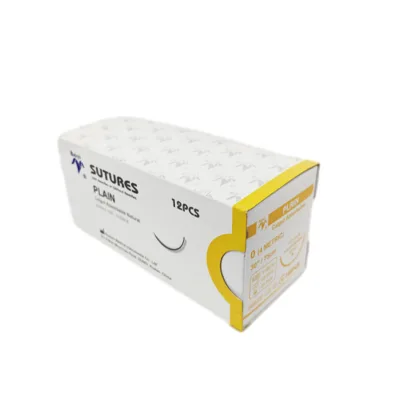
Packaging plays a significant role in cost and logistics. The data lists various packaging configurations, such as "1PC/Pack," "12PCS or 36PCS/Box," "12PCS / Bag 50 Boxes / Carton," and "Foil Bag and Carton Bag." The "Single Aluminum Foil Bag Packaging" is particularly relevant for maintaining sterility. The carton dimensions are specified as "322926.5cm," which is crucial for calculating shipping costs and warehouse storage requirements. Bulk purchasing, such as the "600 PCS/Carton" option, can reduce the per-unit cost but increases the initial capital outlay. Buyers must balance the cost savings of bulk orders against the storage capacity and cash flow constraints of their organization.
Customization is a key cost driver. The data repeatedly mentions "Customized" for length, standard, and model numbers. Custom orders often incur higher unit costs and longer lead times due to the need for specialized production runs. The "Oec: Accepted OEM" attribute indicates that suppliers are open to Original Equipment Manufacturer arrangements, which can be a cost-effective strategy for large buyers seeking branded products. However, OEM agreements typically involve higher MOQs and longer development cycles. Buyers should evaluate whether the benefits of a customized, branded product outweigh the costs and lead time implications compared to purchasing standard, off-the-shelf inventory.
Typical Applications and Clinical Considerations
The application of absorbable surgical sutures varies widely depending on the tissue type and the desired healing timeline. The data identifies the "Function" as "Wound Suture" and the "Product name" as "Absorbable Surgical Sutures Thread." This confirms their primary use in closing incisions and repairing internal tissues. The "Tissue Response" is noted as "Small," which is a desirable attribute for absorbable sutures, indicating that the material elicits minimal inflammation or foreign body reaction. This is particularly important for internal sutures where the material remains in the body for an extended period.
The "Group" attribute is listed as "All People," suggesting that these sutures are suitable for a broad patient demographic without specific contraindications based on age or gender. However, the "Product Structure" is described as "Multi-Strand Non-Absorbent" in one instance, which contrasts with the "Absorbable" material classification. This discrepancy highlights the importance of verifying the specific product attributes for each order. Buyers must ensure that the product selected matches the clinical requirement for absorbability. For example, in soft tissue approximation, a multi-strand absorbable suture might be preferred for its tensile strength, whereas in vascular surgery, a single-strand absorbable suture might be necessary to minimize thrombogenicity.
The "Properties" are described as "The Basis of Surgical Instruments," which is a broad statement. More specific properties include the "Thread No" and "Needle Type," which directly influence the surgical technique. The "PRO Duct Color" is listed as "Violet," which can be a helpful visual cue for surgeons to distinguish the suture from surrounding tissue during the procedure. Color coding is a common practice in medical devices to aid in identification and reduce errors. Buyers should confirm that the color coding is consistent and clearly marked on the packaging to ensure easy identification in the operating room.
Supplier Evaluation and Quality Assurance
Evaluating suppliers for absorbable surgical sutures requires a rigorous assessment of their manufacturing capabilities and quality control systems. The data indicates that "Stock: Yes" is available, which is a positive indicator of supply chain reliability. However, the "Quality Guarantee Period" of "3-5years" requires scrutiny, as it may refer to the shelf life or a warranty on performance rather than a guarantee of sterility. Buyers should request detailed quality assurance documentation, including batch testing results and sterility assurance levels (SAL).
The "Brand Name" "Fule" is mentioned in the data, providing a specific reference point for one supplier. While the guide does not recommend specific suppliers, the existence of a named brand suggests that some manufacturers have established reputations. Buyers should investigate the track record of such brands, including their history of product recalls, customer feedback, and regulatory compliance history. The "Instrument classification: Class Iii" reinforces the need for suppliers to have robust quality management systems (QMS) in place, likely certified to standards such as ISO 13485, even if not explicitly listed in the provided facts.
Verification of the "Needle Shape" and "Needle Length" consistency is also part of quality control. Variations in needle geometry can affect surgical outcomes. Buyers should request samples to test the needle's sharpness, the swage quality, and the thread's tensile strength. The "Standard" field lists "usp6/0-usp2#" and "45cm, 75cm, 90cm or customized," indicating that dimensional consistency is a key metric. Buyers should implement a sampling plan to verify that the received products meet the specified dimensions and thread counts.
Long-Term Procurement and Supply Chain Resilience
Long-term procurement of absorbable surgical sutures involves planning for supply chain resilience and inventory management. The "Location" of production in "Jiangsu, China" and "Korea" suggests that buyers may need to manage cross-border logistics, which can introduce risks related to shipping delays, customs clearance, and geopolitical factors. Diversifying the supplier base can mitigate these risks. The "MOQ" range of "1-12000" offers flexibility, allowing buyers to start with small orders and scale up as demand stabilizes.
The "Customization" attribute suggests that suppliers are willing to adapt to specific needs, which can be beneficial for long-term contracts. However, reliance on custom orders can increase lead times and reduce flexibility. Buyers should maintain a balance between standard and custom products to ensure a steady supply of essential items. The "Packing" specifications, such as "12PCS / Bag 50 Boxes / Carton," provide a framework for inventory management. Buyers should calculate their optimal order quantity based on their usage rates and storage capacity to minimize waste and maximize efficiency.
Finally, the "Quality Guarantee Period" of "3-5years" implies a long shelf life, which is advantageous for inventory management. However, buyers must monitor expiration dates closely to prevent the use of degraded products. Regular audits of supplier performance and product quality are essential to maintain high standards. By focusing on technical specifications, compliance, cost drivers, and supplier evaluation, buyers can establish a robust procurement strategy for absorbable surgical sutures that ensures patient safety and operational efficiency.
FAQs
What thread sizes are available for absorbable surgical sutures?
Thread numbers range from 0 to 8/0, covering various surgical needs. The product specifications explicitly list sizes including 0, 1, 2, 2/0, 3/0, 4/0, 5/0, 6/0, 7/0, and 8/0 to accommodate different tissue requirements.
Which needle shapes are compatible with these suture threads?
Available needle shapes include Round Bodied, Curved Cutting, and Reverse Cutting. These options allow surgeons to select the appropriate tip for penetrating specific tissue types during various surgical procedures.
Can I customize the length of the suture thread?
Yes, customized thread lengths are available for specific surgical requirements. Standard options include 45cm, 75cm, and 90cm, but buyers can request other dimensions to match their procedural needs.
How are these surgical sutures packaged for shipping?
Packaging varies from single foil bags to bulk cartons containing multiple boxes. Common configurations include 12 pieces per bag with 50 bags per carton or 12 pieces per box with 600 pieces per carton.
What is the minimum order quantity for these products?
Minimum order quantities range from 1 piece to 12,000 pieces depending on the supplier. Some specific product lines may require a minimum of 1,200 pieces for standard orders.
Are these sutures sterilized before delivery?
Yes, the products undergo Ethylene Oxide Sterilization to ensure safety. This process is standard for surgical supplies to guarantee they are free from viable microorganisms before reaching the operating room.
What is the origin of these surgical suture products?
Products originate from manufacturing locations in Jiangsu, China, and Korea. Buyers should verify the specific origin for each order to ensure compliance with their local import regulations.