Source Asphalt Drum Melter for Pavement, Road, and Construction
Compare 30 Asphalt Drum Melter units from Shandong suppliers with capacities up to 400t/h. These mobile and fixed machines support bitumen melting and asphalt concrete pavement applications with continuous or semi-dry shotcrete options.
Key considerations
Products List


Asphalt Mixer Bitumen Distributor Mixing Plant Recycle Material
$8000.00 - $10000.00
MOQ: 1 Pieces
LIAONING XINLAI INTELLIGENT EQUIPMENT MANUFACTURING CO LIMITED


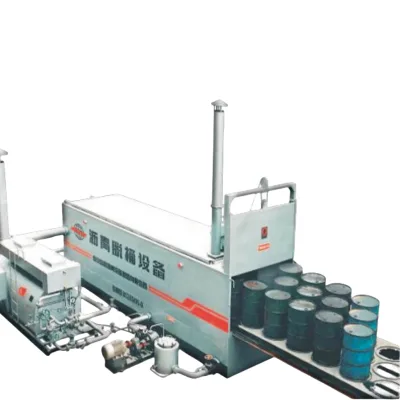
Asphalt Drum Melter Asphalt Unloading Barrel Equipment Bitumen Decanter
$30000.00 - $39000.00
MOQ: 1 Pieces


Comprehensive Sourcing Guide
Strategic Sourcing Guide for Asphalt Drum Melter Equipment
The global construction and road maintenance sectors rely heavily on efficient asphalt heating and mixing solutions. For procurement professionals, the Asphalt Drum Melter represents a critical piece of machinery designed to transform solid bitumen drums into a fluid state suitable for paving operations. Sourcing this equipment requires a disciplined approach that balances technical specifications, operational capacity, and supplier reliability. This guide synthesizes observed market data and technical attributes to provide a framework for evaluating potential assets without relying on unverified claims.
Technical Specifications and Operational Configuration
When evaluating an Asphalt Drum Melter, the primary focus must be on the machine's structural design and its specific melting methodology. The market presents distinct configurations, ranging from mobile units to fixed installations. Buyers must verify the "Moving Type" attribute, as this dictates the logistical requirements of the project site. Mobile units offer flexibility for remote locations, whereas fixed units are typically integrated into permanent batching plants. The observed product data indicates that models exist with both "Mobile" and "Fixed" configurations, each serving different operational needs.
The core melting mechanism is another critical differentiator. The equipment is categorized by its "Melting Type," with "Continuous" being a prominent feature in high-efficiency models. This continuous process allows for a steady flow of heated bitumen, which is essential for maintaining the viscosity required for asphalt concrete pavement applications. The thermal performance is governed by the "Thermal Oil Operating Temperature," which typically ranges between 200-240℃ in observed listings. This range ensures that the bitumen is heated sufficiently to achieve the desired fluidity without degradation. Furthermore, the "Asphalt Temperature" output is critical for the final mix quality, with observed specifications indicating a target range of 120-160℃.
Capacity is a defining factor in the selection process. The "Product Capacity" varies significantly across the market, with observed ranges spanning from 40~400t/h to units exceeding 400t/h. For large-scale infrastructure projects, the higher capacity units are often necessary to meet production deadlines. The "Bitumen Storage Capacity" is another specification to scrutinize, with observed values falling between 11-27m³. This storage volume determines how long the machine can operate before requiring a refill, directly impacting workflow continuity. Additionally, the "Total Power" consumption, observed in the range of 26kw-36kw, influences the electrical infrastructure requirements at the deployment site.
Compliance, Certification, and Safety Standards
Ensuring that the Asphalt Drum Melter meets international safety and quality standards is a non-negotiable aspect of the procurement process. The "Condition" of the equipment is a fundamental starting point; most observed listings specify "New" units, which generally implies adherence to current manufacturing standards. However, buyers must verify the specific certifications held by the manufacturer. The "Certification" attribute often includes "CE" and "ISO9001," indicating compliance with European safety directives and international quality management systems. While "CE" is a common observation, it is essential to confirm that the specific model being purchased carries valid certification documentation.
Safety and operational standards are further defined by the "prod_standard" attribute. In many cases, the standard is "Based on model," suggesting that dimensional and performance criteria may vary. For fixed units, specific dimensional standards such as 1050022002400mm have been observed, providing a baseline for spatial planning. The "Voltage" requirements are also critical for electrical integration, with observed specifications listing 220V/380V. Procurement teams must ensure that the local power grid matches these voltage requirements to prevent equipment damage or operational failure.
The "Warranty of Core Components" is a vital indicator of manufacturer confidence. A standard observation in the market is a "1 Year" warranty on core components. This warranty period should be clearly defined in the contract, specifying which parts are covered and the terms of service. Additionally, the "After-Sales Service Provided" is a key differentiator among suppliers. Services such as "Video Technical Support" and "Online Support" are commonly listed, offering remote assistance for troubleshooting. Buyers should verify the availability of these services and the response times associated with them.
Cost Drivers and Pricing Dynamics
The pricing of asphalt drum melters is influenced by a complex interplay of factors, including capacity, automation level, and structural complexity. The observed price range in the market is substantial, spanning from 1700 to 154000 USD. This wide variance reflects the diversity of equipment, from smaller, semi-dry shotcrete-related units to large-scale, fully automatic asphalt drum melting machines. The "Automatic Grade" is a significant cost driver; units classified as "Automatic" typically command a higher price due to the advanced control systems and reduced labor requirements.
The "Total Weight of The Whole Machine" is another factor that impacts logistics and, consequently, the total cost of ownership. Observed weights range from 8t to 24t, with some heavy-duty models reaching up to 24t. Heavier machines require more robust transportation solutions and potentially reinforced foundation work for fixed installations. The "Total Capacity of Electrical Appliances," observed at 22kw for certain models, also influences the electrical installation costs.
Buyers should be aware that the "MOQ" (Minimum Order Quantity) can affect the unit price. The observed MOQ range is 1-7 units. Purchasing a single unit may result in a higher per-unit cost compared to bulk orders, although the flexibility of a low MOQ is beneficial for smaller projects. The "prod_packing" method, such as "Laminated Packaging" or "40FT Container," also adds to the cost. Proper packaging is essential to prevent damage during transit, especially for international shipments from origins like "Shandong" or "China."
Typical Applications and Functional Versatility
The Asphalt Drum Melter is designed for specific applications within the road construction and maintenance industry. The primary "Object" for these machines is "Asphalt Concrete Pavement." This indicates that the equipment is optimized for producing the hot mix asphalt required for durable road surfaces. The "Mixing Method" observed is often "Continuous Drum," which aligns with the continuous melting process to ensure a consistent supply of heated material.
Beyond the primary melting function, these units often serve multiple roles in the production line. The "Features" and "Fountion" attributes highlight the versatility of the equipment. Common functions include "Asphalt Drum Unloader," "Bitumen Drum Decanter," and "Bitumen Drum Melter." Some models are also described as "Asphalt Drum Melting Machine" or "Bitumen Decanting Equipment." This multifunctionality allows a single machine to handle the entire process of unloading, decanting, and melting bitumen drums, streamlining the workflow at the site.
The "Unique Selling Point" of many observed models is "High Operating Efficiency." This efficiency is crucial for maintaining project schedules, as delays in bitumen heating can halt the entire paving operation. The "Productivity" of these machines varies, with observed ranges from 4~10t/H for smaller units to 75m³/h for larger, high-capacity models. Selecting the right productivity level depends on the scale of the paving project and the required output rate.
Supplier Evaluation and Quality Assurance
Evaluating a supplier for Asphalt Drum Melter equipment requires a thorough review of their track record and quality assurance processes. The "prod_origin" is a key piece of information, with "Shandong" and "China" being common origins for these machines. While the origin provides context, it does not guarantee quality. Buyers must look for evidence of quality control, such as the "Machinery Test Report." However, it is important to note that for some observed listings, the "Machinery Test Report" is marked as "Not Available." In such cases, buyers should request third-party inspection reports or video evidence of the machine in operation.
The "Video Outgoing-Inspection" is a valuable tool for remote verification. Many suppliers offer this service, allowing buyers to visually inspect the machine before shipment. This practice helps verify the "Condition" and "Structure" of the equipment, ensuring it matches the description. The "Structure" of the machine, whether "Rotor Type" or "Integrated," should be inspected to ensure it meets the project's durability requirements.
Supplier reliability is also indicated by the "After-Sales Service Provided." As mentioned, "Video Technical Support" and "Online Support" are common offerings. Buyers should inquire about the availability of spare parts and the lead time for repairs. The "Warranty of Core Components" serves as a safety net, but the practicality of the warranty depends on the supplier's ability to deliver support promptly.
Long-Term Procurement Considerations and Maintenance
Long-term procurement planning involves considering the lifecycle of the Asphalt Drum Melter. The "prod_packing" and shipping logistics, such as the use of a "40FT Container," are immediate concerns, but the long-term maintenance is equally important. The "Total Weight" and "Dimension" of the machine affect its mobility and the ease of maintenance. For mobile units, the "Moving Type" must be robust enough to withstand frequent relocation.
The "Standard" of the machine, often "Based on model," implies that maintenance procedures may vary. Buyers should ensure that the supplier provides detailed operation and maintenance manuals. The "Voltage" compatibility is a long-term consideration, as electrical standards can vary by region. Ensuring the machine can be adapted to local voltage standards without major modifications is essential.
Finally, the "Productivity" and "Capacity" of the machine should be aligned with future project needs. Investing in a machine with a higher capacity than currently required can provide flexibility for future expansion. However, this must be balanced against the "Total Power" consumption and the "Bitumen Storage Capacity" to ensure operational efficiency. By carefully evaluating these factors, buyers can secure an Asphalt Drum Melter that delivers value over its entire operational lifespan.
| Attribute Category | Observed Range/Value | Procurement Verification Focus |
|---|---|---|
| Condition | New | Verify manufacturing date and inspection reports. |
| Moving Type | Mobile / Fixed | Assess site logistics and foundation requirements. |
| Melting Type | Continuous | Confirm flow consistency and output stability. |
| Thermal Oil Temp | 200-240℃ | Ensure heating efficiency and safety controls. |
| Asphalt Temp | 120-160℃ | Verify mix quality and viscosity control. |
| Product Capacity | 40~400t/h / >400t/h | Match with project volume requirements. |
| Bitumen Storage | 11-27m³ | Calculate refill frequency and site storage. |
| Voltage | 220V/380V | Check local grid compatibility. |
| Warranty | 1 Year | Review terms for core components. |
| Origin | Shandong / China | Assess shipping logistics and lead times. |
In conclusion, sourcing an Asphalt Drum Melter requires a meticulous approach that prioritizes technical fit, compliance, and supplier reliability. By focusing on the specific attributes observed in the market, such as capacity, temperature ranges, and structural design, buyers can make informed decisions that align with their operational goals. The wide range of available options, from mobile to fixed and varying capacities, offers flexibility, but the final selection must be grounded in verified data and a clear understanding of the project's specific needs.
FAQs
What certifications do asphalt drum melters typically have?
Most observed units carry CE and ISO9001 certifications to ensure safety and quality compliance. Buyers should verify that the specific model includes valid documentation for these standards before purchase.
How is the bitumen melting process configured in these machines?
The equipment primarily uses a continuous melting type to ensure steady fluid flow for paving operations. This configuration supports high operating efficiency by maintaining consistent bitumen viscosity without degradation.
What is the typical price range for asphalt drum melting equipment?
Market prices for these machines range from 1700 to 154000 USD depending on capacity and automation. The final cost is influenced by factors like total weight, power consumption, and specific structural configurations.
Can buyers customize the specifications of the Asphalt Drum Melter?
Yes, customization is available for many models to meet specific project requirements. Buyers should confirm the available options for dimensions, capacity, and voltage to ensure compatibility with their site infrastructure.
What is the standard warranty period for core components?
A one-year warranty is commonly provided for core components of the Asphalt Drum Melter. This coverage helps protect against manufacturing defects, though terms should be clearly defined in the purchase contract.
Which moving types are available for asphalt drum melting units?
Both mobile and fixed configurations are available to suit different operational needs. Mobile units offer flexibility for remote sites, while fixed units are designed for permanent integration into batching plants.
What is the typical bitumen storage capacity for these machines?
Observed bitumen storage capacities range between 11 and 27 cubic meters for standard models. This volume determines how long the machine can operate before requiring a refill during continuous production.