Source Fruity Pencil Toy Candy for Kids, Adults, and Events
Find 30 verified options for Fruity Pencil Toy Candy designed for children, adults, and special events. Buyers can compare specifications, packaging materials, and customization features from manufacturers in China to select the best fit for their needs.
Key considerations
Products List




Sweet Candy Toy Plastic Spinning Top Candy Gyro Toys Candy with Sticker
$10.90 - $11.05
MOQ: 1000 Boxes


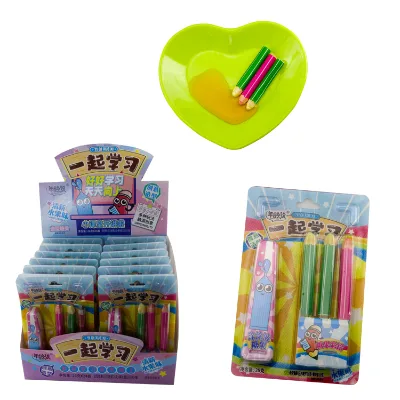
Stress Relieving Toy and Lollipop Fruit Flavored Candy Toy Confectionery Products
$0.74 - $0.75
MOQ: 360000 Pieces

Stress Relieving Toy and Lollipop Fruit Flavored Candy Toy Confectionery
$0.74 - $0.75
MOQ: 360000 Pieces


Comprehensive Sourcing Guide
Strategic Sourcing Guide for Fruity Pencil Toy Candy Procurement
The global market for novelty confectionery items, specifically those combining edible treats with interactive play elements, presents a unique procurement challenge. The core keyword "Fruity Pencil Toy Candy" points to a specific product category where the primary value proposition is the dual nature of the item: it serves as a snack and a toy. Buyers entering this sector must navigate a landscape defined by diverse packaging materials, variable regulatory standards, and complex supply chain requirements. This guide synthesizes observed market data and technical specifications to provide a disciplined framework for sourcing these items effectively, ensuring that procurement decisions are grounded in verified facts rather than marketing assertions.
Technical Specifications and Product Attributes
Understanding the physical and compositional attributes of the product is the first step in defining a precise procurement requirement. The observed product data indicates that these items are classified under the department of "Hard Candy" and "Toy Candy," with a solid form factor. The specific product model numbers observed in the market, such as YX-H00979, YX-SW11455, and YX-SW11454, suggest a standardized yet varied production line. A critical technical observation is the specification of the standard packaging unit, which frequently appears as "8g30pcs24boxes" or "8g30pcs24boxs/ctn." This implies a unit weight of 8 grams per piece, packaged in sets of 30, and then consolidated into master cartons of 24.
The physical dimensions of the toy component are also a vital specification. One observed standard lists the toy size as 9.0x9.0x24.4cm, which likely refers to the dimensions of the packaging carton or the assembled toy structure rather than the candy piece itself. The product models vary significantly, with some listed as "Yx-Sw11515" and others as "180507," indicating that buyers must verify the exact model number against their specific design requirements. Furthermore, the ingredients are not explicitly detailed in the general product descriptions; instead, the standard instruction is to "See Packaging for Details." This necessitates a strict requirement for label verification during the sampling phase to ensure ingredient transparency.
Packaging Materials and Storage Requirements
The packaging of Fruity Pencil Toy Candy is a critical factor in both product protection and regulatory compliance. The observed data reveals a mix of packaging materials, including Paper, Plastic, and Cans. This variation suggests that different suppliers or product lines utilize different primary and secondary packaging solutions. For instance, some listings specify "Paper" as the packaging material, while others explicitly list "Plastic" or "Cans." The secondary packaging is consistently described as "Box" or "Carton," with specific mentions of "Standard Export Packing" for international shipments.
Storage requirements are equally specific and must be adhered to strictly to maintain product integrity. The data indicates a "Normal" storage method is generally acceptable, but a more detailed instruction advises storing in a "Cool Place" and avoiding "Sunshine." This dual instruction highlights the sensitivity of the candy component to heat and light, which can cause melting, sugar bloom, or degradation of the toy's mechanical parts. Buyers must ensure that their logistics partners and warehousing facilities can maintain these conditions. The "Toy with Candy" and "Candy in Toy" attributes confirm that the product is a composite item, meaning the packaging must protect both the edible portion from contamination and the toy portion from damage during transit.
Compliance, Certification, and Regulatory Standards
Navigating the regulatory landscape for toy-candy hybrids requires rigorous attention to certifications and standards. The observed product data lists specific certifications such as "ENASTM" and "CE." These designations are crucial for market access, particularly in Europe and North America. The "CE" mark indicates conformity with health, safety, and environmental protection standards for products sold within the European Economic Area. However, the presence of "ENASTM" suggests a reference to European and American standards, though buyers must verify the exact nature of this certification, as it is not a single, universally recognized standard code like ASTM F963 or EN71.
The product origin is consistently listed as "China," with specific locations including "Shantou" and "Shantou, Guangdong." Shantou is a known manufacturing hub for toys and confectionery, but this geographic concentration means buyers should be aware of the specific factory capabilities and local regulatory enforcement. The "OEM: Yes" and "OEM: Ok" attributes indicate that these products are available for customization, which is a significant advantage for buyers seeking private label solutions. However, customization introduces additional compliance layers, as the buyer becomes responsible for ensuring that the customized product meets the target market's safety standards. The "Market: All" attribute suggests broad applicability, but buyers must not assume universal compliance without verifying specific regional regulations for food and toy safety.
Cost Drivers and Minimum Order Quantities
The economic structure of sourcing Fruity Pencil Toy Candy is defined by a wide range of Minimum Order Quantities (MOQ) and pricing variables. The observed MOQ range spans from 50 units to 360,000 units, with specific listings showing MOQs of 300 and 500 cartons. This vast range indicates that the market accommodates both small-scale trial orders and large-volume industrial procurement. The listed price range in USD is observed between 0.07 and 32. This extreme variance suggests that the price is heavily dependent on the complexity of the toy mechanism, the quality of the candy, the packaging materials used, and the order volume.
Several factors drive these costs. The inclusion of a toy within the candy increases the manufacturing complexity compared to standard hard candy. The choice of packaging material—whether paper, plastic, or a can—directly impacts the unit cost. Additionally, the "Customization: Available" attribute implies that any bespoke design work, such as custom molds for the toy or specific flavor profiles, will incur additional costs. Buyers must be prepared to negotiate based on the specific model number and the required customization level. The "Standard Export Packing" requirement also adds to the cost, as it involves robust packaging to prevent damage during long-distance shipping.
Supplier Evaluation and Verification Protocols
Evaluating suppliers in this sector requires a multi-faceted approach that goes beyond basic contact information. Since the product origin is China, specifically Shantou, buyers should verify the supplier's capacity to handle the specific "Toy Candy" category. The presence of multiple product models (YX-H00979, YX-SW11455, etc.) suggests that a single supplier may offer a wide catalog, but buyers must confirm that the specific model they intend to purchase is in stock or feasible for production. The "OEM: Yes" attribute is a positive indicator of flexibility, but it requires a clear communication channel to define the scope of customization.
Buyers should prioritize suppliers who can provide detailed ingredient lists and packaging specifications, as the general product descriptions often defer to "See Packaging for Details." This deference is a red flag for initial due diligence; a reputable supplier should be able to provide a sample or a technical data sheet before the order is placed. The "Market: All" claim should be treated with caution; buyers must independently verify that the supplier has experience exporting to their specific target region and can provide the necessary documentation for customs clearance. The "Low-confidence background" regarding the "CE" certification in the source data reinforces the need for independent verification of all certification claims.
Quality Control and Long-Term Procurement Strategy
Implementing a robust quality control (QC) strategy is essential for managing the risks associated with composite food-toy products. The "Storage Way: Cool Place. Avoid Sunshine" requirement is a critical quality parameter that must be monitored throughout the supply chain. Any deviation in temperature or light exposure during transit can compromise the candy's quality, leading to returns or brand damage. QC protocols should include visual inspections of the toy mechanism to ensure it functions correctly and does not pose a choking hazard, as well as sensory checks of the candy for flavor and texture consistency.
For long-term procurement, buyers should focus on building relationships with suppliers who demonstrate consistency in their product models and packaging standards. The observed standard of "8g30pcs24boxes" provides a baseline for consistency, but buyers must ensure that future orders match this specification exactly. The "Application: Old Man, Adult, Children" attribute highlights the broad demographic appeal, but it also underscores the need for age-appropriate safety testing. Long-term success in this category depends on the ability to maintain high standards of food safety and toy durability while managing the cost drivers identified earlier. Buyers should establish clear quality benchmarks in their contracts and conduct regular audits to ensure compliance with these standards.
Comparative Analysis of Product Variants
To assist in decision-making, the following table summarizes the key observed attributes of the product variants mentioned in the market data. This comparison highlights the diversity in specifications that buyers must navigate.
| Attribute | Variant A (YX-H00979) | Variant B (YX-SW11455) | Variant C (YX-SW11454) | Variant D (YX--W987) |
|---|---|---|---|---|
| Department | Hard Candy | Hard Candy | Hard Candy | Hard Candy |
| Packaging Material | Paper | Plastic | Plastic | Can |
| MOQ | 300 | 500 ctns | Not Listed | Not Listed |
| Standard | 8g30pcs24boxes | 8g30pcs24boxs/ctn | As you require | Toy Size: 9.0x9.0x24.4cm |
| Origin | China | Shantou, China | Shantou, Guangdong, China | Shantou, Guangdong, China |
| Certification | ENASTM, CE | Not Listed | Not Listed | Not Listed |
| Customization | Yes | Yes | Yes | Yes |
This table illustrates that while the core product remains consistent, the packaging materials and MOQs vary significantly. Buyers must align their procurement strategy with the specific variant that best fits their logistical and financial constraints. The variation in certification data further emphasizes the need for due diligence, as not all variants may carry the same safety endorsements.
In conclusion, sourcing Fruity Pencil Toy Candy requires a meticulous approach that balances the dual nature of the product as both a food item and a toy. By focusing on verified technical specifications, rigorous compliance checks, and strategic supplier evaluation, buyers can mitigate risks and ensure a successful procurement process. The observed data provides a solid foundation for these decisions, but the dynamic nature of the market demands continuous verification and adaptation to maintain quality and compliance standards.
FAQs
What packaging materials are used for Fruity Pencil Toy Candy?
Packaging materials vary and include paper, plastic, and cans. Secondary packaging typically uses boxes or cartons with standard export packing. Buyers must verify the specific material for each model number before ordering.
How should Fruity Pencil Toy Candy be stored during transit?
Store the product in a cool place and avoid direct sunshine to prevent melting or degradation. Normal storage methods are acceptable, but temperature control is critical for maintaining both candy quality and toy integrity.
Which certifications are available for Fruity Pencil Toy Candy products?
Some variants carry ENASTM and CE certifications for European and American market compliance. Buyers must verify specific certification status for each model as not all listed products explicitly display these endorsements in general descriptions.
Can buyers customize Fruity Pencil Toy Candy with private labels?
Yes, OEM and customization services are available for these products. Buyers can request specific designs, but they must ensure the customized item meets target market safety standards for both food and toy components.
What is the typical minimum order quantity for Fruity Pencil Toy Candy?
MOQs range widely from 50 units to 360,000 units depending on the supplier and model. Specific listings show MOQs of 300 units or 500 cartons, so buyers should confirm exact requirements for their selected product variant.
Where are Fruity Pencil Toy Candy manufacturers located?
Manufacturers are primarily located in China, with specific hubs in Shantou and Shantou, Guangdong. Buyers should verify the exact origin city for each supplier to ensure logistics compatibility and regulatory compliance for their target region.