Source High Time Resolution Frequency Counter for Lab Testing
Find and compare 30 High Time Resolution Frequency Counter models from verified Chinese manufacturers. Evaluate specifications like 25ps time resolution, 26.5 GHz max frequency, and digital display options for precise period and interval measurements in industrial and laboratory settings.
Key considerations
Products List






Comprehensive Sourcing Guide
High Time Resolution Frequency Counter Sourcing Guide
Procuring high time resolution frequency counters requires a nuanced understanding of both digital signal processing capabilities and mechanical counting alternatives. The market presents a diverse array of devices, ranging from sophisticated digital instruments capable of measuring frequencies up to 26.5 GHz with time resolutions as fine as 25 picoseconds, to robust mechanical or electromechanical counters designed for industrial summation and reversible counting tasks. Buyers must first distinguish between these distinct categories, as the procurement strategy, technical verification steps, and commercial terms differ significantly between high-speed electronic measurement tools and general-purpose industrial counters.
The decision to source a high-resolution digital counter versus a standard industrial counter hinges on the specific measurement requirements of the application. Digital counters offer advanced statistical calculations, including multi-average, maximum, minimum, parts per million (Ppm), standard deviation (SD), and Allan Variance, which are critical for precision engineering and telecommunications. In contrast, mechanical or PLC-based counters are suited for applications requiring simple addition, subtraction, or reversible counting in manufacturing environments. Understanding this fundamental dichotomy is the first step in defining the correct product scope and avoiding costly mismatches between equipment capabilities and operational needs.
Product Scope and Observed Listing Signals
The observed product landscape includes a wide variety of counter types, with listed prices ranging from $0.55 to $3,000 USD and minimum order quantities (MOQs) spanning from 1 to 5,000 units. This broad range indicates that the market serves both individual engineers seeking single-unit prototypes and large-scale industrial operations requiring bulk procurement of standard counting devices. The presence of both high-end digital models, such as the SS7301 with a 10-digit per second display resolution, and basic mechanical meters suggests that buyers must carefully filter listings based on their specific technical requirements rather than relying solely on price or availability.
Listing signals also reveal significant variation in customization options and packaging standards. Many suppliers offer OEM/ODM services and customized solutions, which is particularly relevant for industrial applications where specific form factors or integration requirements are necessary. Packaging varies from standard carton boxes to export-standard packaging, reflecting the different handling needs of delicate electronic instruments versus rugged industrial counters. Buyers should pay close attention to these logistical details, as they can impact total landed cost and the condition of the equipment upon arrival, especially for high-precision devices that require careful handling to maintain calibration integrity.
Technical Specifications to Verify
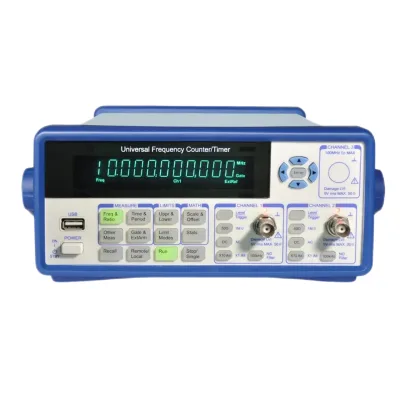
When evaluating high time resolution frequency counters, buyers must verify critical performance metrics such as frequency range, time resolution, and measurement methods. The SS7301 model, for instance, supports a maximum frequency of 26.5 GHz and a time resolution of 25 picoseconds, with a period range of 5ns to 1000s and a time interval range of 10ns to 10000s. These specifications are essential for applications requiring precise timing analysis in high-speed digital circuits or RF systems. Buyers should confirm that the selected device supports the required coupling modes, such as AC or DC, and ensure that the counting speed, typically around 10 times per second for standard models, aligns with the data acquisition rates needed for their specific tests.
For industrial or mechanical counters, verification should focus on counting range, power consumption, and operational environment compatibility. Models like the CSKE-7R offer a counting range of 0-9999999 and operate on 3W of power, making them suitable for continuous industrial use. Buyers must also check the operating temperature range, which is typically specified as 0~50℃ for many digital counters, and confirm whether the device is waterproof or requires vertical installation. Additionally, the type of counter, whether it is an addition counter, subtract counter, or reversible counter, must match the process requirements, and the presence of PLC integration, such as SE PLC compatibility, should be verified for automated systems.
Compliance and Safety Documentation
Compliance with international standards is a critical aspect of sourcing frequency counters, particularly for devices used in regulated industries or exported to specific markets. The observed listings indicate that many products carry CE, ISO, and RoHS certifications, which are essential for ensuring safety, electromagnetic compatibility, and restriction of hazardous substances. Buyers should request valid certification documents from suppliers to verify that the devices meet the necessary regulatory requirements for their target markets. This is especially important for high-frequency digital counters, which may generate electromagnetic interference that needs to be controlled to comply with local regulations.
In addition to product certifications, buyers should verify the warranty terms and after-sales support provided by the supplier. The observed warranty periods range from 12 to 18 months, which is standard for electronic and mechanical counting devices. A clear warranty policy ensures that buyers are protected against manufacturing defects and provides access to technical support for troubleshooting and calibration issues. Buyers should also confirm the availability of spare parts and the supplier’s capability to provide repair services, as this can significantly impact the total cost of ownership and operational continuity for industrial counting applications.
Cost Drivers and Commercial Terms
The cost of frequency counters is influenced by several factors, including the complexity of the measurement capabilities, the level of customization required, and the volume of the order. High-resolution digital counters with advanced statistical functions and wide frequency ranges typically command higher prices due to the sophisticated internal components and software involved. In contrast, standard mechanical or electromechanical counters are generally more affordable, with prices starting at lower thresholds. Buyers should consider the total cost of ownership, including shipping, import duties, and potential maintenance costs, when evaluating the price ranges observed in the market.
Commercial terms such as MOQ, lead time, and payment conditions also play a significant role in the procurement process. The observed MOQs range from 1 to 5,000 units, offering flexibility for both small-scale and large-scale purchases. Buyers should negotiate favorable terms based on their order volume and relationship with the supplier. Additionally, the availability of OEM/ODM services may incur additional costs but can provide significant value for companies requiring customized solutions. It is advisable to clarify all commercial terms in writing before placing an order to avoid misunderstandings and ensure a smooth transaction process.
Supplier Qualification and Quality Control
Supplier qualification is crucial for ensuring the reliability and quality of the sourced frequency counters. Buyers should verify the supplier’s manufacturing capabilities, quality control processes, and track record in the industry. Suppliers located in China, particularly in regions like Wenzhou and Jiangsu, are known for their expertise in producing a wide range of counting devices. Buyers should request information about the supplier’s production facilities, testing procedures, and quality management systems to assess their ability to consistently deliver high-quality products.
Quality control measures should include pre-shipment inspections and verification of product specifications against the agreed-upon requirements. Buyers should ensure that the devices meet the stated performance metrics, such as time resolution, frequency range, and counting accuracy. For high-resolution digital counters, calibration certificates may be required to verify the precision of the measurements. Additionally, buyers should confirm the packaging standards to ensure that the devices are protected during transit, especially for delicate electronic instruments that are sensitive to shock and vibration.
Long-Term Procurement Checks
Long-term procurement success depends on establishing a robust supply chain relationship and implementing continuous monitoring of supplier performance. Buyers should regularly review supplier delivery times, product quality, and customer service responsiveness to identify any potential issues early. Maintaining open communication with suppliers and providing feedback on product performance can help improve the overall procurement process and ensure that the sourced equipment continues to meet the evolving needs of the organization.
It is also important to stay updated on technological advancements and market trends in the frequency counter industry. As measurement technologies evolve, new features and capabilities may become available that could enhance operational efficiency and accuracy. Buyers should periodically reassess their procurement strategies and consider upgrading to newer models if they offer significant improvements in performance or cost-effectiveness. By staying informed and proactive, buyers can ensure that their sourcing decisions remain aligned with their long-term business objectives and technical requirements.
FAQs
What is the maximum frequency range for this counter?
The device supports a universal frequency range up to 26.5 GHz. It utilizes direct counting methods to ensure accurate measurements across this broad spectrum for various industrial applications.
Can the product be customized for specific needs?
Yes, customization is available for this frequency counter. Buyers can request specific configurations through OEM and ODM services to meet unique operational requirements or branding standards.
What certifications does the equipment hold?
The product holds CE, ISO, and RoHS certifications. These standards ensure compliance with international safety and environmental regulations for electronic measurement instruments used globally.
How long is the warranty period for the unit?
The warranty period is 18 months for the frequency counter. This coverage protects against manufacturing defects and ensures reliability during the initial operational phase for the buyer.
What is the time resolution capability of the device?
The device offers a time resolution of 25 PS. This high precision allows for detailed analysis of short time intervals and accurate period measurements in demanding environments.
Where is the product manufactured and shipped from?
The product originates from China, with specific manufacturing locations in Wenzhou and Jiangsu. It is packed in export standard cartons for safe international shipping and handling.
What is the operating temperature range for the counter?
The operating temperature range is 0 to 50 degrees Celsius. This specification ensures stable performance in standard industrial environments without requiring additional cooling or heating systems.