Source Industrial Network Switch for Automation, Rail, and Factory
Find 30 Industrial Network Switch options with varying transmission rates, mounting types, and protection levels. Compare specifications for Full-Duplex, Half-Duplex, and Optical Switch models suitable for diverse industrial environments.
Key considerations
Products List


Comprehensive Sourcing Guide
Industrial Network Switch Sourcing Guide
Procuring industrial network switches requires a disciplined approach to distinguishing between commercial-grade hardware and equipment designed for harsh environments. The observed market data indicates a diverse range of models, from the CD-SW-8 series to specialized optical switches, each serving distinct connectivity needs in demanding settings. Buyers must carefully evaluate the specific operational context, such as whether the deployment requires full-duplex communication or specific transmission rates like 100Mbps, to ensure the selected hardware aligns with the network architecture.
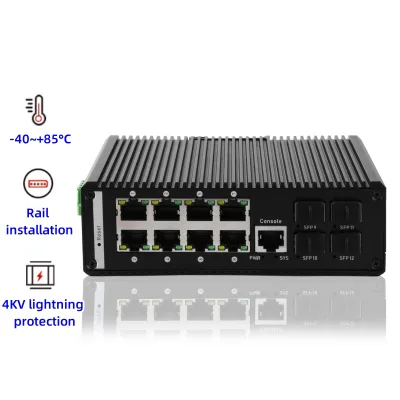
The physical durability of the switch is often the primary differentiator in industrial applications, where standard office equipment would fail rapidly. Evidence from current listings highlights the prevalence of metal shells and IP40 protection levels, which are essential for resisting dust, moisture, and physical impact in factory floors or outdoor substations. Understanding these physical attributes allows procurement teams to filter out unsuitable consumer-grade options and focus on units capable of withstanding the rigors of continuous industrial operation.
Product Scope and Observed Listing Signals
The current market for industrial network switches presents a wide spectrum of configurations, ranging from basic 10/100Mbps Ethernet switches to high-speed 10/100/1000Mbps optical variants. Listings show specific model identifiers such as CD-SW-5, CD-SW-8, and CD-SW-8-PN, alongside generic designations like "Industrial switch 1," indicating that buyers must verify the exact model number against their technical requirements rather than relying on generic product titles. This variation suggests that a single supplier may offer multiple tiers of performance, necessitating a clear definition of port density and speed requirements before initiating contact.
Physical form factors and mounting options are critical signals that define the suitability of a switch for a specific installation site. The observed data confirms the availability of standard DIN35mm rail mounting and wall mounting options, which are standard for industrial control panels and cabinet installations. Additionally, the presence of specific dimensions, such as 40.678103mm or 42.5 x 120 x 161mm, provides tangible evidence of the space constraints a buyer must account for when planning rack or panel layouts.
Technical Specifications to Verify
Transmission speed and communication mode are the foundational technical parameters that dictate network performance and latency. Buyers should verify whether the switch supports full-duplex or half-duplex modes, as this impacts data throughput efficiency in bidirectional communication scenarios. The observed listings indicate a mix of 100Mbps and 10/100/1000Mbps capabilities, requiring the procurement team to match the switch's port transmission rate to the bandwidth demands of the connected sensors, PLCs, or cameras to prevent bottlenecks.
Environmental resilience and power requirements are equally critical for ensuring uninterrupted operation in challenging conditions. The data highlights a storage temperature range of -40 to 85℃ and a working temperature of -40 to 75℃, which are vital for deployments in unheated warehouses or outdoor enclosures. Furthermore, power consumption figures ranging from under 5W to under 15W, along with power supply options like 12~36V DC or 220V AC, must be cross-referenced with the facility's available power infrastructure to ensure compatibility and energy efficiency.
Compliance and Safety Documentation
Safety and regulatory compliance are non-negotiable prerequisites for industrial equipment, particularly when the hardware operates in close proximity to personnel or critical infrastructure. The observed listings reference standards such as ROHS, CE, and ISO, which indicate adherence to environmental and safety guidelines, though buyers must request specific certification documents to confirm the validity of these claims for the exact model being purchased. Relying on general standard mentions without verified documentation can lead to compliance gaps during regulatory audits or safety inspections.
Electrical safety and surge protection capabilities are essential for mitigating the risks associated with unstable power grids common in industrial zones. Specific attributes like a 4kV surge protection rating and a lifetime of 12 years or 100,000 switch cycles provide a baseline for durability, but these figures should be validated against the specific electrical environment of the installation site. Buyers should also verify the IP rating, noting that while some units offer IP40 protection, others may be listed as "Without Switch" regarding IP ratings, requiring careful selection to ensure adequate ingress protection for the intended location.
Cost Drivers and Commercial Terms
Pricing in the industrial switch market is influenced by a complex interplay of technical specifications, build quality, and order volume. The observed price range spans from $0.4 to $9,999, reflecting the vast difference between basic connectivity modules and high-end, ruggedized optical switches with advanced features. This wide variance underscores the importance of defining the exact technical scope before requesting quotes, as purchasing a high-specification unit for a low-demand application results in unnecessary capital expenditure.
Minimum Order Quantities (MOQ) and packaging standards significantly impact the total cost of ownership and logistics planning. Listings show MOQs ranging from 1 to 10,000 units, offering flexibility for small pilot projects while accommodating large-scale deployments. Packaging details, such as carton, original packing, or individual packages, affect shipping costs and the ease of inventory management, making it essential for buyers to negotiate terms that align with their warehousing capabilities and distribution requirements.
Supplier Qualification and Quality Control
Supplier reliability is paramount when sourcing industrial hardware that must operate continuously without failure. The observed data mentions a 3-year quality guarantee, which serves as a baseline for after-sales support, but buyers should investigate the supplier's track record for honoring these guarantees and providing timely technical assistance. A robust supplier relationship often includes access to detailed product documentation, firmware updates, and replacement policies that are critical for maintaining network uptime in mission-critical applications.
Quality control processes extend beyond the initial purchase to include verification of material composition and manufacturing consistency. The use of PC materials and metal shells suggests a focus on durability, yet buyers should request evidence of consistent manufacturing standards across batches. Additionally, the origin of the products, noted as China or specific regions like Wenzhou, Zhejiang, should be considered in the context of supply chain stability and the potential for logistical delays, ensuring that the supplier has the capacity to meet delivery schedules consistently.
Long-Term Procurement Checks
Sustaining a reliable industrial network infrastructure requires a proactive approach to lifecycle management and future-proofing. Buyers should establish a protocol for monitoring the performance of deployed switches, specifically tracking metrics like power consumption and temperature stability to identify potential failures before they disrupt operations. The observed lifetime specifications, such as 12 years or 100,000 switch cycles, provide a theoretical lifespan, but real-world conditions often necessitate earlier replacement or maintenance interventions based on actual usage patterns.
Strategic procurement planning involves maintaining a relationship with suppliers who can support long-term compatibility and upgrades. As network demands evolve, the ability to source compatible models, such as upgrading from 100Mbps to 1000Mbps switches, becomes crucial. Buyers should verify that the supplier offers a consistent product line or clear upgrade paths, ensuring that new acquisitions integrate seamlessly with existing infrastructure and that spare parts remain available for the duration of the equipment's operational life.
FAQs
What is the typical transmission rate for industrial network switches?
Industrial network switches commonly support transmission rates of 10/100Mbps or 10/100/1000Mbps. The specific rate depends on the model, with some units designed for half-duplex or full-duplex communication modes to handle varying data loads.
How are industrial network switches typically mounted in industrial environments?
These switches are usually mounted using standard DIN35mm rails or wall mounting options. This flexibility allows for secure installation in control cabinets or on structural walls, ensuring stability in demanding industrial settings.
What protection level do industrial network switches offer against dust?
Many industrial network switches feature an IP40 protection level, which provides basic protection against solid objects larger than 1mm. This rating is suitable for indoor industrial environments where dust exposure is moderate.
Can industrial network switches be customized for specific project requirements?
Yes, customization is available for industrial network switches. Buyers can request specific configurations to match their network architecture, ensuring the device integrates seamlessly with existing industrial control systems and infrastructure.
What is the standard warranty period for industrial network switches?
A quality guarantee of 3 years is commonly provided for industrial network switches. This warranty period covers manufacturing defects and ensures reliable performance over the initial operational phase of the equipment.
What power consumption range is typical for industrial network switches?
Power consumption for these switches typically ranges from less than 5W to less than 15W, depending on the model and port count. Efficient power usage is critical for maintaining stable operation in continuous industrial applications.
What materials are used for the outer shell of industrial network switches?
The outer shell of industrial network switches is often made of metal to provide durability and heat dissipation. Some models may use PC material, but metal shells are preferred for their robustness in harsh industrial conditions.