Source Inflatable Rib Fiberglass Boat for Sport Fishing, Rescue, and Patrol
Explore 30 listings for the Inflatable Rib Fiberglass Boat, comparing models like Rib 390, Rib 430, and Rib 700. Buyers can evaluate hull materials, engine types, and load capacities to find the right vessel for sport fishing, rescue operations, or patrol duties.
Key considerations
Products List


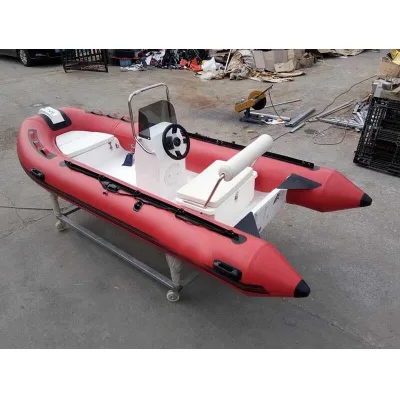


Black Fiberglass Hull Recreational Ribs and Inflatable Boat with Europe Ce Approval
$6750.00 - $6850.00
MOQ: 1 Pieces


Rib Boat Rib 400 400cm Rigid Inflatable Fiberglass Inflatable Rib Boat Rib 400
$1995.00 - $2220.00
MOQ: 1 Pieces

Rib Boat Prices 12.8 Feet Rib390 Fiberglass Rigid Inflatable Recreational Rib Boat Prices
$1999.00 - $2220.00
MOQ: 1 Pieces


17FT 5.2m Inflatable Boat Rib Fiberglass Boat PVC or Hypalon Fishing Boat
$3500.00 - $5000.00
MOQ: 1 set


19feet 5.8m Fiberglass Fishing Boat / Rigid Inflatable Boat/Speed Boat/Boat
$5000.00 - $7400.00
MOQ: 1 set

Ilife Hot Sale Inflatable Style Rib Fiberglass Boat 330b for Sale
$1232.00 - $1796.00
MOQ: 1 Piece/Pieces
Comprehensive Sourcing Guide
Strategic Sourcing Guide for Inflatable RIB and Fiberglass Boat Procurement
Understanding the Hybrid Hull Architecture and Material Composition
The core keyword "Inflatable Rib Fiberglass Boat" describes a specific vessel category that merges the structural rigidity of a hard hull with the buoyancy and shock absorption of inflatable tubes. In the current market, procurement data indicates a divergence in manufacturing approaches. Some listings explicitly identify the hull material as fiberglass, while others specify high-density synthetic materials such as 1.2mm PVC or Hypalon. This distinction is critical for buyers, as the choice of material dictates the vessel's durability, weight, and maintenance profile.
When evaluating suppliers, it is essential to recognize that "RIB" (Rigid Inflatable Boat) traditionally implies a fiberglass or aluminum hull bottom paired with inflatable collars. However, the observed product data reveals a spectrum of configurations. Some units are described with a fiberglass hull, while others utilize 1.2mm PVC/Hypalon or even 1.2mm PVC/Hypalon/Orca composites for the entire structure or specific components. The presence of "1.2mmpvc/Hypalon" suggests a focus on high abrasion resistance and UV stability, which is vital for commercial and sport applications. Conversely, fiberglass hulls offer superior impact resistance and a smoother ride in rough seas but may add significant weight compared to fully inflatable or composite designs.
Buyers must verify the specific material composition for each model number. For instance, the "Rib 700" and "Rib 390" models appear in the data with varying material specifications. The "Rib 430" model is noted with a specific width of 200cm and a hull technology described as "by Vacuum Absorption," a process that typically ensures a high-quality resin distribution and structural integrity in composite hulls. When sourcing, the procurement team should request material datasheets to confirm whether the "fiberglass" claim applies to the hull bottom only or if the inflatable tubes are constructed from Hypalon, PVC, or a hybrid. The distinction between "Inflatable" and "Unfolded" states in the product attributes further suggests that some units may be designed for transport efficiency, requiring verification of the inflation mechanism and tube thickness.
Technical Specifications and Performance Parameters
Technical due diligence requires a granular analysis of the specifications provided in the product listings. The observed data presents a wide range of dimensions, capacities, and power requirements, indicating that the market offers solutions for diverse operational needs. Length is a primary differentiator, with observed ranges spanning from under 6 meters to 10.5 meters. Specific model numbers provide concrete benchmarks: the "Rib 390" corresponds to a standard length of 390cm, the "Rib 430" to 430cm, and the "Rib 700" to 700cm. The "Rhib 480" model is listed with a standard length of 480cm.
Capacity and load-bearing capabilities are equally critical for safety and compliance. The data shows a capacity range from 4 persons to 12 persons. The "Rib 390" is associated with a 4-person capacity and a maximum load of 870kg. The "Rib 430" supports 5 persons with a max load of 680kg, while the "Rhib 480" accommodates 8 persons. The "Rib 700" model is listed with a significantly higher capacity of 12 persons and a maximum load of 2300kg. These figures must be cross-referenced with the intended usage. For example, a vessel listed with a "Sport Fisherman" usage and a "Sport Yacht" type may have different stability requirements than a "Fishing" or "Tandem Kayak" style vessel.
Power systems are another key technical variable. The data indicates that outboard engines are the standard propulsion method. The "Rib 430" model is specified with a maximum outboard engine of 70 HP, while the "Rhib 480" lists an authorized maximum power of 85 HP. Buyers must ensure that the selected vessel's hull design and tube configuration can safely support the intended engine power. Exceeding the authorized maximum power can compromise the structural integrity of the inflatable tubes and the stability of the hull. Additionally, the "Total Weight (Kg)" for the "Rhib 480" is listed as 130kg, which is a crucial figure for transport logistics and trailer compatibility.
Compliance, Certification, and Regulatory Standards
Navigating the regulatory landscape is a non-negotiable aspect of B2B procurement for marine vessels. The observed product data highlights specific certifications, including "Ce" and "CE/Ukca". The presence of "CE" certification suggests compliance with European Union safety, health, and environmental protection requirements. The "CE/Ukca" marking indicates that the product meets both EU standards and the United Kingdom Conformity Assessed standards, which is essential for selling or operating in the UK post-Brexit.
However, buyers must exercise caution. The provided data lists "CE" as a high-confidence fact for some items but also includes a low-confidence background note regarding "CE". This discrepancy underscores the need for rigorous verification. Procurement teams should not rely solely on the product page listing but must request valid, current certification documents from the supplier. These documents should be traceable to a recognized Notified Body and should specifically cover the model in question. The "Hscode 8903190000" is also listed, which classifies inflatable boats under the Harmonized System. This code is vital for customs clearance and duty calculation, and buyers should verify that the supplier's classification aligns with the actual vessel construction to avoid customs delays or penalties.
Furthermore, the "prod_standard" field lists specific length standards, such as "Length 700cm" for the Rib 700. While these appear to be internal manufacturer standards, they serve as a baseline for quality control. Buyers should verify if these standards align with international maritime safety regulations, such as those from ISO or RIB manufacturers' associations. The "After-Sales Service" attributes, ranging from "3" to "3-5years", suggest varying levels of warranty coverage. A "3-5years" service claim requires a clear definition of what is covered, including labor, parts, and the scope of the warranty, to ensure long-term value.
Cost Drivers and Pricing Dynamics
The pricing landscape for inflatable RIB and fiberglass boats is influenced by multiple factors, including hull material, size, engine compatibility, and customization options. The observed price range in the market is substantial, spanning from $670 to $12,100 USD. This wide variance reflects the difference between smaller, entry-level inflatable boats and larger, more complex sport yachts or commercial-grade vessels.
Several key drivers contribute to these costs. First, the hull material is a primary cost factor. Fiberglass hulls generally command a higher price than PVC or Hypalon-only structures due to the manufacturing complexity and material costs. Second, the size of the vessel directly impacts the price. The "Rib 700" with a 12-person capacity and 2300kg load capacity is likely at the higher end of the price spectrum compared to the "Rib 390" with a 4-person capacity. Third, customization availability is a significant value-add. The data confirms that "Customization" is available, which can increase the unit price but allows buyers to tailor the vessel to specific operational needs, such as specialized seating, storage compartments, or color schemes.
The "prod_packing" method also influences the final landed cost. Some models are packed in "Large Cabinets," while others use "Wooden Boxes." Wooden boxes are often more expensive but provide superior protection during international shipping, potentially reducing the risk of damage. The "Folded" attribute for some models suggests that compact packaging may reduce shipping volume and costs, which is a consideration for buyers with limited storage or transport capacity. Buyers should request a detailed breakdown of the FOB (Free on Board) price versus the CIF (Cost, Insurance, and Freight) price to understand the total cost of ownership, including shipping, insurance, and import duties.
Typical Applications and Operational Use Cases
The versatility of inflatable RIB and fiberglass boats makes them suitable for a wide array of applications, as evidenced by the diverse usage tags in the product data. The "Sport Fisherman" and "Sport Yacht" classifications indicate a strong presence in the recreational and luxury marine sectors. These vessels are designed for speed, stability, and comfort, often featuring spacious decks and high-performance outboard engines. The "Yellow" and "White" color options suggest that aesthetics play a role in the sport and luxury market, where brand identity and visual appeal are important.
In contrast, the "Fishing" usage tag points to a more utilitarian application. These boats are often equipped with rod holders, live wells, and durable flooring to withstand the rigors of commercial or serious recreational fishing. The "Tandem Kayak" style listed for the "Rhib 480" model suggests a niche application for paddling or low-speed exploration, highlighting the adaptability of the inflatable design. The "Rib 430" with a 200cm width and vacuum absorption technology offers a stable platform for various activities, from rescue operations to patrol duties.
The capacity and load limits further define the operational scope. A 12-person capacity vessel like the "Rib 700" is ideal for group tours, training, or small-scale commercial transport. The 4-person "Rib 390" is better suited for personal use or small team operations. Buyers should align the vessel's specifications with their intended use case. For example, a vessel intended for high-speed rescue operations would require a high-power engine and a robust hull, while a leisure fishing boat might prioritize storage and comfort over raw speed.
Supplier Evaluation and Quality Assurance Protocols
Selecting the right supplier is paramount to ensuring product quality and long-term reliability. The data indicates that the "prod_origin" is China, which is a major manufacturing hub for marine vessels. However, the origin alone does not guarantee quality. Buyers must evaluate suppliers based on their technical capabilities, quality control processes, and after-sales support. The "After-Sales Service" ranging from 3 to 5 years is a strong indicator of supplier confidence, but the terms must be clearly defined.
Quality control should focus on the manufacturing process. The "Rib Hull Technology: by Vacuum Absorption" is a specific process that should be verified. This technique typically results in a higher quality laminate with fewer voids and better structural integrity. Buyers should request photos or videos of the production line to confirm that the supplier utilizes advanced manufacturing methods. Additionally, the "Max Load" and "Capacity" figures must be validated through third-party testing or certification. Relying solely on manufacturer claims can be risky; independent verification ensures that the vessel can safely handle the intended load.
The "Certification" status, particularly "CE" and "CE/Ukca", should be a primary filter for supplier evaluation. Buyers should verify that the supplier has a valid certification for the specific model and that the certification is current. The "Hscode" should also be checked to ensure accurate classification. Finally, the "prod_packing" method should be assessed to ensure that the vessel will arrive in good condition. A supplier that uses "Wooden Box" packing demonstrates a commitment to protecting their product during transit, which is a positive sign of their overall quality standards.
Long-Term Procurement and Lifecycle Management
Procuring an inflatable RIB or fiberglass boat is a long-term investment that requires careful consideration of maintenance, storage, and lifecycle costs. The "Inflatable" and "Folded" attributes suggest that some models are designed for easy storage and transport, which can reduce long-term storage costs. However, inflatable components require regular maintenance to prevent leaks, UV degradation, and abrasion. Buyers should inquire about the availability of replacement parts, such as tubes, valves, and repair kits, to ensure the vessel remains operational for its intended lifespan.
The "After-Sales Service" warranty is a critical component of long-term value. A 3-5 year warranty provides a safety net against manufacturing defects, but buyers should understand the exclusions and limitations. Regular maintenance schedules, including tube inflation checks, hull cleaning, and engine servicing, are essential to maximize the vessel's lifespan. The "Customization" option allows buyers to future-proof their investment by adding features that may become necessary as their operational needs evolve.
Finally, buyers should consider the resale value and market demand for the specific model. Vessels with recognized certifications, robust build quality, and versatile applications tend to retain value better. By focusing on technical specifications, compliance, and supplier reliability, buyers can make informed decisions that ensure the long-term success of their marine operations. The wide range of options, from the compact "Rib 390" to the robust "Rib 700", offers flexibility for various budgets and needs, provided that the procurement process is grounded in rigorous due diligence and evidence-based evaluation.
FAQs
Can I customize the Inflatable Rib Fiberglass Boat for specific needs?
Yes, customization is available for these vessels to meet specific operational requirements. Buyers should verify the scope of customization, such as color, seating, or storage, before placing an order to ensure the final product matches their intended use case.
What is the maximum load capacity for the Rib 700 model?
The Rib 700 model supports a maximum load of 2300kg. This high capacity allows it to accommodate up to 12 persons, making it suitable for group tours or commercial transport where heavy payload and passenger volume are critical factors.
Which certification does the Rib 430 model hold for European markets?
The Rib 430 model holds CE and UKCA certifications for compliance in European and UK markets. These certifications indicate adherence to safety and environmental standards, but buyers must request valid documents from the supplier to confirm current validity.
How long is the lead time for the Rib 390 inflatable boat?
The provided product data does not list specific lead times for the Rib 390 model. Buyers must contact suppliers directly to obtain accurate delivery schedules, as lead times vary based on production capacity and current order volumes.
What material is used for the inflatable tubes on the Rib 430?
The inflatable tubes are constructed from 1.2mm PVC, Hypalon, or Orca composite materials. This combination offers high abrasion resistance and UV stability, which is essential for durability in both sport fishing and commercial rescue applications.
Which packaging method is used for the Rib 700 large vessel?
The Rib 700 is packed in a large cabinet to ensure safe international transport. This robust packaging protects the vessel during shipping, though buyers should confirm if wooden boxes are available for smaller models like the Rib 390.
Can the Rib 480 model be used for tandem kayaking activities?
Yes, the Rib 480 model is listed with a tandem kayak style for low-speed exploration. It accommodates up to 8 persons and features a total weight of 130kg, making it versatile for both paddling and motorized operations.