Source Multicolor PVC Card Embosser for Retail, Banking, and Events
Compare 30 listings for Multicolor PVC Card Embosser options including manual and semi-automatic models. Buyers can evaluate specifications like ISO standards, printing types, and customization features for shopping, banking, and event applications.
Key considerations
Products List




Comprehensive Sourcing Guide
Strategic Sourcing Guide for Multicolor PVC Card Embossing Solutions
The procurement of multicolor PVC card embossing equipment represents a specialized intersection of printing technology, material science, and mechanical precision. Buyers entering this market must navigate a complex landscape where "multicolor" capabilities often rely on hybrid processes rather than a single integrated embossing action. The core keyword suggests a need for machines capable of handling Polyvinyl Chloride (PVC) substrates while delivering high-fidelity, multi-hue visual outputs alongside raised text or graphics. This guide synthesizes available product attributes and industry standards to provide a disciplined framework for evaluating potential suppliers and equipment configurations.
Technical Architecture and Printing Integration
Understanding the technical architecture of a multicolor PVC embosser is the first step in any sourcing strategy. Based on observed product data, the market offers distinct configurations ranging from fully manual units to semi-automatic systems. A critical observation is that the term "embosser" in this context often refers to a mechanical device that creates raised impressions, while the "multicolor" aspect is frequently achieved through separate or integrated printing processes such as Offset, Screen, Silk Screen, Digital, or Ink Jet printing.
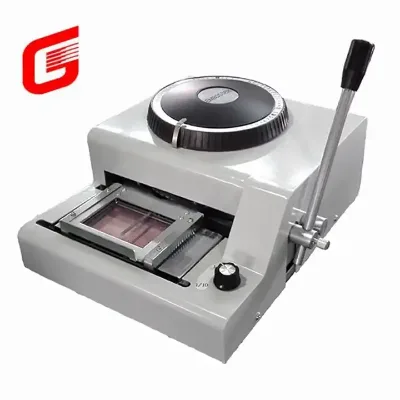
For instance, specific models identified in the market, such as the YQW-3000 and YQW-2000, are explicitly classified as "Manual" and "Non-Computerized" units. These machines typically feature compact dimensions, with the YQW-3000 measuring L400mmW350mmH250mm and the YQW-2000 at L330mmW260mmH125mm. While these units excel at mechanical embossing, achieving multicolor results usually requires a preceding or subsequent printing step. Buyers should verify if the supplier offers a complete workflow solution or if the embosser is a standalone component requiring a separate printing press.
The material compatibility is a key technical constraint. The supplied data confirms that PVC is a primary material, with specific references to "White PVC" and "Plastic" substrates. The embossing process must be compatible with the thermal and mechanical properties of PVC. Some systems utilize "Semi-Automatic" grades, which may offer a balance between manual control and automated feeding, though the specific automation level must be confirmed against the buyer's production volume requirements. The presence of "Artificial Leather" and "Paper" as application materials suggests that some machines are versatile, but the primary focus for PVC cards requires specific die hardness and pressure settings to avoid material deformation.
Compliance Standards and Certification Verification
In the realm of card manufacturing, adherence to international standards is non-negotiable, particularly for products intended for financial, identification, or access control applications. The sourcing guide must prioritize verification of compliance with ISO standards, which govern the physical dimensions and magnetic properties of cards.
Data indicates that specific PVC card products adhere to ISO 7810 and ISO CR80 standards. The ISO CR80 standard defines the physical dimensions as 3.375" x 2.125" with a thickness tolerance, often cited as 760 microns. When sourcing an embosser, the machine's die set must be calibrated to produce impressions that do not compromise the card's compliance with these dimensions. If the embossing depth is excessive, it may interfere with the card's ability to fit into standard readers or wallets, violating the ISO 7810 profile.
Furthermore, electrical safety and operational certifications are critical. The provided facts mention "CE" certification for certain embossing machines originating from Zhejiang, China. Buyers should request valid CE documentation to ensure the equipment meets European safety directives regarding machinery and electrical components. For markets outside Europe, equivalent certifications such as UL or local regulatory approvals should be verified. It is also essential to check if the machine's operation aligns with the "ISO Loco Magnetic Stripe" specifications if the embossing process involves cards that will subsequently be encoded with magnetic data. The embossing process must not damage the magnetic stripe located on the back of the card, which is a common requirement for "Shopping" and "Artificial Leather" applications.
Cost Drivers and Pricing Dynamics
The pricing structure for multicolor PVC card embossing solutions is highly variable, driven by the level of automation, the complexity of the printing integration, and the build quality of the mechanical components. The observed market data reveals a staggering price range from $0.03 to $250,000 USD. This wide spectrum indicates that the "multicolor" capability is not a single product attribute but a system configuration.
Low-cost entries in the $0.03 to $100 range likely correspond to manual dies, replacement parts, or simple hand-operated embossing tools that require manual color application or are used in conjunction with pre-printed cards. Conversely, the high-end figures approaching $250,000 suggest fully automated, computerized systems that integrate offset printing, embossing, and finishing in a single line.
Buyers must analyze the "Minimum Order Quantity" (MOQ) as a cost driver. The observed MOQ ranges from 1 to 50,000 units. For small-scale operations, an MOQ of 1 for a manual machine may be feasible, but for custom dies or specialized semi-automatic units, the MOQ could be significantly higher. The "Customization" attribute is available in the market, which often incurs additional costs for tooling and setup. Buyers should also consider the "Packing" requirements; standard export wooden boxes or cartons add to the logistics cost, especially for heavy machinery like the 13kg gross weight units observed.
Operational Applications and Use Cases
The versatility of multicolor PVC embossing machines allows for a broad range of applications, from commercial retail to industrial identification. The data highlights "Shopping" as a primary industrial use, suggesting these machines are suitable for creating loyalty cards, membership passes, and promotional vouchers. The ability to apply "Full Colors Design" via offset and screen processes makes these cards visually appealing for marketing purposes.
Beyond retail, the "Personalization Available" attributes, including numbers, barcodes, QR codes, and encoding, point to applications in access control and identification. The "Magnetic Stripe" and "Signature Panel" accessories indicate that these cards are designed for secure transactions. The "Stamped Foil" and "Embossing Phone Number" features are common in high-end corporate identification or event management.
The "Type: Paper Embossing Machine" classification in some data points suggests that while the primary material is PVC, the mechanical principles may overlap with paper embossing. However, for PVC, the durability of the embossed impression is paramount. The "Surface Finish: Film Lamination" attribute is crucial for protecting the multicolor print and the embossed text from wear and tear, ensuring the card remains legible and functional over its lifespan.
Supplier Evaluation and Origin Analysis
When evaluating suppliers, the geographic origin of the equipment provides insights into manufacturing capabilities and logistics. The data shows origins in Wuhan, Hubei; Shanghai, China; and Zhejiang, China. These regions are known for their manufacturing clusters, but buyers should not assume uniform quality.
Suppliers from Shanghai and Zhejiang are often associated with higher precision engineering and export compliance, given the proximity to major ports and established industrial zones. The "Standard Export Wooden Box" packing mentioned for units from Wuhan suggests a focus on protecting the equipment during long-distance shipping. Buyers should verify the "Delivery Time," which is observed at 15 days for some units, and ensure this aligns with their project timelines.
The "Accessory" and "Feature" lists provide a checklist for supplier capability. A supplier offering "Moisture Proof" features and "Glossy, Matt, Frosted with Overlay" lamination options demonstrates a comprehensive understanding of card finishing. Buyers should request samples that demonstrate the integration of "Silk Screen Printing," "Digital Printing," and "Laser Printing" to ensure the supplier can handle the specific multicolor requirements of the project.
Quality Control and Long-Term Procurement
Quality control in PVC card embossing extends beyond the initial purchase. The "Net Weight" and "Gross Weight" of the machines, such as the 9kg net and 13kg gross weights observed, are indicators of build quality. Heavier machines often imply more robust frames and better vibration damping, which is essential for precise embossing.
Buyers must establish a quality control protocol for the embossing depth and alignment. The "Embosser Dimension" of 270160340mm for manual units suggests a specific footprint that must be accommodated in the production facility. Long-term procurement considerations include the availability of replacement dies and the ease of maintenance for "Semi-Automatic" systems. The "Customization" availability is a positive sign for long-term adaptability, allowing the buyer to update designs without replacing the entire machine.
Furthermore, the "Delivery Time" of 15 days should be treated as a baseline. Buyers must account for potential delays in shipping, customs clearance, and installation. The "Air, Ocean, Express" shipping options indicate flexibility, but the cost implications of each must be factored into the total cost of ownership.
Comparative Analysis of Equipment Configurations
To assist in decision-making, the following table summarizes the key distinctions between the observed equipment configurations:
| Feature | Manual Embosser (e.g., YQW Series) | Semi-Automatic / Integrated Systems |
|---|---|---|
| Operation Mode | Non-Computerized, Manual | Semi-Automatic, potentially Computerized |
| Dimensions | Compact (e.g., 330mm x 260mm x 125mm) | Variable, often larger footprint |
| Weight | Light (e.g., 9kg Net) | Heavier, robust construction |
| Printing Integration | External or Pre-printed | Often Integrated (Offset/Screen) |
| Certification | CE (varies by model) | CE, ISO compliance verification needed |
| Best For | Low volume, high customization | High volume, consistent multicolor output |
| Material | PVC, Paper, Artificial Leather | Primarily PVC for card applications |
This comparison highlights that while manual units offer flexibility and lower entry costs, they lack the throughput and consistency required for large-scale multicolor production. The decision ultimately depends on the buyer's volume needs and the complexity of the card designs.
Conclusion
Sourcing a Multicolor PVC Card Embosser requires a meticulous approach that balances technical specifications, compliance requirements, and cost factors. Buyers must look beyond the basic "embosser" label and understand the full workflow required to achieve multicolor results. By verifying ISO standards, checking for CE certification, and evaluating the supplier's ability to handle specific materials like White PVC and Artificial Leather, buyers can mitigate risks. The wide range of observed prices and MOQs necessitates a clear definition of project scope before engaging with suppliers. Ultimately, the goal is to secure a solution that ensures high-quality, durable, and compliant card production, whether for shopping, identification, or promotional purposes.
FAQs
Can multicolor PVC cards be embossed manually?
Yes, manual non-computerized embossers like the YQW-3000 can process these cards. However, achieving multicolor results typically requires a separate printing process such as offset or screen printing before the embossing step.
What standards do PVC card embossers support?
These machines support ISO 7810 and ISO CR80 standards for card dimensions and magnetic stripes. Buyers must ensure the embossing depth does not violate the 760-micron thickness tolerance defined by ISO CR80.
Which printing methods work with PVC embossing?
Compatible methods include offset, screen, silk screen, digital, and laser printing. The machine must handle materials like white PVC and plastic while allowing for full-color designs and foil stamping.
How long is the delivery time for these machines?
The standard delivery time is approximately 15 days for manual units. This timeline may vary based on the specific model, customization requirements, and shipping method selected from air, ocean, or express options.
What certifications are available for these embossers?
Some manual embossers originating from Zhejiang, China, carry CE certification. Buyers should verify this documentation to ensure the equipment meets European safety directives for machinery and electrical components.
Can I customize the embossed text and graphics?
Customization is available for numbers, barcodes, QR codes, and phone numbers. The machine supports personalization features like magnetic stripes and signature panels, though tooling costs may apply for unique dies.