Source NFC Google Review Cards for Marketing, Payments, and Events
Compare 30 NFC Google Review Cards from Chinese suppliers. Evaluate customization, chip types, and pricing for identification, payment, and advertising. These passive high-frequency cards support read-write functions with standard or custom sizes. Explore printing options, data storage, and sensing distances to find the best fit for your needs.
Key considerations
Products List


NFC Google Review Display Qr Code for Google Review Social Media NFC Card
$0.50 - $1.00
MOQ: 100 Pieces


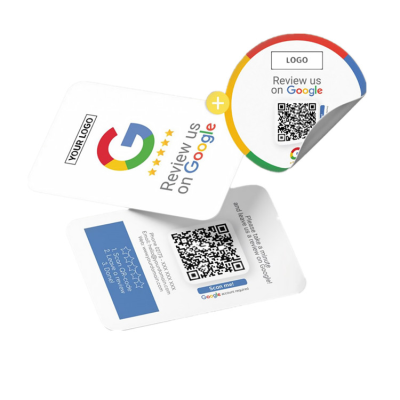


Factory Review Cards Google Review PVC NFC Tap Social RFID Business Cards
$0.75 - $2.50
MOQ: 100 Pieces

Comprehensive Sourcing Guide
NFC Google Review Cards Sourcing Guide
Procurement of NFC Google Review Cards requires careful attention to the specific functional requirements of passive smart card technology. These devices operate without an internal power source, relying on the energy from a reader's field to transmit data for identification and encryption purposes. Buyers must verify that the selected units support the necessary high-frequency protocols to ensure seamless interaction with standard mobile devices and point-of-sale terminals.
The application scope extends beyond simple identification to include dynamic advertising and information retrieval in outdoor environments. Sourcing teams should prioritize suppliers who offer customization options for color and branding, as these cards often serve as marketing tools for businesses seeking to enhance customer engagement. Understanding the distinction between memory and smart card architectures is essential for selecting the right product for specific data storage and security needs.
Product Scope and Observed Listing Signals
Market listings for these cards typically indicate a price range between 0.05 and 2.5 USD, reflecting the variability in customization levels and material quality. Minimum order quantities generally span from 50 to 2000 units, allowing flexibility for both small pilot projects and large-scale distribution campaigns. Buyers should expect standard export packaging, often consisting of paper cases or cartons containing 200 to 5000 pieces, depending on the specific supplier configuration.
Observed product models include specific identifiers like "NFC Google Review Card" and "001," alongside generic descriptions such as "smart card 19." The physical dimensions are frequently standardized at 85.5 by 54 millimeters, though customized sizes are available to meet unique branding requirements. It is critical to confirm the exact model number and material composition, as some listings specify PVC while others may include PET or ABS components in the packaging materials.
Technical Specifications to Verify
Technical due diligence must focus on the communication protocol and data transmission capabilities of the card. Most observed units adhere to the ISO 14443A standard, utilizing a parallel data transmission mode for efficient read-write operations. Buyers should verify the sensing distance, which typically ranges from 0 to 10 centimeters, ensuring the card functions reliably within the intended user interaction zone without requiring excessive proximity.
Data integrity and longevity are paramount for long-term utility, with storage capacities observed at 1024 or 1152 bits and a data retention period of up to 10 years. The erase and write life cycle is a critical metric, with some specifications citing 100,000 cycles while others suggest 10,000 cycles, directly impacting the card's suitability for high-frequency use cases. Additionally, the read and write time, often measured in milliseconds, should be confirmed to ensure it meets the speed requirements of the target application environment.
Compliance and Safety Documentation
While specific certification documents are not explicitly detailed in the provided listings, buyers must request evidence of compliance with relevant international standards for electronic components. The product standards mentioned often refer to physical dimensions or packaging quantities rather than safety certifications, necessitating a direct inquiry into whether the manufacturer adheres to RoHS or REACH regulations for material safety.
Safety documentation should also cover the operational temperature range, which is observed to span from -25 to 80 degrees Celsius, ensuring reliability in diverse environmental conditions. Procurement teams should verify that the manufacturing origin, whether Wuhan, Chengdu, or Shenzhen, aligns with the buyer's regional compliance requirements and that the supplier can provide necessary test reports for the specific chip models used, such as the 215 or 213 series.
Cost Drivers and Commercial Terms
The final cost of NFC Google Review Cards is heavily influenced by the level of customization required, particularly regarding color, printing methods, and chip selection. Full-color offset printing and silk printing are common options that can increase unit costs, while dynamic QR code integration adds another layer of complexity to the production process. Buyers should anticipate that customized standard sizes or specific chip materials will command a premium over generic, off-the-shelf configurations.
Commercial terms regarding packaging and shipping logistics play a significant role in the total landed cost. Suppliers typically offer bulk packaging options ranging from 200 pieces per box to 5000 pieces per carton, which affects handling efficiency and storage requirements. It is essential to clarify the lead times and shipping terms associated with these volume tiers, as larger orders may offer better unit pricing but require longer production windows and more complex logistics coordination.
Supplier Qualification and Quality Control
Supplier qualification should begin with a verification of their manufacturing location and production capacity, as origins in Hubei, Sichuan, and Guangdong indicate different logistical and regulatory environments. Buyers must assess the supplier's ability to maintain consistent quality across large batches, given the observed variations in erase/write cycles and storage capacities across different product models.
Quality control protocols must include rigorous testing of the read-write time and sensing distance to ensure every unit performs within the specified parameters. Since the product attributes are treated as observations rather than universal claims, buyers should request sample testing results for the specific batch they intend to purchase. This verification step is crucial to confirm that the dynamic QR code functionality and encryption features operate correctly before committing to a full production run.
Long-Term Procurement Checks
Sustaining a successful supply chain for NFC Google Review Cards requires ongoing monitoring of the supplier's ability to maintain consistent material quality and production standards. Buyers should establish a schedule for periodic audits to ensure that the PVC or composite materials used continue to meet durability expectations and that the data storage capabilities remain stable over the product's lifecycle.
Long-term checks must also include a review of the supplier's responsiveness to customization requests and their ability to adapt to changing market demands. As the technology evolves, the supplier should demonstrate flexibility in updating chip models or printing techniques to keep the product competitive. Establishing a clear communication channel for feedback on field performance will help identify any emerging issues with the read-write cycles or sensing distances before they impact the end-user experience.
FAQs
How do NFC Google Review Cards work for collecting customer reviews?
Each card contains a passive high-frequency NFC chip that customers tap with their smartphone, opening your Google review page instantly without any app. The cards operate at a sensing distance of roughly 0-10cm and need no battery. Once tapped, the customer lands directly on your review form, shortening the process and improving conversion.
What customization options are available for NFC Google Review Cards?
Customization is available for color, size, and printing. Cards can be produced in the standard 85.5*54mm CR80 size or a custom size, with full color offset printing or silk screen printing. Dynamic QR code crafts can be combined with the NFC function, and chip options such as 215 or 213 can be selected.
Can the cards be printed with my brand design and dynamic QR code?
Yes, full color offset printing and silk screen printing are offered, and color can be customized to your brand. Dynamic QR code crafting is a listed craft option, letting the printed code update the destination link while the NFC chip remains programmed. Minimum order quantities typically start around 50 to 2000 pieces depending on the listing.
Which chip and protocol are used in these NFC review cards?
The cards use NTAG-style 215 or 213 chips with core material customizable, and they follow the ISO 14443A protocol for non-contact read-write communication. Storage is typically around 1024 to 1152 bits, supporting identification, information, and encrypt/decrypt functions. Data storage life is rated at about 10 years with roughly 100,000 erase and write cycles.
What is the typical packaging and minimum order quantity?
Packaging is commonly 200 pieces per box, with 1000 to 5000 pieces per carton in standard export paper cases. Listed minimum order quantities range from 50 up to 2000 pieces depending on the specific product listing. Pricing observed on the platform ranges roughly from 0.05 to 2.5 US dollars per card, varying by specification.
How durable are these cards in daily restaurant or retail use?
Cards are made of PVC with PVC, PET, and ABS packaging material options, supporting operation at temperatures from about -25 to 80 degrees Celsius. The passive design means no battery can fail, and the chip is rated for around 100,000 write cycles with a 1-2ms read time. Standard 0.88mm thickness matches ordinary payment card durability.