Source Tarnish-Free Stainless Steel Ring for Wedding, Gift, Decoration
Explore 30 listings for the tarnish-free stainless steel ring available in various styles like round, oval, and creative designs. Buyers can compare customization options, OEM services, and packaging details for female, male, and unisex applications.
Key considerations
Products List




Comprehensive Sourcing Guide
Strategic Sourcing Guide for Tarnish-Free Stainless Steel Rings
The global market for stainless steel jewelry has expanded significantly, driven by a demand for durable, hypoallergenic, and cost-effective accessories. For procurement professionals seeking tarnish-free stainless steel rings, the supply landscape offers a diverse array of options ranging from simple fashion bands to intricate custom designs. This guide synthesizes available product data and industry best practices to provide a structured approach for sourcing these items. Buyers must navigate a complex matrix of material grades, customization capabilities, and manufacturing standards to ensure the final product meets both aesthetic and functional requirements without compromising on quality.
Material Composition and Corrosion Resistance
The foundational requirement for any "tarnish-free" claim is the specific grade of stainless steel used in production. In the context of the observed product listings, the primary material identified is Stainless Steel. This material is inherently resistant to rust and corrosion, making it a superior choice for jewelry that must withstand daily wear, exposure to moisture, and contact with skin oils. Unlike silver or gold-plated items that may require frequent polishing to remove oxidation, stainless steel maintains its luster with minimal maintenance.
However, the term "stainless steel" encompasses various grades, and not all are equal in terms of corrosion resistance. While the provided data confirms the material category, it does not specify the exact alloy composition (e.g., 304, 316L). Buyers should verify the specific grade with the supplier to ensure it meets the necessary standards for jewelry applications. The 316L grade, often referred to as surgical steel, is particularly valued for its high resistance to chlorides and acids, which is crucial for items worn in humid environments or by individuals with sensitive skin. The observed product attributes indicate that the rings are available in various finishes, including black, silver, and gold-plated options. It is important to note that while the base metal is stainless steel, the longevity of the color finish depends heavily on the plating technology employed, such as electroplating or gold plating, which are explicitly mentioned in the product specifications.
Design Specifications and Customization Capabilities
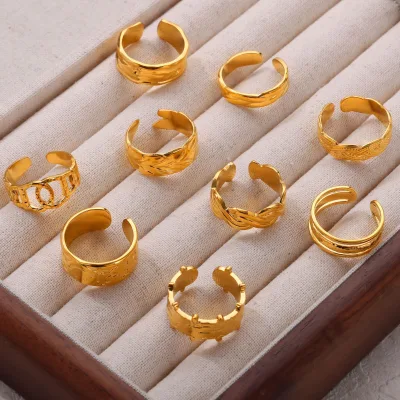
One of the most significant advantages of sourcing stainless steel rings is the high degree of customization available. The data confirms that customization is a standard offering, with many suppliers providing OEM (Original Equipment Manufacturer) and ODM (Original Design Manufacturer) services. This flexibility allows buyers to tailor products to specific brand identities or target demographics. The product models observed, such as Stainless Steel Ring-075J, Stainless Steel Ring-084M, and Gold-Plated Ring-074P, illustrate a wide variety of styles ranging from simple and trendy to creative and cute.
The shape of the rings is another critical specification variable. The market data shows a prevalence of round shapes, but oval options are also available, indicating that manufacturers can accommodate different design preferences. The gender targeting is equally diverse, with listings explicitly categorized for female, male, and unisex markets. This suggests that the production lines are versatile enough to handle different sizing and aesthetic requirements. For instance, the product model R00698G is associated with a brand name "DY," while other models like MTS180-184 and MTS249-255 represent different design iterations.
Customization extends beyond basic geometry. The product attributes highlight specific crafts such as "Exquisite Engraved Patterns" and "Laser Engraving Logo." This indicates that suppliers can apply detailed surface treatments to enhance the visual appeal of the rings. The "Type" attribute further diversifies the options, including "Prime Ring," "Inlaid Ring," and "Cocktail Ring," suggesting that the supply chain can support both minimalist and statement pieces. Buyers should leverage these capabilities to create unique product lines that stand out in a crowded market, ensuring that the final design aligns with current fashion trends while maintaining the structural integrity of the stainless steel base.
Manufacturing Processes and Quality Assurance
The quality of a stainless steel ring is heavily influenced by the manufacturing processes used. The observed data lists several key technologies, including polishing, electroplating, and casting. Polishing is essential for achieving the smooth, reflective surface that characterizes high-quality stainless steel jewelry. This process removes imperfections and prepares the surface for any subsequent plating. Electroplating is frequently mentioned as a method to apply color finishes, such as the gold plating observed in specific models. The durability of these finishes is a critical factor; a high-quality electroplating process ensures that the color does not easily fade or peel, which is a common concern with plated jewelry.
Casting is another process noted in the specifications, which is typically used for creating complex shapes or inlaid designs. The combination of casting and polishing allows for the creation of intricate details that would be difficult to achieve through other methods. To ensure consistent quality, buyers must verify that the supplier adheres to strict quality control protocols. While the data mentions a standard "MABERY JEWELRY," this appears to be a brand-specific standard rather than a universal industry certification. Buyers should not assume that all listed products meet specific international standards unless explicitly verified.
The product packing methods, such as OPP Bag, Paper Case, and the combination of OPP Bag with Paper Case, also play a role in quality assurance during transit. Proper packaging prevents scratches and damage, ensuring that the rings arrive in pristine condition. The "Small Orders: Accepted" attribute suggests that suppliers are flexible with order sizes, which can be beneficial for testing new designs before committing to large-scale production. However, buyers must still conduct rigorous quality checks upon receipt to ensure that the craftsmanship matches the agreed-upon specifications.
Cost Drivers and Pricing Dynamics
Understanding the cost structure of stainless steel rings is essential for effective procurement. The observed price range in the market spans from $0.10 to $4,000, a vast disparity that reflects differences in design complexity, material quality, plating thickness, and customization levels. The lower end of the spectrum likely represents simple, mass-produced bands with basic finishes, while the higher end may include intricate designs, premium plating, or limited edition pieces.
Several factors drive the cost of these products. First, the customization level is a primary cost driver. Custom molds, laser engraving, and unique design work require additional time and resources, increasing the unit price. Second, the plating technology and material thickness affect the cost. Gold plating, for instance, is more expensive than standard electroplating due to the value of the precious metal used. Third, the complexity of the shape and craft, such as the "Exquisite Engraved Patterns" or "Casting" techniques, adds to the manufacturing cost.
The Minimum Order Quantity (MOQ) also influences the overall cost per unit. The observed MOQ range is between 1 and 300,000 units. Suppliers offering lower MOQs, such as those accepting small orders, may charge a higher per-unit price to cover setup costs. Conversely, larger orders benefit from economies of scale, reducing the cost per piece. Buyers should balance their budget constraints with their inventory needs, considering that a lower MOQ allows for greater flexibility in testing the market without significant financial risk. Additionally, the origin of the product, identified as China, suggests that labor and manufacturing costs may be competitive, but buyers must factor in logistics and import duties when calculating the total landed cost.
Supplier Evaluation and Compliance Verification
Selecting the right supplier is a critical step in the sourcing process. The data indicates that suppliers offer OEM services and accept design submissions, which implies a collaborative relationship between the buyer and the manufacturer. When evaluating potential suppliers, buyers should look for evidence of consistent quality control and a track record of meeting deadlines. While the data mentions a standard "MABERY JEWELRY," this should be treated as a specific brand reference rather than a universal compliance marker. Buyers must independently verify the supplier's adherence to relevant industry standards.
Compliance and certification checks are paramount, especially for jewelry that comes into contact with skin. Although the data includes a low-confidence reference to ISO 9001:2015, buyers should not rely on this as a definitive certification for all products. Instead, they should request specific documentation regarding material safety, such as nickel-free certifications or compliance with REACH regulations, which are critical for preventing allergic reactions. The "Characteristic" attribute mentioning "Laser Engraving Logo" also suggests that suppliers have the capability to apply branding, but buyers must ensure that the engraving process does not compromise the structural integrity of the ring.
Furthermore, the "Serve: OEM/ODM" attribute indicates that suppliers are willing to work closely with buyers to develop custom products. This requires clear communication and detailed specification sheets to avoid misunderstandings. Buyers should assess the supplier's ability to handle different gender-specific designs, from female to male and unisex categories, to ensure they can meet diverse market demands. The "Brand Name" attribute, such as "DY," suggests that some suppliers may offer white-labeling options, allowing buyers to brand the products as their own. This capability is valuable for businesses looking to build a distinct brand identity in the jewelry market.
Long-Term Procurement and Market Trends
Sourcing stainless steel rings is not just a one-time transaction but a long-term strategic decision. The fashion industry is dynamic, with trends shifting rapidly from simple styles to more creative and trendy designs. The observed product attributes, including "Style: Fashion," "Style: Trendy," and "Style: Creative," highlight the need for suppliers who can adapt to changing consumer preferences. Buyers should establish partnerships with suppliers who demonstrate flexibility and innovation in their design capabilities.
The "Usage" attribute, which includes "Decoration," "Wedding," "Gift," and "Decoration," indicates the versatility of stainless steel rings in various applications. This versatility makes them a reliable product line for buyers looking to diversify their inventory. However, buyers must also consider the long-term durability of the products. While stainless steel is known for its resistance to tarnish, the longevity of the color finish depends on the quality of the plating. Buyers should request samples and conduct wear tests to ensure that the products maintain their appearance over time.
Additionally, the "Small Orders: Accepted" attribute suggests that the market is becoming more responsive to smaller, agile orders. This trend allows buyers to test new designs with lower risk before scaling up production. As the market evolves, buyers should stay informed about new technologies and materials that could enhance the value proposition of their stainless steel rings. By maintaining a close relationship with suppliers and continuously evaluating their capabilities, buyers can ensure a steady supply of high-quality, tarnish-free stainless steel rings that meet the evolving needs of their customers.
FAQs
Can I customize the design of tarnish-free stainless steel rings?
Yes, customization is available for these rings. Suppliers offer OEM and ODM services with options for laser engraving logos and exquisite engraved patterns. You can request specific shapes like round or oval and styles ranging from simple to creative.
What materials are used for tarnish-free stainless steel rings?
The primary material is stainless steel, which is inherently resistant to rust and corrosion. Some models feature gold plating or electroplating for color finishes. The base metal ensures durability, though plating longevity depends on the specific technology used.
Which gender categories are available for these rings?
These rings are available for female, male, and unisex markets. Listings include specific models tailored for women, men, and general use. The production lines are versatile enough to handle different sizing and aesthetic requirements for all demographics.
How does the pricing vary for stainless steel rings?
Prices range from 0.1 to 4000 USD depending on complexity and customization. Simple mass-produced bands cost less, while intricate designs with premium plating are higher. Custom molds and unique design work also increase the unit price significantly.
What is the minimum order quantity for these rings?
The minimum order quantity ranges from 1 to 300,000 units. Suppliers accept small orders, allowing for market testing without large financial risk. Larger orders benefit from economies of scale, reducing the cost per piece.
Can I get rings with laser engraved logos?
Yes, laser engraving for logos is a standard characteristic offered. Suppliers provide this service to enhance visual appeal and allow for branding. This feature is available alongside other crafts like casting and exquisite engraved patterns.
What packaging options are available for these rings?
Packaging options include OPP bags, paper cases, or a combination of both. Proper packaging prevents scratches and damage during transit. The specific packing method depends on the product model and supplier configuration.