Source Universal Black Motorcycle Chain Roller for Repairs, Maintenance, and Upgrades
Find 30 listings for the Universal Black Motorcycle Chain Roller suitable for transmission systems and repair needs. Buyers can compare specifications, materials like alloy and carbon steel, and trade terms from suppliers in Zhejiang and Hebei.
Key considerations
Products List




High efficiency roller steel chain for motorcycle/bicycle conveyor chain
$1.00 - $999.00
MOQ: 100 Meters


Precision stainless steel hardware drive motorcycle industrial roller chain
$1.00 - $999.00
MOQ: 100 Meters

Industrial roller chain for motorcycle with precision hardware transmission
$1.00 - $999.00
MOQ: 100 Meters


Comprehensive Sourcing Guide
Strategic Sourcing Guide for Universal Black Motorcycle Chain Rollers
Understanding Product Specifications and Technical Attributes
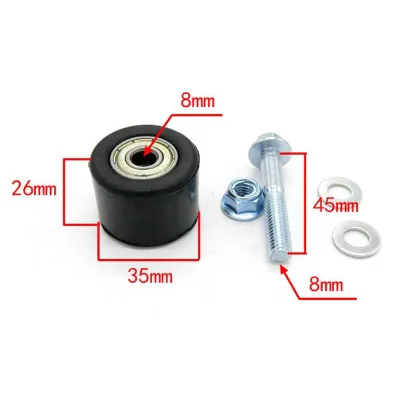
When sourcing a Universal Black Motorcycle Chain Roller, buyers must first distinguish between the specific component requirements and the broader motorcycle transmission systems often listed in general catalogs. The core keyword implies a specific wear part designed to facilitate smooth chain movement within the drivetrain. Based on available product data, the material composition is a critical starting point. While some listings indicate "Alloy" as a primary material for transmission components, specific chain rollers and related wear parts are frequently manufactured from "Carbon Steel" or "Rubber" depending on the specific function, such as a guide roller versus a tensioner wheel. The surface treatment is equally vital; "Electroplating" is a documented process for these components, providing the necessary corrosion resistance and hardness required for high-friction environments.
The physical dimensions and model compatibility are non-negotiable for a "universal" fit, as this term often refers to a broad range of standard motorcycle sizes rather than a single fitment. Available specifications list models such as "420, 420H, 428, 428H, 520, 520H, 525, 525H, 530, 630," which represent standard chain pitch sizes. A buyer must verify that the specific roller they select matches the pitch of their existing chain. Furthermore, the structural design is described as "Rings Chain" or similar configurations, indicating the internal geometry that interacts with the chain links. The color attribute is consistently noted as "Solid Color" or specifically "Black," which is often a result of the electroplating or coating process rather than a paint finish. It is essential to confirm that the "Folded" or "Unfolded" state mentioned in bicycle-related listings does not apply to the rigid nature of motorcycle chain rollers, ensuring the product is a fixed, structural component rather than a folding mechanism.
Compliance, Certification, and Quality Standards
Navigating the compliance landscape for motorcycle components requires rigorous verification of certifications and quality standards. The supply chain data indicates that manufacturers often hold "ISO9001" certification, which is a baseline requirement for quality management systems. Some listings also reference "CCC" (China Compulsory Certification) and "ISOCE," suggesting that certain products may meet specific regional or international safety mandates. However, buyers must treat these as observations of the supplier's current status rather than a universal guarantee for every unit ordered. The standard for the product is frequently cited as "High Quality & OEM Quality" or "ISO9001 SGS," implying that the manufacturing process adheres to strict tolerances and quality control protocols.
When evaluating a supplier, the "Condition" of the product is typically listed as "New," but this should be verified against physical inspection reports. The "Quality" classification is often described as "Class a," which suggests a premium tier of goods, yet this is a subjective internal metric. Buyers should request evidence of the "ISO9001 SGS" standard being actively applied to the specific batch of rollers. Additionally, the "Warranty" period is a critical compliance indicator; a standard offering of "6 months" provides a baseline for defect liability, but this term should be explicitly negotiated in the purchase agreement. The "Standard" of the product must align with the "OEM Quality" expectation, ensuring that the replacement part performs equivalently to the original manufacturer's component.
Cost Drivers and Pricing Structures
The pricing structure for universal black motorcycle chain rollers is highly variable and influenced by several distinct factors. The observed price range in the market spans from $0.50 to $999 USD, a vast disparity that reflects differences in material quality, order volume, and supplier positioning. The primary cost driver is the material composition; "Carbon Steel" and "Alloy" variants will have different base costs compared to those incorporating "Rubber" elements. The "Surface Treatment" of electroplating adds a layer of processing cost that can significantly impact the final unit price.
Trade terms play a substantial role in the landed cost. The available data lists "Fob/CIF" as standard trade terms. Under FOB (Free on Board), the buyer assumes responsibility for freight and insurance once the goods leave the port, typically Ningbo, Shanghai, or other main China ports. Under CIF (Cost, Insurance, and Freight), the supplier covers these costs up to the destination port, which may result in a higher unit price but offers cost certainty for the buyer. The "MOQ" (Minimum Order Quantity) ranges from 1 to 1000 units, directly influencing the per-unit cost. Buyers purchasing small quantities may face higher per-unit prices, while those ordering near the 1000-unit threshold can leverage economies of scale. The "Price" is explicitly noted as "Negotiable," indicating that the listed figures are starting points rather than fixed rates. Buyers should anticipate that the final price will depend on the specific "prod_model" selected and the complexity of the "Customization" required, such as specific packaging or branding.
Typical Applications and Market Fit
The application of universal black motorcycle chain rollers extends across various segments of the motorcycle industry, though the specific use case must be carefully matched to the product specifications. The primary application is for "Transmission Chain" systems, where the roller acts as a guide or tensioner to maintain chain alignment and reduce friction. The "Purpose" is explicitly defined as "for replace/repair," indicating that these are maintenance components rather than primary design elements for new manufacturing. The "Installation" method is described as "Turning," suggesting that the roller is designed to rotate freely on its axle to facilitate chain movement.
While some data points reference "Mountain Bike" applications or "26" Wheel Diameter," these are likely cross-listed items from bicycle component suppliers. Buyers must exercise caution to ensure the product is specifically rated for motorcycle loads, which are significantly higher than bicycle loads. The "Market" for these components is "Global," meaning they are suitable for international distribution and repair networks. The "Used for" attribute mentions "All Ages," which is a generic descriptor likely referring to the broad applicability of the component across different rider demographics, but it does not imply suitability for all vehicle types. The "Color" being "Black" or "Solid Color" is standard for aesthetic consistency with motorcycle drivetrains, though the functional integrity of the black finish depends on the underlying "Electroplating" quality.
Supplier Evaluation and Origin Verification
Evaluating a supplier for motorcycle chain rollers requires a deep dive into their operational capabilities and geographic origins. The supply data identifies multiple production locations, including "Zhejiang, China," "Xingtai City, Hebei Province, China," and "Anhui, China." Each region may have different specializations; for instance, Hebei is known for heavy industrial manufacturing, while Zhejiang often hosts a diverse range of mechanical parts. Buyers should verify the specific "place_of_origin" to ensure the supplier has the requisite infrastructure for producing high-tolerance metal components.
The "Brand Name" is another factor; while some listings mention "HF," many suppliers operate as OEM manufacturers without a prominent consumer brand. This is common in the B2B sector where the focus is on component supply rather than brand marketing. The "Customization" availability is a key differentiator; suppliers offering "Customer Logo Box" or "Colour Box" packaging can add value to the buyer's brand, whereas those offering "Neutral" packing are suitable for private label or bulk distribution. The "prod_packing" methods, such as "50PCS/CTN" or "Wooden Cases," indicate the logistical readiness of the supplier. A supplier offering "Wooden Cases" is likely better equipped for international shipping of heavy or sensitive metal parts compared to those using standard cartons.
Quality Control and Long-Term Procurement Considerations
Ensuring long-term supply chain stability requires a robust quality control (QC) framework. The "Delivery" lead time is observed to be between 20 and 45 days, a window that buyers must factor into their inventory planning. This timeframe can vary based on the "MOQ" and the complexity of the "Customization." To mitigate risks, buyers should request "Free Sample" availability before committing to a large order. This allows for physical inspection of the "Carbon Steel" or "Alloy" quality, the effectiveness of the "Electroplating," and the fitment against the "420" through "630" model specifications.
The "Standard" of "High Quality & OEM Quality" should be backed by tangible test results or third-party inspection reports. Buyers should verify that the "ISO9001" certification is current and that the "SGS" standard is being actively applied to the production line. The "Warranty" of "6 months" provides a safety net for early failures, but it should be complemented by a clear return and replacement policy. For long-term procurement, establishing a relationship with a supplier that offers "Negotiable" pricing and flexible "Trade Terms" is essential. The ability to source "Customer Logo Box" or specific "prod_packing" solutions can also help in building a consistent brand identity for the end-user. Finally, buyers must remain vigilant about the "Market" dynamics, ensuring that the supplier can scale production to meet global demand without compromising the "Class a" quality standard.
Summary of Key Sourcing Parameters
To facilitate a streamlined procurement process, the following table summarizes the critical parameters identified in the market analysis for universal black motorcycle chain rollers.
| Parameter | Observed Range / Standard | Verification Requirement |
|---|---|---|
| Material | Carbon Steel, Alloy, Rubber | Confirm material grade via mill test reports. |
| Surface Treatment | Electroplating | Inspect for uniformity and corrosion resistance. |
| Certification | ISO9001, CCC, ISOCE, SGS | Request valid certificate copies and audit reports. |
| Model Compatibility | 420, 428, 520, 525, 530, 630 | Match pitch to existing chain specifications. |
| Lead Time | 20-45 Days | Confirm production schedule and shipping timeline. |
| MOQ | 1-1000 Units | Negotiate based on volume to optimize unit cost. |
| Trade Terms | FOB, CIF | Calculate landed cost including freight and insurance. |
| Origin | Zhejiang, Hebei, Anhui (China) | Verify factory location and capacity. |
| Warranty | 6 Months | Define terms for defect claims and replacements. |
| Packing | Neutral, Logo Box, Wooden Cases | Ensure packaging meets shipping and branding needs. |
By adhering to these evidence-based guidelines, buyers can navigate the complexities of sourcing universal black motorcycle chain rollers with confidence, ensuring that the final procurement aligns with technical requirements, quality standards, and commercial objectives.
FAQs
What materials are used for universal black motorcycle chain rollers?
These rollers are typically made from Carbon Steel, Alloy, or Rubber depending on the specific function. The material choice affects durability and friction resistance, with Carbon Steel and Alloy being common for structural strength in transmission applications.
Which certifications should I verify for these motorcycle components?
Suppliers often hold ISO9001, CCC, and ISOCE certifications to ensure quality management. Buyers must request valid certificate copies to confirm that the specific batch meets the required High Quality and OEM Quality standards before placing an order.
Can I get free samples before ordering large quantities?
Yes, free sample availability is a documented option for many suppliers in this category. Requesting a sample allows you to physically inspect the Electroplating finish and verify the fitment against standard chain models like 420 or 520 before committing to bulk purchase.
How long does delivery take for these chain rollers?
The standard delivery lead time ranges from 20 to 45 days from the order date. This timeframe can vary based on the Minimum Order Quantity and any Customization requirements, so confirm the production schedule with the factory in Zhejiang or Hebei.
What are the standard model specifications for universal fitment?
Common specifications include chain pitch models such as 420, 428, 520, 525, 530, and 630. You must match the roller pitch to your existing chain to ensure proper installation and smooth operation within the motorcycle transmission system.
Which trade terms are available for international shipping?
Standard trade terms include FOB and CIF, allowing flexibility in logistics management. Under FOB, you handle freight from ports like Ningbo or Shanghai, while CIF covers costs up to your destination port, affecting the final landed price calculation.