Source wall-mounted android 11 industrial pc for Medical, Commercial, Industrial
Find and compare 30 wall-mounted android 11 industrial pc units with varying screen sizes, touch technologies, and protection ratings. Buyers can evaluate specifications like CPU type, connectivity options, and brightness levels to select the right device for medical, commercial, or industrial applications.
Key considerations
Products List


Waterproof Touch All in One Embedded Wall Mounting Android Panel Industrial PC
$260.00 - $295.00
MOQ: 10 Pieces

High-Performance IP65 Waterproof Industrial Panel PC for Android & Windows
$260.00 - $295.00
MOQ: 10 Pieces


Industrial Waterproof Touchscreen All-in-One Android PC for Wall Mounting
$564.00 - $752.00
MOQ: 1 Pieces


Comprehensive Sourcing Guide
Strategic Sourcing Guide for Wall-Mounted Android 11 Industrial PCs
Selecting the right industrial computing hardware requires a disciplined approach that balances technical capability with operational reliability. For buyers investigating wall-mounted Android 11 industrial PCs, the procurement process must move beyond generic marketing descriptions to verify specific engineering attributes. The market offers a diverse array of units, ranging from compact 10.1-inch displays to larger 21.5-inch configurations, each designed for distinct environments. This guide outlines the critical factors for evaluating these systems, ensuring that the final selection aligns with rigorous industrial standards and specific application requirements.
Technical Architecture and Display Specifications
The core of any industrial PC selection lies in its hardware architecture and display performance. When sourcing wall-mounted units, the physical form factor and screen technology are paramount. Based on observed market data, available models frequently feature screen sizes such as 10.1 inches, 15.6 inches, 18.5 inches, and 21.5 inches. The display technology is predominantly TFT (Thin Film Transistor), which offers the necessary contrast and viewing angles for industrial settings.
Brightness is a critical variable for wall-mounted installations, as these units often face ambient light challenges. The observed data indicates a wide range of brightness capabilities, from 200-300 nits for indoor environments to 250 candelas per square meter (cd/m²) and ranges up to 700 nits for high-visibility applications. Buyers must verify the specific brightness rating of the unit intended for their facility, as insufficient luminance can render a screen unreadable in brightly lit factories or outdoor kiosks.
Touch technology is another essential specification. Capacitive touch screens are the standard for modern industrial interfaces, offering multi-touch capabilities. Specific models observed support 10-point touch technology, which is vital for complex user interfaces or gesture-based controls. The resolution varies significantly across the product spectrum; some units operate at 1024x600 or similar standard resolutions, while high-end models support 1920x1080 (Full HD) or higher, ensuring crisp text and detailed graphics.
Processor architecture also dictates performance. While some units utilize ARM-based processors like the RK3566 for Android 11 environments, others employ x86 architectures with Intel Celeron or Core i3/i5 processors (such as the 3rd Gen Intel Core i5-3210M). The choice between Android and Windows/Linux depends on the software ecosystem required. The observed systems support a broad range of operating systems, including Win 7, 8, 10, CE, Android, Linux, XP, and Mac, though the specific Android 11 requirement narrows the field to units explicitly configured for that OS version.
Physical Durability and Environmental Ratings
Industrial environments demand hardware that can withstand dust, moisture, and physical impact. The protection rating is a primary indicator of durability. While specific IP ratings vary, the data suggests a focus on robust construction. Many units feature an all-steel chassis, providing the structural integrity needed for wall mounting and resistance to vibration.
The physical dimensions are strictly defined for wall-mounting compatibility. Observed standard dimensions for various models include sizes like 435405145mm, 575418142mm, and 647445142mm. These measurements are crucial for planning the installation space and ensuring the unit fits within the designated enclosure or wall cavity. The weight of these units, ranging from approximately 6kg for smaller models to heavier configurations for larger screens, must be accounted for in the mounting hardware selection.
Installation orientation is another key factor. The data confirms that many of these industrial PCs are designed for horizontal installation, which may influence how they are mounted on a wall or integrated into a control panel. Buyers should verify if the specific model supports vertical mounting if their application requires it, as horizontal-rated units may not have the necessary thermal or structural design for vertical orientation.
Connectivity and Interface Requirements
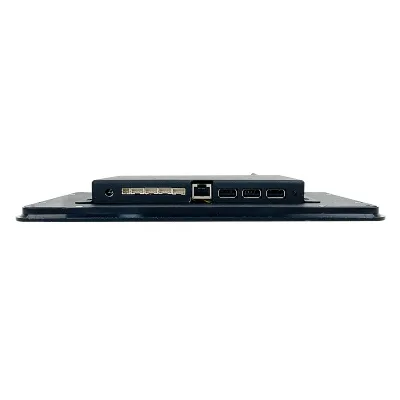
Reliable connectivity is essential for industrial PCs to communicate with sensors, PLCs, and other networked devices. The connectivity options observed in the market are extensive, typically including Wi-Fi, VGA, USB, HDMI, and Ethernet ports. This variety allows for flexible integration into existing infrastructure.
For wall-mounted units, the placement of these ports is critical. They should be accessible for maintenance without requiring the removal of the entire unit. The presence of multiple USB ports facilitates the connection of peripherals such as barcode scanners, keyboards, or external storage. Ethernet connectivity is non-negotiable for networked industrial applications, ensuring stable data transmission.
The CPU card size is another specification to consider for future upgrades or maintenance. Some models utilize a Full-Size Card format, which offers more expansion options compared to smaller form factors. The hard disk rack type, often observed as "Board Type," indicates a compact storage solution that is integrated directly into the system board, saving space and reducing the risk of mechanical failure associated with traditional spinning hard drives.
Application Scenarios and Operational Context
The versatility of wall-mounted industrial PCs allows them to serve in diverse sectors. The observed application data highlights usage in Medical, Commercial, and Industrial settings. In medical environments, these units might function as patient information kiosks or diagnostic interfaces, requiring high hygiene standards and reliable touch response. Commercial applications could include retail kiosks or digital signage, where brightness and viewing angles are critical for customer engagement.
Industrial applications are perhaps the most demanding, involving factory automation, quality control stations, and process monitoring. In these contexts, the contrast ratio becomes a vital specification. Observed contrast ratios range from 250:1 to 3000:1, with higher ratios providing better visibility in varying lighting conditions. The viewing angle is equally important; while some units offer a "Total View" capability, others specify precise angles like 89/89/89/89 degrees, ensuring that operators viewing the screen from different positions can see the interface clearly.
Compliance, Certification, and Standards Verification
Navigating compliance and certification is a critical step in the procurement process. While specific certification statuses for every unit cannot be assumed, buyers should look for adherence to recognized standards. The observed data mentions RoHS (Restriction of Hazardous Substances) as a relevant certification context. This indicates that compliant units should restrict the use of specific hazardous materials, aligning with environmental regulations.
Buyers must verify the specific standards applicable to their region and industry. The product standards observed include dimensional specifications (e.g., 435405145mm) and weight limits, which serve as baseline quality indicators. However, these are not substitutes for formal safety certifications like UL, CE, or FCC. Procurement teams should request official documentation from suppliers to confirm that the specific model meets the safety and electromagnetic compatibility (EMC) requirements of the target market.
Supplier Evaluation and Quality Assurance
Evaluating suppliers requires a focus on their ability to provide consistent quality and support. The customization availability is a significant differentiator in the industrial PC market. Many suppliers offer customization options, allowing buyers to tailor the hardware to specific needs, such as pre-installed software, specific port configurations, or unique mounting brackets.
When assessing suppliers, buyers should examine their production processes and quality control measures. The observation of "Foam" and "Carton" as packing materials suggests attention to transit safety, but the internal build quality is paramount. Suppliers should demonstrate a track record of delivering units with consistent touch technology, reliable power supplies (often ATX12V type), and robust chassis construction.
The origin of the products is another factor. The data indicates that many of these units originate from China. While this does not inherently dictate quality, it highlights the importance of verifying the specific manufacturing facility and its quality management systems. Buyers should request evidence of the supplier's ability to maintain consistent production standards and provide after-sales support.
Long-Term Procurement and Lifecycle Management
Sourcing industrial PCs is not a one-time transaction but a long-term partnership. Lead times, minimum order quantities (MOQ), and pricing structures are critical for planning. The observed MOQ range is 0-20, offering flexibility for both small pilot projects and larger deployments. However, buyers must confirm these figures with the specific supplier, as they can vary based on customization requirements.
Pricing is another variable, with observed ranges spanning from $38 to $1000. This wide range reflects the differences in screen size, processor power, and feature sets. Buyers should not base decisions solely on price but on the total cost of ownership, which includes energy efficiency, maintenance costs, and the potential for hardware obsolescence.
The availability of spare parts and the supplier's ability to support long-term product lifecycles are essential considerations. Industrial applications often require units to remain in service for many years. Buyers should inquire about the supplier's policy on end-of-life support and the availability of replacement components. Additionally, the customization options should be evaluated for their long-term viability, ensuring that any custom features do not become unsupported in future firmware updates.
Summary of Key Specifications for Comparison
To assist in the decision-making process, the following table summarizes the key technical specifications observed in the market for wall-mounted industrial PCs. This comparison highlights the diversity of options available and the specific attributes buyers should verify.
| Specification Category | Observed Range / Options | Key Verification Point |
|---|---|---|
| Screen Size | 10.1", 15.6", 18.5", 21.5" | Match to viewing distance and space constraints. |
| Resolution | 1024x600, 1920x1080 (1920x) | Ensure clarity for text and graphics. |
| Brightness | 200-300 Nits, 250 cd/m², 300-700 Nits | Verify against ambient light levels. |
| Touch Technology | Capacitive Touch (10 Points) | Confirm multi-touch support for UI needs. |
| Processor | Intel Celeron, Core i3/i5, RK3566 | Match compute power to application load. |
| OS Support | Android, Windows, Linux, Mac | Ensure software compatibility. |
| Protection | All-Steel Chassis, IP Rated | Verify environmental resistance. |
| Dimensions | ~400-650mm width, ~130-145mm depth | Check fit for wall mounting. |
| Connectivity | Wi-Fi, VGA, USB, HDMI, Ethernet | Confirm port availability for peripherals. |
By systematically evaluating these factors, buyers can navigate the complex landscape of industrial PC procurement. The goal is to select a unit that not only meets the immediate technical requirements but also provides the reliability and support necessary for long-term industrial operations. The observed data provides a solid foundation for these decisions, but the final selection must always be validated against the specific needs of the application and the capabilities of the chosen supplier.
FAQs
What screen sizes are available for wall-mounted industrial PCs?
Available screen sizes include 10.1 inches, 15.6 inches, 18.5 inches, and 21.5 inches. These units typically feature TFT screens with varying brightness levels to suit different ambient lighting conditions in industrial or commercial environments.
Which touch technology is standard for these wall-mounted units?
Capacitive touch technology is the standard for these industrial PCs. Specific models support 10-point touch capabilities, ensuring responsive interaction for complex interfaces in medical, commercial, and industrial applications.
Can these industrial PCs operate on Android 11 and other systems?
Yes, these systems support a broad range of operating systems including Android, Windows 7, 8, 10, Linux, and Mac. Specific models like the FWS 10.1'' are configured for Android environments while others utilize x86 architectures.
What is the typical brightness range for wall-mounted displays?
Brightness ranges from 200 to 700 nits depending on the specific model and application. Lower brightness units suit indoor environments, while higher brightness options up to 700 nits are available for high-visibility industrial settings.
How are these units physically constructed for durability?
Units feature an all-steel chassis designed for robust construction and wall mounting. Dimensions vary by model, with standard sizes like 435*405*145mm, and they are often packed in foam or cartons for transit safety.
What connectivity options are provided for industrial integration?
Connectivity options typically include Wi-Fi, VGA, USB, HDMI, and Ethernet ports. This variety allows for flexible integration with sensors, PLCs, and networked devices required for factory automation and process monitoring applications.