Automatic 5 Person Camping Tent Suppliers and Manufacturers
Compare 15 verified suppliers offering automatic 5 person camping tents with varying lead times, certifications, and response speeds. Review product specs like waterproof indices and customization options before contacting factories in China Zhejiang and Shandong; review the available evidence before requesting comparable quotations from suitable candidates.
Suppliers List

Ningbo Mingni Import And Export Co., Ltd.
- Verified by SGS
- Manufacturer/Factory
- China Zhejiang
- Lead time23 days
- Avg. response≤ 3h
Main productsWindow Handle, Door Handle, Hinge, Gas Cooker Knob, Oven Knob, Name Plate, Cabinet Handle, Bathroom Hardware, Auto Parts
Main marketsSouth America,Eastern Europe,North America,Western Europe

Automatic Hydraulic Tent 3-4 Person Instant Setup Waterproof Camping Tent Camping Tent
$20.00 - $40.00
MOQ: 50 Pieces

High Quality New Arrival Camping Tent and Outdoor Tent for 1-2 Persons
$10.99 - $11.99
MOQ: 100 Pieces

Qingdao Otia Industry and Trade Co., Ltd.
- Verified by SGS
- Trading Company,Manufacturer/Factory
- China Shandong
- Lead time105 days
- Avg. response≤ 4h
Main productsFolding Wagon, Garden Cart, Shopping Cart, Wheel Barrow, Aluminum Storage Box, Wheels
Main marketsSouth America,Eastern Europe,Mid East,Eastern Asia,Western Europe,Africa

- Verified by CTI
- Combined
- China Fujian
- Lead time30 days
- Avg. response≤ 5h
Main productsRoof Top Tent, Outdoor Tent, Camping Lantern, Solar Light, Car Tent
Main marketsSouth America,Southeast Asia/ Mideast,East Asia(Japan/ South Korea),Domestic,Europe,Australia,North America

Starry (Xiamen) Outdoor Equipment Technology Co., Ltd.
- Verified by SGS
- Trading Company
- China Fujian
- Lead time15 days
- Avg. response≤ 2h
Main productsCamping Tent, Inflatable Tent, Beach Tent, Ice Fishing Tent, Shower Tent, Car Roof Tent, Relief Tent, Camping Chair and Table, Gazebo, Inflatable Mattress
Main marketsEurope,North America


$29.89 - $35.10
MOQ: 100 Pieces


Zhejiang Hexin Umbrella Co., Ltd
- Verified by TUVRHEINLAND
- Combined
- China Zhejiang
- Lead time30 days
- Avg. response≤ 21h
Main productsPop up Canopy, Folding Tent, Easy up Gazebo, Canopy, Pavillion, Shelter, Gazebo, Marquee, Pop up Gazebo, Umbrella
Main marketsAfrica,Domestic,North America

Jinjiang Jiayi Supply Chain Management Co., Ltd.
- Verified by BV
- Trading Company
- China Fujian
- Lead time30 days
- Avg. response≤ 1h
Main productsGift, Shoe, Garment, Machine
Main marketsDomestic

Yiwu BaiQi Outdoor Products Co.,Ltd.
- Trading Company
- China Zhejiang
- Lead time23 days
- Avg. response≤ 4h
Main productsCamping Tent, Relief Tent, Modular Tent, Beach Shelter, Laundry Bag, Kids Tent, Dome Tent, Party Tent, Outdoor Tent, Refugee Tent
Main marketsDomestic

$14.50 - $16.90
MOQ: 100 Pieces

Outdoor Tent 3-4 People 5-8 People Double Automatic Rain and Camp Tent Field Camping Hex Tent
$30.00 - $45.00
MOQ: 50 Pieces

$14.50 - $16.90
MOQ: 100 Pieces

Automatic Tent 3-4 People Outdoor Camping Camping Night Fishing Windproof Waterproof Tent Wholesale
$13.50 - $15.50
MOQ: 50 Pieces


Outdoor Camping Tent Portable Full-Automatic Fast Tent Camping Camping Park Tent
$15.00 - $19.00
MOQ: 50 Pieces

Shanghai Cuckoo Outdoor Products Co., Ltd.
- Verified by TUVRHEINLAND
- Combined
- China Jiangsu
- Lead time30 days
- Avg. response≤ 3h
Main productsInflatable Tent
Main marketsSoutheast Asia/ Mideast,East Asia(Japan/ South Korea)
Henan Aimei Outdoor Products Co., Ltd.
- Verified by SGS Group
- Trading Company
- Lead time25 days
- Avg. response≤ 2h
Main productsTent & Shelter, Camping Sleeping Gear, Camping Furniture, Camping Cart & Storage Box, Camping Kitchen Ware
Main marketsNorth America(30%), Western Europe(30%), Eastern Europe(20%)
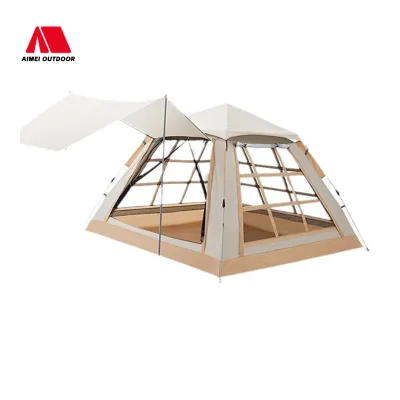
Automatic Instant Setup 1-6 Person Camping Tent for Outdoor Park and Family Use
$22.60 - $24.60
MOQ: 1 acres
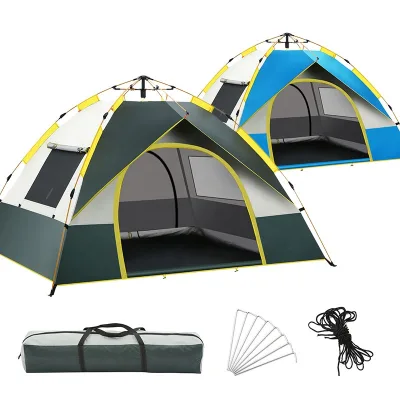
High-quality Automatic Tent Camping Tents to Take Your Camping Experience to the Next Level
$28.45 - $29.47
MOQ: 1 acres
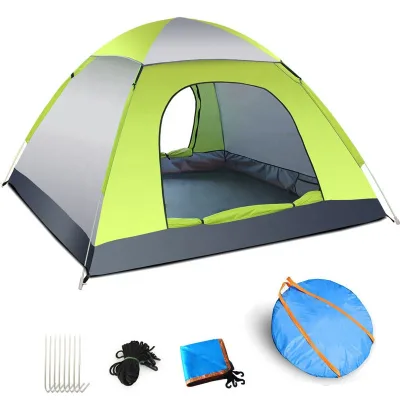

Shaanxi Saifusite Mechanical Electrical Equipment Co., Ltd.
- Verified by SGS
- Trading Company
- China Shaanxi
- Lead time15 days
- Avg. response≤ 3h
Main productsStrand Jack, Rock Splitter, Mud Pump, Rebar Bending Machine, Anchor Wedge, Rock Breaker, Yb Pump, Lifting Jack, DTH Drilling Rig
Main marketsOthers(foreignTradeCapacity.exportBusinessCapacityMarketOther)

Large Waterproof Camping Tent Multi Person Family Outdoor Shelter Tent
$16.00 - $20.00
MOQ: 1 Square Meters

Large Multi-Person Outdoor Camping Tent Waterproof Windproof Big Space
$16.00 - $20.00
MOQ: 1 Square Meters
- Verified by TUVRHEINLAND
- Trading Company
- China Zhejiang
- Lead time30 days
- Avg. response≤ 11h
Main productsSports and Outdoor
Main marketsSoutheast Asia/ Mideast,Europe
FUZHOU SHOO-IN IMP & EXP CO., LTD.
- Verified by SGS
- Trading Company
- China Fujian
- Lead time15 days
- Avg. response≤ 3h
Main productsPadel Ball, Tennis Ball, Hat, Pet Leash, Pickleball, Yoga Mat, Sports Towel
Main marketsEast Asia(Japan/ South Korea),North America

- Verified by BV
- Trading Company,Manufacturer/Factory
- China Zhejiang
- Lead time23 days
- Avg. response≤ 5h
Main productsSpiral Slicer, Tent, Hammock, Garden Decoration, Garden Light, Kitchenware, Homeware, Camping, Travel Suitcase, Organizer
Main marketsSouth America,Eastern Europe,Mid East,North America,Southeast Asia,Eastern Asia,Oceania,Western Europe,Africa

Expomax ( China ) Exhibition Tent Co., Ltd.
- Verified by SGS
- Combined
- China Jiangsu
- Lead time15 days
- Avg. response≤ 2h
Main productsMarquee Tent, Clear Span Tent, Pagoda Tent, Arcum Tent
Main marketsOthers(foreignTradeCapacity.exportBusinessCapacityMarketOther),Domestic
Qingdao Ventop Overland Co., Ltd.
- Verified by SGS
- Manufacturer/Factory
- China Shandong
- Lead time45 days
- Avg. response≤ 1h
Main productsRoof Top Tents, Vehicle Awnings, Canopies, Hard Shell Roof Top Tents, Soft Shell Roof Top Tents, Rooftop Tents, Aluminum Roof Top Tents
Main marketsSouth America,Eastern Europe,Mid East,North America,Southeast Asia,Eastern Asia,Oceania,Western Europe,Africa


Comprehensive Sourcing Guide
Automatic 5 Person Camping Tent Supplier Concentration and Factory Types
When sourcing an Automatic 5 Person Camping Tent, understanding where production actually happens helps you shortlist realistically. Some of the suppliers appearing in current results are located in China's Zhejiang and Shandong provinces, with at least one listing a Qingdao origin on specific tent models. These provinces sit within China's broader outdoor-goods manufacturing belt, where tent sewing, fiberglass pole bending, waterproof coating, and metal fitting supply chains cluster close together. Beyond these confirmed data points, you should identify clusters independently: filter supplier locations by province, then check whether a candidate's main products line up with tents, canopies, gazebos, or camping goods rather than unrelated categories, since tent-capable factories usually list several shelter products.
Factory type matters as much as geography. Current results show both pure Manufacturer/Factory entries and combined Trading Company/Manufacturer entries, so assume the market is mixed and verify which structure you are dealing with. A factory may offer tighter process control and OEM capability, which some listings confirm, while a trading company can aggregate multiple tent styles and handle mixed-container orders. One Shandong-based supplier combines both labels and lists folding wagons, carts, and storage boxes alongside tents, which suggests a broader outdoor-products operation rather than a tent specialist. Ask directly whether the automatic-opening mechanism, pole assembly, and fabric cutting are done in-house or subcontracted, because that answer determines who controls quality on your Automatic 5 Person Camping Tent order.
How to Verify Automatic 5 Person Camping Tent Suppliers
Verification should start with the credentials a platform actually displays, then extend to what you must confirm yourself. In current results, at least one supplier carries SGS verification and ISO 9001 plus ISO 14001 system certifications, and another lists BSCI, ISO 9000, and ISO 9001. These are meaningful signals of audited management systems, but they certify processes, not the waterproof index of a specific tent model. Treat any certification not shown in the supplier's listing as unverified until you receive a copy of the certificate and check its scope and validity date against the certification body's records.
Beyond certificates, verify the supplier's identity and operational reality. Confirm the registered company name matches the bank account you will pay, and ask for business licence details consistent with the stated location. For product-level verification, request recent production photos of automatic-opening tent mechanisms, a sample unit assembled and folded repeatedly, and written confirmation of the fabric specification; current listings reference materials such as 190T silver-coated cloth and 210D PU waterproof oxford fabric with stated waterproofing indexes, so pin your own specification down in the same format. Check that OEM or ODM claims are backed by examples: one listing explicitly marks OEM as available, and another lists own brand, OEM, and ODM capacities. Finally, test responsiveness before committing — logged response times in current results range from roughly 2.6 to 3.5 hours, which you can use as a benchmark when comparing how quickly prospects answer technical questions.
What to Compare Across Automatic 5 Person Camping Tent Suppliers
Build a comparison table using the attributes suppliers actually display, and leave blank cells where data is missing rather than assuming parity. Useful dimensions in current results include location, company type, main products, system certifications, verification status, response time, lead time, research capacity, and establishment year. Lead times show dramatic variation here: one Zhejiang entry lists about 23 days while a Shandong entry lists about 105 days, a gap wide enough to reshape your launch calendar. Response times of roughly 2.6 versus 3.5 hours suggest both are active, but you should log your own message-to-reply performance during pre-sales.
Compare products on the technical attributes that define an Automatic 5 Person Camping Tent. Current listings disclose waterproof indexes of 1500–2000 mm for outer fabric and floors, fiberglass automatic poles, double-skin structures, 210D oxford base cloth, packing dimensions, and gross weights, so normalize these into your table. Prices in visible listings range from about $11 to $40 per unit depending on size and configuration, and MOQs range from 50 to 500 units — a tenfold spread that changes which supplier fits a trial order versus a container order. Also compare customization depth: several listings state customization is available, including logo printing on specific models, while one capacity label distinguishes OEM-only from ODM-capable operations. Finally, weigh main-product fit; a supplier whose catalog centers on tents, canopies, and marquees is structurally different from one whose catalog centers on handles or hardware, even if both list a tent.
Common Automatic 5 Person Camping Tent Sourcing Risks
The most frequent risk in this category is specification drift between the sample and production runs. Automatic-opening mechanisms depend on pole joints, spring tension, and fabric panel alignment, and a factory can pass a hand-checked sample while missing tolerances at volume. Current listings cite fiberglass automatic poles in diameters like 7.9 mm and fabrics such as 190T and 210T PU-coated cloth; if your contract does not fix these values plus the waterproof index — listed examples run 1500–2000 mm to 2000 mm — the factory can legally substitute a cheaper equivalent. Always attach a signed specification sheet with the model code, such as the tent-011 or CT-0030 style identifiers visible in listings, to the purchase contract.
Second, watch for mixed supplier types creating hidden markups or accountability gaps. When a trading company fronts a factory, warranty claims for failed automatic mechanisms can bounce between parties. A related risk is capacity misrepresentation: a supplier whose main products are wagon carts and garden tools may subcontract your tents entirely. Lead-time optimism is another documented hazard — the 23-day versus 105-day spread in current results shows how differently suppliers estimate production, and peak season before Northern-hemisphere spring can stretch both. Finally, packaging and logistics risks are real: one listing specifies cartons of 10 pieces at 25 kg gross weight, so an unverified carton spec can trigger freight re-quotes. Mitigate by pre-shipment inspection of a random sample from finished stock, not from reserved golden samples.
Automatic 5 Person Camping Tent Regional Sourcing and Logistics
The confirmed geography in current results is concentrated in eastern China: Zhejiang and Shandong provinces, with one tent model listing Qingdao as its origin. This matters for logistics planning because Zhejiang sits near Ningbo and Shanghai ports, while Shandong's Qingdao is itself a major container port, so both confirmed regions offer direct ocean-freight access to North American and European destinations. When you shortlist suppliers outside these confirmed provinces, ask them to name their nearest export port and typical inland trucking cost to it, since inland freight on bulky tent cartons is a real cost line.
Tents are lightweight but voluminous, so logistics economics revolve around carton compression. Current listings show packed cartons such as 75×28×50 cm holding 10 pieces and 110×15×15 cm for 10 pieces, meaning a full container's value depends heavily on how flat the automatic mechanism folds. Ask each supplier for the packed carton dimensions and pieces-per-carton for your chosen model, then calculate container utilization before comparing unit prices — a slightly higher unit price with better cube efficiency can win on landed cost. The lead-time spread noted earlier, from roughly 23 to 105 days, should drive your ordering calendar: add ocean transit, customs clearance, and inland delivery, then count backward from your selling season. Also confirm who handles export documentation; factory-direct suppliers typically quote FOB, while trading companies may quote ex-works or CIF, so normalize all quotes to the same incoterm before comparing.
Automatic 5 Person Camping Tent Commercial Terms and Order Planning
Commercial planning should anchor on the MOQ and price structure visible in current listings, which vary widely: one automatic tent model lists 50 pieces MOQ at $20–40, a smaller ridge tent lists 100 pieces at roughly $11–12, and another automatic model lists 500 pieces at about $21.30. This spread means you can structure a two-stage plan — a small trial order from a low-MOQ supplier to validate the automatic mechanism and waterproof performance, followed by a volume order negotiated against that trial's inspection results. Ask every shortlisted supplier for a tiered price list rather than a single quote, because the jump from trial to container quantity is where the real margin sits.
On payment and order terms, do not assume protections that are not displayed; none of the current results confirms escrow coverage, so verify independently what transaction protection your chosen platform or payment method provides and document agreed terms in the contract. Plan orders around the lead times you have verified in writing — remember the 23-day and 105-day examples — and add buffer for pre-Chinese New Year production congestion, which reliably delays tent shipments. Fix customization scope in writing: several listings state customization is available with custom logos, so confirm artwork formats, placement, and any tooling cost for branded elements. Finally, schedule a pre-shipment inspection for every order, define AQL sampling levels in the contract, and hold a retention percentage until carton-accurate goods are confirmed at the port of loading, keeping your recourse alive through the riskiest handover point.
(Word count: 1381)
FAQs
What is the typical lead time for automatic camping tents?
The typical lead time for automatic camping tents is 23 days based on current supplier data. Some suppliers offer faster delivery with a 105-day window for specific orders. Buyers should confirm exact timelines with the manufacturer before placing bulk orders to ensure timely delivery.
What are the minimum order quantities for these tents?
Minimum order quantities vary by supplier and product model. Some listings require 50 units, while others set the threshold at 100 or 500 pieces. Buyers must check specific product pages to verify the exact MOQ required for their chosen automatic tent model before proceeding with purchase.
Are these tents waterproof and what is the rating?
Yes, these automatic tents are waterproof with ratings between 1500 and 2000 mm. The fabric often includes PU coating or silver rubber cloth to ensure protection against rain. Buyers should verify the specific waterproof index for each model to match their intended weather conditions.
Do suppliers offer customization for automatic tent designs?
Customization is available for many automatic tent models listed by manufacturers. Buyers can request custom logos, colors, or specific dimensions depending on the supplier capabilities. OEM services are offered, allowing businesses to tailor products to their brand requirements while maintaining quality standards.
What certifications do the manufacturers hold?
Manufacturers hold ISO 9001 and ISO 14001 certifications for quality and environmental management. Some suppliers also possess BSCI certification for social compliance. These credentials indicate adherence to international standards, though buyers should verify specific certificates for their chosen supplier before finalizing contracts.
How quickly do suppliers typically respond to inquiries?
Suppliers typically respond within 2.58 to 3.49 hours based on current data. Some listings indicate a feedback time of 13 hours for specific inquiries. Buyers should expect prompt communication but should verify response times directly with the supplier to ensure timely support during the sourcing process.
Where are the manufacturers of these tents located?
Manufacturers are located in China, specifically in Zhejiang and Shandong provinces. These regions are known for producing outdoor equipment and camping gear. Buyers should confirm the exact city or factory location to assess shipping logistics and potential tariffs associated with importing these automatic tents.