Disposable PET Sushi Box Suppliers and Manufacturers
Compare 15 verified suppliers of disposable pet sushi boxes across locations like China Guangdong and Shandong. Evaluate response times, lead times, certifications, and pricing to source the right product. Contact suppliers directly to request samples; review the available evidence before requesting comparable quotations from suitable candidates.
Suppliers List

Dongguan Yelui Packaging Products Company Limited
- Verified by CTI
- Combined
- China Guangdong
- Lead time30 days
- Avg. response≤ 2h
Main marketsAfrica,Southeast Asia/ Mideast,Domestic,Europe,Australia,North America

Globalink International Limited
- Verified by SGS
- Trading Company,Manufacturer/Factory,Other
- China Shandong
- Lead time45 days
- Avg. response≤ 13h
Main productsPlastic Packaging, Food Container, Fruit packaging, Paper Bags, Paper Packaging, Plastic Bags, Plastic Tape, Egg Tray, Aluminum Foil, Sushi Container
Main marketsSouth America,Eastern Europe,Mid East,North America,Southeast Asia,Eastern Asia,Oceania,Western Europe,Africa

Changzhou Huisu Qinye Import & Export Co., Ltd.
- Verified by BV
- Combined
- China Jiangsu
- Lead time15 days
- Avg. response≤ 4h
Main productsPVC Film, PVC Sheet, PVC Foam Board, PVC Soft Film, PVC Foam Sheet, PVC Board, Acrylic Sheet, Safety Matches, PVC Rigid Film, PVC Matte Sheet
Main marketsSouth America,Africa,Southeast Asia/ Mideast,Europe,Australia

JIANGSU JINCAI POLYMER MATERIALS SCIENCE AND TECHNOLOGY CO., LTD.
- Verified by TUVRHEINLAND
- Combined
- China Jiangsu
- Lead time15 days
- Avg. response≤ 4h
Main productsPet Sheet, PVC Sheet, PVC Film, Cpet Tray, PVC Foam Board, Acrylic Sheet, Other Plastic Sheet
Main marketsAfrica,Domestic

Sushi Disposable Pet Tray Sushi Takeout Packaging Box Sashimi Disposable Tray
$0.04 - $0.36
MOQ: 50000 Pieces


Recyclable Pet Sushi Box Japanese Printing Sushi Packaging Sushi Takeout Packaging Box
$0.04 - $0.36
MOQ: 50000 Pieces

Fujian Longyi Plastic Products Co., Ltd.
- Verified by SGS
- Combined
- China Fujian
- Lead time30 days
- Avg. response≤ 4h
Main productsPlastic Food Container
Main marketsDomestic

Customization Disposable Plastic Sushi Tray Food Container Packaging Box Pet Takeaway Sushi Box
$0.03 - $0.15
MOQ: 10000 Sets

$0.03 - $0.15
MOQ: 10000 Sets

Disposable Pet Plastic Food Container Sushi Packaging Box Takeaway Packing Box
$0.06 - $0.25
MOQ: 10000 Sets

Hot Selling Pet Sushi Takeaway Box Food Sushi Packaging Container Disposable Round Plastic Sushi Box
$0.08 - $0.39
MOQ: 10000 Sets

Recyclable Disposable Pet Sushi Box Plastic Food Packaging Container Sushi Takeout Packaging Box
$0.07 - $0.39
MOQ: 30000 Sets

$0.03 - $0.15
MOQ: 10000 Sets

Hangzhou Meshine Import And Export Co., Ltd
- Trading Company,Manufacturer/Factory
- China Zhejiang
- Lead time23 days
- Avg. response≤ 5h
Main productsFood Packaging, Paper Bag, Paper Cup, Paper Box, Tableware, Sushi Box, Food Box, Salad Bowl, Plastic Packaging, Fast Food Box
Main marketsSouth America,Eastern Europe,Mid East,North America,Southeast Asia,Eastern Asia,Oceania,Western Europe,Africa


Variety Size Available Disposable Plastic Pet/PS Sushi Box with Clear Lid
$0.05 - $0.07
MOQ: 5000 Pieces

Ningbo Greenhome International Trade Co., Ltd.
- Verified by SGS
- Trading Company
- China Zhejiang
- Lead time30 days
- Avg. response≤ 6h
Main productsDisposable Plastic Tableware, Disposable Woodentableware, Disposable Bamboo Tableware, Disposable Paper Tableware, Disposable Biobased Tableware, Disposable Biodearadable Tableware
Main marketsAfrica,Southeast Asia/ Mideast,Europe,North America


$0.09 - $0.20
MOQ: 3000 Pieces

Disposable Plastic Container Custom Logo Food Sushi Packaging Box PS/Pet Sushi Box with Lid
$0.06 - $0.12
MOQ: 200000 Pieces

Disposable PP Plastic Sushi Box Black Food Sushi Box PS/Pet Sushi Box with Lid
$0.06 - $0.10
MOQ: 200000 Pieces

Disposable Plastic Container Custom Logo Black Food Sushi Packaging Box PS/Pet Sushi Box with Lid
$0.06 - $0.10
MOQ: 200000 Pieces


Guangzhou Jianxin Plastic Products Co., Ltd.
- Verified by BV
- Combined
- China Guangdong
- Lead time15 days
- Avg. response≤ 3h
Main productsPlastic Packaging, Disposable Tableware, Disposable Plastic Cup&Lid, Plastic Bowl, Plastic Tary, Plastic Container, Blister Packaging, Plastic Food Packaging, Disposable Food Container, Disposable Catering Supplies
Main marketsSouth America,Africa,Southeast Asia/ Mideast,East Asia(Japan/ South Korea),Europe,Australia,North America

Changsha Mingkai Paper Products Co., Ltd.
- Combined
- China Hunan
- Lead time30 days
- Avg. response≤ 2h
Main productsCoffee Cup, Disposable Plastic Cup, OPP Bag, Brown Craft Paper Cup
Main marketsSouth America,Africa,Southeast Asia/ Mideast,East Asia(Japan/ South Korea),Domestic,Europe,Australia,North America

Disposable Paper Sushi Box with Pet Lid Custom Size for Sushi Take out Packaging
$0.02 - $0.04
MOQ: 50000 Pieces

$0.02 - $0.04
MOQ: 50000 Pieces

Guangdong Yasitai New Material Packaging Co., Ltd.
- Verified by TUVRHEINLAND
- Combined
- China Guangdong
- Lead time15 days
- Avg. response≤ 5h
Main productsPlastic Cup, Pet Cup, PP Cup, PLA Cup, RPET Cup, Sushi Container, Food Box, Plastic Cup Accessories
Main marketsDomestic


$0.04 - $0.12
MOQ: 4000 Sets

Hot Sale Disposable Plastic Sushi Packaging Containers Sushi Box with Lids
$0.04 - $0.12
MOQ: 4000 Sets


Customizable Logo Disposable Japanese Sushi Box Pet Material Thick with Anti-Fog Lid 1109
$0.05 - $0.15
MOQ: 10000 Sets
Fujian Tengyue Plastic Products Co., Ltd.
- Verified by SGS Group
- Manufacturer, Trading Company
- Lead time15 days
- Avg. response≤ 2h
Main productsDisposable Drink Cup, Sauce Cup, Food Box, Plastic Can, Sushi Box
Main marketsDomestic Market(50%), Southeast Asia(15%), South America(10%)
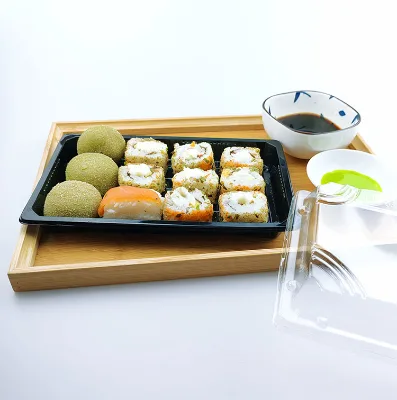
Factory Sustainable Disposable Plastic Pet Black Color Sushi Box With Clear Lid
$0.07 - $0.09
MOQ: 40000 pieces

Putian Qingyuanji Trading Co., Ltd.
- Verified by CTI
- Trading Company
- China Fujian
- Lead time15 days
- Avg. response≤ 2h
Main productsDisposable Tableware, Disposable Cups
Main marketsDomestic


Food Grade Disposable Sushi Box Eco-Friendly Takeaway Sushi Container
$0.03 - $0.05
MOQ: 100000 Pieces

NINGBO HAISHU JUDIN PACKING PRODUCTS CO., LTD.
- Verified by CTI
- Combined
- China Zhejiang
- Lead time15 days
- Avg. response≤ 5h
Main productsCup, Paper Cup, Food Packaging, Salad Bowl, Coffee Cup, Plastic Cup, Soup Cup, Take Away Box, Ice Cream Cup, Food Container
Main marketsEurope,North America

Anhui Nature Imp. & Exp. Co., Ltd.
- Verified by SGS
- Trading Company
- China Anhui
- Lead time15 days
- Avg. response≤ 2h
Main productsBamboo Products, Wooden Products, Multiple Knife Fork & Spoon, Bamboo Scissors Stick, Bamboo Sushi Curtain, Disposable Creative Bead Bamboo Stick, Bamboo Straw, Bamboo Stick, Wooden Cutlery, Wooden Knife Spoon Fork
Main marketsSoutheast Asia/ Mideast,Europe,North America

Wholesale Blister Disposable Bento Box Plastic Pet Sushi Box for Takeout Packaging
$0.00 - $0.00
MOQ: 100 Pieces

OEM Disposable Food Tray Food Grade to Go Rectangular Plastic Pet Packaging Box for Sushi
$0.00 - $0.00
MOQ: 100 Pieces


Dongguan Sunyo Plastic Co., Ltd.
- Verified by TUVRHEINLAND
- Manufacturer/Factory
- China Guangdong
- Lead time15 days
- Avg. response≤ 3h
Main productsSushi Tray, Food Container, Pet Sheet, PVC Sheet, PETG Sheet, PP Sheet, PS Sheet
Main marketsSouth America,Mid East,North America,Southeast Asia,Eastern Asia,Western Europe,Africa


Comprehensive Sourcing Guide
Disposable PET Sushi Box Supplier Concentration and Factory Types
Current data indicates that suppliers for disposable pet sushi boxes are concentrated in specific Chinese provinces, with Guangdong and Shandong emerging as primary manufacturing hubs. Fact records show facilities in Guangdong offering combined company types that handle both trading and manufacturing, while Shandong-based entities often list themselves as trading companies, manufacturers, or other business structures. This geographic clustering suggests that buyers should prioritize regions where these specific operational models are documented to ensure access to a diverse range of production capabilities. The presence of ODM and OEM capacities in Guangdong and OEM-only capabilities in Shandong highlights distinct manufacturing specializations that influence product customization and volume flexibility.
When evaluating factory types, buyers must distinguish between combined entities that manage the entire supply chain and pure trading companies that may source from third-party factories. The observed data reveals that some suppliers in these regions possess ODM and OEM capacities, allowing for significant product customization, while others focus strictly on OEM production. This distinction is critical because combined companies often provide more integrated solutions for branding and design, whereas trading companies might offer broader product ranges but less direct control over the manufacturing process. Buyers should verify the specific company type listed in supplier profiles to align with their strategic needs for either deep customization or broad sourcing options.
How to Verify Disposable PET Sushi Box Suppliers
Verification of suppliers for disposable pet sushi boxes relies heavily on third-party audit reports and specific certification claims found in supplier profiles. Available evidence shows that some suppliers hold CTI verification status, while others are verified by SGS or BV, indicating different levels of external scrutiny regarding their business operations and product quality. These verification bodies provide a layer of trust that goes beyond self-declared claims, offering buyers a concrete basis for assessing supplier reliability. It is essential to cross-reference these verification statuses with the specific certifications listed, such as BSCI, ISO 9000, BRC, or ISO 22000, which appear in the profiles of certain manufacturers.
Beyond verification status, buyers should scrutinize the specific product certifications claimed for the disposable pet sushi boxes themselves. The data indicates that some products carry CE/EU certifications, while others are marked with FDA compliance, reflecting different regulatory standards for food contact materials. A supplier claiming FDA certification for their plastic trays must be able to provide documentation proving that their specific materials meet these safety requirements. Similarly, the presence of BSCI or ISO 22000 certifications suggests adherence to social compliance and food safety management systems, respectively. Buyers must treat these certifications as non-negotiable prerequisites for food-grade packaging and request valid certificates before proceeding with any order.
What to Compare Across Disposable PET Sushi Box Suppliers
Comparing suppliers requires a detailed analysis of key operational metrics such as lead times, minimum order quantities, and response speeds. The observed data reveals significant variation, with lead times ranging from 15 days to 45 days depending on the supplier's location and capacity. Response times also differ, with some suppliers responding within 1.67 hours while others take over 12 hours, which can impact the speed of negotiation and order finalization. Buyers should prioritize suppliers with shorter lead times if their inventory turnover is high, but must balance this against the potential for higher costs or lower quality associated with rushed production schedules.
Minimum order quantities (MOQ) and pricing structures are equally critical factors in supplier comparison. Evidence shows MOQs ranging from 1,000 pieces to 100,000 pieces, with unit prices varying between $0.04 and $0.20 depending on the material and customization level. Some suppliers offer competitive pricing for high-volume orders, while others maintain higher price points for smaller batches. Buyers must calculate the total cost of ownership, including shipping and potential sample fees, rather than focusing solely on the unit price. Additionally, the availability of customization options, such as color, size, and branding, should be weighed against the MOQ requirements to ensure the supplier can meet specific market demands without excessive financial risk.
Common Disposable PET Sushi Box Sourcing Risks
One of the primary risks in sourcing disposable pet sushi boxes is the discrepancy between claimed certifications and actual product compliance. While some suppliers list FDA or CE/EU certifications, the lack of standardized verification across all products can lead to regulatory issues in target markets. Buyers must be vigilant about ensuring that the specific product model they order matches the certification claims, as a supplier might hold a general company certification that does not apply to every item in their catalog. This risk is particularly acute when dealing with mixed product lines that include both plastic and paper-based packaging solutions.
Another significant risk involves the reliability of lead times and the consistency of product quality. The data indicates that lead times can vary widely, from 15 to 45 days, and some suppliers may not adhere strictly to these timelines. Delays in production can disrupt supply chains, especially for businesses with tight inventory cycles. Furthermore, the variation in material specifications, such as the use of PET, PS, or other plastics, can affect the durability and safety of the final product. Buyers should mitigate these risks by requesting samples for testing and establishing clear contractual penalties for delays or quality failures before committing to large orders.
Disposable PET Sushi Box Regional Sourcing and Logistics
Regional sourcing strategies must account for the specific logistical advantages and challenges associated with different manufacturing hubs. Suppliers in Guangdong and Shandong offer distinct logistical profiles, with some indicating shipment methods like sea freight and others specifying delivery windows of 25 to 30 days. The proximity of these regions to major ports can influence shipping costs and transit times, making it essential for buyers to factor in these variables when planning their supply chain. Understanding the specific location of the factory allows for more accurate estimation of freight costs and potential customs delays.
Logistics planning also involves evaluating the packaging and handling capabilities of the supplier. Evidence suggests that products are often packed in cartons or plastic bags, which can impact the efficiency of loading and unloading during transit. Buyers should verify the packaging standards to ensure that the disposable pet sushi boxes arrive in pristine condition, free from damage or contamination. Additionally, the availability of free samples and the ability to customize packaging can provide further logistical flexibility. By aligning regional sourcing with specific logistics requirements, buyers can optimize their supply chain for cost efficiency and reliability.
Disposable PET Sushi Box Commercial Terms and Order Planning
Commercial terms for disposable pet sushi boxes often include specific payment methods and sample policies that must be clearly defined before order placement. The data indicates that some suppliers accept TT (Telegraphic Transfer) as a payment method, while others may offer free samples to facilitate product evaluation. Buyers should negotiate these terms carefully to ensure they align with their financial policies and risk tolerance. Understanding the sample lead time, which can range from 3 to 7 days, is crucial for planning the product development and testing phases effectively.
Order planning must also consider the customization capabilities and production capacity of the supplier. With ODM and OEM options available, buyers can tailor products to their specific brand requirements, but this often requires longer lead times and higher MOQs. The ability to customize features such as color, size, and material composition adds value but also introduces complexity into the supply chain. Buyers should develop a comprehensive order plan that accounts for these variables, ensuring that they have sufficient time for design approval, sample testing, and mass production. By carefully managing commercial terms and order planning, buyers can secure a reliable supply of high-quality disposable pet sushi boxes.
FAQs
What materials are disposable pet sushi boxes typically made from?
They are usually made from PET plastic, with some listings specifying APET or PS plastic types. Many designs pair the plastic tray with a clear PET lid or use kraft paper bases. Buyers should confirm food-grade certification such as FDA or CE/EU with each supplier before ordering, since material and certification details vary between listings.
What is the typical minimum order quantity for disposable sushi boxes?
Minimum order quantities vary widely by supplier and product type. Observed listings range from 1,000 pieces for standard disposable sushi trays to 30,000 pieces for printed food-grade boxes and 100,000 pieces for customized PET plastic trays. Lower MOQs usually apply to stock designs, while customization and printing typically require larger commitments.
How much do disposable pet sushi boxes cost per unit?
Listed prices for disposable sushi boxes and trays range from roughly $0.04 to $0.20 per piece, with many PET tray listings falling between $0.05 and $0.10. Price depends on size, material, lid type, printing, and order quantity. Request quotations for your exact specification, as bulk volumes generally secure the lower end of the range.
What lead times should buyers expect when sourcing sushi boxes from China?
Lead times reported by suppliers range from around 15 to 45 days, and some product listings quote 25 to 30 days for delivery. Sample production is often quoted at 3 to 7 days. Sea freight is the common shipment method, so confirm production schedules, sample timing, and shipping arrangements with suppliers before placing an order.
Can disposable sushi boxes be customized with printing or custom sizes?
Yes, customization is listed as available across multiple product listings, covering custom sizes, two-sided printing, and multicolor options. Suppliers offer OEM and ODM services for packaging products. Note that customized orders often carry higher minimum quantities, such as 100,000 pieces, so verify the MOQ, artwork requirements, and any tooling costs before committing.
Which Chinese regions are known for manufacturing disposable sushi packaging?
Suppliers of disposable sushi boxes and related packaging appear in Guangdong, Shandong, and Jiangsu provinces. Shandong suppliers commonly list plastic and kraft paper sushi trays alongside broader food packaging, while Guangdong suppliers focus on disposable PET trays. Reviewing each supplier's main product categories helps confirm they produce sushi packaging as a core offering.
What certifications should I verify for disposable food packaging?
Look for FDA, CE/EU, or food-grade certification on product listings, and ask suppliers for documentation to support these claims. Some suppliers hold system certifications such as ISO 9001, ISO 22000, BSCI, or BRC, and some carry third-party verification from agencies like SGS, BV, or CTI. Always request current certificates directly rather than relying on listing claims.