Source 600 LED Video Light Panel for Film, Photography, Live Stream
Compare 30 listings of the 600 LED Video Light Panel featuring RGB color temperature, APP control, and aluminum housing. Buyers can evaluate specifications like 600W power, CE certification, and dimensions for film, photography, and live stream applications.
Key considerations
Products List


Comprehensive Sourcing Guide
Strategic Sourcing Guide for 600W LED Video Light Panels
The global demand for high-intensity, portable lighting solutions has surged alongside the expansion of digital content creation, film production, and live streaming industries. For procurement professionals and business buyers, the core keyword "600 LED Video Light Panel" represents a specific segment of professional lighting equipment characterized by high wattage, advanced color control, and specialized form factors. Sourcing these units requires a disciplined approach that balances technical performance with supply chain reliability. This guide outlines the critical factors buyers must evaluate when identifying, verifying, and purchasing 600W LED video light panels, ensuring that the final acquisition meets rigorous professional standards without relying on unverified market assumptions.
Technical Specifications and Performance Parameters
When evaluating a 600W LED video light panel, the primary focus must be on the convergence of power output, spectral quality, and physical dimensions. Based on available product data, a unit with a 600W maximum power rating is designed to deliver high-intensity illumination suitable for professional environments. The power consumption of 600W indicates a significant energy draw, necessitating robust power supply units capable of handling AC100-240V input voltages. This wide voltage range is essential for international procurement, ensuring compatibility with varying grid standards across different regions.
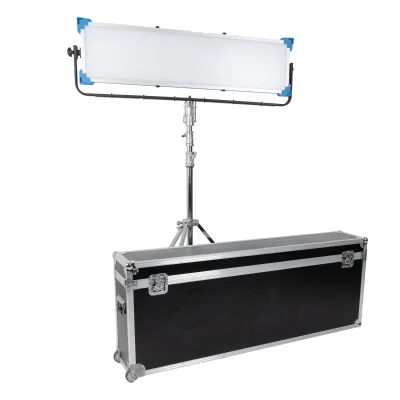
The physical architecture of these panels often utilizes aluminum for the housing material, providing necessary heat dissipation for high-wattage components. In contrast, some variants may incorporate plastic or ABS and PP materials for specific structural elements, though the primary housing for high-power units typically relies on metal for thermal management. The dimensions of a standard 600W panel are substantial; observed specifications indicate a size of approximately 147x51.8x18.2 cm, with a single package size reaching 147x52x19 cm. The weight is a critical logistical factor, with a single unit often weighing around 26 kg. This substantial mass requires careful planning for shipping and on-site handling, particularly in studio environments where mobility is key.
Color temperature control is another defining technical attribute. Modern 600W panels frequently feature RGB capabilities, allowing for a full spectrum of color adjustments rather than a fixed white temperature. This feature is indispensable for creative directors and cinematographers who require precise color grading during production. The beam angle is typically optimized for broad coverage, with observed data suggesting a 120° spread, which is ideal for softening light over a wide area. Furthermore, the control mode has evolved beyond manual switches; many high-end units now support APP-based control, enabling remote adjustment of intensity and color from a mobile device. Buyers must verify if the specific model supports dimming functions, as some high-power units are listed as "Without Dimmable," which could limit their utility in dynamic shooting scenarios.
Compliance and Certification Verification
In the B2B lighting sector, regulatory compliance is not merely a formality but a prerequisite for market access and liability protection. When sourcing 600W LED panels, buyers must rigorously verify the certification status of the product. The supplied data indicates that products in this category often carry CE certification, which is mandatory for selling within the European Economic Area. Additionally, some listings reference CCC (China Compulsory Certification) and RoHS (Restriction of Hazardous Substances) compliance. While RoHS is a common standard for electronic components to limit lead and other hazardous materials, its presence must be confirmed on a per-shipment basis.
It is crucial to distinguish between observed certifications and universal claims. While CE and RoHS are frequently cited, buyers should not assume that every listed 600W panel automatically satisfies all regional standards. For instance, ISORoHS is mentioned in some product attributes, but this is not a standard international designation and requires clarification. Procurement teams should request valid, up-to-date test reports from independent laboratories rather than relying solely on the supplier's marketing claims. The absence of a specific certification in a product listing does not necessarily imply non-compliance, but it does signal a need for deeper due diligence. Buyers must ensure that the "place of origin," often listed as Guangdong, China, aligns with the regulatory requirements of the destination market. For example, if the product is destined for the United States, additional UL or ETL certifications may be required, which are not explicitly detailed in the general product attributes provided.
Cost Drivers and Pricing Structures
The pricing of 600W LED video light panels is influenced by a complex interplay of factors, including material costs, power efficiency, and the sophistication of the control systems. The observed price range for such products in the market spans from $0.20 to $2,590.00. This vast disparity highlights the difference between basic, low-power components and fully integrated, high-end professional units. A 600W panel with RGB capabilities, APP control, and aluminum housing will naturally command a price at the higher end of this spectrum, whereas simpler models may fall near the lower bound.
The Minimum Order Quantity (MOQ) is another significant cost driver. Data indicates that MOQs can range from 1 unit to 1,000 units. High-volume buyers may benefit from negotiating lower unit prices by meeting the 1,000-piece threshold, while smaller buyers or those testing the market may face higher per-unit costs if they order in smaller batches. The "Sample price" is often charged separately, meaning that the initial cost to evaluate a product before a bulk order is a distinct line item. Buyers should factor this into their total cost of ownership. Additionally, packaging costs can impact the final price; some units are packed as single items, while others come in configurations like 2 pieces per inner box and 10 pieces per outer carton. The weight of 26 kg per unit also influences shipping costs, which can be a substantial portion of the total landed cost for international buyers.
Typical Applications and Use Cases
The versatility of 600W LED video light panels makes them suitable for a diverse range of professional applications. The primary use case identified is for film, photography, video shooting, and live streaming. The high wattage and RGB capabilities allow these lights to serve as key, fill, or backlight sources in studio settings, as well as on location shoots where portable, high-output lighting is required. The square appearance and flat-type design are optimized for mounting on stands or rigging systems, providing a consistent and controllable light source.
Beyond the core video production market, these units are also adapted for other specialized uses. Some product attributes suggest applications in garden lighting, indicating that certain models may be designed for outdoor durability or specific aesthetic purposes. However, the high power consumption and weight of 26 kg make them less suitable for casual or residential garden use without proper infrastructure. The inclusion of solar panel options, such as a 0.35W/4.5V Poly Solar Panel with a 3.2V/500mAh LiFePO4 battery, suggests a niche market for portable, off-grid lighting solutions. These solar-integrated models are ideal for field production where grid power is unavailable, though their power output is significantly lower than the 600W mains-powered variants. Buyers must carefully match the application requirements to the specific model's capabilities, ensuring that the power source (AC, DC, or Solar) aligns with the intended environment.
Supplier Evaluation and Quality Control
Selecting the right supplier is critical for ensuring product consistency and long-term support. When evaluating potential partners, buyers should look for suppliers who offer OEM and ODM services, as this indicates a capacity for customization and flexibility. The availability of "Custom Design" models suggests that suppliers can adapt the product to specific branding or functional needs. However, the "private mold" status is noted as "No" in some listings, which implies that the molds may be shared or standard, potentially limiting unique customization options.
Quality control should be a central component of the procurement process. Given the high power rating of 600W, thermal management is a primary concern. Buyers should verify that the aluminum housing is designed to dissipate heat effectively to prevent LED degradation. The "Single gross weight" of 26.000 kg must be consistent across the batch to ensure packaging and shipping stability. Lead times are another critical metric; sample lead times are observed to be between 5 and 7 days, which is a reasonable benchmark for prototyping. However, bulk production lead times are not explicitly defined in the provided data and must be negotiated directly with the supplier.
Buyers should also scrutinize the "prod_standard" and "prod_model" details. For example, models like HS-600, SF-1S, and P100C represent different product lines with varying specifications. A 36W model (prod_model: 36W) is distinct from a 600W unit, and confusing these can lead to procurement errors. The standard size of 598*598mm is mentioned for some products, which may refer to a different form factor or a specific mounting standard. Buyers must ensure that the model number and specifications match the exact requirements of their project.
Long-Term Procurement Considerations
Sourcing 600W LED video light panels is not a one-time transaction but a strategic relationship that impacts long-term operational efficiency. Buyers should consider the availability of replacement parts, such as power supplies or LED drivers, to ensure the longevity of the equipment. The "Selling Units" being listed as "Single item" suggests that the market supports individual sales, but bulk buyers should verify if spare parts are available in the same packaging configurations.
The "Sample charged" policy indicates that the supplier expects buyers to validate the product before committing to a large order. This is a best practice for high-value items, allowing buyers to test the actual performance, including the APP control functionality and RGB color accuracy. Over time, the total cost of ownership will be influenced by the energy efficiency of the LEDs and the durability of the housing. Aluminum housing generally offers better longevity than plastic, but the specific material composition should be confirmed.
Finally, buyers must remain vigilant regarding the "place of origin" and any changes in trade regulations. As products originate from Guangdong, China, changes in export policies or tariffs could impact the cost and availability of these units. Establishing a clear communication channel with the supplier regarding lead times, quality assurance protocols, and after-sales support is essential for mitigating these risks. By adhering to a disciplined sourcing strategy that prioritizes verified specifications and robust supplier evaluation, buyers can secure high-quality 600W LED video light panels that meet the demanding requirements of the professional media industry.
| Feature Category | Key Observation | Verification Requirement |
|---|---|---|
| Power | 600W Max, AC100-240V | Confirm input voltage compatibility with destination grid. |
| Material | Aluminum Housing, Plastic/ABS components | Verify thermal management design for high-wattage use. |
| Dimensions | 147x51.8x18.2 cm, 26 KG | Check shipping logistics and handling equipment needs. |
| Control | APP Control, RGB, 120° Beam | Test APP functionality and color accuracy in sample phase. |
| Certification | CE, RoHS, CCC (observed) | Request valid test reports for specific shipment batches. |
| MOQ | 1 - 1000 PCS | Negotiate pricing tiers based on order volume. |
| Lead Time | Sample: 5-7 Days | Confirm bulk production lead time before signing contract. |
In conclusion, the procurement of 600W LED video light panels requires a meticulous approach that balances technical specifications with regulatory compliance and supplier reliability. By focusing on verified data and avoiding unconfirmed claims, buyers can navigate the complexities of this market and secure equipment that delivers professional-grade performance for film, photography, and live streaming applications.
FAQs
What certifications do 600 led video light panels typically have?
These panels often carry CE, RoHS, and CCC certifications. Some listings also mention ISORoHS, but buyers must verify valid test reports from independent laboratories before purchasing to ensure compliance with regional standards.
How much does a 600 LED Video Light Panel weigh?
A single unit typically weighs 26 kg. This substantial mass requires careful planning for shipping and on-site handling, especially in studio environments where mobility is key for professional film and photography applications.
Can I control the light via a mobile app?
Yes, many high-end units support APP-based control for remote adjustment. This feature allows users to modify intensity and color settings from a mobile device, though some models may lack dimming functions entirely.
What is the minimum order quantity for these lights?
MOQs range from 1 to 1000 pieces depending on the supplier. High-volume buyers may negotiate better prices at the 1000-piece threshold, while smaller buyers might face higher per-unit costs for smaller batches.
Where are these products manufactured?
The place of origin is typically Guangdong, China. Buyers should ensure this location aligns with the regulatory requirements of their destination market, as export policies or tariffs may impact the final cost.
What materials are used for the housing?
Housing is commonly made of aluminum for heat dissipation, though some variants use plastic or ABS and PP. Aluminum is preferred for high-wattage units to manage thermal loads effectively during operation.