Source Biodegradable Compostable Dog Poop Bags for Shopping, Promotion, and Household
Compare 24 listings for Biodegradable Compostable Dog Poop Bags featuring heat seal, biodegradable materials, and custom sizes. Buyers can evaluate options for shopping, promotion, and household use with varying capacities and packaging types.
Key considerations
Products List


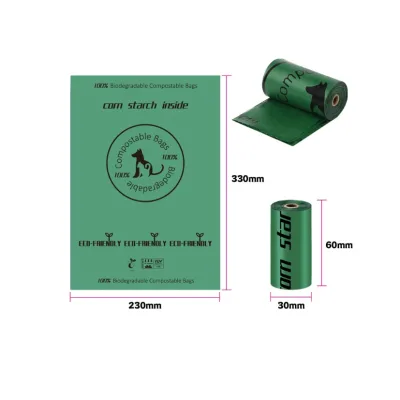
Eco-Friendly Biodegradable Compostable Dog Poop Bag Disposable Waste Bags
$0.20 - $0.25
MOQ: 10000 Rolls


Comprehensive Sourcing Guide
Strategic Sourcing Guide for Biodegradable Compostable Dog Poop Bags
Procuring biodegradable and compostable dog poop bags requires a nuanced understanding of material science, supply chain logistics, and regulatory compliance. Unlike traditional plastic bags, these products demand specific verification of their decomposition properties and structural integrity under load. Buyers must navigate a market where terminology often overlaps, necessitating a rigorous approach to defining technical specifications before engaging with suppliers. The following guide outlines the essential factors for sourcing these eco-friendly waste management solutions effectively.
Technical Specifications and Material Composition
The foundation of any successful procurement strategy lies in the precise definition of material composition and physical dimensions. In the current market, biodegradable bags are frequently constructed from blends of polylactic acid (PLA), polybutylene adipate terephthalate (PBAT), and cornstarch. These materials are selected for their ability to break down under specific environmental conditions, distinguishing them from conventional polyethylene. When evaluating product listings, buyers should look for explicit mentions of these polymer blends rather than generic "biodegradable" claims.
Dimensions and capacity are equally critical variables. Sourcing data indicates that standard bag sizes vary significantly, with common specifications ranging from 22.5 cm by 50 cm to 38 cm by 40 cm. Some product lines offer capacities between 1.0 L and 2.0 L, while others are designed for smaller loads with capacities of 1.0 L to 1.5 L. The physical form factor often includes a "shoulder length handle" for ease of use, though some variations may feature different handle configurations or no handles at all. The hardness of the material is typically described as "soft" to ensure flexibility during the tying process, while transparency levels can range from opaque to fully transparent.
Weight capacity is a vital safety parameter. Reliable specifications suggest a weight limit between 5 kg and 10 kg for standard heavy-duty variants. However, buyers must verify this limit against the specific model number, as some models, such as those designated as "TC-CW001" or "TCXG," may have different load-bearing characteristics. The sealing method is predominantly "heat seal," which ensures a secure closure that prevents leakage. Additionally, the product packing is often listed as "box" or "carton case," which impacts the volume efficiency of shipping and storage.
Compliance and Certification Verification
Verifying the environmental claims of dog poop bags is perhaps the most complex aspect of the sourcing process. While the market often references international standards such as EN 13432 or ASTM D6400, buyers must treat these as verification targets rather than guaranteed attributes of every listed product. The presence of these standards in background data does not confirm that a specific supplier's batch has passed third-party testing. Instead, procurement teams must request current, valid certification documents from the supplier for the specific model being ordered.
The distinction between "biodegradable," "compostable," and "recyclable" is legally and scientifically significant. Some product attributes list features as "Recyclable, Disposable, Biodegradable," while others specify "Biodegradable: Yes." A bag labeled as biodegradable may require industrial composting facilities to break down within a reasonable timeframe, whereas home-compostable bags must degrade in lower-temperature environments. Buyers should explicitly ask suppliers whether the product meets the criteria for industrial composting or home composting, as the infrastructure required for each differs vastly.
Furthermore, the origin of the product plays a role in compliance. Sourcing data indicates that many of these products originate from regions such as Henan, China. While this is a major manufacturing hub, it necessitates a thorough review of the supplier's export compliance and their ability to provide documentation that meets the regulatory requirements of the destination market. Buyers should not assume that a product labeled "biodegradable" automatically complies with local waste management regulations without explicit proof.
Cost Drivers and Economic Factors
The pricing structure for biodegradable dog poop bags is influenced by several volatile factors, primarily the cost of raw materials and the complexity of the manufacturing process. The observed price range in the market spans from $0.01 to $4,000, a wide disparity that reflects differences in order volume, material quality, and customization levels. The minimum order quantity (MOQ) is another significant driver, with observed ranges extending from 1 unit to 1,000,000 units. For smaller buyers, the high MOQs associated with custom runs can significantly increase the unit cost.
Customization is a primary cost variable. Products offering "Customized" handles, "Bicolor" or "Multicolor" designs, and "With Logo Printing" capabilities generally command a premium over standard, unbranded options. The printing process, often described as "Laminating," adds an additional layer of cost but is essential for brand visibility and marketing. Buyers must balance the desire for custom branding against the budget constraints, as the MOQ for customized orders is often higher than for standard stock items.
Lead times also impact the total cost of ownership. Typical delivery times are observed to be between 15 and 20 days. Delays in production or shipping can disrupt inventory levels, leading to stockouts and potential loss of sales. Buyers should factor in these lead times when planning procurement cycles, especially if they are relying on just-in-time inventory models. The type of packing, whether "by Carton" or in "Box" units, also affects shipping costs, as denser packing reduces freight expenses per unit.
Typical Applications and Usage Scenarios
Understanding the intended application of the bags is crucial for selecting the right product. The primary usage scenarios identified include "Shopping," "Promotion," "Packing," "Gift," and "Household" applications. For dog waste specifically, the bags serve as "Pet Cleaning Products" and "Pet Waste Cleaning" tools. The operation type is typically "Manual," requiring the user to manually tie the bag after use.
The versatility of these bags extends beyond simple waste disposal. Their "Biodegradable" and "Disposable" nature makes them suitable for promotional events where brands wish to demonstrate environmental responsibility. The "Shaped Bag" design and "Green" or "Multicolor" options allow for differentiation in the marketplace. However, buyers must ensure that the specific model selected matches the intended use case. For instance, a bag designed for "Shopping" may not have the necessary tensile strength for heavy pet waste, whereas a bag labeled specifically for "Pet Waste Cleaning" will likely have reinforced seams and a higher weight limit.
Supplier Evaluation and Quality Control
Evaluating suppliers requires a multi-faceted approach that goes beyond price comparison. Buyers should assess the supplier's ability to provide consistent quality across large batches. The "Hardness" and "Transparency" of the bags are key quality indicators that should be verified through physical samples. A bag that is too hard may be difficult to tie, while one that is too transparent might not effectively conceal waste, which can be a concern for some users.
Quality control protocols should include testing for "Waterproof" capabilities to ensure that the bags do not leak during transport. The "Sealing" method, specifically "Heat Seal," must be robust enough to prevent accidental opening. Buyers should request test reports that demonstrate the bag's ability to hold the specified weight limit of 5-10 kg without tearing. Additionally, the "Customization" capabilities of the supplier should be verified to ensure that logos and colors can be reproduced accurately without compromising the structural integrity of the bag.
Long-Term Procurement Considerations
Sourcing biodegradable dog poop bags is not a one-time transaction but a long-term commitment to sustainability and supply chain stability. Buyers should consider the scalability of their orders. As demand grows, the ability of the supplier to maintain consistent quality and delivery times becomes paramount. The "Delivery Time" of 15-20 days is a baseline that must be maintained even during peak seasons.
Environmental impact is a long-term consideration that extends beyond the product itself. Buyers should evaluate the supplier's commitment to sustainable manufacturing practices and their ability to provide transparency regarding the lifecycle of the product. The "Feature" of being "Biodegradable" is a selling point that must be backed by credible data to avoid greenwashing accusations. Over time, buyers may need to adapt their specifications as new materials or standards emerge, making flexibility in the supplier relationship a valuable asset.
Comparison of Product Attributes
To assist in the decision-making process, the following table summarizes key attributes observed in the market for biodegradable dog poop bags. This comparison highlights the variability in specifications that buyers must navigate.
| Attribute Category | Observed Variations | Key Considerations for Buyers |
|---|---|---|
| Material Composition | PBAT+PLA+Cornstarch, PET | Verify blend ratios for compostability claims. |
| Dimensions | 22.5cm50cm, 2333cm, 38cm*40cm | Match size to dog breed and waste volume. |
| Capacity | 1L-1.5L, 1.6L-2L | Ensure sufficient volume for intended use. |
| Weight Limit | 5-10 kg | Critical for heavy-duty applications. |
| Handle Type | Shoulder Length Handle, Customizable | Evaluate ergonomics and ease of use. |
| Color Options | Green, Bicolor, Multicolor, Transparent | Align with brand identity or functional needs. |
| Packing | Box, Carton Case, by Carton | Assess storage efficiency and shipping costs. |
| Customization | Customized, Non-Customized, With Logo | Determine if branding is necessary for the order. |
| Origin | Henan, China | Verify export compliance and logistics. |
| Lead Time | 15-20 Days | Plan inventory cycles accordingly. |
In conclusion, sourcing biodegradable and compostable dog poop bags requires a meticulous approach to technical specifications, compliance verification, and supplier evaluation. By focusing on the specific attributes outlined above and maintaining a rigorous standard for quality and documentation, buyers can secure a supply chain that meets both their operational needs and their environmental commitments. The market offers a wide range of options, but success lies in the ability to discern the specific requirements of each product and match them to the buyer's unique context.
FAQs
What materials are used for biodegradable dog poop bags?
These bags are typically constructed from blends of PBAT, PLA, and cornstarch. This composition ensures they break down effectively while maintaining the structural integrity required for waste disposal applications.
Which bag capacity is suitable for standard dog waste?
Standard capacities range from 1.0 L to 2.0 L depending on the specific model. Buyers should select a size that matches the expected waste volume to ensure secure containment without leakage.
Can these bags be customized with logos and colors?
Yes, customization is available for logos, colors, and handle types. Suppliers offer options like bicolor, multicolor, and green designs with laminating printing processes to meet specific branding requirements.
What is the typical lead time for delivery?
The standard delivery time is between 15 and 20 days. Buyers should plan their inventory cycles around this baseline to avoid stockouts during peak procurement periods.
How much weight can these bags safely hold?
Reliable specifications indicate a weight limit between 5 kg and 10 kg. This capacity ensures the bags remain secure during manual operation and transport of pet waste.
Where are these products typically manufactured?
Most products originate from Henan, China. This region is a major manufacturing hub, though buyers must verify export compliance and documentation for their specific destination markets.