Source Biodegradable Kraft Paper Hamburger Box for food, packaging, and thermal use
Find 30 listings for Biodegradable Kraft Paper Hamburger Box options suitable for food, beverage packaging, and thermal applications. Compare features like oil-proofing, biodegradability, and customization to select the right supplier for your needs.
Key considerations
Products List


Eco-Friendly Biodegradable Compostable Kraft Paper Burger Hamburger Box
$0.01 - $0.04
MOQ: 30000 piece

Biodegradable Kraft Fries Hamburger Box Custom Cardboard Paper Burger Box
$0.02 - $0.05
MOQ: 30000 piece


Biodegradable Kraft Paper Burger Box for Environmentally Friendly Packaging
$0.03 - $0.05
MOQ: 50 Pieces

Biodegradable Kraft Paper Burger Packaging Box for Eco-Friendly Restaurants
$0.03 - $0.05
MOQ: 50 Pieces


Compostable Kraft Paper Packaging Hamburger Box for Sustainable Burger Service
$0.03 - $0.05
MOQ: 50 Pieces

Biodegradable Kraft Paper Burger Box Custom Packaging Wholesale Recyclable
$0.03 - $0.05
MOQ: 50 Pieces


Custom Print Packing Cardboard Paper Burger Box Biodegradable Hamburger Box
$0.05 - $0.06
MOQ: 50000 Pieces




Comprehensive Sourcing Guide
Strategic Sourcing Guide for Biodegradable Kraft Paper Hamburger Boxes
Understanding Material Composition and Technical Specifications
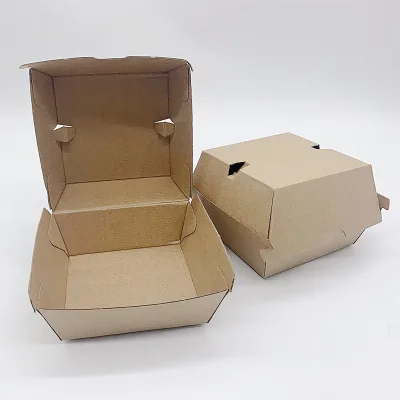
When sourcing biodegradable kraft paper hamburger boxes, the primary focus must remain on the fundamental material composition and the specific technical attributes that define the product's utility. The core material identified in the available market data is kraft paper, often combined with paperboard or white paper variants. This selection is critical because kraft paper provides the necessary structural integrity required to hold hot, greasy food items without collapsing. The paper weight for these containers typically ranges from 150GSM to 350GSM. This range indicates a significant variance in thickness and durability, where lower weights might suffice for dry items, while higher weights are essential for holding substantial moisture and heat.
The shape of the container is predominantly square, a design choice that maximizes space efficiency during both manufacturing and logistics. However, buyers should note that custom sizes are frequently accepted, allowing for adaptation to specific brand requirements or unique product dimensions. The paper type is a critical differentiator; while some listings specify Kraft Paper or Corrugated Paper, others include Paperboard or White Paper. The distinction matters for the final aesthetic and functional performance. For instance, corrugated paper offers superior insulation, which is beneficial for thermal retention, whereas standard kraft paper provides a rustic, eco-conscious aesthetic.
A crucial technical feature to verify is the coating applied to the paper. The data indicates that coatings such as PE (Polyethylene) or PLA (Polylactic Acid) are available. PLA is a biodegradable alternative derived from renewable resources like corn starch, aligning with the "biodegradable" claim in the core keyword. In contrast, PE coatings are petroleum-based and may not be fully compostable depending on the specific facility. Buyers must explicitly verify the coating type to ensure the product meets their specific sustainability goals. Additionally, the printing page is often single-sided, which is standard for cost-effective branding, though the design can be customized to be exquisite and tailored to the buyer's logo.
Compliance, Certification, and Regulatory Standards
Navigating the regulatory landscape is essential for importing food packaging, particularly when claiming biodegradability. The market data highlights several certifications that buyers should look for to validate product safety and environmental claims. The most prominent certifications observed include BV (Bureau Veritas), FSC (Forest Stewardship Council), FDA (Food and Drug Administration), CE (Conformité Européenne), CIQ (China Inspection and Quarantine), LFGB (German Food and Feed Code), and EEC (European Economic Community) standards.
The presence of FSC certification is particularly significant for products marketed as eco-friendly. It verifies that the paper originates from responsibly managed forests, ensuring that the supply chain does not contribute to deforestation. However, buyers must be cautious, as the data also lists "Low-confidence background" certifications like ISO9001:2015 and BSCI. While these are valuable for general quality management and social compliance, they should not be conflated with specific food safety or material biodegradability certifications unless explicitly confirmed by the supplier.
For food contact safety, FDA and LFGB certifications are non-negotiable for markets in the United States and Europe, respectively. These standards ensure that the materials used, including the paper and any coatings, do not leach harmful substances into food. The data also mentions SGS and BV testing, which are third-party verification services. Buyers should request specific test reports from these agencies to confirm that the product meets the claimed standards. It is important to note that while certifications like CE and FSC are listed, their applicability depends on the specific product model and the intended market. A box certified for the EU market may not automatically meet US FDA requirements without specific testing.
Cost Drivers and Economic Factors in Procurement
The economics of sourcing biodegradable kraft paper hamburger boxes are influenced by several variable factors. The observed price range in the market is quite broad, spanning from $0.01 to $0.56 per unit. This wide variance is not indicative of a single product but rather reflects differences in paper weight, coating type, customization level, and order volume. The Minimum Order Quantity (MOQ) is another significant economic driver, with observed ranges from 50 to 100,000 units.
For buyers with lower volume needs, the unit cost will likely be higher due to the fixed costs of setup and customization. Conversely, bulk orders can significantly reduce the per-unit cost, making the higher-end price points in the range more accessible. The customization of the design, including the acceptance of customer logos and specific printing techniques like embossing, glossy lamination, or matte lamination, adds to the cost. These finishing processes require additional machinery time and material, which are passed on to the buyer.
The choice of coating also impacts pricing. PLA coatings, being more sustainable and biodegradable, often command a premium over standard PE coatings. Furthermore, the paper weight plays a direct role in the cost; boxes in the 350GSM range will be more expensive than those at 150GSM due to the higher material usage. Buyers must balance their need for durability and insulation against their budget constraints. It is also worth noting that the "Stocked" status of some products implies lower lead times and potentially lower costs for immediate needs, whereas "Custom Order" items may incur additional setup fees and longer lead times.
Typical Applications and Functional Performance
The functional versatility of biodegradable kraft paper hamburger boxes extends beyond simple food containment. The primary application is clearly defined as food packaging, specifically for burgers, hamburgers, and various food ingredients. The data explicitly lists "Hamburger" and "Food Ingredients Packaging" as key uses. However, the utility of these boxes is not limited to fast food. The observed usage categories include food, tableware, thermal applications, shoes, spice, sundries, garage, and bedding. While the latter categories (shoes, garage, bedding) seem unusual for a hamburger box, they suggest that the material's robustness allows for repurposing or that the manufacturer produces similar kraft paper containers for diverse industrial uses.
Functionally, these boxes are designed to be oil-proof and leak-proof, a critical requirement for handling greasy foods. The data confirms that "Oil Proof and Leak Proof" is a standard feature, achieved through the specific paper treatment and coating. Additionally, the boxes are described as microwavable, which is a valuable feature for consumers who need to reheat their meals. This capability depends heavily on the coating material; PLA coatings generally support microwave use better than certain PE variants, though this must be verified for each specific product.
The thermal properties of the box are enhanced by the paper type. Corrugated paper, in particular, offers better insulation, keeping hot food hot and cold food cold for longer periods. The shape, typically square, provides a stable base for stacking, which is beneficial for both storage and serving. The "Folded" attribute indicates that these boxes are often shipped flat to save on shipping volume and assembled by the end-user or the food service provider, further optimizing logistics costs.
Supplier Evaluation and Verification Protocols
Selecting the right supplier requires a rigorous evaluation process that goes beyond simple price comparison. The data indicates that customization is widely available, with suppliers accepting custom orders, logos, and specific designs. This flexibility is a strong indicator of a capable manufacturer, but it also introduces the need for careful vetting. Buyers should prioritize suppliers who explicitly state their capacity for OEM (Original Equipment Manufacturer) and ODM (Original Design Manufacturer) services.
Verification of the supplier's capabilities should include a review of their production standards. The data mentions "Multiple specifications" and "OEM/ODM" as standards, suggesting a flexible manufacturing environment. Buyers should request samples to test the physical properties of the box, such as its ability to hold weight without bending and its resistance to oil and moisture. The "Test: SGS BV" mention in the data suggests that reputable suppliers undergo third-party testing, and buyers should ask for these reports.
It is also crucial to verify the "Place of Origin," which is listed as China. While this is a major manufacturing hub, buyers should ensure that the specific factory they are dealing with has a track record of exporting to their target market. The "Export Carton" packing method is standard, but buyers should confirm that the packaging is sufficient to prevent damage during transit. Additionally, the "Brand Name: Million Pack" is mentioned in the data, but buyers should not limit their search to this specific brand. Instead, they should look for suppliers who can provide similar quality and customization options.
Quality Control and Long-Term Procurement Considerations
Ensuring consistent quality over the long term is vital for maintaining brand reputation. The data highlights "Customized Exquisite" design and "Biodegradable" features as key attributes. However, "Biodegradable" is a claim that requires strict quality control. Buyers must ensure that the biodegradability claim is backed by valid testing and certification, such as FSC or specific compostability standards. The variability in paper weight (150GSM-350GSM) means that quality control must be rigorous to ensure that every batch meets the specified weight and strength requirements.
Long-term procurement considerations also involve the stability of the supply chain. The "Stocked" status of some products offers a buffer against supply disruptions, but for custom orders, lead times can vary. Buyers should establish clear communication channels with suppliers to manage expectations regarding production schedules. The "Custom Order" and "Accept" attributes indicate that flexibility is available, but this should be balanced with the need for reliability.
Furthermore, the environmental impact of the packaging should be a central consideration. The "Eco-Friendly" and "Biodegradable" features are not just marketing terms but should be integral to the product's lifecycle. Buyers should inquire about the end-of-life disposal options for the boxes in their target markets. The presence of PE or PLA coatings affects this, as PE is not biodegradable in the same way as PLA. Therefore, the long-term strategy should include a clear understanding of the disposal infrastructure available to the end-user.
Comparative Analysis of Product Attributes
To facilitate a clearer decision-making process, the following table summarizes the key attributes observed in the market for biodegradable kraft paper hamburger boxes. This comparison helps buyers identify the specific features that align with their procurement needs.
| Attribute Category | Observed Options | Key Considerations for Buyers |
|---|---|---|
| Material | Kraft Paper, Paperboard, White Paper, Corrugated Paper | Verify paper weight (150-350GSM) for strength. Corrugated offers better insulation. |
| Coating | PE or PLA | PLA is biodegradable; PE is not. Verify coating for microwave safety. |
| Certifications | BV, FSC, FDA, CE, LFGB, EEC, CIQ | Ensure certifications match target market regulations (e.g., FDA for US, LFGB for EU). |
| Customization | Logo, Size, Design, Color (Multicolor) | Confirm MOQ for custom designs. Check if "Exquisite" design adds cost. |
| Functionality | Oil Proof, Leak Proof, Microwavable, Thermal | Test samples for oil resistance and heat retention. |
| Shape & Form | Square, Folded | Square maximizes space. Folded reduces shipping volume. |
| Packaging | Export Carton, Customized | Ensure packaging protects boxes during transit. |
In conclusion, sourcing biodegradable kraft paper hamburger boxes requires a balanced approach that considers material quality, regulatory compliance, cost efficiency, and supplier reliability. By focusing on the specific attributes outlined above and verifying claims through third-party testing, buyers can secure a supply chain that meets both functional and sustainability requirements. The broad range of options available in the market allows for significant customization, but this flexibility must be managed through rigorous quality control and clear communication with suppliers.
FAQs
What certifications do biodegradable kraft paper hamburger boxes have?
These boxes commonly hold BV, FSC, FDA, CE, CIQ, LFGB, and EEC certifications. Buyers should verify specific test reports from SGS or BV to confirm compliance with their target market's food safety and environmental standards.
Can these boxes be customized with a customer logo?
Yes, customization including customer logos is widely accepted for these products. Suppliers offer options for exquisite designs with single-sided printing, embossing, or lamination to meet specific branding requirements.
What is the typical paper weight range for these boxes?
The paper weight typically ranges from 150GSM to 350GSM depending on the model. Heavier weights like 350GSM provide better structural integrity for holding hot, greasy food items without collapsing.
Are these boxes microwavable and oil-proof?
Many models are designed to be microwavable and are oil-proof and leak-proof. This functionality relies on specific coatings like PE or PLA, which must be verified for microwave safety before use.
What is the minimum order quantity for these boxes?
The minimum order quantity ranges from 50 to 100,000 units based on the supplier and customization level. Lower MOQs suit smaller buyers, while bulk orders often reduce the per-unit cost significantly.
Which paper types are used for these hamburger boxes?
Common paper types include Kraft Paper, Corrugated Paper, Paperboard, and White Paper. Corrugated variants offer superior thermal insulation, while standard kraft paper provides a rustic aesthetic suitable for eco-friendly branding.