Source Cookware Set for Home, Restaurant, and Catering Needs
Find 30 Cookware Set options featuring stainless steel and non-stick coatings with customizable logos. Buyers can compare sizes, certifications, and MOQs for pots, pans, and complete sets suitable for various cooktops.
Key considerations
Products List


16 Piece Cookware Pots and Pans Set Ware Cooking Pots Sets Nonstick Cookware Set
$20.30 - $26.90
MOQ: 1000 Sets
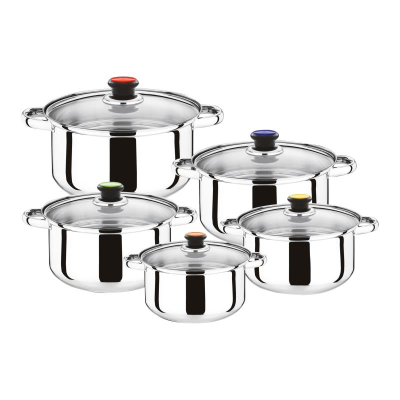


Multifunction Stainless Steel Cookware Set with Pots and Pans Tasty Cookware Set
$20.40 - $25.30
MOQ: 1000 Sets


Heavy Colorful Design Stainless Steel Cookware Set with Soft Touch Handle
$20.50 - $26.50
MOQ: 1000 Sets


Comprehensive Sourcing Guide
Strategic Sourcing Guide for Cookware Sets
Understanding Technical Specifications and Material Variations
When initiating a procurement strategy for cookware sets, the first critical step involves dissecting the technical specifications that define product performance and durability. The market presents a diverse array of configurations, necessitating a clear understanding of material composition, dimensional standards, and functional attributes. Based on current market observations, cookware sets frequently utilize Stainless Steel as a primary material, offering robustness and resistance to corrosion. However, Aluminum is also a prevalent material choice, often selected for its superior thermal conductivity and lighter weight profile. Buyers must recognize that a single supplier may offer distinct product lines where one set is constructed from Stainless Steel while another utilizes Aluminum, or a combination thereof, depending on the intended application and price point.
Dimensional consistency is another vital technical parameter. Observed product standards indicate that cookware sets often come in specific size ranges, such as 26-29cm or 22-25cm for individual pans, while complete sets may adhere to standardized diameters including 16cm, 18cm, 20cm, 22cm, 24cm, 26cm, 28cm, and 30cm. The physical weight of the set is equally significant; specifications range from lightweight configurations weighing approximately 1.78kg for smaller sets to heavier, more substantial units. The quantity per set varies, with common configurations including 3-piece, 4-piece, or larger assortments. Furthermore, the presence of a cover is a defining feature; some sets include a Stainless Steel cover, while others utilize a Glass Lid, which allows for visual monitoring of the cooking process. The transparency of the cover varies, with some options being fully transparent and others opaque, directly impacting the user's ability to monitor food without lifting the lid.
Compliance, Certification, and Safety Standards
Navigating the regulatory landscape is paramount for B2B buyers importing cookware, as non-compliance can lead to shipment delays or market rejection. The supply chain for cookware sets is heavily influenced by certification requirements that vary by destination market. High-confidence data indicates that products may carry certifications such as FDA and LFGB, which are critical for food safety compliance in North America and Europe, respectively. Additionally, CE/EU certification is a mandatory requirement for products entering the European Economic Area, ensuring that the cookware meets specific safety and health standards.
Buyers must verify that the supplier can provide valid documentation for these certifications rather than relying on verbal assurances. The material composition directly impacts compliance; for instance, non-stick coatings must be verified to ensure they do not contain prohibited substances under REACH or similar regulations. The standard for the product itself, often denoted by specific model numbers like NI-339-cookware-4PCS or X-0010, serves as a reference for the manufacturer's internal quality benchmarks. However, these internal model numbers do not replace external regulatory compliance. When evaluating a supplier, procurement teams should request copies of the latest test reports for FDA, LFGB, and CE compliance. It is also essential to confirm that the coating process, whether described as "Non-Stick Coating" or "Heat-Resistant Outside Coating," adheres to the safety standards of the target export market. Without these verified certifications, the risk of the product being deemed non-compliant at customs or by retailers is significantly elevated.
Cost Drivers and Pricing Dynamics
The pricing structure for cookware sets is influenced by a complex interplay of material costs, manufacturing processes, and order volume. The observed price range in the market spans from $3 to $34 USD per unit, a variance that reflects differences in material quality, coating technology, and set complexity. Stainless Steel sets generally command a higher price point compared to Aluminum-based sets due to the raw material costs and the more intensive manufacturing processes required for steel. The inclusion of specific features, such as a Glass Lid versus a Stainless Steel Cover, or the presence of a Non-Stick Coating, also drives up the unit cost.
Order volume is a decisive factor in final pricing. The Minimum Order Quantity (MOQ) varies significantly across suppliers, ranging from as low as 6 units to as high as 13,500 units. This wide range suggests that the market accommodates both small-batch buyers seeking customization and large-scale retailers requiring bulk inventory. A typical MOQ observed in the sector is around 1,000 units, which often unlocks better pricing tiers. Buyers should understand that the "pet set in a box" or "customized color box" packaging options add to the overall cost. Furthermore, the complexity of the coating process, such as the application of heat-resistant outside coatings, adds to the production time and cost. When negotiating, buyers must balance the desire for lower unit prices against the need to meet the supplier's MOQ requirements. It is crucial to analyze the total landed cost, including packaging, shipping, and duties, rather than focusing solely on the ex-factory price.
Typical Applications and Market Segmentation
Cookware sets are designed for a broad spectrum of applications, ranging from general household use to specialized promotional campaigns. The "Applicable Range" for these products is typically described as "General," indicating suitability for everyday cooking tasks. However, specific product attributes allow for targeted market segmentation. For instance, sets labeled as "Eco-Friendly" or those with "Customizable" logos are often targeted toward corporate gifting, promotional events, or brand-building initiatives. The "Using" attribute, which includes "Gift or Promotion," highlights a specific market segment where the cookware serves as a branded item rather than a primary utility product.
The versatility of the cookware is another key application driver. Many sets are designed to be compatible with "All Cooktops," including induction, gas, electric, and ceramic hobs. This universality expands the potential customer base, as the product does not restrict the buyer to a specific kitchen infrastructure. The "Pans Type," which often includes Frying Pans and Skillets, caters to specific culinary needs, while the "Stove" attribute of "All Purpose" reinforces the product's adaptability. For retailers, understanding these application nuances is essential for positioning the product correctly. A set with a "Light Weight" attribute and "Non-stick" features may be marketed towards students or young professionals, whereas a heavier Stainless Steel set with a "Glass Lid" might appeal to serious home cooks or culinary enthusiasts.
Supplier Evaluation and Customization Capabilities
Selecting the right supplier requires a rigorous evaluation of their production capabilities, customization options, and logistical reliability. The market data indicates that OEM (Original Equipment Manufacturer) and ODM (Original Design Manufacturer) services are widely accepted and offered. This means buyers can request significant customization, including the modification of product models, the application of custom logos, and the alteration of packaging designs. The "Customization" attribute is marked as "Available," and "Logo" customization is explicitly listed, allowing brands to create unique product identities.
However, the extent of customization often depends on the order volume. Suppliers may have different thresholds for accepting custom orders, with some requiring a minimum of 1,000 units to initiate a custom run. The "prod_packing" options, such as "Pet Set in a Box" or "Customized Color Box," offer flexibility in how the product is presented to the end consumer. Buyers should also verify the supplier's origin, as locations like Chaozhou, Guangdong, and Dongguan, China, are known hubs for cookware manufacturing. While these locations offer established supply chains, buyers must conduct due diligence on the specific factory's capacity and quality control measures. The "prod_model" variations, such as X-0019 or NI-339-cookware-4PCS, suggest that suppliers maintain a portfolio of standard models that can be adapted. Evaluating a supplier's responsiveness to customization requests and their ability to maintain quality standards during the customization process is critical for long-term success.
Quality Control and Long-Term Procurement Considerations
Ensuring consistent quality in cookware sets requires a robust quality control (QC) framework that addresses both material integrity and functional performance. The "Feature" of "Non-stick" is a critical quality indicator that must be verified through testing. Buyers should establish clear acceptance criteria for the coating's durability, ensuring it can withstand repeated use without peeling or degrading. The "Coating" process, described as "Non-Stick" or "Heat-Resistant," must be consistent across all units in a batch. Quality control should also encompass the physical dimensions and weight, ensuring they match the specified standards (e.g., 26-29cm size, 1.78kg weight) to prevent customer complaints regarding product inconsistency.
Long-term procurement considerations involve building a sustainable relationship with suppliers who can scale with demand. The "Quantity" attribute, often listed as "4PCS/Set," indicates the standard unit of measure, but buyers should negotiate flexibility for future orders. The "prod_standard" for outer box sizes and gross weights (e.g., 554550cm, GW: 14KGS or 22KGS) impacts logistics planning and storage costs. Buyers must verify that the packaging is durable enough to protect the cookware during transit, especially for sets with glass lids which are more prone to breakage. Additionally, the "Style" of the product, such as "Eco-Friendly," may become a regulatory or consumer preference requirement in the future, making it prudent to source from suppliers who are already aligned with sustainable practices. Establishing a clear communication channel for handling defects, returns, and reorders is essential for maintaining a reliable supply chain. By focusing on these quality and logistical factors, buyers can mitigate risks and ensure a steady flow of high-quality cookware sets to their markets.
FAQs
What certifications do these cookware sets hold?
The cookware sets hold FDA, LFGB, and CE/EU certifications. These certifications ensure compliance with food safety standards for North America, Europe, and the European Economic Area, making them suitable for export to regulated markets.
Which materials are used for the cookware sets?
The sets are constructed from Stainless Steel and Aluminum. Stainless Steel offers robustness and corrosion resistance, while Aluminum provides superior thermal conductivity and a lighter weight profile for different cooking needs.
Can I customize the logo and packaging for this set?
Yes, logo customization and packaging options are available for these sets. Buyers can request custom logos and choose between packaging like Pet Set in a Box or Customized Color Box, subject to meeting the supplier's minimum order quantity.
What is the typical minimum order quantity for these sets?
The minimum order quantity ranges from 6 to 13,500 units depending on the supplier and product configuration. A typical MOQ observed in the sector is around 1,000 units, which often unlocks better pricing tiers for bulk buyers.
Are these cookware sets compatible with all cooktop types?
Yes, the sets are designed for use on all cooktop types including induction, gas, and electric. This universal compatibility ensures the cookware can be used in various kitchen environments without requiring specific stove infrastructure.
What size ranges are available for the cookware sets?
Available sizes include individual pans ranging from 22 to 29 cm and complete sets with standard diameters like 16, 18, 20, 22, 24, 26, 28, and 30 cm. Specific models may also have defined capacities such as 2 liters.