Source Diesel Solenoid Valve Spring for Auto, Motorcycle, Home Appliance
Find and compare 30 Diesel Solenoid Valve Spring options from verified manufacturers. These compression springs support industrial, automotive, and home appliance applications with customizable specifications and cold-rolled steel materials.
Key considerations
Products List


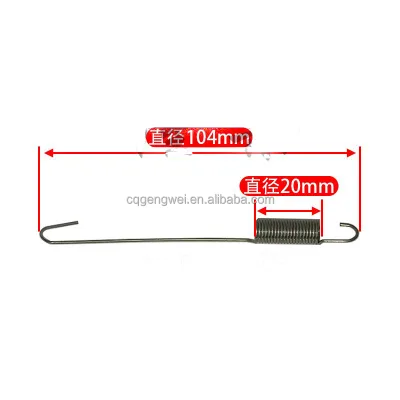
Tractors Engine Accessories Iron Spare Parts Diesel Engine Valve Spring
$0.20 - $3.00
MOQ: 5000 Pieces


$0.10 - $1.00
MOQ: 10000 Pieces




Comprehensive Sourcing Guide
Strategic Sourcing Guide for Diesel Solenoid Valve Springs
Understanding Technical Specifications and Material Standards
When sourcing diesel solenoid valve springs, the primary objective is to identify components that can withstand high-frequency actuation and the harsh thermal environments typical of diesel engine systems. The technical profile of these springs is defined by a specific set of material properties, dimensional tolerances, and manufacturing processes. Based on available industry data, the core material composition often involves high-carbon spring steel, specifically noted as "Oil Tempred Quenched High Carbon Spring Steel Wire." This material selection is critical because it provides the necessary tensile strength and fatigue resistance required for repeated compression cycles in solenoid applications.
The physical geometry of the spring is equally vital. The product attributes indicate a "Spiral" or "Coil" shape, which is the standard configuration for valve springs designed to provide linear force characteristics. The wire diameter range is a significant variable, observed to span from a minimum of 0.1mm (0.004 inch) to a maximum of 12mm (0.48 inch). For diesel solenoid applications, the specific wire gauge must be selected to match the required load type, which is predominantly "Compression." The manufacturing process is typically identified as "Cold Roll," a method that enhances the grain structure of the steel, thereby improving the spring's durability and resistance to stress relaxation.
Buyers must also scrutinize the standard component specifications. While some listings reference "Standard Component" status, others point to specific model numbers such as "VS002," "Pavs001," or "195-03009-1." These identifiers often correlate with specific engine families or solenoid designs. The end type is frequently specified as "Close and Ground Flat," a finish that ensures stable seating and uniform load distribution during operation. Furthermore, the winding direction is often customizable "as Per Your Request," a feature that allows procurement teams to align the spring's helix with the specific mechanical constraints of the solenoid assembly.
Compliance, Certification, and Quality Assurance Protocols
In the industrial and automotive sectors, particularly for diesel engine components, compliance with international standards is non-negotiable. The sourcing process must prioritize suppliers who can demonstrate adherence to recognized material and quality standards. The supplied context highlights several critical certifications and standards that serve as benchmarks for supplier evaluation. These include "ISO9001," "SGS," "RoHS," "CE," and "Ts16949" (often referred to as IATF 16949 in the automotive industry). The presence of these certifications indicates that the supplier has established a quality management system capable of maintaining consistent product integrity.
Material standards are another layer of compliance that requires verification. The data references specific material standards such as "DIN17223," "GB 4357-09," and equivalents like "55SiCr" or "Fd Sicr." These designations refer to the chemical composition and mechanical properties of the steel used. For instance, DIN17223 is a German standard for spring steel, while GB 4357-09 represents a Chinese national standard. Buyers must verify that the supplier's material certificates align with the specific standard required by their engineering team. Relying on a supplier who claims "Standard" compliance without providing traceable documentation for these specific grades can lead to premature failure in the field.
Quality assurance protocols extend beyond material certification to include testing methodologies. The observed data mentions a "Random Sample Inspection" as a testing method, with an "Aql Level" of "Aql 1.0." This Acceptable Quality Limit (AQL) indicates a strict threshold for defect rates, suggesting that only 1.0% of the sample batch can contain defects before the lot is rejected. Additionally, tolerance specifications are critical; the data notes a tolerance of "GB Standard, Grade II or as Per Your Requirement" and a "Spring Rate Tolerance" of "+-3%~10%." These numerical ranges define the acceptable deviation in force and dimensions. Procurement teams must ensure that the supplier's internal quality control processes can consistently meet these tight tolerances, as deviations can affect the solenoid's response time and sealing capability.
Cost Drivers and Pricing Variables
The pricing structure for diesel solomoid valve springs is influenced by a complex interplay of material costs, manufacturing complexity, and order volume. The observed listed price range in the market spans from $0.05 to $2000, a wide variance that reflects differences in size, material grade, and customization levels. The lower end of this spectrum typically corresponds to standard, off-the-shelf components with minimal processing, while the higher end reflects custom-engineered springs with specialized coatings or complex geometries.
Material costs are a primary driver. The use of high-carbon steel, alloy steels, and specific heat treatments like "Oil Tempred Quenched" adds significant value compared to standard carbon steel. Furthermore, surface treatments and coatings, such as the observed "Coating Thickness" of 8~10 Micrometer, contribute to the final price. These coatings are essential for corrosion resistance in diesel environments, which often contain sulfur and moisture. The "Surface Treatment" is noted as "as Per Your Request," meaning that additional treatments like phosphating or galvanizing will increase the unit cost.
Order volume, represented by the Minimum Order Quantity (MOQ), is another critical cost factor. The observed MOQ range is vast, from 1 to 10,000,000 units. Suppliers often offer tiered pricing, where the unit cost decreases significantly as the order volume increases. For a buyer requiring a small batch for prototyping, the MOQ of 1 allows for flexibility, but the per-unit cost will be higher. Conversely, large-scale production runs can leverage the lower end of the price spectrum. The "Business Mode" is frequently identified as "Factory OEM," indicating that direct factory sourcing is the norm, which can reduce intermediary markups. However, buyers must balance the cost savings of large orders against the inventory carrying costs and the risk of obsolescence if the engine design changes.
Typical Applications and Industry Focus
While the core keyword focuses on diesel solenoid valves, the application landscape for these springs is broader, encompassing various sectors where precision compression springs are essential. The data indicates that these components are used in "Industrial," "Auto," "Motorcycle," "Home Appliance," and "Furniture" applications. Specifically for the diesel context, the "Industry Focus" includes "Agricultural" machinery and "Diesel Engine Parts." In these environments, the springs must function reliably under high vibration and temperature fluctuations.
The specific function of the spring in a solenoid valve is to provide the necessary force for "Restoration" and "Buffering" of the valve mechanism. The observed "Item Function" list includes "Pressed," "Buffer," "Drive," and "Restoration," highlighting the dual role of the spring in both actuating the valve and returning it to its neutral position. In diesel engines, solenoid valves control fuel injection timing and pressure; therefore, the spring's ability to respond quickly and consistently is paramount. Any failure in the spring's "Buffer" or "Drive" capability can lead to engine misfires, reduced efficiency, or complete system failure.
Additionally, the data mentions "Pneumatic Actuator Valve Spring" and "Outer Valve Spring" or "Inner Valve Spring" configurations. This suggests that the springs may be used in multi-stage valve assemblies or in systems where multiple springs work in tandem to achieve specific force profiles. The "Product Name" variations, such as "Outer Valve Spring" and "Inner Valve Spring," imply that buyers must carefully match the spring to its specific location within the valve assembly, as the load requirements for inner and outer springs often differ.
Supplier Evaluation and Operational Capabilities
Evaluating a supplier for diesel solenoid valve springs requires a deep dive into their operational capabilities and business model. The data suggests that the "Business Mode" is predominantly "Factory OEM," meaning the supplier is likely a manufacturer rather than a trading company. This distinction is crucial for buyers seeking direct control over quality and customization. A factory OEM can offer "Customization" services, allowing for modifications in wire diameter, coil count, and end types to meet specific design requirements.
The "Production Process" is listed as "Cold Roll" and "Press," indicating that the supplier utilizes advanced machinery for forming and finishing the springs. Buyers should verify the supplier's capacity to handle "Cold Roll" processes, as this method is essential for achieving the high strength properties required in diesel applications. The "Technics" mentioned as "Pressed" further suggests a focus on precision manufacturing techniques.
Location is another factor to consider. The "prod_origin" is listed as "China," which is a major hub for spring manufacturing. However, buyers should not assume that all Chinese suppliers offer the same level of quality. The presence of certifications like "ISO9001" and "Ts16949" is a strong indicator of a supplier's commitment to quality. Additionally, the "Packing Method" and "prod_packing" details, such as "Carton" or "OPP Bags with Blank Carton," provide insight into the supplier's attention to logistics and product protection. Customized packing options are also available, which can be beneficial for buyers with specific labeling or storage requirements.
Quality Control and Long-Term Procurement Strategy
Long-term procurement success for diesel solenoid valve springs depends on a robust quality control strategy and a clear understanding of the supplier's capabilities. The "Testing Method" of "Random Sample Inspection" with an "Aql 1.0" level is a standard practice, but buyers should consider implementing more rigorous testing protocols for critical applications. This might include full lot testing for spring rate and fatigue life, especially for high-volume orders.
The "Tolerance" specifications, such as "GB Standard, Grade II," provide a baseline for quality, but buyers should negotiate tighter tolerances if their application demands higher precision. The "Spring Rate Tolerance" of "+-3%~10%" is a critical parameter; a wider tolerance range may lead to inconsistent valve performance. Buyers should work with suppliers to establish a "Spring Rate Tolerance" that aligns with their engineering requirements, potentially narrowing the range to ensure optimal solenoid performance.
Packaging and logistics also play a role in long-term procurement. The "Normal Carton Size" of "23X23X31/Cm" and the use of "OPP Bags" suggest a standardized approach to shipping. However, for large orders, buyers should discuss "Customized" packing options to optimize container utilization and reduce shipping costs. The "Lead Time" and "MOQ" are also key considerations; while the MOQ can range from 1 to 10,000,000, buyers should negotiate terms that balance inventory costs with production needs.
In conclusion, sourcing diesel solenoid valve springs requires a meticulous approach that balances technical specifications, compliance, cost, and supplier capabilities. By focusing on high-quality materials like oil-tempered quenched steel, verifying certifications such as ISO9001 and Ts16949, and ensuring strict adherence to tolerance standards, buyers can secure reliable components that meet the demanding requirements of diesel engine systems. The ability to customize specifications and the availability of factory OEM models further enhance the sourcing strategy, allowing for tailored solutions that optimize performance and longevity.
FAQs
What material standards apply to diesel solenoid valve springs?
Diesel solenoid valve springs typically comply with DIN17223 or GB 4357-09 standards. These standards define the chemical composition and mechanical properties of the high-carbon spring steel used. Buyers must verify that the supplier provides material certificates aligning with these specific grades to ensure durability.
Can I request custom wire diameter for these springs?
Yes, customization is available for wire diameter ranging from 0.1mm to 12mm. The manufacturing process allows for specific requests regarding winding direction and end types. This flexibility ensures the spring fits precise solenoid assembly requirements without compromising structural integrity.
Which certifications should I verify for these valve springs?
Look for ISO9001, SGS, RoHS, CE, and Ts16949 certifications on the supplier. These indicate a robust quality management system capable of maintaining consistent product integrity. Compliance with these standards is critical for automotive and industrial applications to prevent premature failure.
How is the spring rate tolerance defined for these products?
The spring rate tolerance is typically set between plus or minus 3% to 10%. This range defines the acceptable deviation in force output during operation. Tighter tolerances may be negotiated if the specific solenoid application demands higher precision for consistent valve response.
What is the typical minimum order quantity for these springs?
The minimum order quantity ranges from 1 unit up to 10,000,000 units depending on the supplier. Small batches allow for prototyping, while large volumes often secure lower unit costs. Buyers should confirm the specific MOQ with the factory to align with their production needs.
Which surface treatment options are available for corrosion resistance?
Surface treatments are available as per your request, including coatings with thicknesses of 8 to 10 micrometers. These treatments enhance resistance to corrosion in harsh diesel environments containing sulfur and moisture. The specific finish can be customized to meet the operational conditions of the engine.