Source Dosing Funnel for Lab Testing, Bulk Density, and Storage
Compare 30 available Dosing Funnel options from Jiangxi, China, featuring glass and stainless steel materials with capacities from 35 mL to 64 oz. Buyers can evaluate OEM support, delivery times, and specifications for testing bulk density or storing mixtures.
Key considerations
Products List





Dosing Equipment Dosing Unit Dosing Machine Liquid Dosing System
$2000.00 - $5000.00
MOQ: 1 Pieces
Yangzhou Pujiang Environmental Protection Technology Co., Ltd.

Automatic Dosing Equipment Dosing Machine Dosing System
$2000.00 - $3000.00
MOQ: 1 Pieces
Yangzhou Pujiang Environmental Protection Technology Co., Ltd.


Comprehensive Sourcing Guide
Strategic Sourcing Guide for Industrial Dosing Funnels
Navigating the global market for dosing funnels requires a disciplined approach that balances technical precision with supply chain reliability. Buyers in the chemical, pharmaceutical, and manufacturing sectors must distinguish between general-purpose transfer tools and specialized equipment designed for bulk density testing or pressure vessel integration. The following guide synthesizes available product data and industry best practices to assist procurement professionals in identifying suitable solutions without relying on unverified claims.
Understanding Material Composition and Structural Integrity
The foundation of any reliable Dosing Funnel lies in its material composition, which dictates chemical resistance, durability, and suitability for specific environments. Current market offerings present a distinct divergence between borosilicate glass and stainless steel constructions. Borosilicate 3.3 glass is a high-confidence specification for laboratory-grade applications, offering superior thermal shock resistance and chemical inertness. This material is particularly relevant for products where transparency is required to monitor flow rates and prevent cross-contamination.
In contrast, stainless steel variants are engineered for heavy-duty industrial environments where mechanical strength and pressure resistance are paramount. These units often feature a low-pressure rating, specifically designed to withstand pressures in the range of 0.1 MPa to 1.6 MPa. This specification aligns with applications involving reaction pressure vessels or storage pressure vessels, where the funnel acts as a critical interface for mixture handling. The distinction is critical; a glass funnel cannot be substituted for a pressure-rated steel unit in high-stress scenarios, nor should a steel unit be used where optical clarity is a safety requirement.
Buyers must verify the specific material grade before ordering. While "Glass" is a broad category, the presence of "Borosilicate 3.3" indicates a higher standard of quality. Similarly, when evaluating stainless steel options, the specific alloy grade should be confirmed against the intended storage medium, which may include moncombustible or nontoxic substances. The structural integrity of the spout and top opening must also be assessed, as dimensions like a 17mm spout outer diameter or a 180mm top inner diameter directly impact flow dynamics and compatibility with downstream piping.
Technical Specifications and Dimensional Variability
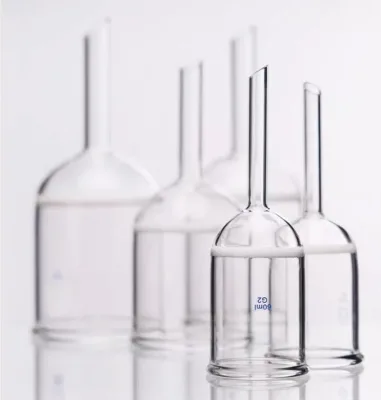
Precision in dimensions is non-negotiable when sourcing dosing funnels for automated or semi-automated lines. The market exhibits a wide range of capacities and physical profiles, from compact 35 mL units to larger 64 oz (approximately 1.9 liters) industrial models. For instance, specific sand core funnels are available in 35 mL and 60 mL capacities, with varying grit sizes (G1 through G6) that influence filtration speed and particle retention.
Dimensional consistency is equally vital. A 60 mL funnel may measure 52 mm in width and 145 mm in height, whereas a 35 mL variant might be 40 mm wide and 135 mm tall. These variations are not merely aesthetic; they determine the fit within standard laboratory racks or industrial hoppers. The entrance width, observed at 75 mm in certain models, and the exit width, noted at 15 mm, define the flow path geometry. Buyers must ensure that the funnel's entrance width matches the source container's opening to prevent spillage, while the exit width must align with the receiving vessel's inlet.
The following table summarizes key dimensional and capacity observations from current market data to aid in specification matching:
| Capacity | Material Type | Width (mm) | Height (mm) | Spout OD (mm) | Top ID (mm) |
|---|---|---|---|---|---|
| 35 mL | Glass (Sand Core) | 40 | 135 | N/A | N/A |
| 60 mL | Glass (Sand Core) | 52 | 145 | N/A | N/A |
| 64 oz | Plastic (PP) | N/A | 170 | 17 | 180 |
| 16 oz | Plastic | N/A | 120 | 16 | 130 |
Note: "N/A" indicates that specific spout or top dimensions were not explicitly paired with the sand core glass entries in the source data, requiring direct verification with the supplier. The plastic variants, often colored black or blue, offer distinct dimensional profiles suitable for bulk handling where chemical resistance to specific solvents is required.
Compliance, Certification, and Safety Standards
While specific certification bodies are not explicitly listed in the provided product data, the functional requirements of dosing funnels imply adherence to rigorous safety and performance standards. Products designed for pressure applications, such as those rated for 0.1 MPa to 1.6 MPa, must comply with pressure vessel regulations. Buyers should verify that the manufacturer holds relevant certifications for pressure equipment, ensuring that the "Low Pressure" classification is backed by validated engineering tests.
For glass products, the material standard of Borosilicate 3.3 is a de facto industry benchmark for thermal and chemical stability. However, buyers should request proof of material certification to ensure the glass meets this specific grade rather than a lower-quality soda-lime alternative. In the context of industrial funnels used for testing bulk density and compacting density, the equipment must be calibrated to provide repeatable and accurate results. This often involves adherence to international standards for density testing, though the specific standard codes (e.g., ASTM, ISO) must be confirmed with the supplier.
Packaging standards also play a role in compliance. The use of "Export Wooden Case" for certain units suggests adherence to international shipping regulations, potentially including ISPM 15 standards for wood packaging to prevent pest transfer. Conversely, plastic funnels may be packed in "Three Proof Fabric" or standard cartons (e.g., 100PCS/CTN), which must be evaluated for their ability to protect the product during transit without introducing contaminants.
Cost Drivers and Procurement Economics
The cost of sourcing dosing funnels is influenced by several factors, including material complexity, customization requirements, and packaging standards. The observed price range in the market spans from $0.01 to $5,000, a variance that reflects the difference between a single-item plastic funnel and a specialized, custom-engineered pressure vessel system. High-cost items typically involve complex manufacturing processes, such as the creation of sand core funnels with specific grit sizes or the fabrication of stainless steel units capable of withstanding pressure differentials.
Customization is a significant cost driver. The availability of OEM support and custom branding allows buyers to tailor products to their specific operational needs, but this often increases the unit price and minimum order quantity (MOQ). The MOQ range observed is 1 to 1000 pieces, offering flexibility for both prototyping and large-scale deployment. Buyers should note that while the minimum order can be as low as one piece, larger orders may benefit from economies of scale, particularly for standard plastic or glass models.
Lead time is another economic factor. A delivery time of 5 days indicates a highly responsive supply chain, likely for standard inventory items. However, custom orders involving specific dimensions or material grades may extend this timeline. Buyers must factor in these lead times into their production schedules to avoid bottlenecks. Additionally, the "Single gross weight" of 0.010 kg for certain items suggests lightweight packaging, which can reduce shipping costs, whereas bulkier items like the 64 oz PP funnels may incur higher freight charges.
Typical Applications and Functional Versatility
Dosing funnels serve diverse functions across multiple industries, ranging from laboratory analysis to heavy industrial processing. One primary application is the testing of bulk density and compacting density. In this context, the funnel acts as a standardized tool to ensure consistent material flow, allowing for accurate measurement of powder or granular properties. The sand core variants, with their specific grit sizes, are particularly suited for filtering or separating particles during this process.
In the chemical and petrochemical sectors, stainless steel funnels are utilized as components of reaction and storage pressure vessels. These units handle mixtures under low pressure conditions, acting as critical interfaces for adding reagents or transferring fluids. The ability to withstand pressures up to 1.6 MPa makes them suitable for processes where containment is vital. Furthermore, the "New" condition of these units ensures that they are free from previous contamination, which is essential for maintaining product purity in sensitive applications.
The versatility extends to general laboratory and manufacturing settings where simple transfer is required. Plastic funnels, available in capacities like 16 oz and 64 oz, are ideal for handling non-reactive liquids or powders in high-volume environments. Their color coding (black or blue) can assist in visual identification of different fluid types or process stages. The "Standard Funnel and Rock Funnel" designation suggests a dual-purpose design, potentially accommodating both fine powders and larger rock-like aggregates, further expanding their utility in mining or construction material testing.
Supplier Evaluation and Quality Assurance
Selecting a reliable supplier is paramount to ensuring product consistency and long-term operational success. The "SWHG" brand name appears in the data, indicating an established manufacturer with a presence in Jiangxi, China. While specific supplier credentials are not detailed, buyers should prioritize vendors who offer OEM support and demonstrate a commitment to quality control. The presence of a 1-year warranty on certain products is a positive indicator of manufacturer confidence in their build quality.
Quality assurance processes should be verified through documentation. Buyers should request test results for pressure ratings, material composition analysis, and dimensional accuracy. For glass products, thermal shock testing is essential to confirm the Borosilicate 3.3 specification. For steel units, pressure testing records are necessary to validate the 0.1 MPa to 1.6 MPa rating. The "Single package size" of 14.0x4.0x4.0 cm for certain items suggests compact packaging, which may indicate a focus on efficient logistics and reduced damage risk.
When evaluating suppliers, consider their ability to handle customization requests. The "Customization: Available" attribute implies flexibility, but buyers must assess the supplier's capacity to maintain tolerances during the customization process. A supplier that can provide samples for validation before full-scale production is highly recommended. Additionally, the "Delivery Time" of 5 days suggests a robust logistics network, but buyers should confirm this for custom orders to avoid delays.
Long-Term Procurement and Lifecycle Management
Sourcing dosing funnels is not a one-time transaction but part of a long-term procurement strategy. Buyers should consider the lifecycle of the equipment, including maintenance, replacement cycles, and compatibility with future process changes. The "Warranty: 1 Year" term provides a baseline for replacement, but buyers should negotiate extended terms for high-volume or critical applications.
Inventory management is also crucial. With a wide range of capacities and materials available, maintaining a diverse stock can prevent operational disruptions. However, overstocking should be avoided due to the risk of material degradation, particularly for plastic components which may become brittle over time. The "Export Wooden Case" packaging for certain items suggests that these are intended for long-term storage or international shipping, which requires proper environmental controls to prevent moisture damage.
Finally, buyers should stay informed about evolving industry standards. As regulations regarding pressure vessels and chemical handling become more stringent, the funnels in use must remain compliant. Regular audits of supplier certifications and product specifications will ensure that the procurement strategy remains aligned with current safety and quality requirements. By focusing on verified data and avoiding unproven claims, buyers can build a resilient supply chain for their Dosing Funnel needs.
FAQs
What materials are used for dosing funnels?
Dosing funnels are primarily constructed from Borosilicate 3.3 glass or stainless steel. Glass options offer transparency for monitoring flow, while steel variants provide pressure resistance for industrial applications involving mixtures.
Which capacities are available for sand core funnels?
Sand core funnels are available in 35 mL and 60 mL capacities with varying grit sizes from G1 to G6. These specific sizes allow for precise filtration and density testing in laboratory settings.
Can I customize the dimensions of a funnel?
Yes, customization is available for these products to meet specific operational needs. Buyers can request OEM support to tailor dimensions like width and height to their existing equipment requirements.
What is the lead time for delivery?
The standard delivery time for these products is five days. This rapid turnaround applies to standard inventory items, though custom orders may require additional processing time depending on complexity.
How are the funnels packaged for export?
Packaging varies by product type, with some units shipped in export wooden cases. Other items, such as plastic funnels, may be packed in cartons containing 100 pieces per carton or protective fabric.
What is the warranty period for these funnels?
A one-year warranty is provided for the supplied products. This coverage ensures reliability for laboratory and industrial applications, protecting buyers against manufacturing defects during the initial usage period.