Source Food Grade Disposable Sushi Container for Packaging Storage Gift
Compare 30 Food Grade Disposable Sushi Container options from Guangzhou suppliers. Buyers can evaluate PS, plastic, paper, and PP materials with varying sizes and eco-friendly features for restaurant and cold drink applications.
Key considerations
Products List


Factory Custom Wholesale Disposable Sushi Container Paper Box for Sushi
$0.02 - $0.09
MOQ: 5000 Pieces


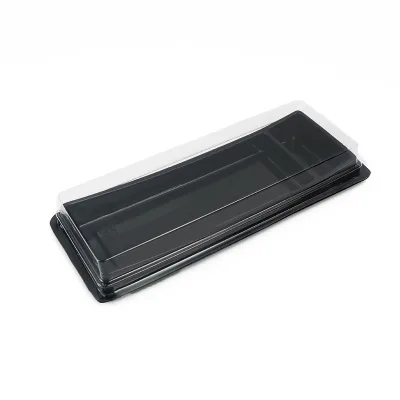


Japanese Decorative Design Takeaway Disposable Plastic Sushi Container with Lid
$0.07 - $0.13
MOQ: 10000 Sets

Eco-Friendly Biodegradable Takeaway Disposable Plastic Sushi Container with Lids
$0.29 - $0.30
MOQ: 500 Pieces


Brown Disposable Kraft Paper Sushi Container Food Packaging Sushi Tray
$0.03 - $0.03
MOQ: 10000 Pieces

Comprehensive Sourcing Guide
Strategic Sourcing Guide for Food Grade Disposable Sushi Containers
Navigating the global market for food grade disposable sushi containers requires a disciplined approach that balances material science, regulatory compliance, and logistical efficiency. The core keyword "Food Grade Disposable Sushi Container" encompasses a diverse range of products, from rigid plastic boxes to biodegradable paper alternatives. Buyers must understand that while the functional requirement is consistent—safe, hygienic containment for raw fish and rice—the execution varies significantly based on material composition, dimensional standards, and intended application. This guide synthesizes observed market data and technical attributes to provide a robust framework for procurement professionals seeking reliable supply chains without relying on unverified claims.
Material Composition and Functional Attributes
The primary differentiator in sourcing sushi containers is the material, which dictates both the environmental profile and the physical performance of the product. Market observations indicate a clear bifurcation between synthetic polymers and natural fiber-based solutions. On one end of the spectrum, products are constructed from Polystyrene (PS) or Polypropylene (PP). These materials are frequently cited for their clarity, rigidity, and ability to maintain structural integrity when holding cold or room-temperature foods. For instance, specific listings identify PP as a material suitable for kitchen applications, offering a transparent finish that allows for visual inspection of the contents. These plastic variants are often characterized as "Disposable" and "Stocked," suggesting immediate availability for high-volume orders.
Conversely, a significant segment of the market offers Paper-based containers. These are marketed with attributes such as "Eco-Friendly," "Biodegradable," and "100% Environmental." The presence of these descriptors indicates a shift toward sustainable packaging solutions that align with modern environmental regulations and consumer preferences. However, buyers must verify that "Food Grade" status is explicitly confirmed for paper products, as not all paper packaging is suitable for direct food contact, particularly with acidic or oily sushi ingredients. The material choice also influences the shape and folding mechanism; while some models are "Unfolded" and rigid, others may require specific folding techniques or are designed as "Bowl" shapes rather than standard "Box" configurations.
Technical Specifications and Dimensional Standards
Precision in dimensions is critical for sushi containers, as the fit between the container and the food affects presentation and leakage prevention. Sourcing data reveals a wide variance in standard sizes, ranging from compact units like 19013050mm to larger configurations such as 26.3cm26.3cm2.5cm. The "Spec" attribute often categorizes these as "Large" or "Medium," which serves as a preliminary filter for buyers. However, relying solely on these generic labels is insufficient. Buyers should prioritize products that offer "Custom size" capabilities or specific model numbers like JX-3003, PL147, or ME-02, which correspond to precise dimensional standards.
The shape of the container is another technical consideration. While "Round" shapes are observed, the "Box" and "Bowl" categories are more prevalent for sushi applications. The "Folded" status of "Unfolded" suggests that the product arrives ready for use, eliminating the need for on-site assembly, which is a significant efficiency gain for high-throughput environments like restaurants and coffee shops. When evaluating technical specifications, procurement teams must cross-reference the listed dimensions with the actual volume of the sushi portions they intend to serve. A container that is too small may compromise the presentation, while one that is too large may increase material costs unnecessarily.
Compliance, Certification, and Safety Verification
Ensuring that a disposable container meets food safety standards is non-negotiable. The supply chain for food-grade products is heavily regulated, and buyers must verify that the materials used do not leach harmful substances into the food. Observed data points to specific standards such as "SGS," which is a recognized third-party testing and certification body. The presence of "SGS" in product attributes suggests that the supplier has undergone external verification for quality and safety. However, buyers should not assume that all listed products automatically satisfy every standard without requesting current certificates.
While some background information mentions ISO 22000, this should be treated as a general industry reference rather than a confirmed attribute of every product listed. Buyers must explicitly request documentation proving compliance with local food safety regulations, such as FDA standards in the United States or equivalent regulations in the European Union. The "Food Grade" claim found in product features must be backed by a Certificate of Analysis (CoA) or a specific material safety data sheet. Furthermore, the "Eco-Friendly" and "Biodegradable" claims require verification of the specific degradation conditions and timelines, as these terms can be misused without proper certification.
Cost Drivers and Procurement Economics
The cost structure of disposable sushi containers is influenced by several variables, including material type, order volume, and packaging density. The observed price range of 0.02 to 0.46 USD per unit indicates a significant variance, likely driven by the distinction between mass-produced plastic items and more specialized biodegradable options. Material costs for PP and PS are generally lower than those for high-grade, food-safe paper, which can explain the lower end of the price spectrum. However, the "Eco-Friendly" premium may push prices toward the higher end for sustainable alternatives.
Minimum Order Quantity (MOQ) is another critical economic factor. The observed MOQ range spans from 500 to 100,000 units, with specific listings citing "100 Cartons" as a baseline. This wide range allows flexibility for both small startups and large-scale distributors. Buyers must calculate the total landed cost, which includes the unit price, freight charges, and packaging fees. The "Packing" attribute, such as "100PCS/Carton" or "500PCS/CTN," directly impacts shipping efficiency. A higher density of units per carton reduces the number of pallets required, thereby lowering freight costs. Additionally, the "Sample" policy, often listed as "Freight Collect," means that buyers should budget for shipping costs when evaluating prototypes before committing to a bulk order.
Supplier Evaluation and Operational Capabilities
Selecting a supplier requires a holistic assessment of their operational capabilities beyond just product specifications. The origin of the products, frequently listed as "Guangzhou, China" or generally "China," places the supply chain within a major manufacturing hub known for plastic and paper processing. Buyers should verify the supplier's capacity to handle "Customization" requests, as many listings indicate this is "Available." This capability is essential for brands seeking unique branding or specific dimensional requirements.
The "Custom Sample" lead time is another metric for supplier reliability. Observed ranges of 3-5 days and 5-7 days suggest a relatively agile production environment. However, buyers must confirm if these timelines apply to the initial prototype or the final production run. The "Application" field, which includes "Restaurant," "Coffee Shop," and "Cold Drink Shop," indicates that the supplier has experience serving the food service industry. This experience is a proxy for understanding the specific hygiene and durability requirements of food-grade packaging. Buyers should also inquire about the "Stocked" status of items, as suppliers with ready inventory can offer faster turnaround times for urgent orders compared to those operating on a make-to-order basis.
Quality Control and Long-Term Procurement Strategy
Implementing a robust quality control (QC) protocol is essential to mitigate the risks associated with disposable food packaging. Buyers should establish clear acceptance criteria based on the observed attributes, such as color consistency ("Multicolor" vs. "Transparent"), structural integrity, and dimensional accuracy. Regular audits of the production line can ensure that the "Disposable" nature of the product does not come at the expense of safety or functionality. For long-term procurement, building a relationship with a supplier who offers "Non-Customized" or "Customized" options based on demand allows for flexibility in managing inventory levels.
Sustainability is becoming a long-term strategic imperative. The availability of "Biodegradable" and "100% Environmental" options suggests that the market is evolving. Buyers should plan for a transition to more sustainable materials where feasible, ensuring that the supply chain can support this shift without disrupting operations. The "Export Carton" and "Master Carton/Pallet" packing standards indicate that the supplier is equipped for international logistics, which is vital for maintaining a consistent supply chain. By focusing on suppliers who demonstrate transparency in their material sourcing and adherence to verified standards, buyers can secure a reliable source of food grade disposable sushi containers that meet both current operational needs and future regulatory requirements.
Comparative Analysis of Product Attributes
To facilitate decision-making, the following table summarizes key attributes observed across different product models, highlighting the trade-offs between material, specification, and application.
| Attribute | Plastic Variant (PP/PS) | Paper Variant |
|---|---|---|
| Material | PP, PS | Paper |
| Feature | Disposable, Stocked, Transparent | Eco-Friendly, Biodegradable, Food Grade |
| Shape | Box, Bowl | Box, Bowl |
| Spec Size | Medium, Large (e.g., 24015045mm) | Custom Size (e.g., 19013050mm) |
| Color | Transparent, Multicolor | Natural/Multicolor |
| Application | Kitchen, Restaurant, Cold Drink | Food Service, Eco-conscious Markets |
| Sample Lead | 3-5 Days / 5-7 Days | 3-5 Days / 5-7 Days |
| MOQ | 100 Cartons / 500-100000 Units | 100 Cartons / 500-100000 Units |
This comparison underscores that while both categories serve the "Food" and "Restaurant" applications, the choice ultimately depends on the buyer's specific priorities regarding cost, environmental impact, and visual presentation. By rigorously applying the verification steps outlined in this guide, procurement professionals can navigate the complexities of the market and secure high-quality, compliant packaging solutions.
FAQs
What materials are used for food grade disposable sushi containers?
Products are constructed from Polystyrene (PS), Polypropylene (PP), or Paper. Plastic variants offer transparency and rigidity, while paper options provide eco-friendly and biodegradable attributes suitable for food contact.
Which dimensions are available for these sushi containers?
Standard sizes range from 190*130*50mm to 26.3cm*26.3cm*2.5cm. Some models support custom sizes, allowing buyers to select specific dimensions based on their portion requirements.
Can I find suppliers offering customization for these containers?
Yes, customization is available for many product listings. Buyers can request specific branding or dimensional changes, though some items are also available as non-customized stock options.
What is the minimum order quantity for these products?
The minimum order quantity ranges from 500 to 100,000 units, with some suppliers requiring 100 cartons as a baseline. This flexibility accommodates both small startups and large distributors.
How long does it take to receive a custom sample?
Custom sample lead times are typically 3 to 7 days depending on the supplier. Buyers should budget for freight collect shipping costs when evaluating prototypes before bulk orders.
Are these containers suitable for restaurant and coffee shop use?
Yes, applications include restaurants, coffee shops, and cold drink shops. The products are designed for food service environments requiring hygienic and disposable packaging solutions.
What certifications verify the safety of these containers?
Some products list SGS as a recognized third-party testing standard. Buyers should request specific food grade certificates to ensure compliance with local safety regulations before purchasing.