Source Front and Rear Brake Discs and Pads for cars, trucks, and buses
Explore 30 listings for Front and Rear Brake Discs and Pads suitable for automotive brake systems. Buyers can compare specifications, certifications, and delivery times from suppliers in China to find parts for replacement and repair.
Key considerations
Products List

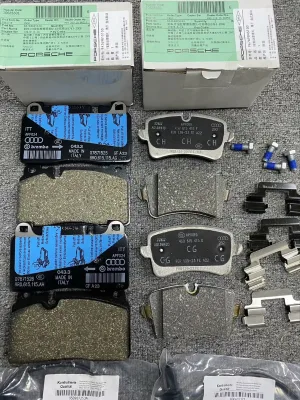


$0.10 - $10.00
MOQ: 10 Pieces


$0.21 - $0.45
MOQ: 3000 Pieces


Comprehensive Sourcing Guide
Strategic Sourcing Guide for Front and Rear Brake Discs and Pads
Procuring automotive braking components, specifically Front and Rear Brake Discs and Pads, requires a rigorous approach that balances technical compatibility with supply chain reliability. The global market for these critical safety parts is vast, with manufacturers primarily originating from major industrial hubs in China, such as Guangdong and Hebei provinces. Buyers must navigate a complex landscape where product attributes vary significantly between disc and pad categories, even when sourced from the same facility. This guide outlines the essential verification steps, technical parameters, and compliance checks necessary for successful B2B procurement of these components.
Technical Specifications and Component Differentiation
Understanding the distinct technical profiles of brake discs versus brake pads is the first step in any sourcing strategy. While often purchased together, they serve different mechanical functions and possess unique material requirements. Brake discs, classified under the "Disc" category, are typically manufactured from iron, a material chosen for its thermal conductivity and durability under high friction. The product specifications indicate that these discs are designed for both front and rear applications, with specific model identifiers such as "X01-90000272" or "D1846-9073" used to distinguish variants. The physical dimensions are critical; observed standard packaging dimensions for these components often range from 30x30x30 cm to 80x70x30 cm, reflecting the substantial size of the metal rotors.
Conversely, brake pads are categorized distinctly, with models like "SP1107FA Ceramic" and "SP1115 Semi-metallic" representing different friction material compositions. The choice between ceramic and semi-metallic formulations depends heavily on the vehicle's intended use and the driver's preference for noise reduction versus heat dissipation. The product attributes confirm that these pads are designed for the automotive brake system, specifically for replacement and repair purposes. Buyers must verify the OE (Original Equipment) numbers, such as "581014de00," and reference numbers like "MD8514m" or "B1g12010512" to ensure exact fitment for specific vehicle models, particularly those manufactured for the Chinese market or international OEM standards. The "Front" position attribute is explicitly noted for certain disc variants, necessitating careful cross-referencing to avoid installing rear components on front axles, which could compromise braking efficiency.
Compliance and Certification Verification
In the automotive aftermarket, certification is not merely a formality but a prerequisite for liability and safety. The supply chain data reveals a complex array of certifications that suppliers may claim. High-confidence observations include ISO/TS, IATF (often cited as IATF-Classification or IATF-ISO), and ISO9001. Specific listings mention certificates such as "ISO9001/SGS" and "ISO 9001/ IATF16949," which are critical for demonstrating a supplier's adherence to quality management systems. Furthermore, for products intended for export to Europe, the E-MARK ECE R90 certification is a vital indicator of compliance with European safety standards for brake pads.
Buyers must exercise caution when interpreting certification lists. Some product entries aggregate numerous standards, including DOT, BSCI, FSC, HACCP, GSV, and GMP. While these indicate a broad compliance framework, the relevance of food safety standards like HACCP or GMP to automotive parts is negligible and may indicate a copy-paste error in the supplier's catalog. The primary focus for brake components should remain on IATF 16949 for automotive quality management and ECE R90 for European market access. The presence of "ISO/TS" and "IATF" classifications confirms that the manufacturer operates within the stringent requirements of the automotive industry, but buyers should request valid, current certificates for the specific product line being ordered rather than relying on generic claims.
Cost Drivers and Pricing Dynamics
The pricing structure for brake discs and pads is influenced by several variables, including material composition, customization levels, and order volume. The observed price range in the market spans from $0.10 to $999 USD, a wide disparity that reflects the difference between a single replacement pad and a complete set of high-performance disc assemblies. The Minimum Order Quantity (MOQ) is a significant cost driver, with observed ranges extending from 1 unit to 3,000 units. Suppliers often offer lower per-unit costs for bulk orders, with specific listings citing MOQs of 100 sets for pads and 50 pieces for discs.
Customization is a key factor in pricing. The product attributes confirm that customization is available for color, packaging, and potentially the friction material composition. Customized packaging, such as specific cartons, pallets, or bulk shipping, can alter the final landed cost. Additionally, the "Selling Units" are often listed as single items, allowing for sample procurement, but the transition to bulk pricing requires meeting the MOQ thresholds. Buyers should note that "Free Sample" availability is mentioned in some listings, which can be a strategic tool for initial quality verification before committing to a large order. However, the cost of shipping and potential tariffs must be factored into the total cost of ownership, especially given the heavy nature of iron brake discs.
Typical Applications and Market Segmentation
The application scope for these components is broad, covering a wide array of global markets. The main market data indicates a strong presence in South America, North America, Eastern Europe, Africa, Western Europe, Northern Europe, Southern Europe, and South Asia. This global distribution suggests that the supply chain is capable of meeting diverse regulatory and climatic demands. The products are explicitly designed for "Chiness Car" models as well as general automotive repair, indicating versatility in fitment.
The "Purpose" is consistently listed as "for replace/repair," targeting the aftermarket sector rather than direct OEM assembly lines, although some listings mention "OEM ODM" market capabilities. This implies that suppliers can produce parts that match original specifications or offer custom designs for specific vehicle manufacturers. The condition of the products is uniformly "New," ensuring that buyers receive fresh inventory suitable for immediate installation. The "Installation" attribute is described as "Easy and Perfect," suggesting that the components are designed with user-friendly tolerances to facilitate straightforward replacement by mechanics or DIY enthusiasts.
Supplier Evaluation and Lead Time Management
Evaluating suppliers requires a focus on their operational capacity and logistical reliability. The data points to two primary regions of origin: Guangdong and Hebei, both in China. These regions are known for their robust manufacturing ecosystems, but buyers should verify the specific factory capabilities. Lead times vary significantly based on order volume and customization needs. Observed delivery times range from 25 days to 60 days, with specific windows of 30-45 days and 45-60 days noted. This variance underscores the importance of early planning in the procurement cycle.
When evaluating a supplier, buyers should look for clear communication regarding the "Delivery Time" and the specific production status. The "Quality" attribute is frequently highlighted as "100% Professional Test," which should be verified through third-party inspection reports rather than supplier self-declaration. The "Brand" "Frontech" is mentioned in one context, but buyers should not rely on brand recognition alone; instead, they should focus on the supplier's track record for consistency and their ability to meet the specified lead times. The "Packing" methods, ranging from "Carton/Pallet" to "Bulk," also impact the supplier's ability to handle logistics efficiently.
Quality Control and Long-Term Procurement Considerations
Ensuring long-term supply stability requires a robust quality control framework. The "Quality" of the product is a primary concern, with claims of professional testing being standard. Buyers should insist on documentation that validates these tests, particularly regarding friction coefficients, wear rates, and thermal stability. The "Standard" dimensions provided, such as 30x30x30 cm or 80x70x30 cm, serve as a baseline for packaging but do not replace the need for dimensional verification of the actual brake discs and pads upon receipt.
For long-term procurement, establishing a relationship with a supplier that offers "Customized" solutions is advantageous. This allows for tailoring the product to specific vehicle models or market requirements, such as specific color coding for packaging or unique friction formulations. The availability of "Free" samples is a critical step in the initial phase, allowing buyers to conduct their own performance tests before scaling up. Additionally, the "Main Market" diversity of the supplier suggests they are experienced in handling international logistics and compliance, which reduces the risk of customs delays.
Buyers must also consider the "Condition" and "Purpose" of the parts. Since these are for replacement and repair, the longevity of the component is paramount. A supplier that consistently delivers "New" condition parts with accurate OE references ensures that the end-user experience remains positive, reducing the likelihood of returns and warranty claims. The "Installation" ease is another long-term factor; parts that are difficult to install can lead to labor cost overruns and customer dissatisfaction.
Summary of Key Procurement Parameters
To facilitate a clear comparison of the critical factors discussed, the following table summarizes the key parameters observed in the market data for Front and Rear Brake Discs and Pads.
| Parameter | Brake Discs | Brake Pads |
|---|---|---|
| Primary Material | Iron | Ceramic / Semi-metallic |
| Key Certifications | IATF, ISO/TS, ECE R90 | ISO9001, SGS, ECE R90 |
| Typical MOQ | 50 Pieces | 100 Sets |
| Lead Time | 25-60 Days | 25-60 Days |
| Origin | Guangdong, Hebei (China) | Guangdong, Hebei (China) |
| Customization | Available (Color, Packaging) | Available (Friction Material) |
| Application | Front/Rear Axle | Front/Rear Axle |
| Condition | New | New |
In conclusion, sourcing Front and Rear Brake Discs and Pads demands a meticulous approach to verifying technical specifications, certifications, and supply chain reliability. By focusing on the specific attributes of iron discs and ceramic or semi-metallic pads, and by rigorously checking for IATF and ECE R90 compliance, buyers can secure high-quality components that meet the diverse needs of the global automotive market. The variability in lead times and MOQs necessitates early planning and clear communication with suppliers to ensure a smooth procurement process.
FAQs
What certifications are required for brake discs and pads?
High-confidence facts indicate IATF, ISO/TS, and ISO9001 are key certifications. Some listings also mention ECE R90 for European compliance. Buyers should verify specific certificates like IATF 16949 rather than relying on generic claims.
Which materials are used for front and rear brake discs?
Brake discs are typically manufactured from iron due to its thermal conductivity. Brake pads use ceramic or semi-metallic formulations. The material choice depends on the specific vehicle application and friction requirements.
Can I customize the packaging and color of these parts?
Yes, customization is available for color and packaging options. Suppliers offer customized packing such as cartons, pallets, or bulk shipping. This allows buyers to tailor the product presentation to their specific market needs.
What is the typical lead time for delivery?
Delivery times range from 25 to 60 days depending on order volume. Specific windows observed include 25 days, 30-45 days, and 45-60 days. Early planning is essential to manage these varying logistical timelines effectively.
How do MOQs vary between brake discs and pads?
Minimum Order Quantities differ by component type. Brake pads often require an MOQ of 100 sets, while brake discs may start at 50 pieces. Buyers should check specific listings as ranges can extend up to 3000 units.
Where are these automotive parts primarily manufactured?
Products originate mainly from Guangdong and Hebei provinces in China. These regions are known for robust manufacturing ecosystems capable of meeting global demand. Buyers should verify specific factory capabilities within these locations.