Source Heavy Commercial Truck Brake Lining for trucks, buses, and trailers
Find 27 listings for Heavy Commercial Truck Brake Lining from verified suppliers. Compare specifications including part numbers, materials, and certifications to select the right brake lining for your fleet needs.
Key considerations
Products List




Comprehensive Sourcing Guide
Strategic Sourcing Guide for Heavy Commercial Truck Brake Lining
The global market for Heavy Commercial Truck Brake Lining is defined by a complex intersection of safety-critical performance, regulatory compliance, and supply chain reliability. For procurement professionals operating in the heavy-duty transport sector, sourcing brake linings requires a rigorous approach that moves beyond simple price comparison. The core keyword "Heavy Commercial Truck Brake Lining" encompasses a diverse range of products, from non-asbestos formulations to specialized drum brake components designed for specific axle configurations. This guide synthesizes available market data and technical requirements to provide a structured framework for evaluating suppliers, verifying product specifications, and ensuring long-term operational safety.
Technical Specifications and Material Composition
The foundation of any successful procurement strategy for heavy-duty braking systems lies in a precise understanding of technical specifications. The supplied data indicates a clear distinction between various product types, including "Brake Lining," "Brake Shoe," and "Brake Pad," with specific applications noted for "Truck Brake Pad/Brake Shoe/Brake Lining." A critical observation in the current market is the prevalence of "Non-Asbestos" materials. This shift is driven by health regulations and environmental standards, making the verification of material composition a primary step in the sourcing process. Buyers must confirm that the lining material is explicitly non-asbestos to ensure compliance with modern safety mandates.
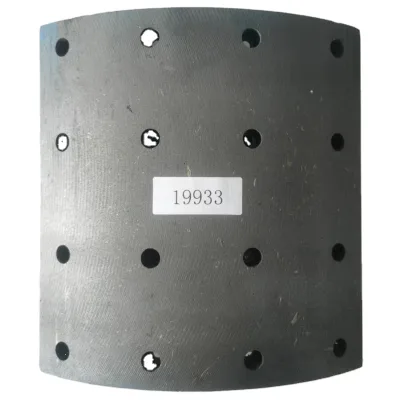
Furthermore, the physical attributes of the lining are paramount. The data highlights specific dimensions and performance metrics, such as a "Maximum Machining Radius" of 230mm and a "Minimum Working Radius" of 200mm. These figures suggest that the linings are engineered for specific drum geometries common in heavy-duty applications. The "Heavy Duty" performance classification is frequently cited, indicating that these components are designed to withstand the high thermal loads and friction demands of long-haul transport. Procurement teams should verify that the "Part No." and "Model" (such as WG9100440027 or 19365) align exactly with the vehicle manufacturer's original equipment specifications. Mismatches in part numbers can lead to premature wear or catastrophic failure.
Additionally, the "Position" of the brake lining is a vital specification. The data notes "Rear" and "Front Axle" applications, which require distinct friction characteristics. Rear axles often prioritize durability and heat dissipation, while front axles may require higher friction coefficients for immediate stopping power. The "Color" is observed as "Black," which is standard for many organic and semi-metallic formulations, but this visual cue should never replace a chemical composition analysis.
Compliance and Certification Verification
In the heavy commercial vehicle sector, certification is not merely a formality; it is a legal and operational necessity. The supplied context lists several critical standards that serve as benchmarks for quality assurance. Buyers must verify that products meet "ISO/TS" classifications, specifically referencing "ISO/TS16949" or similar automotive quality management standards. The presence of "TS16949" indicates a supplier's adherence to rigorous automotive production processes, which is essential for components that directly impact vehicle safety.
Regulatory compliance extends to specific safety standards. The data explicitly mentions "FMVSS 121D" and "FMVSS 121D TEST." FMVSS 121 is the U.S. Federal Motor Vehicle Safety Standard governing air brake systems, and the "D" suffix typically refers to specific testing protocols for braking efficiency and fade resistance. A supplier claiming compliance with FMVSS 121D must provide valid test reports or certification documentation. Additionally, the "SGS" certification is noted, representing an independent third-party verification of product quality and safety.
Other certifications observed include "Greenings," which may relate to environmental compliance or specific manufacturing processes, and general "ISO" classifications. However, buyers should be cautious of generic claims. The "Certification" field in the data shows variations like "ISOISOClassification:Drum" and "ISO/TSClassification:Drum," suggesting that the specific nature of the certification (e.g., ISO 9001 vs. ISO/TS 16949) must be clarified. Procurement teams should request the actual certificate numbers and verify their validity with the issuing bodies. Relying on a supplier's verbal assurance without documented proof of "STANDARD: FMVSS 121" compliance poses a significant liability risk.
Cost Drivers and Pricing Dynamics
Understanding the cost structure of heavy-duty brake linings is essential for budgeting and negotiation. The observed price range in the market spans from $0.88 to $860 USD. This wide disparity is not indicative of a single product category but rather reflects the diversity of the supply chain, ranging from individual lining segments to complete axle assemblies or bulk packaging. The lower end of the spectrum likely represents single components or smaller MOQs, while the higher end may encompass full sets, specialized heavy-duty kits, or bulk industrial packaging.
Several factors drive these costs. First, the "Material" composition is a primary cost driver. Non-asbestos formulations, particularly those utilizing ceramic or advanced organic compounds, typically command a premium over older, less regulated materials. Second, the "Performance" rating, such as "Heavy Duty," influences pricing. Linings designed for extreme conditions require higher-grade raw materials and more rigorous manufacturing controls. Third, the "Packing" method affects the final landed cost. The data shows variations from "8PCS Per Small Box" to "Plastic Film and Carton" or "Wooden Box" for larger shipments. Bulk packaging reduces per-unit shipping costs but requires higher upfront capital and storage capacity.
The "MOQ" (Minimum Order Quantity) range of 1 to 2000 units also plays a significant role in unit economics. Suppliers offering an MOQ of 1 allow for trial orders but often charge a higher per-unit price. Conversely, an MOQ of 2000 suggests a focus on large-scale industrial distribution, where economies of scale can lower the unit cost. Buyers must balance their inventory needs against the price benefits of larger orders. Additionally, the "After-sales Service" period, noted as "3 Months" in some listings, can impact the total cost of ownership. A longer warranty or service period may justify a higher initial purchase price by reducing the risk of premature replacement.
Typical Applications and Market Distribution
The application of heavy commercial truck brake linings is highly specific, dictated by the vehicle's role and the operating environment. The data identifies "Japanese Truck" and "HEAVY DUTY" as key application categories, suggesting that these linings are compatible with a wide range of international truck models. The "Part No." PU49 Nigeria and 0009962 Brake Lining indicate that these components are often sourced for specific regional markets or vehicle makes.
Geographically, the "Main Market" data reveals a diverse distribution network. Products are targeted at "South America," "North America," "Middle East," "Africa," "Eastern Asia," "South Asia," and the "Domestic Market." This global reach implies that suppliers must be capable of meeting varying regional regulatory standards. For instance, North American buyers will prioritize FMVSS compliance, while African or South American markets may have different, yet equally critical, safety requirements. The "Origin" of the products is primarily "Jiaxing, Zhejiang, China" and "Haiyan, Jiaxing, Zhejiang China," indicating that the majority of the supply chain is concentrated in this manufacturing hub.
The "Driving System Parts" and "Brake System Parts" classifications further clarify the application. The linings are integral to the "Brake" system, often working in conjunction with "Clutch" components in the "Transmission System Parts." The "Electrical System Parts" count of "1" suggests that some brake systems may include electronic sensors or actuators, which requires careful integration with the braking lining. Buyers must ensure that the "Application" field explicitly states compatibility with their specific truck models, as a mismatch can lead to system failure.
Supplier Evaluation and Quality Control
Evaluating suppliers for heavy-duty brake linings requires a multi-faceted approach that goes beyond checking certifications. The "Location" of the supplier, specifically in Jiaxing, Zhejiang, offers insight into the manufacturing ecosystem, but it does not guarantee quality. Buyers should conduct a thorough audit of the supplier's production capabilities, focusing on their adherence to "ISO/TS" standards and their ability to perform "FMVSS 121D TEST" in-house or through accredited partners.
Quality control should be a continuous process. The "Standard" field lists "10005701150mm," which likely refers to packaging dimensions or a specific product size standard. Buyers must verify that the physical dimensions of the delivered product match these specifications exactly. The "Weight" of 200kg for a shipment or unit is another critical metric; deviations from the expected weight can indicate material density issues or packaging errors.
The "Pack" options, such as "Shrink Bag in Carton, Pallet" or "Plastic Film, Carton, Pallet," are indicators of the supplier's attention to detail. Proper packaging is essential to prevent damage during transit, especially for heavy components. Buyers should request photos of the packaging process and verify that the "Packing" method aligns with the "prod_packing" specifications provided. Furthermore, the "After-sales Service" of 3 months is a baseline; buyers should negotiate for extended support or replacement guarantees, particularly for high-volume orders.
Long-Term Procurement Considerations
Sourcing heavy commercial truck brake linings is a long-term strategic decision that impacts fleet reliability and safety. The "Performance" attribute of "Heavy Duty" suggests that these components are designed for longevity, but buyers must monitor wear rates and replacement cycles. The "Minimum Stroke" and "Maximum Stroke" of 440mm and 500mm, respectively, are critical for ensuring that the braking system maintains proper clearance and function over time.
Buyers should also consider the "Power" requirements of 110V-440V if the brake system includes electronic components, ensuring compatibility with the truck's electrical system. The "Distribution Box Output Voltage" of 12V is another specification that must be verified to prevent electrical failures. The "Maximum External Intake Pressure" of 1MPa and "Minimum External Intake Pressure" of 0.8MPa indicate the operational limits of the pneumatic or hydraulic systems associated with the brakes.
Finally, the "Main Market" trends suggest that buyers should stay informed about regional regulatory changes. As markets like "Middle East" and "Africa" develop, new safety standards may emerge. Procurement teams should maintain a flexible supply chain that can adapt to these changes without disrupting operations. By focusing on verified specifications, robust certifications, and reliable supplier relationships, buyers can secure a steady supply of high-quality brake linings that ensure the safety and efficiency of their heavy commercial truck fleets.
FAQs
What material composition is used for these brake linings?
The brake linings are manufactured using Non-Asbestos material to ensure safety and environmental compliance. This composition meets modern health regulations while providing the necessary friction characteristics for heavy-duty truck applications.
Which certifications verify the quality of these brake components?
Products are verified by ISO/TS16949, SGS, and FMVSS 121D standards to ensure automotive quality management and safety. These certifications confirm adherence to rigorous production processes and specific braking efficiency testing protocols.
How are the brake linings packaged for international shipping?
Packaging options include 8PCS per small box within a big carton, or plastic film and carton on pallets. Some shipments utilize wooden boxes to ensure the integrity of heavy-duty components during transit.
Can I find suppliers with specific part numbers like 19365?
Yes, specific part numbers such as 19365 and WG9100440027 are available in the product listings. Buyers should verify these exact identifiers to ensure compatibility with their specific truck models and axle configurations.
What is the minimum order quantity for these brake linings?
The minimum order quantity ranges from 1 to 2000 units depending on the supplier and product type. Lower MOQs allow for trial orders, while higher volumes may offer better unit economics for large fleets.
Where are these heavy-duty brake linings manufactured?
The products originate from manufacturing hubs in Jiaxing, Zhejiang, China, and Haiyan, Jiaxing, Zhejiang China. This location indicates a concentrated supply chain capable of meeting global demand for commercial truck components.