Source IP67 Momentary Power Symbol Button for Home Hotel Industrial
Find 30 listings for the IP67 Momentary Power Symbol Button designed for home, hotel, and industrial applications. Buyers can compare specifications including IP67 protection, stainless steel construction, and various LED voltage options to select the right switch for their projects.
Key considerations
Products List




Comprehensive Sourcing Guide
Strategic Sourcing Guide for IP67 Momentary Power Symbol Buttons
Technical Specifications and Operational Mechanics
When sourcing industrial-grade push buttons, specifically those defined by the core keyword of IP67 momentary power symbol buttons, buyers must first dissect the precise technical architecture. The product landscape for these components reveals a distinct separation between the actuator mechanism and the internal switching logic. A critical observation in the current market is the prevalence of the "Amplifier Separated Type" structure. This design choice implies that the sensing or amplification circuitry is physically distinct from the mechanical switch housing, a configuration often selected to enhance signal integrity in noisy industrial environments or to allow for flexible mounting arrangements where the switch body and the control module are decoupled.
The operational principle for the majority of these units is resistive, relying on the physical deformation of a conductive element to complete a circuit. However, the specific "Momentary" operation type is a defining characteristic that distinguishes these units from latching switches. In a momentary configuration, the circuit is closed only while the button is depressed and immediately reopens upon release. This is essential for applications such as "Start Button," "Reset Button," or "Control Button" functions where continuous engagement is not required. The contact configuration typically observed is 1NO1NC (One Normally Open, One Normally Closed), providing a versatile switching capability that allows for complex logic control within a single compact housing.
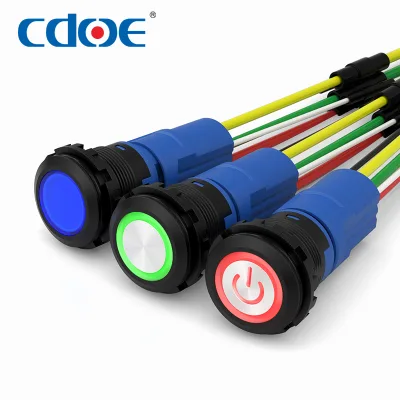
The physical dimensions are equally critical for integration. The standard size observed in high-volume listings is 16mm, a diameter that balances robustness with space efficiency in control panels. The front shape is frequently specified as a "Flat Round Ring Illuminated Power Symbol" or simply a "Flat Round Power Symbol." This aesthetic choice serves a dual purpose: it provides immediate visual identification of the power function and often integrates LED indicators. The illumination is a significant feature, with rated voltages ranging from 6V to 220V, accommodating both low-voltage DC control systems and standard AC mains applications. The LED color options are extensive, including Red, Green, Yellow, Orange, Blue, and White, allowing procurement teams to align the visual feedback with specific operational states, such as power-on (Green), power-off or alarm (Red), or standby (Yellow).
Environmental Protection and Durability Standards
The "IP67" designation is the primary environmental claim for this category, and understanding its implications is vital for procurement in harsh settings. The IP (Ingress Protection) rating system, defined by IEC standards, indicates that the first digit "6" represents complete dust-tight protection, meaning no ingress of dust is possible. The second digit "7" signifies that the device can withstand immersion in water up to 1 meter for 30 minutes without harmful effects. This level of protection is non-negotiable for applications in "Home," "Commercial," "Hotel," and "Industrial" sectors where exposure to moisture, cleaning agents, or dust is a daily reality.
Beyond the IP rating, the mechanical durability is often quantified by the IK rating. Observed data indicates a range of IK08 to IK09. The IK rating measures resistance to external mechanical impacts. An IK08 rating suggests the device can withstand impacts of 5 Joules, while IK09 indicates a higher resistance of 10 Joules. This is particularly relevant for "Lighting" and "Electronics" applications where accidental impacts from tools or debris might occur. The material composition plays a significant role in achieving these ratings. The "Crust Material" is frequently identified as Stainless Steel, which offers superior corrosion resistance and structural integrity compared to plastic alternatives. This material choice supports the "Dust-Proof" and "Waterproof" claims, ensuring that the seal remains intact over long-term exposure to the elements.
The wiring configuration is another technical constraint to note. Some listings specify "Null Line and Live Line" wiring, which implies a specific electrical topology that must be respected during installation to ensure safety and functionality. The switch rating is consistently observed at 5A/250V, which defines the maximum electrical load the component can safely handle. Buyers must verify that their specific application load does not exceed this threshold, particularly when dealing with inductive loads like motors or solenoids, which may require derating the current capacity.
Compliance, Certification, and Regulatory Alignment
Navigating the compliance landscape is a critical step in B2B procurement, especially for components destined for global markets. The supplied data indicates a robust array of certifications that buyers should verify on a per-shipment basis. The most prominent certifications observed include CCC (China Compulsory Certification), CE (Conformité Européenne), UL (Underwriters Laboratories), RoHS (Restriction of Hazardous Substances), and REACH (Registration, Evaluation, Authorisation and Restriction of Chemicals).
The presence of ISO90001 (often cited as ISO9001 in industry standards) is a strong indicator of a manufacturer's commitment to quality management systems. This standard ensures that the production process is consistent and that the manufacturer has documented procedures for maintaining product quality. However, it is important to treat these certifications as observations of the supplier's capabilities rather than automatic guarantees for every single unit produced. Buyers must request valid, current certificates for the specific batch or model they are purchasing.
The "Standard" field often lists a combination of ISO90001, CE, ROHS, CCC, and UL. This suggests that the manufacturer aims to meet multiple regional regulatory requirements simultaneously. For instance, CE is mandatory for products sold in the European Economic Area, while CCC is required for products sold within China. UL certification is often a prerequisite for markets in North America. The inclusion of RoHS and REACH addresses environmental concerns, ensuring that the product does not contain restricted hazardous substances like lead, mercury, or cadmium. Buyers should explicitly request proof of compliance for these directives, as counterfeit or non-compliant products can lead to significant legal and financial liabilities.
Cost Drivers and Economic Factors
Understanding the cost structure of IP67 momentary power symbol buttons requires an analysis of several variables. The observed price range in the market is approximately 0.1 to 6 USD per unit. This wide variance is driven by several factors, including the complexity of the LED integration, the specific material grade of the stainless steel, and the level of certification included. A basic 16mm button with a simple power symbol and no illumination will likely fall at the lower end of this spectrum, while a unit with multi-color LED options, higher IK ratings, and comprehensive international certifications will command a premium price.
The Minimum Order Quantity (MOQ) is another significant economic factor. The observed MOQ range spans from 1 to 1000 units. This flexibility allows buyers to scale their procurement based on their immediate needs. Small prototype runs or replacement orders can be fulfilled with an MOQ of 1, while large-scale production runs can leverage the lower per-unit costs associated with higher volumes. The packaging configuration also influences logistics costs. Standard packaging is often 40 pieces per box, with 400 pieces per carton. This standardized packing facilitates efficient shipping and inventory management, reducing the overhead associated with handling loose components.
Production time is another variable that affects the total cost of ownership. The observed production time is 3-5 working days, which is relatively short and indicates a responsive supply chain. However, buyers should be aware that lead times can fluctuate based on raw material availability, particularly for stainless steel and electronic components like LEDs. Customization is listed as "Available," which introduces a potential cost driver. While standard models are readily available, custom features such as specific LED colors, unique front shapes, or tailored wiring configurations may increase the unit price and extend the production timeline.
Typical Applications and Industry Use Cases
The versatility of IP67 momentary power symbol buttons makes them suitable for a diverse range of applications. The "Usage" field lists a comprehensive set of functions, including Start Button, Reset Button, Check Button, Control Button, Limit Button, Control Switch, Change-over Switch, Disconnector, and Playback Switch. This breadth of functionality allows the same component to be used in various roles within a single system, simplifying inventory management for procurement teams.
In the "Home" and "Apartment/Villa" sectors, these buttons are often used in smart home control panels or home appliance interfaces where a clean, modern aesthetic and water resistance are desired. The "Commercial" and "Hotel" applications frequently utilize these components for elevator controls, room service buttons, or lighting control panels in public areas where durability and ease of cleaning are paramount. The "Industrial" sector represents the largest volume of usage, where the buttons are integrated into control panels for machinery, automation systems, and safety interlocks. The "Lighting" and "Electronics" sectors also rely on these components for power distribution and control in LED lighting systems and consumer electronics.
The specific application dictates the required features. For example, a "Start Button" in an industrial motor control panel requires a momentary action to ensure the motor only runs while the button is pressed, preventing accidental continuous operation. In contrast, a "Control Switch" might require a change-over function to toggle between different modes of operation. The "Small Circuit Control" function is particularly relevant for low-voltage applications where the button acts as a trigger for a larger control system rather than directly switching the main power load.
Supplier Evaluation and Quality Assurance
Evaluating suppliers for IP67 momentary power symbol buttons requires a rigorous approach to quality assurance. The "Manufacturer" attribute is listed as "Yes," indicating that many suppliers in this space are direct manufacturers rather than trading companies. This distinction is crucial as it often implies better control over the production process, more transparent pricing, and greater flexibility for customization. Buyers should verify the manufacturer's location, with "Zhejiang, China" being a prominent origin point for these components. This region is known for its robust manufacturing ecosystem and supply chain efficiency.
Quality control should focus on verifying the consistency of the IP67 rating and the IK rating. Buyers should request test reports that demonstrate the product's ability to withstand water immersion and mechanical impact. The "Detection Method" is listed as "Reflection Type," which is a specific sensor technology. While this is common for proximity sensors, in the context of a mechanical button, it may refer to the internal sensing mechanism or a specific feature of the illuminated version. Buyers must clarify this with the supplier to ensure it aligns with their system requirements.
The "Customization" availability is a key differentiator. Suppliers that offer customization can tailor the button to specific needs, such as unique LED colors or specific front shapes. However, customization introduces complexity into the quality control process. Buyers should establish clear specifications and acceptance criteria before placing an order. The "Production Time" of 3-5 working days suggests a lean manufacturing process, but buyers should confirm that this timeline includes quality inspection and packaging.
Long-Term Procurement and Supply Chain Resilience
Long-term procurement strategies for these components must account for supply chain resilience and product lifecycle management. The "Standard" list includes ISO90001, CE, ROHS, CCC, and UL, which suggests a commitment to international standards. However, regulations are subject to change, and buyers should monitor updates to these standards to ensure continued compliance. The "Item No." variations, such as HBS1-AGQ16F-11DT/J/S/LED Voltage/Y, indicate a complex product coding system. Maintaining a clear and up-to-date Bill of Materials (BOM) is essential to avoid ordering incorrect variants, especially when dealing with different LED voltages and colors.
The "prod_packing" of 40 PCS/Box and 400 PCS/Carton is a standard that facilitates efficient logistics. However, buyers should consider the storage conditions for these components, particularly the LEDs, which can be sensitive to humidity and static electricity. Proper warehousing is essential to maintain product quality over time. The "Switch Rating" of 5A/250V is a fixed specification, but buyers should plan for potential upgrades or changes in system requirements that might necessitate different ratings in the future.
Finally, the "Manufacturer" status suggests a direct relationship with the source. Building a strong partnership with a manufacturer can lead to better support, faster response times for technical issues, and priority access to new product developments. Buyers should engage in regular communication with their suppliers to stay informed about market trends, material availability, and potential supply chain disruptions. By focusing on these long-term considerations, procurement teams can ensure a stable and reliable supply of high-quality IP67 momentary power symbol buttons for their operations.
Summary of Key Technical Parameters
| Parameter | Observed Value/Range | Notes |
|---|---|---|
| Size | 16mm | Standard diameter for panel mounting |
| Protection Grade | IP67 | Dust-tight and water-immersion resistant |
| Impact Rating | IK08 - IK09 | High resistance to mechanical impact |
| Switch Rating | 5A / 250V | Maximum electrical load capacity |
| Operation Type | Momentary | Circuit closes only while pressed |
| Contact Config | 1NO1NC | One Normally Open, One Normally Closed |
| Material | Stainless Steel | Durable and corrosion-resistant crust |
| LED Voltage | 6V, 12V, 24V, 110V, 220V | Multiple voltage options available |
| Certifications | CCC, CE, UL, RoHS, REACH, ISO90001 | Verify specific batch compliance |
| Origin | Zhejiang, China | Major manufacturing hub |
| Production Time | 3-5 Working Days | Standard lead time for manufacturing |
| MOQ | 1 - 1000 Units | Flexible ordering options |
FAQs
What certifications do these buttons typically hold?
These buttons commonly hold CCC, CE, UL, RoHS, and REACH certifications. Buyers should verify specific batch certificates as standards vary by manufacturer and region.
How long is the production time for these units?
The standard production time is 3 to 5 working days. This timeline applies to standard models, while customized orders may require additional processing time.
Which switch rating is standard for this product?
The standard switch rating is 5A at 250V. This rating defines the maximum electrical load the component can safely handle during operation.
Can I customize the LED color and voltage?
Customization is available for LED colors like red, green, and white, and voltages ranging from 6V to 220V. Specific options depend on the manufacturer's capabilities.
What is the minimum order quantity for these buttons?
The minimum order quantity ranges from 1 to 1000 units. This flexibility allows buyers to order small prototype batches or large production runs.
Where are these products typically manufactured?
These products originate from Zhejiang, China. This location is a known hub for manufacturing industrial electrical components and switches.
What is the protection grade of the button housing?
The protection grade is IP67, ensuring dust-tight and water-immersion resistance. Some models also feature IK08 or IK09 impact resistance ratings.