Source Japanese Style Wood Serving Tray for Home, Kitchen, Picnic
Find 30 Japanese Style Wood Serving Tray options from verified suppliers in China. Buyers can compare models like TCWP012 and AE7006, materials such as bamboo and wood, and customization features including logos and finishes.
Key considerations
Products List




Comprehensive Sourcing Guide
Strategic Sourcing Guide for Japanese Style Wood Serving Trays
Understanding Material Composition and Aesthetic Standards
When sourcing Japanese style wood serving trays, the primary focus must be on the intrinsic properties of the raw materials and the finishing processes that define the aesthetic. Based on available market data, the predominant material for these items is bamboo and wood, a combination that offers the necessary structural integrity while maintaining the lightweight nature preferred in Japanese design. The visual appeal of these trays often relies on a "Retro" style, which aligns with traditional Japanese craftsmanship that values natural textures and organic forms.
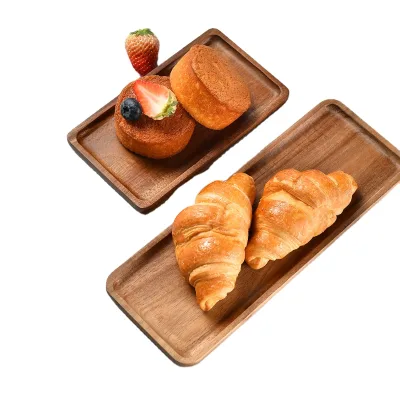
The shape of the tray is a critical differentiator. While the core keyword suggests a specific aesthetic, the market data indicates a diversity in form factors, including "Round" and "Rectangle" shapes, as well as "Long with Round Corner" designs. This variation allows buyers to select products that fit specific serving scenarios, from formal dining to casual picnics. The finish applied to the wood is equally important for both durability and safety. The observed processing methods include "Vegetable Oiled" or "Lacquered" finishes. Vegetable oiling is often preferred for food-contact surfaces as it enhances the natural grain without introducing synthetic chemicals, whereas lacquering provides a harder, more protective shell.
The manufacturing process is frequently described as "Handmade" or involving "Carving." This distinction is vital for procurement teams, as handmade items often command a higher price point due to the labor intensity but offer unique character that mass-produced items cannot replicate. The "Carving" process specifically adds depth and texture, which is a hallmark of high-end Japanese serving ware. Buyers should verify that the specific supplier they engage utilizes these traditional methods if the product positioning relies on artisanal quality.
Technical Specifications and Customization Capabilities
Technical specifications for Japanese style wood serving trays vary significantly based on the intended application and the customization level requested. The market data reveals that models such as TCWP012 through TCWP015 exist, alongside customizable options like "wooden serving tray" or specific model numbers like AE7006. A key observation is that the standard size is not fixed; instead, specifications often list "Customization" for size, with some observed dimensions ranging from 2010.5 CM to 37.819 CM. This flexibility allows buyers to tailor the product to specific serving needs, whether for individual portions or family-style dining.
Customization extends beyond dimensions to include branding and design elements. The "Logo" is acceptable upon customized designs, enabling companies to brand these trays for corporate gifts or retail packaging. The "Design" itself is noted as customizable, allowing for adjustments in the "Retro" style or the specific carving patterns. Furthermore, the "Color" is typically observed as "Unicolor," preserving the natural look of the bamboo or wood, though this can be a point of negotiation for specific dyeing requests.
The packaging specifications are also a technical consideration. Options include "Bulk in Cartons," "Customized Gift Packing," or "Individual Bubble Bag" with bulk packing into cartons. For larger orders, "Carton/Palletizing" is available. The weight of the product is another specification to monitor, with observed "Grem Weighta" (likely referring to gross weight or unit weight) ranging from 100-500g. This weight range is consistent with the use of bamboo and wood, ensuring the trays are sturdy enough for serving but light enough for easy handling.
Compliance, Certification, and Food Safety Standards
For any product intended for food contact, compliance with international safety standards is non-negotiable. The market data confirms that suppliers in this category often hold certifications such as "CE/EU" and "FDA." These certifications are critical for ensuring that the wood and the finishes used (vegetable oil or lacquer) do not leach harmful substances into food. Additionally, "CIQ" (China Inspection and Quarantine) is listed, which is a standard for export quality control from China, further validating the safety of the materials.
When evaluating suppliers, buyers must verify that the "Standard" for the product is either "customized" or adheres to "OEM" (Original Equipment Manufacturer) guidelines. The "prod_standard" field in the data often reflects these customizable standards, meaning there is no single universal standard that applies to every unit. Instead, the buyer must define the standard based on the target market's regulations. For instance, if the destination is the European Union, the CE mark is essential. If the target is the United States, FDA compliance is the primary requirement.
The "Usage" of the product is explicitly listed as "Food," "Egg," and "Silverware Organizer," which reinforces the need for food-safe materials. The "Application Scenarios" include "Kitchen," "Home," "Restaurant," and "Picnic," all of which require high durability and hygiene. Buyers should request specific test reports or certificates of analysis to confirm that the lacquer or oil used meets the specific migration limits required by their local regulations. Relying solely on the presence of a certification label without verifying the scope of that certification can lead to compliance gaps.
Cost Drivers and Minimum Order Quantity Analysis
The cost structure for Japanese style wood serving trays is influenced by several factors, including material sourcing, labor intensity, and customization levels. The observed price range in the market is broad, spanning from 0.01 to 68 USD. This wide variance is likely due to differences in the quality of the wood, the complexity of the carving, the type of finish, and the volume of the order. Lower-priced items may be mass-produced with simpler finishes, while higher-priced items likely feature intricate hand-carving and premium organic oils.
Minimum Order Quantity (MOQ) is a significant cost driver. The data indicates an MOQ range of 10 to 10,000 units, with specific observations of 500 units or negotiable upon stock, and another observation of 1000 PCS. This suggests that suppliers have flexible tiers. For buyers testing the market, the "Sample Product" is supported, with a sample time of 7-15 days. This allows for cost-effective prototyping before committing to a large production run. However, the "Delivery Time" for bulk orders is typically 15-30 days, which must be factored into the supply chain planning.
The "Quotation" is explicitly stated to be "Based on Your Requirements on Quantity, Material," meaning that unit price is highly dynamic. Buyers should expect that increasing the order volume will reduce the per-unit cost, but the savings may be marginal if the customization (e.g., specific carving or logo printing) remains constant. Additionally, the "Packing" method affects the cost; "Customized Gift Packing" will inherently cost more than "Bulk in Cartons." Understanding these variables is essential for accurate budgeting and margin calculation.
Supplier Evaluation and Production Capabilities
Evaluating a supplier for Japanese style wood serving trays requires a deep dive into their production capabilities and origin. The primary production locations identified are "Nanping, Fujian, China" and "Shaowu, Fujian, China." These regions are known for their bamboo and wood industries, suggesting a mature supply chain for raw materials. However, buyers should not assume that all suppliers in these regions offer the same quality. The distinction between "Handmade" and "Other" processes is a key indicator of the supplier's capability.
Suppliers that emphasize "Handmade" and "Carving" processes are better suited for high-end, authentic Japanese style products. Those offering "Other" processes may be focusing on mass production with less attention to detail. The "Feature" of being "Eco-Friendly" and "Stocked" is also a positive indicator, suggesting that the supplier maintains inventory and uses sustainable materials. However, buyers must verify these claims through site audits or third-party assessments, as "Eco-Friendly" is a broad term that can be applied loosely.
The ability to handle "Customized" designs is another critical evaluation point. The data shows that "Logo" acceptance and "Design" customization are standard offerings. A capable supplier should be able to provide samples of their previous work, particularly for "Retro" styles and specific carving techniques. The "Sample Time" of 7-15 days is a reasonable benchmark, but buyers should also inquire about the cost of samples and whether they are refundable upon placing a bulk order.
Quality Control and Long-Term Procurement Strategy
Implementing a robust quality control (QC) strategy is essential for maintaining the integrity of Japanese style wood serving trays. Given that the product is "Non-Disposable" and intended for "Daily Use," durability is a key quality metric. Buyers should establish clear acceptance criteria for the "Finish," ensuring that the vegetable oil or lacquer is applied evenly and does not peel or crack under normal use. The "Shape" must also be consistent, with no warping or uneven edges, especially for "Rectangle" and "Long with Round Corner" designs.
Long-term procurement considerations involve building a relationship with suppliers who can maintain consistency over time. The "Standard" being "Customizable" means that the buyer has the opportunity to refine the product specifications with each order. However, this requires clear communication and documentation to ensure that changes do not compromise the product's quality. The "Delievery Time" of 15-30 days should be treated as a baseline, with contingency plans for potential delays due to raw material shortages or seasonal variations in bamboo and wood availability.
The "Usage" scenarios, such as "Restaurant" and "Picnic," imply that the trays will undergo significant wear and tear. Therefore, the "Grem Weighta" and material density should be sufficient to withstand repeated use. Buyers should also consider the environmental impact of the "Packing" materials, opting for recyclable options where possible to align with the "Eco-Friendly" nature of the product. Finally, maintaining a buffer stock of "Stocked" items can help mitigate supply chain disruptions, ensuring that the buyer can meet demand even if production lead times extend.
Comparative Analysis of Product Attributes
To facilitate decision-making, the following table summarizes the key attributes observed in the market for Japanese style wood serving trays. This comparison helps buyers identify the specific characteristics that align with their procurement goals.
| Attribute Category | Observed Options | Strategic Implication |
|---|---|---|
| Material | Bamboo & Wood | Lightweight, sustainable, natural aesthetic. |
| Shape | Round, Rectangle, Long with Round Corner | Versatility for different serving styles and table settings. |
| Finish | Vegetable Oiled, Lacquered | Oil offers natural feel; Lacquer offers durability. |
| Process | Handmade, Carving | Higher cost, unique character, artisanal value. |
| Certification | CE/EU, FDA, CIQ | Essential for food safety and international export. |
| MOQ | 10 - 10,000 (Commonly 500 or 1000) | Flexibility for small startups or large retailers. |
| Origin | Nanping, Shaowu (Fujian, China) | Established wood/bamboo manufacturing hubs. |
| Packaging | Bulk Cartons, Gift Packing, Bubble Bag | Affects final retail presentation and shipping costs. |
| Customization | Logo, Design, Size, Standard | High potential for branding and product differentiation. |
| Usage | Food, Egg, Silverware Organizer | Multi-functional for home, restaurant, and event use. |
This table highlights the diversity available in the market. Buyers should use this matrix to prioritize attributes based on their specific brand positioning. For example, a luxury brand might prioritize "Handmade" and "Vegetable Oiled" finishes, while a budget-conscious retailer might focus on "Rectangle" shapes and "Bulk Cartons" to minimize costs. By systematically evaluating these attributes, procurement teams can make informed decisions that balance quality, cost, and market requirements.
FAQs
What certifications do japanese style wood serving trays have?
These trays typically hold FDA, CE/EU, and CIQ certifications to ensure food safety. Buyers should verify that the specific supplier provides valid certificates for the vegetable oil or lacquer finishes used on the bamboo and wood materials.
Can I customize the size and logo on these wooden trays?
Yes, customization is available for size, shape, and logo designs upon request. Suppliers accept customized designs for logos and offer flexible dimensions ranging from 20*10.5 CM to 37.8*19 CM or fully custom specifications.
What is the minimum order quantity for these serving trays?
The minimum order quantity ranges from 10 to 10,000 units depending on the supplier and stock availability. Some vendors list an MOQ of 500 units or 1000 pieces, while others may negotiate lower quantities if stock is available.
How long does it take to receive samples and bulk orders?
Sample products are supported with a lead time of 7 to 15 days for production. Bulk delivery typically requires 15 to 30 days, depending on the order volume and specific customization requirements for the bamboo and wood trays.
Which finishing processes are used on these wood serving trays?
The trays are finished using vegetable oil or lacquer to ensure durability and food safety. These finishes are applied to the bamboo and wood materials, often through handmade or carving processes to maintain a retro aesthetic.
Where are these bamboo and wood trays manufactured?
Manufacturing locations are primarily in Nanping, Fujian, and Shaowu, Fujian, China. These regions are known for their bamboo and wood industries, ensuring a mature supply chain for producing these eco-friendly serving trays.