Source leak-proof modern plastic sauce cup for Restaurant, Hotel, Kitchen
Compare 30 listings for the leak-proof modern plastic sauce cup designed for restaurant, hotel, and kitchen use. Buyers can evaluate specifications, customization options, and pricing from verified Chinese manufacturers offering food-grade PP materials.
Key considerations
Products List

Free Sample Disposable Plastic PP Round Leakproof Sauce Cup for Restaurant
$0.01 - $0.01
MOQ: 10000 Pieces

Disposable Plastic PP Customized Volume Waterproof Soy Sauce Cup with Lid
$0.00 - $0.00
MOQ: 10000 Pieces

Low MOQ Disposable Plastic PP Round Leakproof Sauce Cup for Restaurant
$0.00 - $0.00
MOQ: 10000 Pieces


4oz Leakproof Compact PP Disposable Plastic Sauce Cup Used for Condiment Portioning
$0.04 - $0.05
MOQ: 50000 Pieces


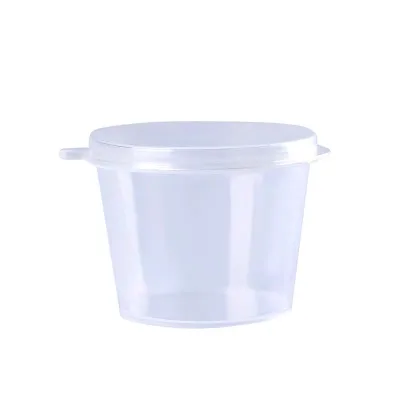

Disposable Plastic Transparent PP Sauce DIP Cups
$0.04 - $0.36
MOQ: 50000 Pieces
JIANGSU JINCAI POLYMER MATERIALS SCIENCE AND TECHNOLOGY CO., LTD.

Durable Transparent Polypropylene PP Sauce Cups
$0.04 - $0.36
MOQ: 50000 Pieces
JIANGSU JINCAI POLYMER MATERIALS SCIENCE AND TECHNOLOGY CO., LTD.


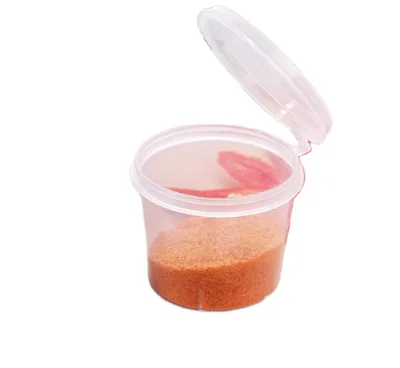

Comprehensive Sourcing Guide
Strategic Sourcing Guide for Leak-Proof Modern Plastic Sauce Cups
Understanding Product Specifications and Material Composition
When sourcing a leak-proof modern plastic sauce cup, the primary objective is to identify a product that balances structural integrity with functional utility. Based on current market data, the core material for these containers is Polypropylene (PP). This thermoplastic polymer is selected for its high heat resistance, chemical stability, and ability to withstand the rigors of injection molding. The specific product attributes observed indicate a "Food Grade Material" composition, which is a non-negotiable baseline for any item intended to hold edible condiments, dips, or sauces.
The physical dimensions of these cups vary significantly to accommodate different serving volumes. The observed size range spans from 0.75 Oz to 5.5 Oz, with specific models available in capacities such as 1 Oz, 1.5 Oz, 3.25 Oz, and up to 6 Oz. The physical footprint is equally diverse, with dimensions ranging from compact 30x23mm units for small portions to larger 52x35mm variants for more substantial servings. The shape is predominantly round, designed to maximize stackability and minimize storage space, a critical factor for logistics and warehousing. The manufacturing process is consistently identified as injection molding, a technique that ensures high precision, smooth surface finishes, and consistent wall thickness, all of which contribute to the "leak-proof" claim by creating tight seals and uniform structural walls.
Compliance, Certification, and Safety Standards
For B2B buyers, verifying compliance is as critical as evaluating the physical product. The market data highlights specific certifications that serve as indicators of safety and quality. A prominent certification observed is the FDA (Food and Drug Administration) approval. This suggests that the materials used in the production of these PP cups meet United States standards for food contact safety. However, buyers must treat this as a verification point rather than a universal guarantee for every listing. It is essential to request current, valid certification documents from the supplier to ensure the specific batch being ordered adheres to these standards.
Beyond FDA compliance, the products are described as "Food Safe" and "Eco Friendly," though the latter requires careful interpretation. In the context of disposable PP cups, "Eco Friendly" often refers to the recyclability of the PP material or the efficiency of the manufacturing process, rather than biodegradability. Buyers should verify if the supplier utilizes recycled PP content or if the claim refers to the material's ability to be recycled in standard municipal streams. Additionally, the product standard is noted as "PP Plastic" with specific capacity ranges from 1oz to 6oz. When evaluating a potential supplier, procurement teams must confirm that the specific model number (such as SC-R, SC-L, or WL-series) aligns with the required regulatory standards for the destination market. If the target market is outside the US, buyers should verify if the supplier holds additional certifications such as LFGB (Germany) or BRCGS (UK), as the provided data does not explicitly list these, and assuming their presence would be an unsupported claim.
Cost Drivers and Pricing Dynamics
The pricing structure for disposable plastic sauce cups is influenced by several variable factors, including order volume, customization requirements, and logistics. The observed price range in the market is between $0 and $13.55 USD. This wide variance is likely attributable to the distinction between unit pricing for small samples versus bulk pricing for large orders, or potentially the inclusion of packaging and shipping costs in the upper range. It is crucial for buyers to understand that the "Free Sample" and "Free Sample+OEM+ODM" service offerings are common, but these samples may not reflect the final unit cost of a mass production run.
The Minimum Order Quantity (MOQ) is a significant cost driver, with observed ranges spanning from 100 units to 1,000,000 units. For smaller businesses or those testing a new product line, an MOQ of 100 units offers a low barrier to entry. However, for large-scale restaurant chains or food service distributors, the ability to order up to one million units allows for significant economies of scale. The cost per unit will inevitably decrease as the order volume increases toward the higher end of the MOQ spectrum. Furthermore, the "Customized" attribute, which includes logo printing and custom packaging, will introduce additional costs. While the base product is standard, the requirement for custom branding or specific color variations can impact the final price. Buyers should also factor in the "Price Term" options, which include EXW (Ex Works), FOB (Free on Board), and CIF (Cost, Insurance, and Freight). The choice of Incoterm will drastically affect the total landed cost, with EXW placing the burden of freight and insurance on the buyer, while CIF includes these costs up to the destination port.
Typical Applications and Usage Scenarios
The versatility of the modern plastic sauce cup makes it suitable for a wide array of applications across the food service industry. The product attributes explicitly list usage scenarios including "Cold Beverage," "Dessert," "Food," "Fruit," and "Ice Cream." This indicates that the cups are designed to handle both dry and wet contents, as well as semi-solid items like sauces and dips. The "Single Wall" construction and "Simple" style suggest a focus on functionality and cost-efficiency, making them ideal for high-volume, disposable applications where durability is required only for the duration of the meal or service.
The intended occasions for these cups include "Kitchen," "Tableware," "Home," "Restaurant," and "Hotel." In a commercial restaurant setting, the leak-proof nature of the injection-molded PP cups is essential for preventing spills during transport from the kitchen to the table. The "Stackable" advantage mentioned in the product features is particularly valuable for storage in back-of-house operations, allowing for efficient use of limited cabinet space. For home use, the convenience of the "Disposable" nature of the product appeals to consumers seeking easy cleanup. The inclusion of "Cup Accessories: With cover" further expands the utility, allowing the cups to function as portable containers for takeout orders or pre-prepared ingredients, ensuring that the contents remain fresh and secure during transit.
Supplier Evaluation and Operational Capabilities
Selecting the right supplier requires a thorough evaluation of their operational capabilities and service offerings. The data indicates that the products originate from "Shandong, China," with a primary port of loading in "Qingdao." This geographic concentration suggests a robust supply chain ecosystem in the region, potentially offering competitive logistics rates. However, buyers must verify the specific factory location within Shandong to ensure it aligns with their quality control expectations.
Key service attributes to evaluate include the availability of "OEM" (Original Equipment Manufacturer) and "ODM" (Original Design Manufacturer) services. The "Accept Customber Logo" and "Customized" attributes confirm that suppliers are willing to adapt the product to the buyer's brand identity. The "Delivery Time" is observed to be between 15 to 20 days, which is a standard lead time for injection-molded goods from this region. Buyers should confirm if this timeframe includes sample approval and production setup or if it refers strictly to manufacturing. Payment terms are typically "T/T" (Telegraphic Transfer) and "L/C" (Letter of Credit), offering flexibility for different transaction sizes. A reputable supplier should be transparent about their capacity to handle large orders, given the high-end MOQ of 1,000,000 units, and should demonstrate a track record of meeting the 15-20 day delivery window consistently.
Quality Control and Long-Term Procurement Strategy
Implementing a robust quality control (QC) strategy is vital for maintaining the integrity of the supply chain. Given that the product is "Disposable" and "Food Safe," any defect in the molding process, such as flash, warping, or incomplete sealing, could lead to leaks and customer dissatisfaction. Buyers should establish clear acceptance criteria based on the observed specifications, such as the exact dimensions (e.g., 45x30mm for the 1.5oz model) and the integrity of the "With cover" accessories.
For long-term procurement, consistency is key. The "Injection" and "Injection Molding" processes are highly repeatable, but buyers must ensure that the supplier maintains strict process controls to prevent variations between batches. The "Advantage" of being "Food Grade - Stackable - Eco Friendly" should be validated through regular third-party testing, especially if the supplier claims eco-friendly attributes. Buyers should also consider the scalability of the supplier. With a product range covering 0.75oz to 6oz, a supplier capable of producing the entire spectrum of sizes can offer better flexibility for a buyer's evolving menu or product line. Finally, the "Free Sample" service should be utilized not just for initial evaluation but as a benchmark for ongoing quality checks. By comparing production samples against the initial approved sample, buyers can ensure that the supplier maintains the high standards required for a leak-proof, modern plastic sauce cup.
FAQs
What material is used for leak-proof modern plastic sauce cups?
These cups are made from Polypropylene (PP) food grade material. This thermoplastic polymer ensures high heat resistance and chemical stability suitable for holding sauces and dips.
Can I get a free sample for leak-proof modern plastic sauce cups?
Yes, free samples are available for leak-proof modern plastic sauce cups. Some suppliers also offer free samples combined with OEM and ODM services to help you evaluate the product quality.
Which certifications do leak-proof modern plastic sauce cups have?
The cups hold FDA certification to ensure food contact safety. Buyers should verify specific batch documents as this certification indicates compliance with United States standards for food safety.
How long is the delivery time for leak-proof modern plastic sauce cups?
The standard delivery time is 15 to 20 days for leak-proof modern plastic sauce cups. This lead time applies to production after sample approval and order confirmation.
What is the minimum order quantity for leak-proof modern plastic sauce cups?
The minimum order quantity ranges from 100 to 1,000,000 units for leak-proof modern plastic sauce cups. Lower MOQs allow testing while higher volumes offer better economies of scale.
Can I customize the logo on leak-proof modern plastic sauce cups?
Yes, custom logo printing is accepted for leak-proof modern plastic sauce cups. Suppliers offer customization services including OEM and ODM to adapt the product to your brand identity.
What sizes are available for leak-proof modern plastic sauce cups?
Sizes range from 0.75 Oz to 6 Oz for leak-proof modern plastic sauce cups. Specific models include capacities like 1 Oz, 1.5 Oz, 3.25 Oz, and up to 5.5 Oz.