Source Red and White Check Paper Food Trays for fast food, barbecue, and hot dogs
Compare 30 listings for Red and White Check Paper Food Trays designed for fast food, barbecue, and hot dogs. These disposable containers offer heat resistance and waterproof features suitable for various food applications.
Key considerations
Products List


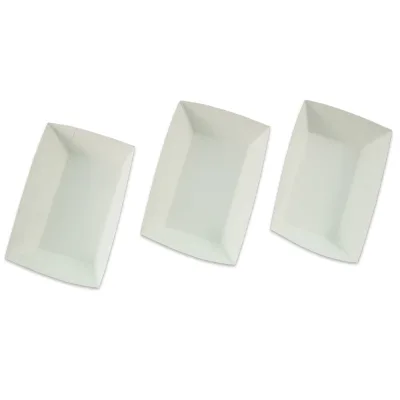
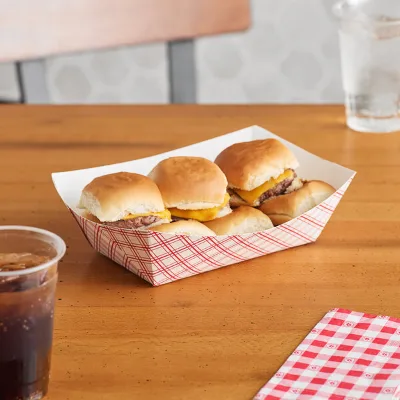


$0.02 - $0.02
MOQ: 30000 Pieces


Disposable Food Grade Kraft Paper Food Tray - Ideal for Takeout and Delivery
$0.02 - $0.04
MOQ: 10000 Pieces




Custom Food Packaging Kraft Paper Tray with Coating Fast Food Paper Tray
$0.01 - $0.05
MOQ: 30000 piece


Comprehensive Sourcing Guide
Sourcing Guide for Red and White Check Paper Food Trays
Understanding Product Attributes and Design Specifications
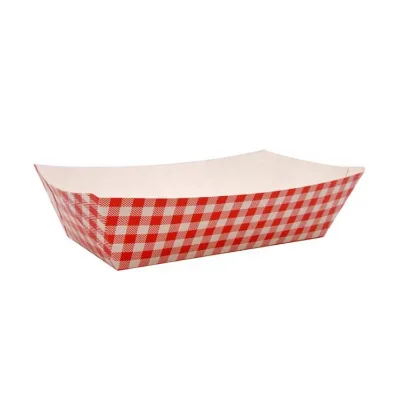
When sourcing Red and White Check Paper Food Trays, buyers must first distinguish between the aesthetic design and the functional material composition. The defining visual characteristic of this product line is the red and white check color pattern, a classic design often associated with traditional fast-food and barbecue establishments. This style is not merely decorative; it serves as a brand identifier for vendors specializing in hot dogs, nachos, and barbecue items. The product is categorized under paper plates, bowls, and trays, specifically designed as boat-type food containers. This shape is critical for holding loose or saucy foods without spillage, making it ideal for the fast-food and barbecue industry applications.
The material composition varies across different supplier listings, requiring careful verification. Some product data indicates the use of food-grade paper, specifically kraft paper or paperboard, which offers a sturdy base for heavy foods. Other entries suggest materials such as bamboo and wood pulp processed through pulp molding, which aligns with eco-friendly positioning. The paper type can range from white paper to kraft paper with white lining, or entirely kraft finishes. It is essential for buyers to confirm the specific paper type for their application, as the choice between standard paperboard and pulp-molded bamboo affects both the structural integrity and the environmental profile of the final product. The trays are generally described as disposable, intended for single-use scenarios in high-volume food service environments.
Technical Performance and Operational Limits
The operational limits of Red and White Check Paper Food Trays are defined by their thermal and chemical resistance properties. A key technical specification observed in the product data is a heat resistance capability of above 200℃. This high thermal tolerance suggests suitability for hot food items, ensuring the container does not deform or fail under the weight of steaming barbecue or hot dogs. Furthermore, the product is noted as microwave safe, allowing for reheating capabilities in certain commercial or consumer settings. However, a critical constraint is that these trays are not dishwasher safe. This limitation dictates that they are strictly for single-use applications and cannot be reused or sanitized through industrial dishwashing cycles.
Waterproofing is another paramount feature. The product is explicitly described as having a waterproof function, which is essential for containing sauces, oils, and liquids common in nachos and barbecue dishes. The feature list also highlights durability and oil-water leakage proofing, indicating that the paper treatment or coating is designed to prevent saturation. The temperature tolerance range for some variants is specified as extending from -20 degrees Celsius to 120 degrees Celsius, which covers a broad spectrum of food service needs, from chilled items to hot meals. Buyers should verify if the specific model they are sourcing meets the -20℃ to 120℃ range or the higher 200℃ threshold, as this distinction impacts the types of food that can be safely served.
Compliance, Certification, and Safety Standards
In the food packaging sector, compliance with international safety standards is non-negotiable. The product data references several critical certifications that buyers must verify before placing orders. FDA certification is explicitly mentioned, which is a baseline requirement for food contact materials in the United States. Additionally, CE and EU certifications are listed, indicating compliance with European safety and health requirements. These certifications are vital for ensuring that the paper trays do not leach harmful substances into food, particularly when the trays are used for hot or oily items.
Beyond material safety, buyers must evaluate the standard of production. The product data lists "OEM/ODM" as a standard, implying that manufacturers are capable of customizing the product to meet specific regulatory or branding needs. The origin of the products is primarily listed as Zhejiang, China (Mainland), with some entries citing Ningbo as the production location. While these are major manufacturing hubs, buyers should ensure that the specific factory holds valid, current certifications rather than relying on general regional knowledge. The "Food Grade Paper" designation is a material attribute that must be backed by the aforementioned certifications to be considered a verified claim. Without explicit documentation of FDA, CE, or EU compliance for the specific batch, the safety of the product cannot be assumed.
Cost Drivers and Procurement Economics
The economics of sourcing Red and White Check Paper Food Trays are influenced by several variables, including material composition, customization, and order volume. The observed price range in the market is extremely low, spanning from $0.01 to $0.20 USD per unit. However, this wide range often reflects the difference between basic unbranded trays and customized, high-specification versions. The Minimum Order Quantity (MOQ) is a significant cost driver, with observed ranges varying from 2 units to 100,000 units. Specific listings indicate an MOQ of 50,000 pieces, which is typical for custom printing and large-scale industrial packaging.
Customization is a primary factor in pricing. The product supports custom sizes, customer logos, and customized designs. The printing handling options include embossing, glossy lamination, and matt lamination. These finishing processes add value but also increase the unit cost. The "One Stop Packaging Solution" advantage suggests that suppliers may offer bundled services, which can streamline procurement but may also affect the total cost structure. Buyers should note that while the base price is low, the cost per unit can fluctuate based on the paper type (e.g., bamboo pulp vs. standard kraft) and the complexity of the printing. The packing specifications, such as 500 pieces per carton or 50 pieces in a poly bag, also impact logistics costs and storage requirements.
Typical Applications and Industry Use Cases
The red and white check paper food tray is specifically engineered for the fast-food and barbecue industry. Its boat-type shape and waterproof features make it the ideal vessel for serving hot dogs, nachos, and barbecue items. The product is designed for "Packing Food" and has a specific usage noted for "Food, Egg," indicating versatility in holding various food types. The compartment feature, which can range from one to three sections with different sizes, allows for the separation of main courses and sides, a common requirement in fast-food service.
The shape of the trays is available in oval, rectangular, and round configurations, providing flexibility for different menu items. The dimensions vary significantly, with specifications ranging from small sizes like 4 1/4" x 3 1/4" x 1 1/8" to large sizes up to 9 1/4" x 6 1/2" x 2". This variety allows buyers to select the exact size needed for their specific menu offerings, whether it is a small snack portion or a full meal. The "25/50/100 LB" specification suggests that the trays are rated for different weight capacities, ensuring they can support heavy food items without collapsing. This versatility makes the product suitable for a wide range of food service environments, from street food vendors to large-scale catering events.
Supplier Evaluation and Quality Control Protocols
Evaluating suppliers for Red and White Check Paper Food Trays requires a rigorous approach to quality control and verification. Buyers should prioritize suppliers who offer OEM/ODM capabilities and can demonstrate a history of meeting FDA and CE standards. The "Million Pack" brand is mentioned in the data, but buyers should not rely on a single brand name; instead, they should verify the manufacturing capabilities of any potential supplier. Key evaluation criteria include the consistency of the red and white check pattern, the integrity of the waterproof coating, and the structural strength of the paperboard.
Quality control should focus on the "Feature: Durable / Oil Water Leakage Proof" claim. Buyers must request test results or samples to verify that the trays do not leak or degrade when in contact with hot, oily foods. The "Process Type: Pulp Moulding" for some variants suggests a specific manufacturing method that should be inspected to ensure uniformity. Additionally, the "Printing Handling" options like embossing and lamination must be checked for consistency. A high-quality supplier will provide samples that match the "Red And White" color specifications exactly and will have a robust quality assurance process to ensure that every batch meets the "Food Grade" standards.
Long-Term Procurement and Sustainability Considerations
For long-term procurement, buyers should consider the sustainability profile of the red and white check paper food tray. The product data highlights "Eco-Friendly" as a feature, particularly for trays made from bamboo and wood pulp via pulp molding. This aligns with growing market demands for compostable and biodegradable packaging. The "Compostable Paper Tray" specification indicates that certain models are designed to break down naturally, reducing environmental impact. However, buyers must verify the compostability claims, as not all paper trays are compostable, especially those with heavy plastic coatings or laminations.
The "Custom Size Accepted" and "Customer Logo Accepted" attributes offer significant long-term value. By customizing the trays, businesses can strengthen their brand identity and differentiate themselves in a crowded market. The ability to accept custom sizes allows for optimization of food portions and waste reduction. Furthermore, the "One Stop Packaging Solution" advantage suggests that suppliers may offer ongoing support and inventory management, which can streamline the procurement process over time. Buyers should establish long-term relationships with suppliers who can consistently meet the "OEM/ODM" standards and provide reliable lead times, ensuring a steady supply of high-quality, branded food trays.
Comparative Analysis of Product Variants
To assist in decision-making, the following table summarizes the key differences between observed product variants based on the supplied data. This comparison highlights the trade-offs between material, certification, and specifications.
| Feature | Variant A (Standard Paperboard) | Variant B (Bamboo/Pulp Molding) | Variant C (Custom OEM) |
|---|---|---|---|
| Material | Kraft Paper / Paperboard | Bamboo & Wood Pulp | Customizable (Paperboard/Craft) |
| Certification | FDA | FDA, CE/EU | FDA, CE/EU (Verify per batch) |
| Heat Resistance | Above 200℃ | -20℃ to 120℃ | Varies by specification |
| Compostable | Not explicitly stated | Yes (Eco-Friendly) | Depends on material choice |
| MOQ | 50,000 PCS | 50,000 PCS | 2 - 100,000 PCS |
| Shape | Boat Type | Oval, Rectangular, Round | Custom Size Accepted |
| Printing | Embossing, Lamination | Customized Design | Custom Logo Accepted |
| Origin | Zhejiang, China | Ningbo, China | China (Mainland) |
This table illustrates that while the core aesthetic (red and white check) remains constant, the underlying material and performance characteristics vary significantly. Buyers must align their specific operational needs—such as the need for compostability or extreme heat resistance—with the correct variant to ensure successful procurement.
FAQs
What certifications do Red and White Check Paper Food Trays have?
These trays typically hold FDA, CE, and EU certifications to ensure food safety. Buyers must verify that specific batches carry valid documentation for these standards before ordering, as compliance is critical for international shipping and food contact applications.
Can these trays be used in a microwave?
Yes, the product data confirms that Red and White Check Paper Food Trays are microwave safe. However, they are not dishwasher safe and must be treated as disposable items intended for single-use scenarios in food service environments.
What is the heat resistance capability of these trays?
The trays exhibit heat resistance above 200 degrees Celsius for some variants, while others tolerate temperatures from -20 to 120 degrees Celsius. This range ensures suitability for hot foods like barbecue and hot dogs without deformation or failure.
Which customization options are available for these food trays?
Customization includes accepting customer logos, customized designs, and specific sizes ranging from 4 to 9 inches. Suppliers also offer printing handling options like embossing and lamination to meet unique branding or functional requirements for fast food applications.
How does the MOQ vary for these paper trays?
Minimum Order Quantities range from as low as 2 units up to 100,000 units depending on the supplier and customization level. Some specific listings require an MOQ of 50,000 pieces, which is typical for large-scale industrial packaging orders.
What materials are used to make these food containers?
Materials include food-grade paper, kraft paper, paperboard, and bamboo pulp processed via pulp molding. The specific material choice affects the eco-friendly profile and structural integrity, with options ranging from standard white paper to kraft with white lining.
Where are these red and white check trays manufactured?
Products originate primarily from Zhejiang and Ningbo in Mainland China. Buyers should confirm the specific factory location for their order, as these regions are major manufacturing hubs for food packaging with varying production capabilities and lead times.