Find Silver Plate Closed Hole Flute for Bands, Orchestras, and Education
Explore 30 Silver Plate Closed Hole Flute options to compare specifications, materials, and mechanisms. This guide helps buyers identify suitable instruments for professional ensembles, student programs, and personal practice; compare the available evidence and request quotations based on your requirements.
Key considerations
Products List


Antique Brass Plated 16 Holes Closed Hole Instrument Vintage Style Flute
$71.43 - $75.43
MOQ: 10 Pieces


C Key Bass Flute Silver-Plated Nickel Silver Closed Hole Flute for Orchestra Performance
$500.00 - $580.00
MOQ: 1 Pieces

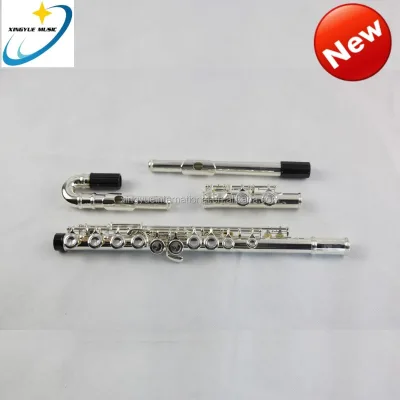

Wholesale Nickel/Silver Plated 16 Keys Closed Holes C Flute for G/E Key
$75.00 - $120.00
MOQ: 10 Pieces

![[Aileen]16 Hole Silver Plated Best Student Flute (FL4011S)](https://image.made-in-china.com/221f0j00VwRhQglCHZYq/-Aileen-16-Hole-Silver-Plated-Best-Student-Flute-FL4011S-.webp)


Flute / Nickel Silver Flute / Professional Flute 18 Holes (FL182KE)
$8500.00 - $100000.00
MOQ: 1 Pieces

Comprehensive Sourcing Guide
Silver Plate Closed Hole Flute Sourcing Guide
Closed hole flutes with silver-plated finish are among the most commonly procured student and intermediate woodwind instruments in global B2B trade. For buyers sourcing at wholesale volume, the Silver Plate Closed Hole Flute sits at the intersection of affordability, durability, and playability, making it a staple for music retailers, school procurement programs, and instrument rental fleets. This guide is written for procurement teams evaluating listings on wholesale platforms, comparing factory capabilities, and structuring commercial terms that protect both budget and product quality.
The category includes instruments of widely varying build quality, even when listing attributes look nearly identical. Silver plating can range from thin decorative coating to heavier nickel-silver keywork with durable finish, and closed hole design is typically paired with student-level mechanisms that prioritize ease of use. Throughout this guide, treat every listed attribute as an observation to be verified through samples and documentation, not as a guarantee. The goal is to help you move from broad keyword search results to a qualified, repeatable supply arrangement.
Product Scope and Observed Listing Signals
Observed listings in this category reveal useful patterns for buyers to screen against. Brands such as Afanti appear with models like AFL-160S, AFL-150S, AFL-163V, AFL-175A, AFL-177A, and AFL-173S, with product standards describing 16-hole and 17-hole configurations in silver plated and vintage bronze plated finishes. Some listings specify CE certification, C tone, E mechanism presence or absence, and customization availability. A separate listing with model XYFL-306SE shows OEM branding, cupro-nickel body material, nickel silver keys, G tone, and a student flute level designation, along with a supply ability of 2000 pieces per month.
Buyers should note the diversity within these signals. Hole counts of 16 versus 17, open versus closed hole design, C versus G tone, and E mechanism versus not-E-mechanism configurations all appear in observed listings, so keyword searches alone do not guarantee a matched product. MOQ values observed range from 1 piece to 10 pieces, and observed price listings span roughly 50 to 100,000 USD, indicating that the category mixes entry-level student instruments with higher-spec or bulk-differing offers. Packaging observations include 10 pieces per carton and carton packing with dimensions such as 42.5 x 14.5 x 8 cm. All of these should be confirmed per listing before comparison.
Technical Specifications to Verify
Before committing to any order, build a verification checklist around the mechanical specifications that determine playability and consistency. Confirm the exact number of holes or keys (16 or 17 hole configurations appear in observed standards), whether the hole design is truly closed, and whether an E mechanism is fitted, since observed listings show both E mechanism and not-E-mechanism variants at similar price points. Verify the key material — silver plated, nickel silver, or related alloys — and the body material, with cupronickel or cupro-nickel appearing in the observed data. Tone should be confirmed as C or G depending on your market needs.
Equally important is finish quality and dimensional accuracy. Silver plating thickness, plating adhesion, and pad seating are not typically stated in listings, so request physical samples and inspect key action, spring tension, and pad sealing under playing conditions. Check the instrument's total assembly tolerance, headjoint fit, and case or packaging dimensions (the observed 42.5 x 14.5 x 8 cm carton standard is a useful reference). Ask the supplier for a written specification sheet tied to the exact model number, such as AFL-160S or XYFL-306SE, so that production batches can be audited against a fixed reference rather than a verbal description.
Compliance and Safety Documentation
Certification claims in observed listings include CE, and in one listing a combination of CQC, CE, and GOST. Buyers should never accept these labels at face value; request the actual certificates, verify issuing bodies, confirm that the certificate number and scope cover the specific flute model being ordered, and check validity dates. For instruments intended for children or school programs, additionally ask about compliance with applicable toy or consumer product safety regulations in the destination market, since flutes with plating, pads, and cork or synthetic components may fall under chemical substance restrictions depending on the jurisdiction.
Material safety documentation is a second priority. Request declarations on plating composition, solder and adhesive content, and any restricted substances relevant to your import market. If a supplier claims certifications like GOST or CQC for exports to specific regions, ask for documentation linking those marks to the shipment batch. Keep in mind that observed data shows certification attributes listed inconsistently across products — some carry CE, others list multiple certifications, and many listings show none at all. Your compliance file should therefore be built per supplier and per model, with copies retained for customs inspection and any post-shipment audit or customer complaint response.
Cost Drivers and Commercial Terms
Observed prices in this category range dramatically, from around 50 USD to as high as 100,000 USD, which tells buyers that cost comparison must be normalized by specification. Real cost drivers include plating process and thickness, keywork material (nickel silver versus lower-cost alloys), pad quality, whether an E mechanism is included, hole count, tone variant, case and accessory inclusion, and customization such as custom logos — observed listings explicitly note customized logos and available customization. Accessories are listed as included in at least one offer, but what "included" means varies widely and should be itemized.
On commercial terms, observed MOQs run from 1 piece to 10 pieces, and packaging is described as 10 pieces per carton or as carton packing per buyer demand. Negotiate packaging format, marking, and inner-box protection explicitly, since flutes are damage-prone in transit. Confirm incoterms, port of dispatch (Qingdao appears in observed data), payment structure, and whether sample costs are credited against bulk orders. Ask for a quotation breakdown separating unit price, packaging, and freight estimate so you can compare suppliers on like-for-like terms rather than a single bundled number that hides differences in specification or service.
Supplier Qualification and Quality Control
Supplier qualification in this category should focus on demonstrated production capability rather than listing polish. Ask for factory information, production capacity (one observed listing claims a supply ability of 2000 pieces per month), and evidence of consistent model production — model numbers like AFL-160S or AFL-173S indicate standardized SKUs, which is a positive signal. Request references or trade history relevant to woodwind instruments, and confirm the place of origin (observed data shows Shandong, China) and whether the supplier manufactures directly or trades. Direct manufacturers generally offer better consistency and customization control.
Quality control should be structured before the first bulk order. Require a pre-production sample tied to the agreed specification sheet, define an inspection checkpoint for plating finish, pad sealing, and key mechanism function, and agree on an acceptable defect definition in writing. For repeat orders, arrange either third-party inspection or a documented in-house check at the supplier covering a defined sampling rate per batch. Confirm that each carton is labeled with the model number and that 10-piece carton packing matches your warehouse handling. Retain a sealed reference sample from the approved production run so future shipments can be compared against a physical standard.
Long-Term Procurement Checks
Sustained sourcing success depends on monitoring consistency over time, not just at first order. Establish a periodic re-verification cycle for plating durability, pad life, and mechanism reliability based on feedback from your own retail or end-user channels. Track whether the supplier maintains the same model specifications across production runs — a change in key material, hole count, or E mechanism without notice is a common failure mode in instrument sourcing. Review certification validity annually and request updated documents rather than relying on copies supplied during initial onboarding.
Finally, build resilience into the relationship. Confirm that customization options (customized logos, customized packaging per observed listings) remain available and priced consistently as volumes grow. Keep a secondary qualified supplier for the same specification family so that supply disruptions — capacity limits, holiday shutdowns around Chinese New Year, or regional logistics issues through ports like Qingdao — do not leave you without stock. Document every specification change in a versioned record, and review cost, quality, and delivery performance on a fixed schedule, using the observed price and MOQ ranges in this category as benchmarks during annual renegotiation.
FAQs
What is the standard body material for silver plated closed hole flutes
The standard body material for these flutes is cupronickel. This alloy provides a stable foundation for the silver plating process, ensuring durability and consistent acoustic performance. Buyers should verify that the plating thickness meets their specific quality requirements for long-term use.
Can suppliers customize the logo on silver plate closed hole flutes
Yes, customization is available for these instruments. Suppliers can apply customized logos to the flute body according to buyer specifications. This allows brands to create private label products for their retail channels. Ensure the logo placement does not interfere with the key mechanisms or player comfort.
What certifications are available for silver plate closed hole flutes
Available certifications include CE, CQC, and GOST. These certifications indicate compliance with specific regional safety and quality standards. Buyers should request current certification documents to ensure the products meet their target market regulatory requirements before placing bulk orders.
How many holes does a standard Silver Plate Closed Hole Flute have
Standard models typically feature sixteen holes, though some variations include seventeen holes. The closed hole design is common for student and intermediate players. The number of holes affects the instrument's range and technical capabilities, so buyers should match the specification to their target user level.
What is the typical packaging for silver plate closed hole flutes
Standard packaging is often ten pieces per carton, though custom packaging details can be arranged based on buyer demand. This configuration helps optimize shipping costs and warehouse space. Buyers should confirm the carton dimensions and weight to ensure compatibility with their logistics infrastructure.
Which tone is standard for silver plate closed hole flutes
The standard tone for these flutes is C. This is the most common pitch for concert flutes used in orchestras and bands. Some models may offer a G tone, but C is the primary specification for general musical education and performance contexts.
Can I order a single unit of a Silver Plate Closed Hole Flute
Yes, the minimum order quantity is often one piece. This low MOQ allows buyers to test product quality or fulfill small retail orders without committing to large inventory. However, bulk orders may offer better pricing and more flexible customization options for logos and packaging.