Source Snap Off Blade Utility Knife for Home Industrial Office
Compare 30 Snap Off Blade Utility Knife options from verified Chinese suppliers. Buyers can evaluate specifications like blade material, handle type, and MOQ to find the right tool for industrial, home, or office applications.
Key considerations
Products List
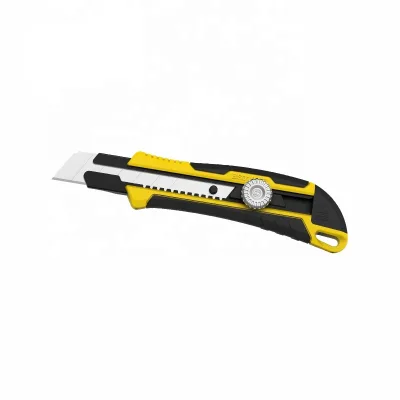


Snap-off Cutter Multi-Function Utility Knife with Double Slider and Screw Lock
$0.35 - $0.85
MOQ: 2000 Pieces


18mm Ratchet-Lock Snap off Heavy-Duty Cutter Utility Knife with Custom Logo
$0.30 - $0.32
MOQ: 5000 Pieces


Multifunction Retractable Utility Knife with Snap off Blades and Slide Locks
$0.52 - $0.58
MOQ: 5000 Pieces


Professional 18mm Snap-off Utility Knife with Ergonomic Anti-Slip Handle
$0.10 - $0.50
MOQ: 1000 Pieces


Comprehensive Sourcing Guide
Strategic Sourcing Guide for Snap-Off Blade Utility Knives
Understanding the Core Product Category and Technical Variants
The snap-off blade utility knife represents a specialized category within industrial and general-purpose cutting tools, distinguished by its ability to break off dull segments of a blade to expose a fresh, sharp edge. This mechanism is critical for maintaining cutting efficiency in high-volume environments where blade dulling occurs rapidly. Based on observed market data, these tools are frequently categorized under "Safety Blade Utility Knife" types, emphasizing the reduction of accidental cuts through controlled blade exposure. The core construction typically involves a robust handle and a precision blade mechanism.
In the current supply landscape, the materials used for these knives vary significantly, directly influencing their durability and application scope. The blade material is predominantly identified as Carbon Steel, which offers a balance of hardness and edge retention suitable for general industrial tasks. The handle materials observed include Stainless Steel, Aluminum, and Aluminium Alloy, with specific product listings noting an "18mm Aluminium Alloy Utility Knife" and others specifying "Stainless Steel" handles. The choice of handle material often dictates the tool's weight and resistance to corrosion. For instance, aluminum variants are noted to have weights around 0.1kg to 0.13kg, while stainless steel constructions may offer different tactile properties.
The physical specifications of these knives are equally diverse. Observed data indicates a blade length of 1 1/8 inches, with a specific thickness of 0.013 inches for certain models. The folding mechanism is a key differentiator; some units are designed as "Unfolded" fixed blades, while others feature a "Folded" design for portability. The blade change style is consistently identified as "Quick-Change," allowing for rapid maintenance without the need for additional tools. This feature is essential for minimizing downtime in industrial settings. The color of these tools ranges from standard Black and Silver to "Colored" options that may serve as visual indicators for specific departments or safety zones.
Compliance, Safety Standards, and Certification Verification
When sourcing snap-off blade utility knives, verifying compliance with safety standards is paramount, particularly for tools used in industrial and commercial environments. While specific certification names were not explicitly detailed in the provided product attributes, the classification of these tools as "Industrial" grade implies they must meet rigorous safety benchmarks. Buyers should verify that the "Safety Blade Utility Knife" designation is supported by actual engineering features that prevent accidental blade release or user injury.
The "Grade" attribute observed in the market data includes both "Industrial" and "DIY" classifications. This distinction is critical for procurement decisions. Industrial-grade knives are expected to withstand higher frequency of use and more demanding materials compared to DIY variants. Buyers must ensure that the supplier can provide documentation confirming the knife's suitability for the intended application, whether it is for heavy-duty construction, general office use, or specialized tasks like gear cutting. The "Gear Cutter" attribute, specifically mentioning "Pinion Cutter," suggests that some utility knives in this category may be dual-purpose or designed for specific mechanical tasks, requiring even higher precision and safety assurances.
Regarding standards, the observed data lists a "prod_standard" of "Regular" and specific dimensions like "30* 40*50," which likely refer to packaging or product dimensions rather than international safety certifications. However, the presence of a "6 months" warranty on some models indicates a baseline expectation of product reliability. Buyers should request explicit confirmation of compliance with relevant regional safety standards (such as ISO or ANSI standards for hand tools) rather than relying solely on the "Industrial" label. The "Condition" is universally listed as "New," which is a standard requirement, but the absence of specific test results in the provided data necessitates a proactive approach to quality assurance.
Cost Drivers and Pricing Dynamics in the Supply Chain
The pricing structure for snap-off blade utility knives is influenced by several key factors, including material composition, manufacturing complexity, and order volume. The observed listed price range in the market spans from $0.03 to $2.08 USD. This wide variance suggests that the lowest prices likely correspond to basic, single-item units with minimal packaging or lower-grade materials, while the higher end of the spectrum reflects premium features such as stainless steel handles, specialized packaging, or bulk ordering discounts.
Material costs are a primary driver of price variation. Knives with Stainless Steel handles or high-grade Carbon Steel blades will inherently cost more than those with standard aluminum or plastic components. The "Aluminium Alloy" construction noted in specific product names adds a layer of complexity and cost compared to basic metal or plastic alternatives. Additionally, the "Quick-Change" mechanism requires precise engineering, which can increase the unit cost compared to simpler fixed-blade designs.
Order volume plays a significant role in the final cost per unit. The observed Minimum Order Quantity (MOQ) ranges from 1 to 5000 units, with specific listings showing MOQs of 300 PCS and 1000 PCS. Buyers purchasing at the lower end of the MOQ spectrum may face higher per-unit costs due to the fixed costs of production and setup. Conversely, large-volume orders can leverage economies of scale to reduce the price significantly, potentially approaching the lower end of the $0.03 range. Packaging also affects cost; options such as "Cardboard Box," "Blister Card," "Paper Bag," and "Inner Box" vary in expense. The "Bulk Packaging" of "1PC/OPP Bag" is a cost-effective option for large shipments, whereas individual blister cards add to the unit price but improve retail readiness.
Typical Applications and Usage Scenarios
The versatility of snap-off blade utility knives makes them suitable for a broad spectrum of applications, ranging from light office tasks to heavy industrial operations. The "Application" attributes observed include "Home," "Industrial," "Gift," and "Office," indicating their adaptability across different sectors. In an industrial context, these knives are used for cutting packaging materials, stripping insulation, and general maintenance tasks. The "Usage" field further elaborates on this, listing "Industrial Knife," "Combat Knife," "Utility Knife," "Multi Functional Knife," "Camping Knife," and "Office" applications.
The "Safety Blade Utility Knife" classification is particularly relevant for environments where user safety is a priority, such as construction sites or manufacturing floors. The ability to snap off dull blade segments ensures that the cutting edge remains sharp, reducing the force required to cut and minimizing the risk of slippage. For office environments, the "Office" application suggests a need for precision cutting of paper, cardboard, or tape, where the "Quick-Change" feature allows for quick adjustments without interrupting workflow.
In specialized scenarios, such as the "Gear Cutter" or "Pinion Cutter" applications mentioned, these knives may be used for specific mechanical adjustments or cutting of softer metal components. The "Camping Knife" designation implies that some models are ruggedized for outdoor use, requiring durability against the elements and rough handling. The "Weight" of the tools, ranging from 0.02kg to 0.13kg, influences their suitability for extended use; lighter models are preferred for precision work, while slightly heavier models may offer better control for heavy-duty cutting.
Supplier Evaluation and Origin Considerations
Evaluating suppliers for snap-off blade utility knives requires a careful assessment of their location, production capabilities, and customization options. The "Place of Origin" data indicates that the majority of these products are manufactured in China, with specific regions like "Zhejiang" and "He Nan" identified. Zhejiang is a well-known manufacturing hub for hardware and tools, suggesting a mature supply chain and competitive pricing. However, buyers should verify the specific factory capabilities rather than relying solely on the province name.
The "Customized support" attribute, specifically "OEM" (Original Equipment Manufacturer), is a crucial factor for buyers seeking branded products. The availability of OEM services allows companies to have their logos, colors, or specific design modifications applied to the knives. The "Customization" attribute is listed as "Available," confirming that suppliers are generally open to bespoke orders. Buyers should inquire about the minimum order quantities for customized runs, as these often differ from standard stock items. The "Model Number" variations, such as "BS310053," "T-d18," "dp-18," "QS-D9mm," and "OS-63," indicate a wide range of SKUs, suggesting that suppliers have diverse production lines capable of meeting different specifications.
When evaluating suppliers, buyers should also consider the "Selling Units" and "Packing" options. The "Single item" selling unit suggests flexibility for small orders, while the "Bulk Packaging" options like "1PC/OPP Bag" or "Cardboard Box" indicate readiness for larger shipments. The "Condition" being "New" is a standard expectation, but buyers should ensure that the supplier maintains strict quality control to prevent the sale of refurbished or damaged goods. The "Warranty" of "6 months" provides a baseline of confidence, but buyers should clarify the terms of this warranty, including what constitutes a defect and the process for claims.
Quality Control and Long-Term Procurement Strategy
Implementing a robust quality control (QC) strategy is essential for ensuring the reliability of snap-off blade utility knives over the long term. Given the "Industrial" and "DIY" grades observed, buyers must establish clear acceptance criteria for blade sharpness, handle durability, and the smoothness of the snap-off mechanism. The "Thickness" of 0.013 inches for the blade is a specific specification that should be verified during incoming inspections to ensure consistency across batches.
For long-term procurement, building a relationship with suppliers who offer "OEM" support and consistent "Customization" capabilities is advantageous. This allows for the development of a branded product line that meets specific user needs. The "Weight" variations, from 0.02kg to 0.13kg, should be monitored to ensure that the final product matches the intended ergonomic profile. Buyers should also consider the "Color" consistency, as "Black," "Silver," and "Colored" options may be required for different safety or branding purposes.
The "Standard" of "Regular" and specific dimensions like "30* 40*50" should be used as a baseline for packaging and storage requirements. However, buyers should verify if these standards align with international shipping regulations and storage conditions. The "Lead Time" and "MOQ" values, which range from 1 to 5000 units, should be factored into inventory planning to avoid stockouts or overstocking. By maintaining a clear understanding of the "Product Name," "Model Number," and "Material" specifications, buyers can ensure that their procurement strategy aligns with the specific demands of their operations, whether for home use, office tasks, or heavy industrial applications.
Conclusion and Strategic Recommendations
Sourcing snap-off blade utility knives requires a balanced approach that considers technical specifications, cost drivers, and supplier capabilities. The observed data highlights a diverse market with products ranging from basic DIY tools to specialized industrial equipment. Buyers should prioritize suppliers who offer transparent information on materials, such as Carbon Steel blades and Stainless Steel or Aluminum handles, and who provide clear customization options. Verifying compliance with safety standards and establishing a rigorous quality control process will ensure that the procured knives meet the demanding requirements of industrial and commercial environments. By leveraging the wide range of MOQs and pricing options available, buyers can optimize their procurement strategy to achieve cost efficiency while maintaining high product quality.
FAQs
What materials are used for the blade and handle?
The blade is made of Carbon Steel while the handle is constructed from Stainless Steel or Aluminum Alloy. Some models specify an 18mm Aluminium Alloy handle with a blade thickness of 0.013 inches for industrial durability.
How does the blade change mechanism work?
These knives feature a Quick-Change style that allows users to snap off dull blade segments to expose a fresh edge. This mechanism is designed for rapid maintenance without requiring additional tools during industrial tasks.
What is the typical minimum order quantity for these knives?
The minimum order quantity ranges from 1 to 5000 units depending on the specific supplier and customization needs. Common listings show MOQs of 300 pieces or 1000 pieces for standard industrial models.
Can I get custom branding on these utility knives?
Yes, OEM customized support is available for these safety blade utility knives. Buyers can request specific modifications to the model number, color, or packaging to suit their brand requirements.
Where are these utility knives typically manufactured?
Most products originate from Zhejiang, China, with some listings indicating He Nan as the place of origin. These regions are known manufacturing hubs for hardware tools and industrial cutting equipment.
What warranty is provided for these industrial knives?
A standard warranty of 6 months is offered for new condition products. This coverage applies to defects in materials or workmanship for the specified industrial and DIY grade knives.