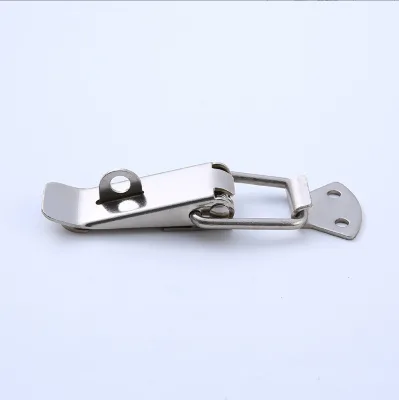
Source Spring Loaded Toggle Draw Latch for Truck, Box, and Pipe
Compare 30 Spring Loaded Toggle Draw Latch options from Chinese manufacturers. Buyers can evaluate models like MT-TL01 and DK014 for heavy-duty clamping, pipe, and glass applications with varying locking loads and surface treatments.
Key considerations
Products List


Toggle Latch Toggle Clips Stainless Steel Spring Loaded Draw Toggle Latch
$0.51 - $1.53
MOQ: 100 Pieces


Cabinet Toggle Latch Machine Stainless Steel Spring Loaded Latch Toggle Draw Latch
$0.46 - $0.60
MOQ: 100 Pieces


Comprehensive Sourcing Guide
Strategic Sourcing Guide for Spring Loaded Toggle Draw Latches
Understanding Product Variants and Technical Specifications
When sourcing spring-loaded toggle draw latches, buyers must navigate a landscape of diverse configurations that serve distinct mechanical needs. The core product category often includes items described as "Stainless Steel Toggle Latch for Truck" or "Heavy Duty Clamp," indicating a robust design intended for high-stress environments. Technical specifications vary significantly across available models, requiring precise alignment with application requirements. For instance, specific models such as MT-TL01, DK014, DK-002, and DK-001 represent different iterations of the same fundamental mechanism, each potentially optimized for unique load capacities or dimensional constraints.
Material composition is a primary differentiator. While many listings specify "Stainless Steel" or "SS304" as the base material, others may offer "Iron Nickel Plating" as an alternative cost-effective option. The choice between SS304 and plated iron directly influences corrosion resistance, longevity, and suitability for outdoor or marine applications. Surface treatments further refine these properties; observed finishes include "Passivation," "Polished," "Nickel-Plated," and "Zinc-Plated." Passivation is particularly critical for stainless steel components to enhance corrosion resistance by removing free iron particles from the surface. Polished surfaces, while aesthetically pleasing, may also reduce friction during operation.
Dimensional data is equally vital for integration. Available models exhibit varying lengths and widths, with specific observations noting dimensions such as 61mm in length and 35mm in width. The physical form factor, including "D Shape" configurations, must match the mounting interface of the target equipment, whether it be a truck box, a pipe assembly, or a glass enclosure. The locking load capacity is another critical specification; observed values range from 74G to 70kgs, highlighting a massive disparity in performance potential. A buyer selecting a latch for a heavy-duty truck box must verify that the locking load meets the specific shear and tensile forces expected during transport, rather than assuming a standard value applies to all units.
Compliance, Certification, and Quality Assurance
In the B2B procurement of industrial hardware, verifying compliance and quality management systems is non-negotiable. The supply chain for these components often originates from manufacturing hubs in China Main Land, where quality control protocols can vary. Buyers should prioritize suppliers who can demonstrate adherence to recognized quality standards. One specific observation in the market data points to "ISO9001:2015" certification, which indicates a commitment to consistent quality management. However, this should be treated as a verification point rather than a universal guarantee; not every listed product explicitly confirms this status.
When evaluating a potential supplier, the first step is to request valid, current certificates of compliance. The presence of an ISO9001:2015 certificate suggests that the manufacturer has established processes for continuous improvement and defect prevention. Beyond general quality management, buyers must investigate specific material certifications. If the specification requires SS304, the supplier should provide mill test reports or material certificates that verify the chemical composition and mechanical properties of the steel used. This is essential to prevent the substitution of lower-grade materials, such as 200-series stainless steel, which may be marketed as 304 but lacks equivalent corrosion resistance.
Standardization is another area requiring careful scrutiny. While some products are listed with "Nonstandard" or "Custom" designations, others may adhere to "Standard" or "OEM" specifications. The term "OEM" implies that the product can be manufactured to the buyer's specific drawings or requirements, but it does not inherently guarantee that the product meets an external industry standard. Buyers must explicitly define whether they require a standard-compliant off-the-shelf item or a custom-engineered solution. For applications involving safety-critical systems, such as securing heavy loads on trucks, relying on "custom-made" designs without rigorous third-party testing can introduce significant risk. Therefore, the procurement strategy must include a clause requiring proof of testing for locking loads and fatigue resistance, especially when the claimed capacity (e.g., 70kgs) is critical to the safety of the operation.
Cost Drivers and Pricing Dynamics
The pricing structure for spring-loaded toggle draw latches is influenced by a complex interplay of material costs, manufacturing processes, and order volume. The observed price range in the market spans from $0.07 to $10.00 USD, a wide variance that reflects differences in material grade, size, and customization level. A unit priced at the lower end of this spectrum is likely a smaller, iron-based component with basic plating, whereas a unit at the higher end is likely a larger, SS304 stainless steel model with advanced surface treatments like passivation.
Material cost is the most significant driver. SS304 stainless steel is inherently more expensive than iron or lower-grade stainless steels. Consequently, a switch from a nickel-plated iron latch to a full stainless steel unit will result in a noticeable price increase. Surface treatment processes also add to the cost. Passivation and polishing require additional labor and chemical processing steps compared to standard manufacturing. Furthermore, the "Heavy Duty" designation often correlates with higher material thickness and more robust internal spring mechanisms, which increase both material usage and machining time.
Order volume plays a pivotal role in determining the final unit price. The Minimum Order Quantity (MOQ) observed in the market ranges from 1 to 5000 units. Suppliers typically offer tiered pricing structures where the unit cost decreases as the order volume increases. For buyers requiring small quantities for prototyping or replacement, the per-unit cost will be higher, potentially approaching the upper limit of the observed range. Conversely, large-scale procurement can leverage economies of scale to access the lower price points. However, buyers must balance cost savings with inventory holding costs. The standard packaging, often described as "100PCS/Carton Then on Pallets" or "Carton/Pallet," suggests that logistics efficiency is tied to bulk ordering. Ordering in palletized quantities reduces per-unit shipping costs but requires adequate storage capacity.
Customization is another factor that impacts cost. While "Customization" and "Support for Custom" are widely available, these services incur additional engineering and setup fees. A "custom-made" model with a specific length, width, or locking load will cost more than a standard "DK-001" or "DK-011" model. Buyers should request a detailed cost breakdown that separates the base material cost, processing fees, and customization charges to understand the true value proposition.
Typical Applications and Usage Scenarios
Spring-loaded toggle draw latches are versatile components designed for a wide array of industrial and commercial applications. The observed usage data highlights several primary sectors, including transportation, construction, and general manufacturing. One of the most common applications is for "Truck" and "Box" securing. In this context, the latches function as heavy-duty clamps to ensure cargo doors remain tightly sealed during transit, preventing shifting or accidental opening. The high locking load capacities observed, such as 70kgs, are particularly relevant here, as they provide the necessary tension to withstand road vibrations and aerodynamic forces.
Beyond transportation, these latches are frequently utilized in "Pipe Clamp" and "Glass Clamp" applications. In industrial piping systems, toggle latches secure access panels or valve covers, allowing for quick opening and closing while maintaining a secure seal. The "D Shape" and specific dimensional profiles make them suitable for mounting on curved or irregular surfaces. Similarly, in glass enclosure applications, such as display cases or protective barriers, the latches provide a secure locking mechanism that is both functional and aesthetically discreet.
The "Heavy Duty Clamp" designation suggests that these components are also used in machinery and equipment where vibration resistance is paramount. In such environments, the spring-loaded mechanism ensures that the latch remains engaged even under dynamic loads, preventing loosening over time. The material choice is critical here; for applications exposed to moisture, chemicals, or extreme temperatures, SS304 stainless steel with passivation is the preferred choice to prevent rust and degradation. For indoor, low-stress applications, nickel-plated iron may suffice, offering a cost-effective solution without compromising functionality.
Supplier Evaluation and Selection Criteria
Selecting the right supplier is a critical step in the procurement process, as it directly impacts product quality, delivery reliability, and long-term support. Buyers should evaluate potential suppliers based on their manufacturing capabilities, customization support, and logistical infrastructure. The availability of "Large Factory Productivity" suggests that established manufacturers can handle high-volume orders with consistent quality. However, buyers must verify this claim through site audits or third-party assessments to ensure that the production capacity matches the stated capabilities.
Customization support is another key evaluation metric. The market data indicates that "Support for Custom" and "OEM" services are widely available. Buyers should assess the supplier's engineering team to determine their ability to translate specific design requirements into manufacturable products. This includes the ability to modify dimensions, such as the 61mm length or 35mm width, and to adjust locking loads to meet specific safety standards. A supplier that offers flexible OEM services can adapt to unique application needs, reducing the need for expensive tooling changes or custom molds.
Logistical capabilities are equally important. The observed shipping options, including "by Sea," "by Air," and "by Express," indicate that suppliers have diverse logistics networks. Buyers should evaluate the supplier's ability to meet lead times and handle packaging requirements. The standard packaging of "322215cm" cartons on pallets is efficient for bulk shipping, but buyers must ensure that the supplier can accommodate special packaging requests if necessary. Additionally, the origin of the product, typically "China Main Land," should be factored into the risk assessment regarding supply chain disruptions and geopolitical factors.
Quality Control and Long-Term Procurement Considerations
Implementing a robust quality control (QC) protocol is essential for mitigating risks associated with the procurement of spring-loaded toggle draw latches. Given the wide range of observed specifications and materials, buyers must establish clear acceptance criteria before production begins. This includes defining acceptable tolerances for dimensions, verifying material grades through mill test reports, and conducting functional tests on locking loads. The observed weight variations, such as 18g versus 83g, indicate significant differences in component mass, which can affect the overall performance and balance of the assembly.
Long-term procurement considerations extend beyond the initial purchase. Buyers should evaluate the supplier's ability to provide consistent quality over time, especially for repeat orders. This involves assessing the supplier's quality management system, including their procedures for handling non-conforming products and their commitment to continuous improvement. The presence of ISO9001:2015 certification is a positive indicator, but it should be complemented by regular quality audits and performance reviews.
Sustainability and environmental compliance are also becoming increasingly important in B2B procurement. Buyers should inquire about the environmental impact of the manufacturing processes, particularly regarding surface treatments like plating and passivation. Ensuring that the supplier adheres to environmental regulations can help mitigate reputational risks and align with corporate sustainability goals.
Finally, buyers should consider the total cost of ownership (TCO) rather than just the unit price. A lower-cost latch that requires frequent replacement due to corrosion or failure can be more expensive in the long run than a higher-quality SS304 unit. By prioritizing quality, durability, and supplier reliability, buyers can ensure a stable supply chain and minimize operational disruptions.
Comparison of Key Product Attributes
To facilitate decision-making, the following table summarizes the key attributes observed in the market for spring-loaded toggle draw latches. This comparison highlights the diversity in specifications and helps buyers identify the most suitable options for their specific needs.
| Attribute | Observation A | Observation B | Observation C |
|---|---|---|---|
| Material | Stainless Steel | SS304 | Iron Nickel Plating |
| Surface Treatment | Passivation | Polished | Nickel-Plated / Zinc-Plated |
| Locking Load | 74G | 70kgs | Variable (Heavy Duty) |
| Weight | 18g | 83G | Variable |
| Dimensions | 61mm L x 35mm W | Custom-made | Standard / OEM |
| Application | Truck, Box | Pipe Clamp, Glass Clamp | Heavy Duty Clamp |
| Origin | China | China Main Land | China |
| Certification | ISO9001:2015 | OEM | Nonstandard / Custom |
| Packing | 100PCS/Carton | Carton/Pallet | 322215cm |
This table underscores the importance of matching specific product attributes to application requirements. For instance, a buyer needing a high-load solution for a truck box should prioritize the 70kgs locking load and SS304 material, while a buyer for a light-duty glass enclosure might opt for the lighter 18g unit with a polished finish. By carefully analyzing these attributes, buyers can make informed decisions that balance performance, cost, and reliability.
FAQs
What materials are used for spring loaded toggle draw latches?
These latches are primarily made from Stainless Steel or SS304 metal. Some alternative options include iron with nickel plating. The material choice affects corrosion resistance and suitability for heavy-duty applications.
Which surface treatments are available for these latches?
Available surface treatments include passivation, polishing, nickel plating, and zinc plating. Passivation is critical for stainless steel to enhance corrosion resistance. Polished surfaces reduce friction during operation.
Can these latches be customized for specific truck boxes?
Yes, customization is available for models like MT-TL01 and DK series. Buyers can request specific dimensions such as 61mm length or 35mm width. Custom-made options support unique locking load requirements.
What is the typical locking load capacity for heavy duty clamps?
Locking loads vary significantly, ranging from 74 grams to 70 kilograms. Heavy duty clamps often feature higher capacities like 70kgs for secure transport. Always verify the specific load rating for your application.
How are these products packaged for shipping?
Products are typically packed in cartons containing 100 pieces, then placed on pallets. Standard carton dimensions are 32 by 22 by 15 centimeters. This packaging supports efficient bulk shipping via sea or air.
What certifications do manufacturers of these latches hold?
Some manufacturers hold ISO9001:2015 certification for quality management. Buyers should request valid certificates to ensure consistent quality. Not all listed products explicitly confirm this status without verification.
Where are these spring loaded toggle draw latches manufactured?
The products originate from China Main Land. Suppliers offer large factory productivity for high-volume orders. Buyers should consider logistics and lead times associated with this manufacturing location.