Source Spring Loaded Toggle Latch for Truck, Box, and Pipe
Find 30 Spring Loaded Toggle Latch options from suppliers in China. Compare stainless steel models with passivation or polish finishes, varying weights, and customization support for heavy-duty applications.
Key considerations
Products List


Comprehensive Sourcing Guide
Strategic Sourcing Guide for Spring Loaded Toggle Latches
Understanding Technical Specifications and Material Variability
When sourcing spring-loaded toggle latches, the primary challenge lies in navigating the diverse range of technical specifications that define product performance. The market offers a wide spectrum of configurations, from heavy-duty industrial clamps to lightweight components for general packaging. A critical observation in the current supply landscape is the variation in material composition. While stainless steel is a dominant material choice, specifically noted in product attributes as SS304 and general stainless steel, other options such as iron with nickel plating are also available. Buyers must verify the exact material grade required for their specific application, as the corrosion resistance and tensile strength of SS304 differ significantly from standard iron or other metal alloys.
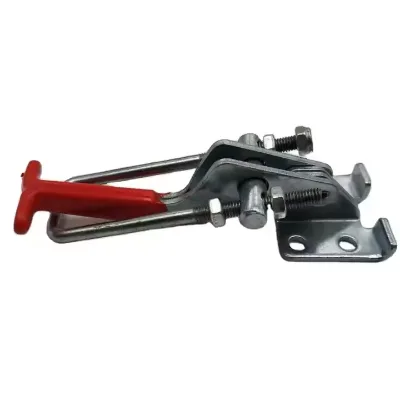
The structural design of these latches is equally critical. The product data indicates several distinct structural forms, including "G Clamp" configurations and "D Shape" variants. The presence of a "Keyhole" feature is another specific design attribute that buyers should confirm, as it dictates the mounting method and compatibility with specific striker plates. Furthermore, the locking mechanism itself varies; some units are described as having a "Locking Load" of 74g, while others are characterized by a weight of 18g or 567g. These numerical values represent specific product instances rather than universal standards for the category. Therefore, procurement teams must treat these figures as observations of specific models rather than baseline performance metrics for all spring-loaded toggle latches.
Surface treatment is another vital technical parameter. The observed data highlights "Passivation" and "Polish" as common surface treatments. Passivation is essential for stainless steel to enhance corrosion resistance, while polishing affects the aesthetic finish and smoothness of operation. Buyers should explicitly request documentation on the surface treatment process to ensure the finish meets the environmental demands of the end-use application, whether it involves exposure to moisture, chemicals, or heavy abrasion.
Compliance, Certification, and Standard Verification
In the realm of industrial hardware, compliance and certification are often the first hurdles in the procurement process. While the supplied product attributes mention "Nonstandard" and "Custom" standards alongside "Standard" classifications, there is no explicit confirmation of universal compliance with major international standards like ISO9001 for all listed items. The background information references ISO9001, but this should be treated as a general industry expectation rather than a guaranteed attribute of every supplier.
Buyers must approach certification with a verification mindset. The term "OEM" (Original Equipment Manufacturer) appears in the product standards, indicating that many suppliers operate on a custom manufacturing basis. This implies that the "Standard" listed for a specific product might be an internal company standard or a custom specification agreed upon between the buyer and the manufacturer, rather than a globally recognized code. Consequently, the procurement strategy should focus on requesting specific test reports and quality management system certificates from the supplier for each batch or order.
It is crucial to distinguish between the product's standard designation and the supplier's operational certifications. A product labeled with a "Standard" of 88mm or 74G refers to its physical dimensions or load capacity, not a regulatory compliance mark. Buyers should not assume that a product labeled "Standard" automatically meets external safety or quality regulations. Instead, the verification process must involve direct inquiry into the supplier's quality control protocols and their ability to provide traceability for materials and processes. The presence of "Nonstandard" or "Custom-made" models further underscores the need for rigorous specification alignment before production begins, as these items will not conform to off-the-shelf industry norms.
Cost Drivers and Pricing Dynamics
The pricing structure for spring-loaded toggle latches is influenced by a complex interplay of factors, including material costs, customization levels, and order volume. The observed price range in the market spans from $0.09 to $10.00 USD, a wide variance that reflects the difference between basic, high-volume components and specialized, heavy-duty units. The lower end of this spectrum likely corresponds to simple, non-customized models with minimal surface treatment, while the higher end may encompass custom-molded parts, premium stainless steel grades, or units with complex locking mechanisms.
Material selection is a primary cost driver. As noted in the product attributes, the choice between SS304 stainless steel and iron with nickel plating will significantly impact the unit price. Stainless steel generally commands a premium due to its superior corrosion resistance and durability. Additionally, the surface treatment process, such as passivation or polishing, adds to the manufacturing cost. Buyers seeking to optimize costs must carefully balance the required performance characteristics against the budget, understanding that a cheaper alternative in terms of material or finish may lead to higher long-term maintenance or replacement costs.
Order volume, represented by the Minimum Order Quantity (MOQ), is another critical factor. The observed MOQ range extends from 1 to 10,000 units. Suppliers with high-productivity capabilities, as indicated by the "Large Factory Productivity" attribute, may offer more competitive pricing for larger orders. However, for buyers requiring small quantities or custom prototypes, the unit cost will naturally be higher due to the setup and tooling expenses involved. The "Customization: Available" attribute suggests that bespoke designs will incur additional costs beyond the standard catalog pricing. Procurement teams should negotiate based on total cost of ownership, considering that a slightly higher unit price for a durable, standard-compliant product may yield better value over the product lifecycle compared to a low-cost, non-standard alternative.
Typical Applications and Industry Use Cases
Spring-loaded toggle latches are versatile components found across a wide array of industries, primarily where secure, quick-release fastening is required. The product attributes explicitly mention applications in "Truck" and "Box" contexts, indicating their use in transportation and logistics. In the trucking industry, these latches are essential for securing cargo doors, side panels, and equipment enclosures, ensuring that loads remain stable during transit. The "Heavy Duty Clamp" designation suggests that these units are engineered to withstand the vibrations and dynamic forces encountered in heavy vehicle applications.
Beyond transportation, the "Pipe Clamp" usage indicates applicability in industrial piping systems, where they may be used to secure valves, gauges, or protective covers. The "G Clamp" structure is particularly relevant in manufacturing and assembly lines where temporary or adjustable clamping is necessary. The "D Shape" and "Keyhole" features allow for specific mounting configurations that are often required in tight spaces or where aesthetic integration is important.
The "Adjustable" feature highlighted in the product data is a key enabler for diverse applications. It allows the latch to accommodate variations in door thickness or striker plate positioning, making it suitable for retrofitting existing equipment or manufacturing products with slight dimensional tolerances. Whether for securing heavy machinery, protecting sensitive electronic equipment in boxes, or managing fluid lines in industrial settings, the versatility of the spring-loaded toggle latch makes it a fundamental component in modern mechanical design. Buyers should match the specific load requirements and environmental conditions of their application to the appropriate model, ensuring that the "Locking Load" and material properties align with the operational demands.
Supplier Evaluation and Operational Capabilities
Selecting the right supplier for spring-loaded toggle latches requires a thorough evaluation of their operational capabilities and service offerings. The supply base includes manufacturers with "Large Factory Productivity," suggesting they have the capacity to handle high-volume orders efficiently. However, the availability of "Customization" and "OEM" services indicates that many suppliers are also equipped to handle bespoke projects. Buyers should assess whether a supplier's production scale aligns with their volume needs; a large factory may offer better economies of scale but might be less flexible for small, highly customized orders compared to a specialized workshop.
The "Our Service: Support for Custom" attribute highlights the importance of supplier responsiveness and technical support. A capable supplier should be able to assist with design modifications, material selection, and surface treatment specifications. The "Shipping or Express" options available suggest that logistics capabilities vary, and buyers should clarify lead times and shipping methods to ensure timely delivery. The "Packing" details, such as "100PCS/Carton Then on Pallets" or "Carton/Pallet," provide insight into the supplier's packaging standards, which can affect shipping costs and product protection during transit.
Geographic location is another factor in supplier evaluation. The data indicates origins in "China" and specifically "Shandong, China." While this provides a baseline for logistics planning, buyers should verify the specific factory location to assess proximity to ports and potential supply chain risks. The "Nonstandard" and "Custom" nature of many products means that communication and collaboration are paramount. Buyers should prioritize suppliers who demonstrate a clear understanding of their technical requirements and can provide detailed drawings or samples before mass production.
Quality Control and Long-Term Procurement Considerations
Ensuring consistent quality in spring-loaded toggle latches is essential for maintaining the integrity of the final product. The observed attributes include specific weight measurements and load capacities, such as "74G" or "18g," which serve as quality benchmarks for specific models. However, buyers must establish their own quality control protocols to verify that incoming shipments meet these specifications. The "Surface Treatment" of "Passivation" and "Polish" requires inspection to ensure uniformity and effectiveness in preventing corrosion.
Long-term procurement considerations involve building a relationship with suppliers who can provide consistent quality over time. The "Large Factory Productivity" attribute suggests that some suppliers have the capacity for sustained production, but buyers should also consider the supplier's ability to maintain quality standards during peak demand periods. The "Custom-made" nature of many products means that any changes in the supply chain, such as material sourcing or process adjustments, could impact the final product. Therefore, maintaining open communication and regular audits of the supplier's quality management system is crucial.
Buyers should also consider the lifecycle of the product. A latch that performs well initially may degrade if the material or surface treatment is not suitable for the long-term environment. The "Stainless Steel" and "SS304" options offer better longevity, but the cost-benefit analysis must be weighed against the initial investment. Additionally, the "Components: Catch and Striker" detail indicates that the system relies on the interaction of multiple parts; quality control should extend to the compatibility and durability of both the latch and the striker plate. By focusing on these long-term factors, buyers can mitigate risks associated with premature failure and ensure the reliability of their spring-loaded toggle latch systems.
FAQs
What materials are used for spring loaded toggle latches?
These latches are primarily made from stainless steel, specifically SS304, or iron with nickel plating. Buyers must verify the exact material grade as SS304 offers superior corrosion resistance compared to standard iron alloys for heavy-duty applications.
How are these latches typically packaged for shipping?
Products are commonly packed in cartons containing 100 pieces, which are then placed on pallets. Some suppliers also offer carton bag packaging, ensuring secure transport for both small and large industrial orders.
Can I request custom specifications for these latches?
Yes, customization is available for many models, including custom-made designs and OEM services. Buyers should confirm specific requirements like dimensions or surface treatments such as passivation or polishing before production begins.
What is the minimum order quantity for these products?
The minimum order quantity ranges from 1 to 10,000 units depending on the supplier and product model. Lower MOQs allow for small prototypes, while larger factories may offer better pricing for high-volume orders.
Which surface treatments are applied to these latches?
Common surface treatments include passivation and polishing to enhance durability and appearance. Passivation is essential for stainless steel to improve corrosion resistance, while polishing ensures a smooth finish for smooth operation.
Where are these spring loaded toggle latches manufactured?
These products originate from China, with specific manufacturing hubs located in Shandong. Buyers should verify the exact factory location to assess logistics capabilities and potential supply chain risks for their specific needs.