French Type Extension Socket with IP45 Suppliers and Manufacturers
Explore 17 verified options for French Type Extension Socket with IP45 from China. Compare lead times, certifications, and pricing to find suitable factories. Contact suppliers directly to request samples; review the available evidence before requesting comparable quotations from suitable candidates.
Suppliers List

- Verified by BV
- Manufacturer/Factory
- China Fujian
- Lead time23 days
- Avg. response≤ 6h
Main productsCeiling Fan Light, Lighting, Electronic Product, Electrocity Product
Main marketsSouth America,Eastern Europe,Mid East,Southeast Asia,Western Europe,Africa


Wellsdiy French Type IP44 4-Way 3G1.5mm2 Waterproof Rubber Extension Socket with Cover
$2.95 - $2.96
MOQ: 1000 Pieces
YIWU GELISTAR ELECTRIC APPLIANCES CO.,LTD
- Trading Company
- ZHEJIANG, China
- Lead time0 days
- Avg. response≤ 9h
Main productssocket,extension,cable,wire,led light
Main marketsAfrica(60.0%), Mid East(40.0%)

- Combined
- China Zhejiang
- Lead time30 days
- Avg. response≤ 25h
Main productsPVC Insulated Building Wire, LV/Mv Power Cable, Control Cable, Solar Cable, XLPE PVC Armoured Cable, Rubber Cable, Welding Cable, Aerial Bundled(ABC) Cable, Australian/New Zealand Standard (AS/NZS) Cable, Speaker/LAN/Telephone/Coaxial Cable
Main marketsAfrica

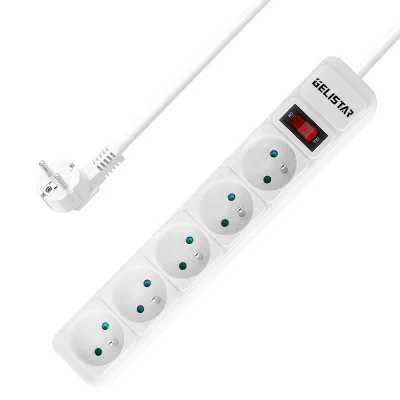
Power Strip 6 Outlets French Socket with Switch/French Type Electric Extension Socket
$0.10 - $8.00
MOQ: 2000 Pieces


High Quality 4 Way Multiple Type Extension Socket with Switch Israel Power Strip
$0.10 - $8.00
MOQ: 2000 Pieces


High Quality Extension Socket UK 5 Ways Extension Socket with Individual Switch
$0.10 - $8.00
MOQ: 2000 Pieces

$0.10 - $8.00
MOQ: 2000 Pieces

WANSHUN ELECTRICAL & INTELLIGENT MANUFACTURE (GUANGDONG) CO., LTD.
- Trading Company
- China Guangdong
- Lead time0 days
- Avg. response≤ 10h
Main productsSocket, Switch, Travel Adapter, Extension Socket, Plug Top, Terminal Block, Conversion Box

Fuzhou Colshine Electric Co., Ltd.
- Verified by SGS
- Trading Company,Manufacturer/Factory
- China Fujian
- Lead time23 days
- Avg. response≤ 12h
Main productsLED Corn Light, LED Street Light, LED Yard Light, LED Dusk to Dawn Light, Sauna Lamp, Pendant Light, Porcelain Lampholder, Metal Lampholder, Halogen Lampholder, Retro Switch & Socket
Main marketsSouth America,Eastern Europe,Mid East,North America,Southeast Asia,Eastern Asia,Oceania,Western Europe,Africa

Guangzhou Sunlight Electronic Technology Co., Ltd.
- Verified by SGS
- Trading Company,Manufacturer/Factory
- China Guangdong
- Lead time15 days
- Avg. response≤ 21h
Main products3c Electronic, Home Electronic, Mobile Accessories, Bluetooth Earphone, Wireless Charger, USB Charger, USB Cable, Hair Dryer, Game Machine, Photography Products
Main marketsSouth America,Eastern Europe,Mid East,North America,Southeast Asia,Eastern Asia,Oceania,Western Europe,Africa

Wenzhou Sinoamigo Electric Co.,Ltd
- Verified by BV
- Manufacturer/Factory
- China Zhejiang
- Lead time23 days
- Avg. response≤ 4h
Main productsFloor Boxes, Floor Sockets, Receptacles, Desk Sockets, Wall Switches, Sockets, Wiring Solution, Outlet Boxes, Outlets, Electrical Outlet
Main marketsSouth America,Mid East,North America,Eastern Asia,Africa


Modular French Socket Belgian Outlet with Fast Connection Mounting Plate
Contact supplier
MOQ: 500 Pieces


Wenzhou Huafeng Electric Co., Ltd.
- Verified by SGS
- Combined
- China Zhejiang
- Lead time30 days
- Avg. response≤ 3h
Main productsWall Switch, Socket, Plug, Circuit Breakers, Lighting Equipment, Wall Socket, Swith Socket, LED Bulb, Switches, Cable Tie
Main marketsSouth America,Africa,Others(foreignTradeCapacity.exportBusinessCapacityMarketOther),Europe,North America


Factory New Design EU France Standard PC 86 Type Electrical French Socket
$0.93 - $0.96
MOQ: 1000 Pieces


Wenzhou Gaoxinte Electric Co., Ltd.
- Trading Company,Manufacturer/Factory
- China Zhejiang
- Lead time38 days
- Avg. response≤ 22h
Main productsSwitch, Socket, Plug, Outlet, Lampholder, Switch Socket, Switched Socket with USB Outlet, Socket with Switch, GFCI, Type C
Main marketsSouth America,North America,Eastern Asia

- Manufacturer/Factory,Group Corporation,Other
- China Zhejiang
- Lead time0 days
- Avg. response≤ 25h
Main productsDropout Fuse, Insulators, Poleline Hardwares, Arrester, LV Fuses, Distribution Box, Plugs&Sockets, Disconnector Switches, Junction Boxes, Fuse Links
Main marketsSouth America,Eastern Europe,Mid East,North America,Southeast Asia,Eastern Asia,Oceania,Western Europe,Africa

WENZHOU ELENDAX ELECTRICAL CO., LTD.
- Combined
- China Zhejiang
- Lead time30 days
- Avg. response≤ 6h
Main productsWall Switch, Socket, Plug, Extension Socket, Adaptor, Lamp Holder, Power Cord, Outlet, Power Strip, Switch
Main marketsOthers(foreignTradeCapacity.exportBusinessCapacityMarketOther),Southeast Asia/ Mideast,Europe

Guangzhou Longgui Intelligent Technology Co., Ltd.
- Verified by BV
- Combined
- China Guangdong
- Lead time30 days
- Avg. response≤ 6h
Main productsCable Cubby, Projector Lift, TV Lift, TV Bracket, Monitor Lift, Pup-up Sockets, Wall Panel, Hotel Socekt, Customrized Goods, Customerized Alumnium or Steel Parts
Main marketsOthers(foreignTradeCapacity.exportBusinessCapacityMarketOther)

Huizhou Qihe Electronic Technology Co., Ltd.
- Verified by TUVRHEINLAND
- Combined
- China Zhejiang
- Lead time30 days
- Avg. response≤ 8h
Main productsVoltage Regulator, Voltage Stabilizer, Automatic Voltage Regulator, Automatic Voltage Stabilizer, Servo Type of Voltage Stabilizer, Relay Type of Voltage Stabilizer, Power Panel, Power Strip, Power Strip with USB, Power Strip USB
Main marketsAfrica,Europe

Wenzhou Sunny Electrical Co., Ltd.
- Verified by CTI
- Trading Company,Manufacturer/Factory
- China Zhejiang
- Lead time23 days
- Avg. response≤ 9h
Main productsWall Switch, Socket, Light Switch, Electric Switch, Plug, Electrical Switch, Power Socket, Socket Outlet, Switch Plate, Lamp Holder
Main marketsSouth America,Mid East,North America,Southeast Asia,Eastern Asia,Africa

Ningbo Znpon Electrical Appliance Co., Ltd
- Combined
- China Zhejiang
- Lead time45 days
- Avg. response≤ 3h
Main productsElectronic Components, Cable Reel, Extension Lead, Cee Plug, Cee Socket, Adaptor, Industrial Plug, Industrial Socket
Main marketsSoutheast Asia/ Mideast,Europe,Australia,North America

Factory Price Znpon Outdoors IP44 Waterproof 3 Way Extension Socket with USB
$4.00 - $10.00
MOQ: 500 Pieces


- Trading Company
- China Zhejiang
- Lead time38 days
- Avg. response≤ 11h
Main productsWeatherproof Switch and Socket, Cee Form Industrial Plug and Socket, Terminal Block, Wire Connector, Pre-Insulated Terminal, Electrical Junction Box, Electrical Distribution Box, Circuit Breaker
Main marketsSouth America,Eastern Europe,Mid East,Southeast Asia,Eastern Asia,Oceania,Western Europe,Africa

Wenzhou Sifuweier Electrician Co., Ltd.
- Trading Company
- China Zhejiang
- Lead time30 days
- Avg. response≤ 11h
Main productsFloor Socket, Desktop Socket, Switch, 45 Type Function Accessories
Main marketsAfrica,Southeast Asia/ Mideast,Europe


Comprehensive Sourcing Guide
French Type Extension Socket with IP45 Supplier Concentration and Factory Types
Search results for this category consistently point to eastern China as the dominant sourcing base, with Zhejiang appearing repeatedly as a supplier location and Fujian also represented among listed manufacturers. Zhejiang in particular is associated with plugs, sockets, extension leads and related electrical supplies, so buyers should treat it as a high-confidence cluster when shortlisting factories for French-type extension sockets. The product evidence on the page reinforces this: one listed product carries an origin notation of Zhejiang, and location fields for multiple suppliers identify Zhejiang or Fujian. If your search returns suppliers without a confirmed location, verify the address through business registration records rather than assuming cluster membership.
Supplier types in these results split between manufacturers/factories, trading companies, and combined operations. One supplier profile lists ceiling fan lights, lighting and electronic products as main products while still stocking extension sockets, which signals a broader electrical-goods maker rather than a socket specialist. Another is explicitly a trading company whose main products include sockets, extensions, cables, wire and LED lights. A third profile combines manufacturing with trading, with main products weighted toward insulated building wire and power cables. Each structure affects pricing, customization depth and quality control. Factory-direct suppliers are generally stronger for custom molding and switching configurations; trading companies can aggregate socket styles but may add a margin layer. Ask each candidate directly whether extension sockets are core production or a sideline.
How to Verify French Type Extension Socket with IP45 Suppliers
Verification should start with the credentials actually displayed on supplier profiles, then move to documents you request. In the current results, one manufacturer shows BSCI and ISO 9001 system certification and is BV-verified, which are meaningful starting signals for social compliance and quality management. Another profile lists ISO9001:2015 and ISO14001:2015 certificates. Do not assume every supplier carries these; several listings show no system certification at all, which means you must request certificate copies, check issuing-body validity, and confirm the certificate covers the manufacturing site, not just a sales office.
Product-level claims need equal scrutiny, especially the ingress-protection rating. The core keyword references an IP45 rating, but the listed socket evidence shows IP20 on one model and IP22 on another, while a waterproof rubber extension socket is marketed as IP44 with a waterproof cover. This gap matters: an "IP45" request may be answered with an IP44 product or with untested claims. Ask each supplier for the exact IP marking, the test standard applied, and lab reports. Also confirm the socket standard itself — listed products reference Cee 7/5 socket types and Cee 7/7 plugs, CE and RoHS markings, and French-type configurations — and request declarations of conformity you can cross-check. Finally, verify the entity behind the profile: registered company name, business scope covering electrical accessories, and whether the contact is the factory or an intermediary.
What to Compare Across French Type Extension Socket with IP45 Suppliers
Build a comparison sheet using the supplier-label dimensions actually visible on listings, since not every supplier displays every attribute. Lead time is one of the most differentiating fields: current results show one manufacturer quoting 23 days while another shows a lead-time value of zero, which usually means unstated rather than instant — treat blanks as questions, not answers. Response time is another comparable figure; displayed averages in these results range from roughly 5.7 hours to 9 hours, and slower responders often stay slow during production disputes. Minimum order quantities vary widely here, from 240 units on one five-way extension socket listing to 500, 1,000 and 3,000 units on others, so match MOQ against your sell-through forecast before shortlisting.
Beyond those labels, compare main products and company type. A supplier whose catalog centers on sockets, cables and wire will handle conductor gauge, PVC sheathing and switch assembly more competently than a lighting supplier listing sockets among many categories. Compare customization availability, which is explicitly marked as available on several listed products, against suppliers that show no customization flag. Price bands also deserve comparison: listed French-type extension sockets span roughly $1.15 to $2.96 per unit depending on gang count, USB integration and waterproof features. Weight these figures together — a low price with a 3,000-unit MOQ and no customization may cost more overall than a mid-price factory offering flexible runs.
Common French Type Extension Socket with IP45 Sourcing Risks
The most likely risk in this category is specification drift on the protection rating. Because the keyword asks for IP45 while comparable listed products are documented at IP20, IP22 or IP44, a supplier may confirm your requirement verbally and ship a lower-rated or untested unit. Mitigate this by fixing the IP rating, the test method, and acceptance criteria in the purchase contract, and by reserving the right to third-party test before shipment. A related risk is socket-standard mismatch: French-type requirements involve specific pin geometry and grounding, and listings reference Cee 7/5 and Cee 7/7 variants that are not interchangeable, so approve a golden sample and retain a signed copy.
Compliance and material risks follow closely. Several listings declare CE and RoHS, but declarations must be verified as genuine and current, and cable construction deserves attention — evidence shows conductor options including copper, CCA, and copper/aluminium mixes, plus wire sections of 1.5mm² to 2.5mm². A supplier substituting CCA for copper or undersizing the cable creates overheating and rejection risks that a photo inspection will not catch. Trading-company structures add a transparency risk: if the listed company is an intermediary, you may not know the actual factory, which complicates audits and corrective actions. Finally, treat missing profile data — absent certifications, blank lead times, unverified status — as a risk signal requiring extra due diligence before any deposit payment.
French Type Extension Socket with IP45 Regional Sourcing and Logistics
Zhejiang stands out as the practical anchor region for this category, given both supplier location data and a listed product origin in Zhejiang, with Fujian as a secondary listed base. Sourcing within one cluster simplifies supplier visits, allows consolidating shipments from multiple socket suppliers through one forwarder, and shortens the distance to the ports commonly used for electrical-goods exports from eastern China. When comparing suppliers, ask each for its actual manufacturing address rather than its sales-office address, since combined and trading-company profiles may list one city while producing elsewhere.
On logistics, use the lead-time fields that suppliers display as a starting benchmark — the 23-day lead time shown by one manufacturer is a realistic planning reference for production, but a zero or blank value means you must request a written lead-time commitment covering sample, pilot and mass-production stages. Packing matters for sockets: listed products specify inner-box-then-master-carton packing or standard export cartons, so confirm carton dimensions, gross weight and units per carton to calculate container utilization. For IP-rated or waterproof variants, request moisture-protected inner packing, since rubber cable and brass contacts can degrade in humid container transit. Ask about export documentation experience for your destination market, including CE/RoHS documentation where applicable, and confirm which Incoterms the supplier routinely handles. Consolidating socket, cable and lighting orders through the same cluster can also reduce per-unit freight if your supplier list overlaps.
French Type Extension Socket with IP45 Commercial Terms and Order Planning
Structure commercial terms around the variables this category actually exposes. Prices on listed French-type extension sockets range from about $1.15–$1.25 for a basic switched model to $2.45 for a three-outlet USB version and $2.95–$2.96 for a waterproof four-way unit, so segment your RFQ by product configuration rather than asking for one blended price. Tie each quote to its stated MOQ — observed values run 240, 480, 500, 1,000 and 3,000 units — and negotiate trial orders at the lower MOQ with a written price ladder for later volume. Confirm what customization costs separately, since several listings mark customization as available but do not show its price impact.
Order planning should sequence verification before commitment. Reserve payment terms that protect you — escrow-style arrangements or staged payments against inspection are worth requesting even if a supplier does not advertise them — and avoid large deposits with unverified trading companies. Build the schedule backward from the quoted lead time, adding time for golden-sample approval, the IP-rating and safety tests discussed earlier, and pre-shipment inspection, since a 23-day production window can be consumed entirely by rework if samples fail. Specify packing per the supplier's stated format, agree on markings and carton labels in writing, and set a re-order lead time so replenishment does not slip between seasons. Finally, document every agreed attribute — socket type, cable gauge, conductor material, IP rating — as an annex to the contract rather than relying on listing text.
[Word count: 1,402]
FAQs
What is the price range for French extension sockets?
Prices for French extension sockets typically range from $1.15 to $2.96 per unit depending on specifications. Basic models with standard features start at the lower end, while waterproof or multi-outlet variants cost more. Buyers should verify exact pricing based on quantity and customization needs.
What certifications are available for these products?
Manufacturers often provide CE and RoHS certifications for French extension sockets. System certifications like ISO 9001 and BSCI are also common among verified suppliers. Buyers should request specific test reports to ensure compliance with local electrical safety standards and regulatory requirements for their target markets.
What is the typical lead time for orders?
Lead times vary by supplier, with some listing around 23 days for production. Other suppliers may indicate zero days or different schedules based on stock availability. Buyers must confirm the exact production timeline with the supplier before placing orders to ensure timely delivery for their projects.
What is the minimum order quantity (MOQ)?
MOQs generally range from 240 to 3000 units depending on the product type. Standard extension sockets may have lower MOQs, while specialized waterproof or USB-integrated models often require higher volumes. Buyers should negotiate MOQs based on their initial order size and long-term purchasing potential.
Where are these suppliers located?
Suppliers are primarily located in China, specifically in Fujian and Zhejiang provinces. These regions are known for manufacturing electrical components and lighting products. Buyers can filter results by location to prioritize suppliers closer to shipping ports or with specific regional manufacturing capabilities for their supply chain.
What materials are used in the sockets?
Common materials include PVC for cable sheathing and PP for the socket body. Conductors are typically copper or CCA, with brass contacts for durability. Insulating materials like polypropylene ensure safety. Buyers should verify material grades to ensure compliance with fire safety and electrical performance standards.