Source Apple Specific Compound Fertilizer for fruit, vegetables, and grain crops
Find 30 verified listings for Apple Specific Compound Fertilizer tailored for fruit, vegetables, and grain crops. Buyers can compare specifications like NPK ratios, purity levels, and packaging options from suppliers in China.
Key considerations
Products List




Comprehensive Sourcing Guide
Strategic Sourcing Guide for Apple-Specific Compound Fertilizers
Understanding the Product Landscape and Technical Specifications
When sourcing compound fertilizers specifically tailored for apple cultivation, buyers must navigate a diverse market where product attributes vary significantly based on the intended release mechanism and chemical composition. The core requirement for apple orchards is a nutrient profile that supports robust vegetative growth, flower development, and fruit quality. Based on available market data, the primary product categories identified include General Compound Fertilizers, NPK Complex Fertilizers, and specific formulations like Sodium Sulfate or Ammonium Sulfate derivatives.
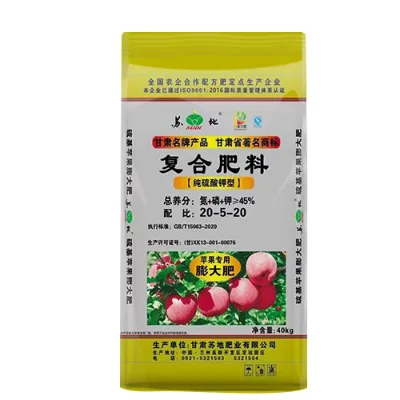
Technical specifications are the first critical filter in the procurement process. Apple trees require a balanced supply of Nitrogen (N), Phosphorus (P2O5), and Potassium (K2O). Market observations indicate that specific formulations often carry ratios such as 15-15-15 or 20-15-15, while others may exceed 45.0% total nutrient content (N+P2O5+K2O≥45.0%). The physical form of the fertilizer is equally important for application efficiency. The observed product attributes range from granular forms with particle sizes between 1.00 mm and 4.75 mm (or 3.35 mm to 5.60 mm) with a minimum of 90% granularity, to crystalline forms that offer 100% instant solubility.
The release type is another decisive technical factor. Some products are categorized as "Quick" release, which provides immediate nutrient availability, while others are labeled as "Regular" release, offering a more sustained feeding schedule. For apple production, the choice between these depends on the phenological stage of the tree. Additionally, the chemical character is noted as "Chemical Neutral" or "Physiological Neutral" in several listings, which is beneficial for maintaining soil pH balance over long-term cultivation. Buyers should verify that the specific model number, whether designated as "chemical fertilizer," "npk fertilizer," or "organic fertilizer," aligns with the orchard's soil testing results before placing an order.
Compliance, Certification, and Grade Standards
Navigating the compliance landscape for agricultural inputs is essential for ensuring that the fertilizer meets both local regulatory requirements and international trade standards. The supplied data highlights several key certification and standard markers that buyers must verify. A prominent certification observed is ISO, with some listings also referencing RoHS compliance. While ISO certification indicates adherence to quality management systems, it does not automatically guarantee the fertilizer's efficacy for specific crops; therefore, it should be treated as a baseline quality indicator rather than a performance guarantee.
Grade standards are another critical area of verification. The market data presents a split between "Industrial Grade" and "Agriculture Grade NPK." For apple cultivation, the "Agriculture Grade" designation is the primary target, as it implies the product is formulated for plant consumption and soil application rather than industrial processes. The presence of an EINECS number (e.g., 613-934-4) suggests that the product has been registered under European chemical inventory systems, which can be a proxy for regulatory scrutiny in certain export markets. However, buyers must confirm that this registration applies to the specific batch and formulation being purchased.
Furthermore, purity levels reported in the market data vary widely, ranging from 99% to 100%, and specific nutrient percentages like Nitrogen content at 20.5%. These figures should be treated as observations from specific listings rather than universal standards. A responsible procurement strategy involves requesting third-party laboratory test reports to validate these purity claims. The absence of specific certification names beyond ISO and RoHS in the general data means buyers cannot assume other certifications (such as OMRI for organic standards or specific national agricultural approvals) are present without explicit confirmation from the supplier.
Cost Drivers and Economic Factors in Procurement
The economics of sourcing apple-specific compound fertilizers are influenced by several variables, including raw material costs, packaging requirements, and logistical constraints. The observed price range in the market is exceptionally broad, spanning from $0.52 to $23,539. This variance is not indicative of a single product's price fluctuation but rather reflects the difference between small sample units, bulk commodity orders, and specialized high-concentration formulations. Buyers must understand that the unit price is heavily dependent on the quantity ordered, as indicated by the Minimum Order Quantity (MOQ) range of 1 to 16,000 units.
Packaging specifications play a significant role in the final cost structure. The data shows options for 25kg, 50kg, 500kg, and 1000kg bags. Larger packaging formats, such as the 1000kg bags, typically reduce the cost per kilogram by minimizing packaging material and handling labor, but they require significant storage space and handling equipment at the destination. Conversely, smaller 25kg bags offer flexibility for smaller orchards or precise application rates but incur higher per-unit costs. The "Sales Unit" is often listed as a "Single Item," which can complicate bulk pricing negotiations if the supplier does not have a standardized tiered pricing structure.
Logistics and origin also impact the total landed cost. Most observed products originate from China, with Qingdao listed as a common port of dispatch. The distance from the port to the orchard, combined with current freight rates, will determine the final price. Additionally, the "Customization" attribute suggests that buyers can request tailored nutrient ratios or packaging, but such customizations often carry a premium and may increase the MOQ. Buyers should calculate the total cost of ownership, including freight, insurance, and customs duties, rather than focusing solely on the FOB price listed in the catalog.
Typical Applications and Nutrient Delivery for Apple Orchards
The application of compound fertilizers in apple production is highly specific to the growth cycle of the tree. The observed product attributes list applications for "Vegetables, Flowers, Fruit, Grain Crops," confirming that these fertilizers are suitable for fruit trees like apples. However, the specific nutrient ratio must match the tree's needs at different stages. For instance, a "Quick" release type might be ideal for the early spring growth phase to stimulate vegetative development, while a "Regular" release type could be more appropriate for the fruit maturation stage to ensure steady potassium uptake for fruit sizing and sugar accumulation.
The physical form of the fertilizer dictates the application method. Granular fertilizers with a granularity of 90% or more are typically suitable for broadcast application or banding in the orchard floor, ensuring even distribution and minimizing nutrient loss. In contrast, crystalline fertilizers with 100% instant solubility are designed for fertigation systems, where the fertilizer is dissolved in irrigation water and applied directly to the root zone. This method is highly efficient for apple trees, as it reduces the risk of nutrient leaching and allows for precise control over nutrient delivery.
The "Physiological Neutral" and "Chemical Neutral" characteristics observed in the product data are particularly valuable for apple orchards. Apple trees are sensitive to soil pH imbalances, which can lead to nutrient lockout or toxicity. A neutral fertilizer helps maintain the soil's existing pH, preventing the acidification or alkalization that can occur with certain nitrogen sources. This stability is crucial for long-term orchard health and consistent fruit quality. Buyers should ensure that the chosen fertilizer's release type and solubility match their existing irrigation and soil management infrastructure.
Supplier Evaluation and Quality Assurance Protocols
Evaluating suppliers for apple-specific compound fertilizers requires a rigorous approach to quality assurance, given the variability in product attributes observed in the market. The presence of a "Brand Name" such as "Sudi" in some listings indicates that branded products are available, which may offer more consistent quality control than generic unbranded items. However, the lack of a universal brand standard means that buyers cannot rely on brand recognition alone. Instead, the evaluation must focus on the supplier's ability to provide consistent test results that match the claimed specifications.
Buyers should verify the "Appearance" of the product, which is described as "Granular, Free of mechanical impurities" or "Crystal." The presence of mechanical impurities can clog irrigation systems or create uneven application in granular fertilizers. A visual inspection of samples is a necessary step before committing to a large order. Additionally, the "Purity" claims, ranging from 99% to 100%, must be validated through independent laboratory analysis. Buyers should request Certificates of Analysis (CoA) for every batch, ensuring that the nutrient content (N, P, K) and any trace elements meet the agreed-upon standards.
The "Customization" attribute suggests that suppliers are willing to tailor products, but this introduces a risk of inconsistency. Buyers must establish clear quality control protocols that define acceptable tolerances for nutrient ratios and physical properties. For instance, if a 20-5-20 ratio is ordered, the supplier must guarantee that the actual content falls within a specific margin of error. The "MOQ" of 25 tons for some products indicates that suppliers may have minimum production runs, which can affect the flexibility of small-scale buyers. Establishing a long-term partnership with a supplier who can demonstrate consistent quality and adherence to the "Agriculture Grade" standard is more valuable than chasing the lowest price.
Long-Term Procurement and Supply Chain Considerations
Sourcing compound fertilizers for apple orchards is not a one-time transaction but a long-term supply chain commitment. The "Lead time" and "Port of Dispatch" are critical factors in maintaining a steady supply of nutrients. With Qingdao, China, being a common origin, buyers must account for shipping durations and potential logistical disruptions. The "Place of Origin" being listed as Gansu, China, for some products highlights the importance of verifying the specific manufacturing location, as regional differences in raw materials can affect product consistency.
Inventory management is another key consideration. Apple orchards have a predictable annual cycle of fertilizer application. Buyers should plan their orders to align with the planting and growing seasons to avoid stockouts during critical growth phases. The "Sales Unit" of "Single Item" can be a challenge for inventory planning if the supplier does not offer bulk discounts or consistent availability. Establishing a contract that guarantees supply volume and delivery schedules is essential for large-scale operations.
Finally, the environmental impact and sustainability of the fertilizer should be considered. While the data mentions "Organic fertilizer" as a model number, the specific environmental certifications are not universally present. Buyers should inquire about the sourcing of raw materials and the manufacturing process to ensure alignment with sustainable agricultural practices. The "Chemical Neutral" property is a positive indicator for soil health, but buyers should also verify that the product does not contain heavy metals or other contaminants that could accumulate in the soil over time. By focusing on long-term supplier relationships and rigorous quality control, buyers can ensure a reliable supply of high-quality compound fertilizers that support the health and productivity of their apple orchards.
FAQs
What certification standards apply to these fertilizers?
Most products carry ISO certification, with some also meeting RoHS standards. These certifications indicate adherence to quality management systems but do not guarantee specific crop performance. Buyers should verify that the Agriculture Grade NPK standard applies to their specific needs rather than Industrial Grade options.
Which physical forms are available for apple orchards?
Products appear as either granular or crystalline forms. Granular options typically have particle sizes between 1.00 mm and 4.75 mm with 90% minimum granularity, while crystalline forms offer 100% instant solubility for fertigation systems. The choice depends on whether the orchard uses broadcast application or liquid irrigation.
Can I customize the nutrient ratios for apple trees?
Customization is available for specific nutrient profiles and packaging requirements. Buyers can request tailored ratios like 15-15-15 or 20-15-15, though such customizations often increase the minimum order quantity. Suppliers may require a minimum of 25 tons for customized batches to ensure production feasibility.
What is the typical minimum order quantity for bulk purchase?
Minimum order quantities range from 1 unit to 16,000 units depending on the supplier and product type. Some specific listings require a minimum of 25 tons for certain formulations. Smaller orders may be available for single items, but bulk pricing is generally tied to larger volume commitments.
Where do these fertilizers originate and how are they shipped?
Products originate from China, with specific locations including Gansu and dispatch ports in Qingdao. Shipping terms vary, but the origin is consistently listed as China. Buyers should account for logistics from Qingdao to their destination when calculating total landed costs for these agricultural inputs.
How does the release type affect apple tree growth?
Fertilizers are available in Quick or Regular release types to match different growth stages. Quick release provides immediate nutrients for early vegetative growth, while Regular release offers sustained feeding for fruit maturation. Selecting the correct release type ensures optimal nutrient availability without causing burn or leaching.
What purity levels are reported for these compound fertilizers?
Reported purity levels vary from 99% to 100% across different listings. Specific nutrient content, such as Nitrogen at 20.5% or total NPK at 45.0%, is also documented. Buyers should request third-party test reports to validate these claims before purchasing, as figures are observations rather than universal standards.