Source Kitchen Storage Ceramic Jars for herbs, spices, and salt
Compare 30 listings for Kitchen Storage Ceramic Jars designed for storing salt, pepper, and dried herbs. Options include round and square shapes with wooden or plastic lids, featuring leakproof designs and various capacities to suit different kitchen storage needs.
Key considerations
Products List


Retro-Style Ceramic Storage Jars Suitable for Home Decoration and Candy Storage
$11.90 - $13.80
MOQ: 50 Pieces

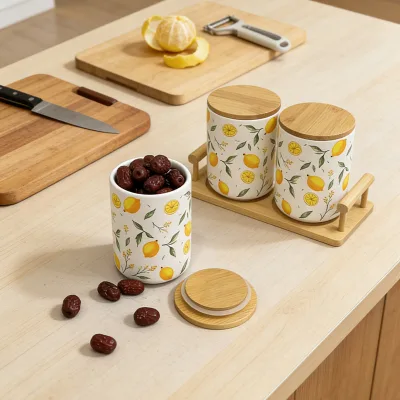


High Quality Kitchenware Storage Jar Borosilicate Glass Jar with Different Lid
$0.60 - $1.80
MOQ: 3000 Pieces


Kitchen Lard Oil Jar Ceramic Seasoning Food Storage Container Pot with Lid
$3.00 - $4.60
MOQ: 500 Pieces

Ins Style Food Container Jar Simple Ceramic Spice Jar Custom Ceramic Storage Jar
$2.50 - $5.00
MOQ: 5000 Sets

High Quality Ceramic Kitchen Storage Jar Embossed Sugar Jar White Ceramic Spice Jar
$0.80 - $1.50
MOQ: 5000 Pieces
Comprehensive Sourcing Guide
Strategic Sourcing Guide for Kitchen Storage Ceramic Jars
Navigating the global market for kitchen storage solutions requires a nuanced understanding of material properties, regulatory compliance, and supply chain logistics. For buyers specifically targeting ceramic jars, the procurement process involves balancing aesthetic appeal with functional durability and strict food safety standards. The following guide synthesizes available market data and technical requirements to assist procurement professionals in making informed decisions when sourcing these essential household items.
Material Composition and Structural Integrity
The primary differentiator in the ceramic jar market is the material composition of the main body. High-quality sourcing begins with verifying the "Premium Food-Safe Ceramic" designation. Unlike plastic alternatives, which may be constructed from Food-Grade Safe PP Plastic, ceramic offers superior thermal mass and chemical inertness, making it ideal for long-term storage of dry goods. Buyers must distinguish between products labeled as ceramic and those utilizing plastic components for lids or seals. The structural integrity of the jar is often defined by its shape and volume. Market observations indicate a prevalence of round and square geometries, with specific models offering capacities ranging from 200ml to 500ml.
When evaluating structural specifications, the dimensions provided in product standards are critical. For instance, specific models adhere to precise measurements such as 8.8cm x 7.8cm, while others may feature larger volumes, such as 1100ml units with dimensions around 11.3cm x 11cm x 14.7cm. The "Folded" attribute is generally noted as "Unfolded" for rigid storage containers, implying a fixed structural form that does not collapse. This rigidity is essential for stacking efficiency in warehouse and retail environments. Furthermore, the "Type" classification often distinguishes between single units and multi-piece sets, such as three-piece or two-piece configurations, which may include integrated shaker lids or separate sealing components.
Functional Design and Sealing Mechanisms
The functional efficacy of a ceramic jar relies heavily on its sealing accessory and core design features. A "Tight Fit Natural Wooden Lid" is a common specification for premium ceramic storage, providing an aesthetic contrast to the ceramic body while offering a natural barrier against moisture and pests. However, not all ceramic jars utilize wood; some designs incorporate plastic components or specific "Shaker Lid" mechanisms to facilitate easy seasoning dispensing. The "Feature" of being leakproof is a critical performance metric, particularly for jars intended to store liquid seasonings or high-moisture herbs.
Buyers should carefully review the "Storage Purpose" to ensure the design aligns with intended use cases. While many units are designed to store salt, pepper, and dried herbs, others may be optimized for general pantry organization. The "Single Pack Specification" often dictates the completeness of the unit, with many products shipped as "1 Jar Per Independent Package" or as a "3 Box Set" depending on the model. The "Matching Set Options" allow for diverse color and jar quantity combinations, enabling buyers to curate collections that fit specific retail or hospitality requirements. It is important to note that while some products are described as "Three-piece" or "Two-piece," the actual component count must be verified against the "Single Pack Standard," which may define a complete set as one unit per package.
Compliance, Certification, and Safety Standards
Food safety is the non-negotiable pillar of sourcing kitchen storage. Products must be verified against international standards to ensure they do not leach harmful substances into food. The supplied data references several key compliance benchmarks, including SGS, FDA, PROP65, and LFGB. These certifications indicate that the materials have undergone rigorous testing for heavy metals, lead, and cadmium leaching, as well as general chemical safety. Specifically, the attribute "No High-Concerned Harmful Chemicals" serves as a baseline requirement for all food-contact surfaces.
When evaluating suppliers, buyers should request current test reports that explicitly reference these standards. While some product listings mention "FSC" certification, this is often associated with wood components rather than the ceramic body itself. Therefore, the primary focus should remain on the ceramic glaze and the plastic components (if any) used in lids or seals. The "Raw Material" for plastic parts is frequently listed as "Food-Grade Safe PP Plastic," which must be confirmed to meet specific food-contact regulations. Buyers must verify that the "Material Safety" claims are backed by third-party laboratory results, as the absence of high-concern chemicals is a critical claim that requires empirical validation.
Cost Drivers and Pricing Dynamics
The pricing of ceramic jars is influenced by a complex interplay of material costs, manufacturing complexity, and order volume. The observed market price range spans from $0.03 to $138, reflecting the vast difference between basic plastic-accents units and premium, hand-finished ceramic sets. The "MOQ" (Minimum Order Quantity) is a significant cost driver, with observed ranges from 1 unit to 5,000 units. For custom orders, a specific model may require an MOQ of 1,000 pieces, which can significantly impact the unit cost for smaller buyers.
Lead times and sample availability also contribute to the total cost of ownership. Sample times are typically quoted between 15 to 20 days, while full delivery times for large orders can extend to 40-50 days after sample confirmation. These timelines must be factored into inventory planning to avoid stockouts. Additionally, the "prod_packing" dimensions, such as 403020cm for bulk sets, directly affect shipping costs. Buyers should calculate the cost per cubic meter of cargo to determine the most economical shipping method. OEM and ODM services are welcomed by many suppliers, but these customizations will inevitably increase the unit price and extend the lead time beyond standard production cycles.
Supplier Evaluation and Operational Logistics
Selecting a reliable supplier requires a thorough assessment of their operational capabilities and geographic location. The majority of ceramic jar production is concentrated in China, with specific manufacturing hubs noted in Guangzhou. This regional concentration offers access to a robust supply chain but also necessitates careful vetting of individual factories. Buyers should evaluate the supplier's ability to handle "OEM and ODM" requests, as this indicates flexibility in branding and design customization.
The "prod_packing" method is another critical factor in supplier evaluation. Standard practices include "Normal Safe Packing" or "Customized Boxes," with individual units often packed in "Poly Bag+Brown or White Box." The consistency of this packaging is vital to prevent breakage during transit, given the fragile nature of ceramic. Suppliers should demonstrate a track record of maintaining the "Single Pack Standard" without damage. Furthermore, the "Delivery Time" of 40-50 days for post-sample confirmation orders suggests a need for early planning. Buyers should verify if the supplier offers expedited options or if the timeline is fixed based on current production capacity.
Quality Control Protocols and Long-Term Procurement
Implementing a robust quality control (QC) protocol is essential for mitigating the risks associated with ceramic procurement. Given the fragility of the material, visual inspections for cracks, chips, and glaze defects are mandatory. Buyers should also verify the "Sealing Accessory" integrity, ensuring that wooden lids fit tightly and that any plastic components are free from burrs or defects. The "Core Function" of the jar, such as the "Shaker Lid for Easy Seasoning Dispensing," must be tested for mechanical durability to ensure it does not fail after repeated use.
For long-term procurement, consistency in product specifications is paramount. The "prod_model" numbers, such as SKU-017, SKU-019, and JN0296, serve as unique identifiers that must be maintained across production runs. Any deviation in dimensions, such as the standard 8.8cm x 7.8cm or the larger 11.31114.7 specifications, could disrupt retail shelving or consumer expectations. Buyers should establish a clear communication channel with suppliers to address any changes in "Raw Material" sourcing or "Material Safety" standards. Regular audits and pre-shipment inspections are recommended to ensure that every batch meets the agreed-upon "Standard" and "Feature" requirements.
Comparative Analysis of Product Specifications
To assist in decision-making, the following table summarizes key specifications observed across different product models. This comparison highlights the variance in shape, material, and capacity that buyers must consider when selecting the right product for their specific market segment.
| Product Model | Shape | Main Body Material | Capacity/Volume | Sealing Accessory | Type |
|---|---|---|---|---|---|
| SKU-017 | Round | Premium Food-Safe Ceramic | 200-500ml | Tight Fit Natural Wooden Lid | Storage Boxes & Bins |
| SKU-019 | Square | Plastic (Food-Grade PP) | N/A | Shaker Lid | Three-piece |
| SKU-018 | Irregular | Ceramic | 1100ml | N/A | Two-piece |
| WKC0333G-L | N/A | Ceramic | N/A | N/A | Single |
| JN0296 | N/A | Ceramic | N/A | N/A | Single |
This table illustrates that while ceramic is the dominant material for premium storage, plastic variants exist for specific functional needs like shaker lids. The "Shape" varies from round to square and irregular, influencing both aesthetic appeal and storage efficiency. The "Type" classification further differentiates the complexity of the unit, ranging from simple single jars to multi-piece sets.
Conclusion
Sourcing Kitchen Storage Ceramic Jars requires a meticulous approach that balances material quality, regulatory compliance, and logistical efficiency. By focusing on verified standards such as FDA and LFGB, and by carefully evaluating the structural and functional specifications of each model, buyers can secure high-quality products that meet consumer expectations. The variability in pricing, MOQ, and lead times necessitates a strategic approach to inventory management and supplier relationship building. Ultimately, the success of a procurement strategy for these items depends on a deep understanding of the product attributes and a commitment to maintaining rigorous quality control throughout the supply chain.
FAQs
What materials are used for Kitchen Storage Ceramic Jars?
The main body material is Premium Food-Safe Ceramic, while some models use Food-Grade Safe PP Plastic for specific components. Buyers must verify the specific model to ensure the material matches their food safety requirements and intended storage purpose.
Which certifications apply to these Kitchen Storage Ceramic Jars?
Products adhere to standards such as SGS, FDA, PROP65, and LFGB to ensure safety. These certifications verify that the items contain no high-concerned harmful chemicals and are suitable for storing salt, pepper, and dried herbs safely.
Can I find ceramic jars with specific capacity requirements?
Yes, capacities range from 200-500ml for standard units up to 1100ml for larger storage needs. Specific models offer distinct dimensions like 8.8cm x 7.8cm or 11.3*11*14.7 to accommodate different volume requirements.
How does customization affect the minimum order quantity?
Customization is available, but specific models may require a minimum order quantity of 1000 pieces. Buyers should note that OEM and ODM services are welcomed, which can influence the final pricing and production timeline.
What is the typical lead time for delivery after sample confirmation?
Delivery typically takes 40-50 days after the sample is confirmed. The sample time itself is usually quoted between 15-20 days, so buyers must plan their inventory cycles accordingly to avoid stockouts.
Where are these Kitchen Storage Ceramic Jars manufactured?
The products originate from China, with specific manufacturing hubs noted in Guangzhou. This regional concentration allows for diverse sourcing options while maintaining access to a robust supply chain for ceramic and plastic components.
What sealing accessories are included with the ceramic jars?
Many units feature a Tight Fit Natural Wooden Lid for a secure seal. Other designs incorporate a Shaker Lid for easy seasoning dispensing, ensuring the core function matches the intended storage purpose for dry goods.